
The AI Agent Readiness Framework: A Maturity Model for Enterprise Deployment
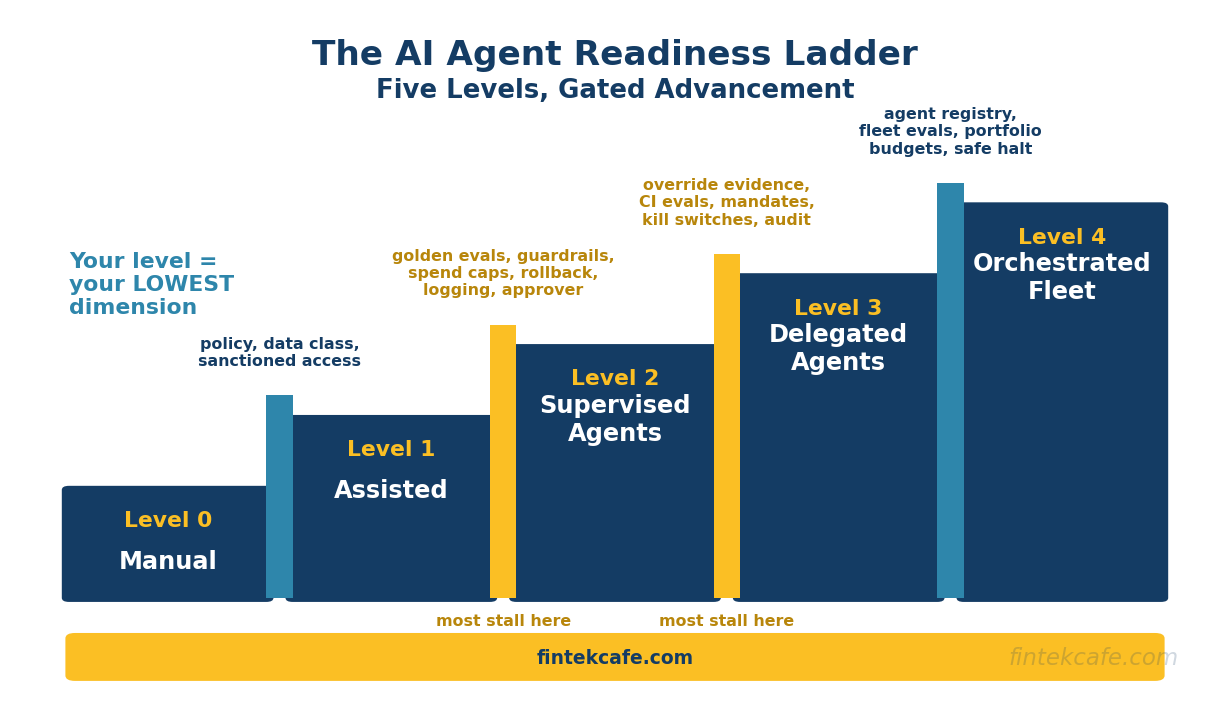
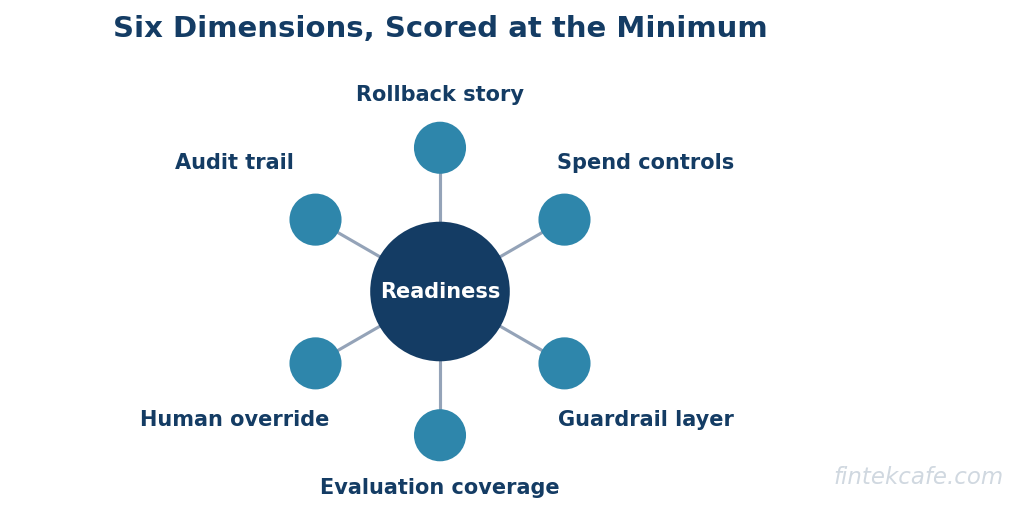
Enterprise readiness for AI agents is measurable on a five-level maturity model: Level 0 Manual, where no AI sits in the workflow; Level 1 Assisted, where copilots suggest and humans execute every action; Level 2 Supervised Agents, where agents perform multi-step work but a human approves each consequential action before it lands; Level 3 Delegated Agents, where agents complete scoped tasks autonomously and humans review by exception; and Level 4 Orchestrated Fleet, where multiple coordinated agents are governed as a portfolio rather than as individual deployments. Advancement between levels is gated, not aspirational: an organization moves up only when it can demonstrate six capabilities at the next level's bar, namely evaluation coverage, a guardrail layer, spend controls, a rollback story, an audit trail, and a human-override design. The scoring rule is deterministic and unforgiving: an organization's true level is the lowest level any of the six dimensions scores, because an agent program is exactly as safe as its weakest control. By that measure, most enterprises that describe themselves as running autonomous agents are actually at Level 1 or Level 2, and the gap between the level an organization claims and the level its controls support is where agent incidents come from. Everything below expands that one paragraph: what each level looks like, the entry gates that must be demonstrated before advancing, and a self-assessment matrix an executive can score in ten minutes.
Key Takeaways
- AI agent readiness is a five-level ladder: Manual, Assisted, Supervised Agents, Delegated Agents, and Orchestrated Fleet. The levels describe how much authority the organization can safely hand to software, not how ambitious its roadmap is.
- Each level has deterministic entry gates across six dimensions: evaluation coverage, guardrails, spend controls, rollback, audit trail, and human-override design. The gates are capabilities to demonstrate before advancing, not boxes to tick after deploying.
- Your organization's level is the minimum score across the six dimensions. A team with Level 3 autonomy and Level 1 spend controls is a Level 1 organization operating outside its readiness, which is the profile behind the agentic cost blowouts reported during the week of July 6.
- The most common failure is level-skipping: moving from copilots straight to autonomous agents without the supervised period that produces the evidence, the eval baselines, and the override-rate data that make delegation defensible.
- Gartner projects that over 40 percent of agentic AI projects will be canceled by the end of 2027 on cost and risk grounds. The maturity gates below are, almost point for point, the missing controls behind those cancellations.
Why Readiness Needs a Maturity Model
The evidence on enterprise AI deployment is consistent and sobering. MIT's Project NANDA reported in 2025 that about 95 percent of enterprise generative AI pilots showed no measurable profit-and-loss impact. S&P Global Market Intelligence found in 2025 that the share of companies abandoning most of their AI initiatives jumped to 42 percent, from 17 percent a year earlier. Gartner projected in June 2025 that more than 40 percent of agentic AI projects will be canceled by the end of 2027, citing escalating costs, unclear business value, and inadequate risk controls. At the same time, Gartner expects agentic capability to be embedded in a third of enterprise software by 2028, up from under 1 percent in 2024. Both projections are credible simultaneously because they describe the same population: organizations adopting agents faster than they build the controls that make agents survivable.
The cost dimension turned acute in the current cycle. Industry reporting during the week of July 6 described enterprises imposing per-user token spend caps after agentic workloads ran far past inference budgets, with individual power users on agentic coding tools consuming multiples of their seat price in tokens. That is not a pricing problem. It is a maturity problem: an organization granting Level 3 autonomy with Level 1 spend controls discovers the gap on the invoice. A maturity model exists to surface that gap before the invoice does.
What follows deliberately avoids vendor names as prescriptions. The model is architecture-agnostic and sits on top of whatever stack an organization runs; the companion piece on the enterprise AI stack reference architecture describes the layers themselves, and the primer on what AI agents are and how they work covers the underlying mechanics. This framework answers a different question: how much authority is this organization ready to delegate, and what must it prove before delegating more?
The Five Levels
Level 0: Manual
No AI participates in the workflow, or usage is confined to individuals pasting text into consumer chat tools without sanction, visibility, or policy. Level 0 is not shameful; it is honest. The dangerous variant is shadow Level 0, where the organization believes it is at zero while employees run unsanctioned tools against company data. The first act of readiness is making actual usage visible.
Entry gates to Level 1 (demonstrate before advancing):
- An acceptable-use policy that names permitted tools and prohibited data.
- Data classification defining what may and may not enter a prompt.
- Sanctioned, identity-gated access to approved AI tools, so usage is attributable.
- Baseline usage and spend visibility per user.
Level 1: Assisted
AI suggests; humans execute. This is the copilot pattern: drafting, summarizing, code completion, analysis on demand. Every action that touches a production system, a customer, or money is still performed by a person, which means the blast radius of a model error is bounded by human review at the point of action. Most enterprises are genuinely here, and the executive framing in the executive guide to agentic AI draws the line precisely: Level 1 systems recommend, Level 2 and above act.
Entry gates to Level 2:
- A golden evaluation dataset for each task the agent will perform, with baseline scores, built along the lines of an LLM evaluation harness that catches real failures.
- A guardrail layer filtering inputs and validating outputs in the request path, per the patterns in keeping LLM features safe in production.
- Per-user and per-agent token metering with hard caps and alerting, not monthly reporting.
- A tested rollback or compensation path for every action type the agent will be allowed to execute.
- Complete logging of every tool call with inputs and outputs.
- A named human approver and a defined approval flow for consequential actions.
Level 2: Supervised Agents
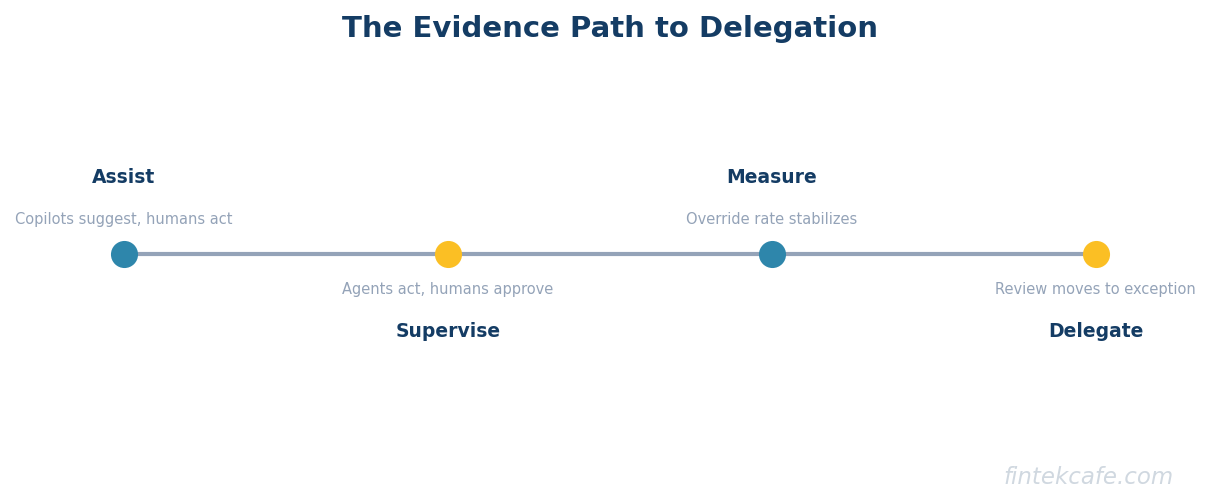
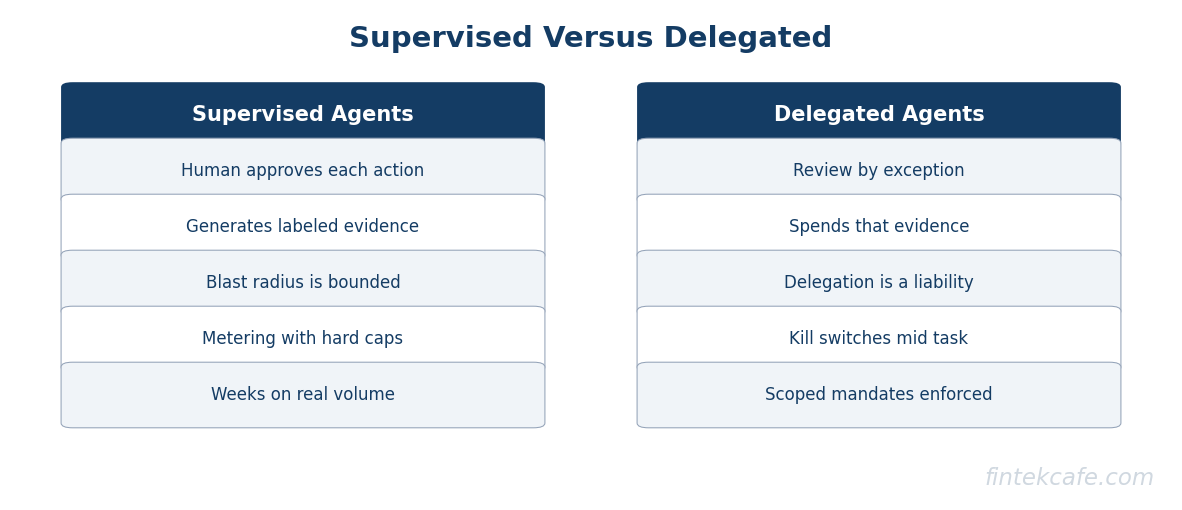
Agents plan and execute multi-step work, calling tools and completing sequences, but a human approves consequential actions before they land. This is the pull-request pattern generalized: the agent does the work, a person merges it. Level 2 is where the organization starts generating the evidence that all later levels depend on, because every approval or rejection is a labeled data point about agent reliability on real work. The spend-control gate matters most here: supervised agents already consume tokens autonomously even though they act with permission, which is exactly the profile behind the per-user cap stories of the current cycle. Organizations that skip the metering gate at this level are the ones that discover agentic economics through billing shock.
Entry gates to Level 3:
- A sustained supervised period, typically measured in weeks per task type, with an approval-override rate below a threshold the organization sets in advance and holds itself to.
- Evaluation in continuous integration, so a prompt, model, or tool change that regresses task success blocks deployment.
- Scoped mandates: each delegated task carries an explicit allowlist of tools, systems, and action limits, enforced outside the model rather than requested in the prompt.
- Real-time budget kill switches that halt an agent mid-task when cost ceilings are hit.
- An immutable audit trail sufficient to reconstruct any agent decision after the fact.
- A documented escalation path and a tested human override that stops an agent safely mid-task.
Level 3: Delegated Agents
Agents complete whole tasks autonomously within scoped mandates; humans review by exception and by sample rather than per action. Delegation is a liability event, not just a technical one: the organization is now accountable for actions no employee individually approved. The defensibility of that position rests entirely on the Level 2 evidence, which is why the supervised period cannot be skipped. The catalogue of ways this goes wrong in practice, compounding multi-step errors, runaway tool loops, and non-reproducible incidents, is the subject of the production failure modes of AI agent frameworks, and every one of those failure modes maps to a missing gate in this model.
Entry gates to Level 4:
- An agent registry with per-agent identity and credentials, so every action in every system attributes to a specific agent and its mandate.
- Fleet-level evaluation: regression suites that test agents against each other's changes, not just their own.
- Portfolio budget governance with per-agent cost attribution and automated anomaly detection.
- Dependency-aware halt: the demonstrated ability to stop one agent, or all agents, without stranding in-flight work in an unrecoverable state.
- Cross-agent trace correlation, so a multi-agent outcome can be reconstructed end to end.
Level 4: Orchestrated Fleet
Multiple agents coordinate on composite work, sometimes delegating to each other, and the organization governs them as a portfolio: policies, budgets, and evaluation applied fleet-wide rather than per deployment. Human oversight shifts from reviewing actions to managing policies. Level 4 is real but rare, and claiming it is easy to test: an organization that cannot name its agent registry, its fleet-wide eval suite, and its portfolio budget owner is not at Level 4, whatever its architecture diagram says. The survey of what actually works in enterprise agent deployments finds that the successful deployments are overwhelmingly narrow, well-instrumented Level 2 and Level 3 systems, which should calibrate how much of the market is genuinely operating at fleet scale.
The Readiness Self-Assessment Matrix
Score each dimension against the highest column whose description is fully true today, with evidence. Your organization's level is the lowest row score. The matrix is designed to be scored honestly in ten minutes by anyone who knows the deployment.
| Dimension | Level 1 bar | Level 2 bar | Level 3 bar | Level 4 bar |
|---|---|---|---|---|
| Evaluation coverage | Outputs spot-checked by users | Golden dataset per task; evals run before every change | Evals gate deployment in CI; live success and false-action rates measured | Fleet-wide regression suite; continuous production sampling |
| Guardrail layer | Data-classification policy for prompts | Input filtering and output validation in the request path; tool allowlists | Externally enforced scoped mandates per task; permission checks on every tool call | Central policy engine shared by all agents |
| Spend controls | Per-seat spend visible monthly | Per-user and per-agent metering with hard caps and alerts | Real-time kill switches per task; cost per outcome tracked | Portfolio budgets; per-agent attribution; anomaly detection |
| Rollback story | Humans execute, so normal change process applies | Tested rollback or compensation per approved action type | Automated compensation for failed multi-step tasks; safe mid-task halt | Dependency-aware halt and rollback across agents |
| Audit trail | Chat and usage logs retained | Every tool call logged with inputs and outputs | Immutable trace reconstructs any decision post hoc | Cross-agent trace correlation across delegation chains |
| Human-override design | Human performs every action | Named approver; approval gate before consequential actions | Exception-based review with sampling; measured override rate; tested escalation | Humans govern policies and budgets, not individual actions |
Two properties of the matrix do the real work. First, the minimum rule prevents the most common self-deception, which is averaging: strong evals do not compensate for absent spend controls, because incidents exploit the weakest dimension, not the mean. Second, every cell is evidenced rather than intended: the question is never whether a capability is planned, only whether it can be demonstrated today.
Reading the Dimensions as Decisions
Each dimension reduces to one deterministic question that locates an organization on the ladder.
| Dimension | The one question | If the answer is no |
|---|---|---|
| Evaluation coverage | Would a quality regression in an agent task block a deployment automatically? | You are at most Level 2 in this dimension |
| Guardrail layer | Is the agent's authority enforced outside the model, or requested inside the prompt? | Prompt-level restraint is at most Level 2 |
| Spend controls | Can a runaway agent be stopped by a budget ceiling in the moment, rather than found on the invoice? | You are at most Level 2, whatever autonomy is deployed |
| Rollback story | For every action the agent can take, is there a tested path to undo or compensate it? | Do not advance past supervised operation |
| Audit trail | Can you reconstruct, step by step, why the agent did what it did last Tuesday? | Delegation is indefensible; stay at Level 2 |
| Human-override design | Has the mid-task override actually been exercised, not just designed? | An untested override is a diagram, not a control |
How to Run the Assessment
The procedure takes one meeting. First, inventory actual agent behavior, not intended behavior: what can the software do today without a human click, including the shadow usage nobody sanctioned. Second, score the matrix per dimension, requiring a named artifact or a demonstrated capability for every cell claimed. Third, take the minimum as the organization's level. Fourth, compare the level to the autonomy actually deployed. When deployed autonomy exceeds the scored level, the correct move is almost never to pause the program; it is to close the specific gates in the gap, because each gate is a bounded engineering task with a clear definition of done. An organization at Level 2 readiness running Level 3 autonomy does not need an AI strategy review. It needs mandate scoping, budget kill switches, and an exercised override, which is a quarter of focused work, not a transformation.
Where the Model Fails
Three caveats bound the framework. First, the levels are per workflow, not per company: the same enterprise can correctly run customer-support triage at Level 3 and financial reconciliation at Level 1, and blanket organization-wide level claims are a smell. Second, the model measures control readiness, not value: a perfectly gated agent doing a worthless task is still worthless, and the readiness question comes after the business-case question, never instead of it. Third, gates can ossify: an organization that treats the Level 3 gates as a permanent excuse to stay supervised forever pays a real cost in the compounding learning it forgoes, because the override-rate data that justifies delegation only accumulates when supervision is actually pointed at delegation as a goal.
FAQ
What level are most enterprises actually at?
Honest scoring places the bulk of enterprises at Level 1, with production copilots and early supervised pilots. Genuine Level 3 delegation exists in narrow, well-instrumented workflows such as support triage and code migration. Level 4 fleet orchestration is rare, and most claims of it fail the agent-registry and fleet-eval tests.
Can an organization skip Level 2 and go straight to delegation?
No, and the reason is evidential rather than procedural. The supervised period is the only source of labeled data on how the agent performs on real work: approval-override rates, false-action rates, and eval baselines. Delegating without that evidence means the delegation decision rests on vendor benchmarks, which do not transfer to your workflows.
How long does the supervised period at Level 2 need to be?
Long enough for the override rate to stabilize below a threshold the organization sets in advance, on real volume, typically several weeks per task type. The threshold itself matters less than setting it before measuring, because a threshold chosen after seeing the data is a rationalization, not a gate.
Do the spend-control gates really belong ahead of quality gates?
They belong alongside them, and they bind earlier than most teams expect. Quality failures usually surface through users; cost failures compound silently until billing. The per-user token caps enterprises imposed in the current reporting cycle are Level 2 gates being retrofitted at Level 3 prices.
Who should own the maturity assessment?
The executive who owns the loss when an agent misacts, which in most organizations is the CTO or COO rather than an AI program office. Ownership by the team building the agents fails the honesty requirement, for the same reason developers do not approve their own pull requests.
Related Articles
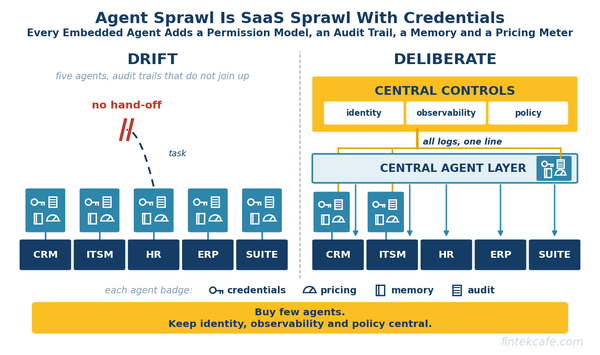
Every Software Vendor Now Sells an Agent, and Most Enterprises Should Buy Very Few of Them
Buying an agent from every system of record recreates SaaS sprawl one layer up. How CIOs should choose, and which controls must stay central.
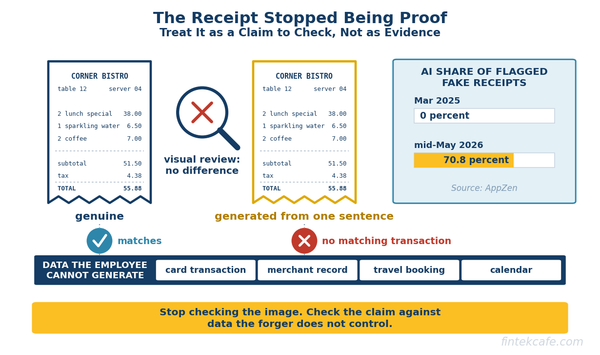
AI-Generated Fake Receipts: How Expense Fraud Changed and How Finance Teams Catch It
AI-generated fake receipts now beat visual review. How expense fraud changed, which detection still works, and the controls to use by company size.
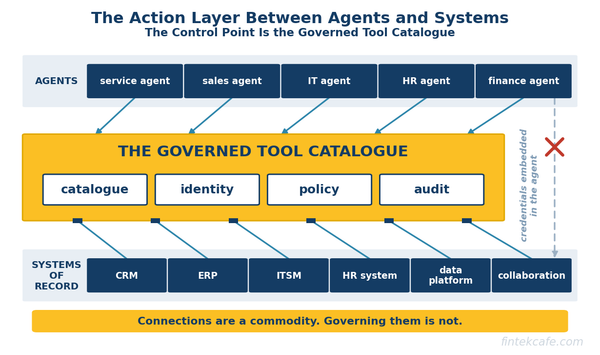
Integration Platforms Are the Quiet Winners of the Agent Era
Agents act through integrations. iPaaS and API vendors hold the connectors, credentials and audit trails, and MCP makes governing that layer worth more.