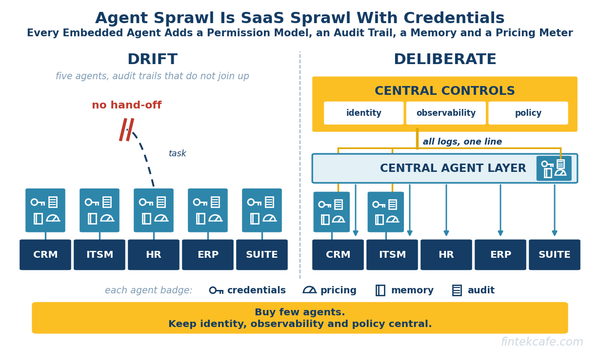
Every Software Vendor Now Sells an Agent, and Most Enterprises Should Buy Very Few of Them
Buying an agent from every system of record recreates SaaS sprawl one layer up. How CIOs should choose, and which controls must stay central.
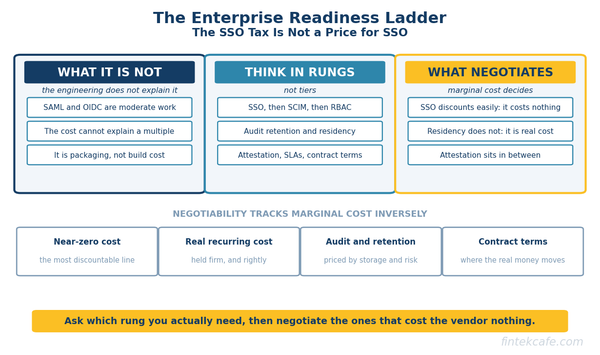
The SSO tax is not a price for SSO. It is a segmentation fence, and the features behind it are chosen for willingness to pay, not cost to build.
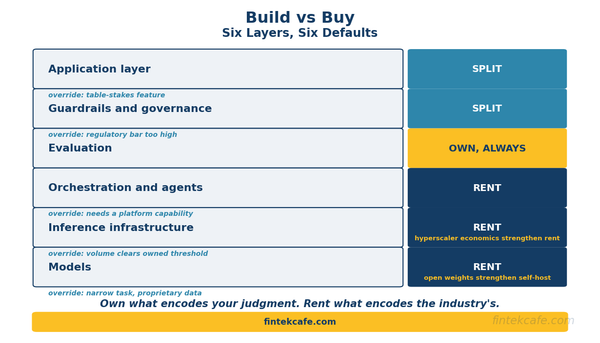
AI build versus buy is not one decision but six, one per stack layer. A decision matrix with defaults, override conditions, and traps for each.
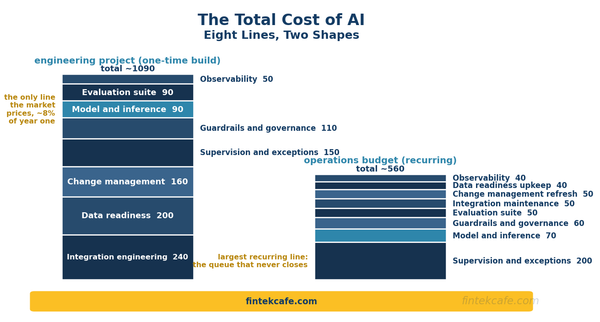
An eight-line total cost of ownership framework for enterprise AI, with a worked example, realistic cost shares, and a build-buy-wait decision table.
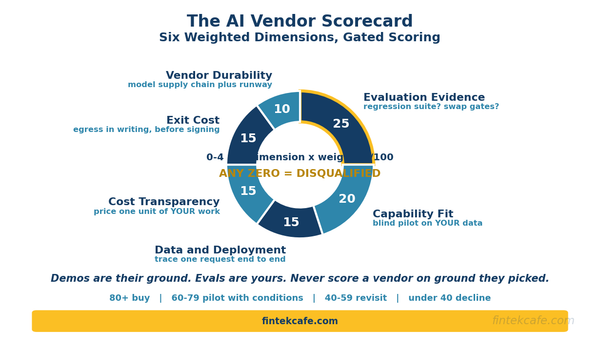
A six-dimension scoring framework for evaluating AI vendors, with weights, pass/fail gate questions, and a matrix a buyer can apply in a live meeting.
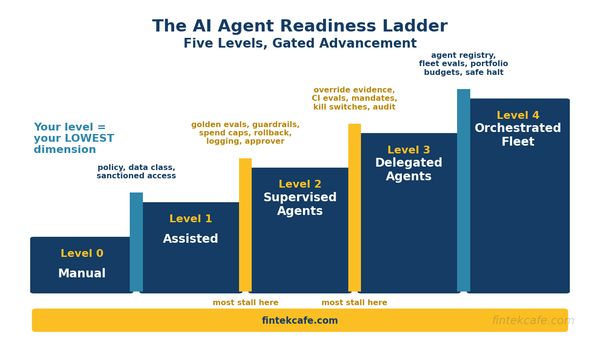
A five-level maturity model for enterprise AI agent readiness, with deterministic entry gates and a self-assessment matrix executives can score in minutes.
Most teams ship LLM features with no real evals, then find failures in production. A practical framework for an evaluation harness that scales.
Frontier models do not win every task. A 2026 framework for when small and mid-sized models beat them on cost, latency, privacy, and accuracy.
Most enterprise AI agents stall in pilot. A framework for the narrow, tool-constrained, well-evaluated patterns that ship, and the demoware that does not.
Why most enterprise knowledge graph projects stall at six months: schema, ingestion, and consumer mismatch. The pattern top AI teams actually follow.
Deep analysis across the systems, strategies, and economics that shape modern technology.
Premium Members Get: Exclusive deep-dive research · Architecture playbooks · Executive briefings · Full archive access