
The AI Headcount Illusion: What Agents Actually Do to the Org Chart
The loudest promise in enterprise AI is headcount reduction. It anchors the board deck, justifies the pilot budget, and supplies the multiple in every vendor's ROI model: agents will do the work, so fewer people will be needed to do it. The promise is intuitive, quantifiable, and endorsed by every prior wave of automation. It is also, on the evidence accumulating from organizations actually deploying agents at scale, mostly not what happens.
What the deployment data keeps showing instead is reshaped roles, wider spans of control, and a new category of supervisory work, far more often than smaller payrolls. Surveys of enterprises running agentic systems in production report returns arriving as throughput, quality, and customer engagement rather than cost-out; SAP's published findings on enterprise AI value are representative, locating the realized gains in insight and customer-facing performance rather than payroll lines. Adoption is genuinely high and rising fast, but at-scale role transformation remains rare, and the organizations reporting material workforce reduction attributable to agents remain a small minority even among aggressive adopters.
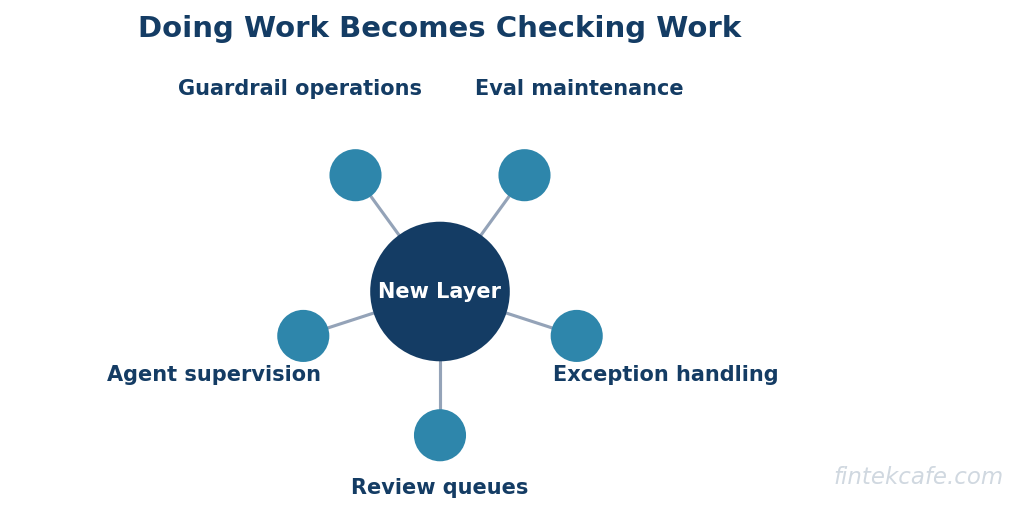
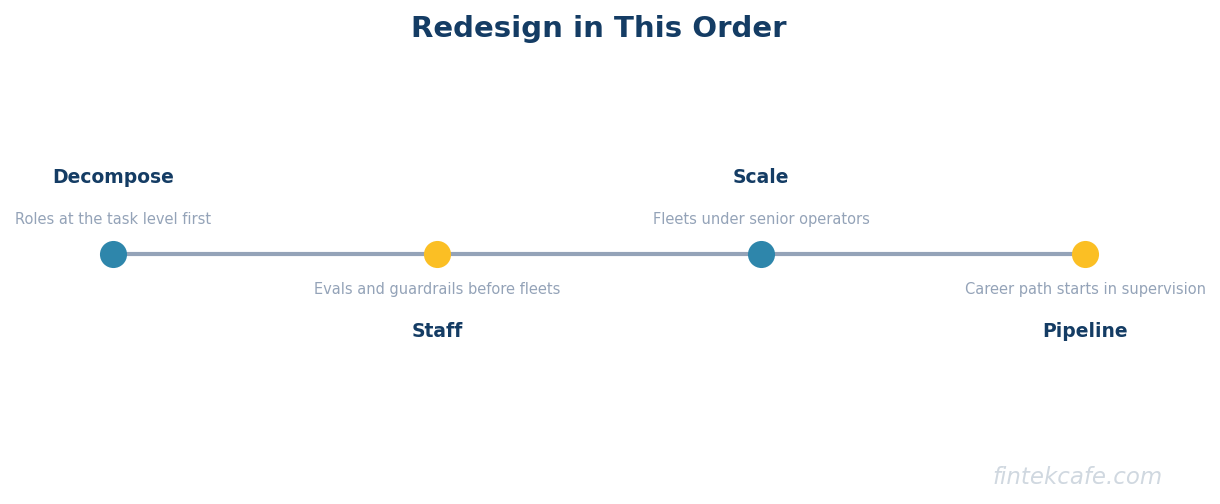
The contrarian thesis of this piece is that the gap between promise and evidence is not an execution failure that better deployment will close. It is a category error about what agents do. Agents do not remove work from the organization. They convert doing-work into checking-work, and the conversion produces a different org chart rather than a smaller one. Executives who write the business case as a headcount story spend the deployment cycle discovering, expensively, what the case should have said from the start. The organizations that win are the ones that redesign around the conversion, and this piece is about what that redesign looks like.
What the Deployment Data Actually Shows
Hold the claims to the numbers first, because the numbers are consistent across sources that agree on little else.
Adoption is not the bottleneck. Industry surveys through 2025 and 2026 put generative AI usage at large majorities of enterprises, with agentic pilots spreading fast behind the copilot wave; Gartner expects agentic capability embedded in a third of enterprise software by 2028, up from under 1 percent in 2024. Meanwhile the same analyst house projects that over 40 percent of agentic AI projects will be canceled by the end of 2027 on cost and risk grounds, and MIT's Project NANDA reported that roughly 95 percent of enterprise generative AI pilots showed no measurable profit-and-loss impact. High adoption, thin measured returns, heavy cancellation risk: that is not a picture of agents cutting payrolls at scale. It is a picture of organizations buying a transformation and receiving a tool.
Where returns do show up, they show up on the revenue and quality side of the income statement. The SAP finding is the clean version: enterprises realizing value from AI report it in better insight, faster customer response, and improved engagement, not in headcount lines. Support organizations report faster resolution and higher deflection at flat staffing. Engineering organizations report more code shipped per team, not fewer teams. The macro data agrees: through the current cycle, aggregate white-collar employment in AI-exposed occupations has shifted in composition, with entry-level hiring visibly softening while experienced hiring holds, rather than contracting outright.
That composition shift is the tell, and it points directly at the mechanism the rest of this piece is built on.
This is a Premium Article
Sign up for a Premium membership to read this article and get full access to strategic intelligence on technology and business.
Already a member? Sign in
Related Articles
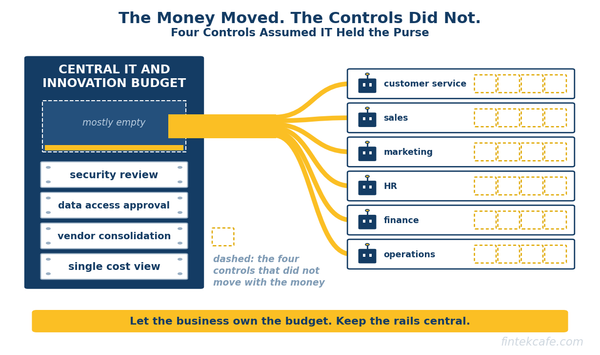
The AI Budget Is Moving From IT to the Business Lines, and Governance Has Not Followed
AI spend is moving from central IT to business lines. That ties cost to outcomes but breaks controls built for an IT-held purse. The model that works.
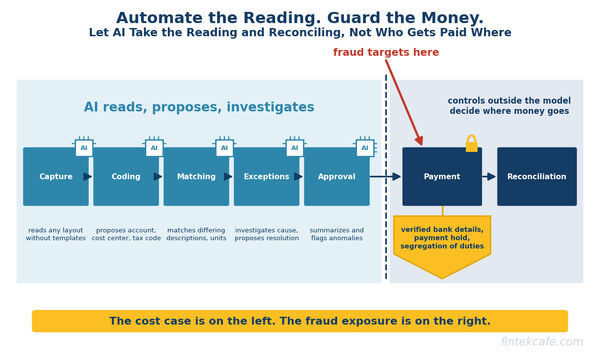
Accounts Payable Automation: What AI Can Actually Take Over in Invoice-to-Pay
What AI can take over in accounts payable, step by step from capture to payment, where the fraud risk grows, and which controls must stay outside the model.
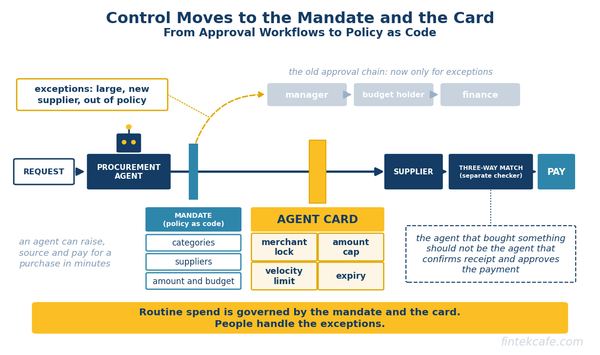
Procurement Is Where Agents Will Spend the Company's Money First
The first agents trusted with company money will buy for the enterprise. Control moves from approval chains to policy as code and card-level limits.