
Why AI Agent Frameworks Keep Breaking in Production: LangGraph, CrewAI, and the Orchestration Reality
The agent framework demo is one of the most reliably misleading artifacts in enterprise software. The video shows a planner agent decomposing a goal, a researcher agent calling a search tool, a writer agent producing a report, and a critic agent reviewing the output. The demo runs in ninety seconds, looks magical, and convinces a vice president to budget the production deployment for the next quarter. The production deployment six months later looks like a Rube Goldberg machine that crashes at three in the morning, runs up six-figure token bills on a weekend, and produces outputs that the operations team has stopped trusting.
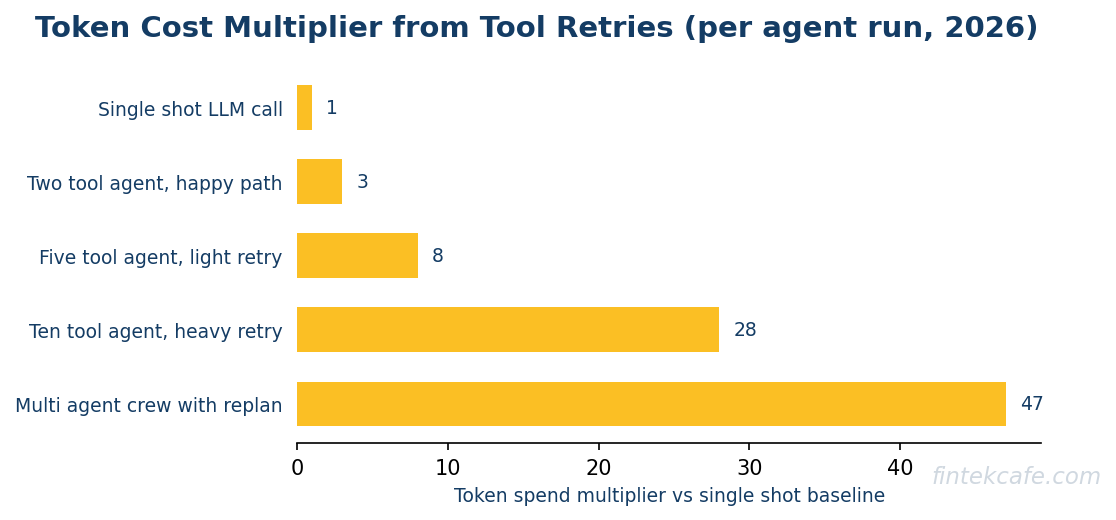
The pattern is consistent enough across teams now that it is no longer a story about immature engineering. It is a story about a class of software in which the demo and the production system are governed by different laws. The demo runs at low concurrency on a happy path with a developer watching. The production system runs at high concurrency on every path including the failure paths, with no developer watching, against rate limits, retries, partial failures, and the inherent nondeterminism of the underlying language model. The frameworks that exist in 2026, LangGraph, CrewAI, AutoGen, OpenAI's Assistants API, and the increasingly visible Anthropic-pattern minimal approaches, all paper over the gap between demo and production in different ways. This piece names the three structural failure modes that show up regardless of framework, compares the frameworks on how they handle each one, and ends with a decision framework for when an agent is genuinely the right primitive and when it is not.
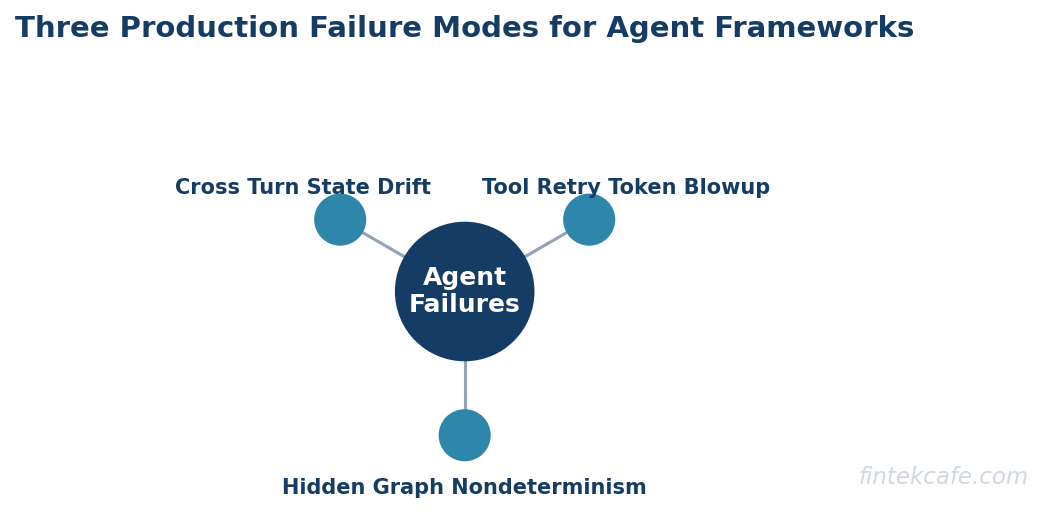
Failure Mode One: The Orchestration Graph Hides Nondeterminism That Breaks Service Level Agreements
The first failure mode is the one that gets the most production engineers fired. The agent framework presents itself as a graph of nodes and edges, with the implication that the graph is a deterministic state machine. The actual execution is a graph of language-model calls, each of which is stochastic on token sampling, on tool selection, on whether the model chooses to terminate or continue, and on whether the model emits the structured output the next node was expecting. Every edge in the graph is a probabilistic edge whose actual transition rate is a function of the prompt, the model version, the tool definitions, and the conversation history up to that point.
The implication for service level agreements is severe. A five-node graph in which each node has a ninety-eight percent probability of producing the expected handoff has an aggregate end-to-end success rate of about ninety percent. A ten-node graph at the same per-node rate has an aggregate success rate of about eighty-two percent. The math is unforgiving. Teams that designed the graph in a whiteboard session assumed nodes compose like deterministic functions. They do not compose like deterministic functions. They compose like noisy distributed system calls, except the noise is unobservable from the framework's perspective because the framework cannot distinguish between a model that chose to skip a tool call and a model that hallucinated that it had already called the tool.
Concrete consequences observed across multiple teams running multi-agent systems in 2025 and 2026:
- Latency variance is multimodal. P50 looks acceptable. P95 is two to four times P50. P99 is sometimes ten times P50 because the model decided to loop a tool call eight times before deciding to give up. The team that promised the business a three-second response time has a P99 of forty seconds.
- Cost variance follows the same shape. A median request costs a few cents in tokens. The tail-end request costs a few dollars because the agent decided to read three large documents into context before answering.
- Failure mode taxonomy is not stable across model versions. A graph that ran cleanly on Claude Sonnet 4.5 needs partial re-tuning on Sonnet 4.6 because the model's tool-selection priors shifted. Teams that did not budget for re-validation on every model upgrade end up running deprecated models because the migration cost is unbudgeted.
- Observability is poor by default. The framework logs node entries and exits. It does not log why the model chose this branch and not that one, because the model itself cannot reliably explain its own choice. Debugging is forensic, not deductive.
The teams that ship reliable multi-step language-model systems in production have collectively stopped pretending the graph is deterministic. They treat each node as a stochastic process with measured success rates, model the aggregate as a probability distribution, and put hard determinism back into the system at the structural level: budget caps, hop limits, mandatory deterministic checkpoints, and explicit human-in-the-loop gates at high-stakes decisions. The framework is then a convenience layer over what is really a small distributed system with a probabilistic component.
This is a Premium Article
Sign up for a Premium membership to read this article and get full access to strategic intelligence on technology and business.
Already a member? Sign in
Related Articles
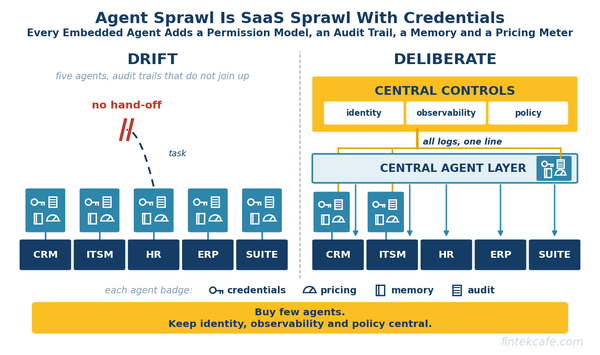
Every Software Vendor Now Sells an Agent, and Most Enterprises Should Buy Very Few of Them
Buying an agent from every system of record recreates SaaS sprawl one layer up. How CIOs should choose, and which controls must stay central.
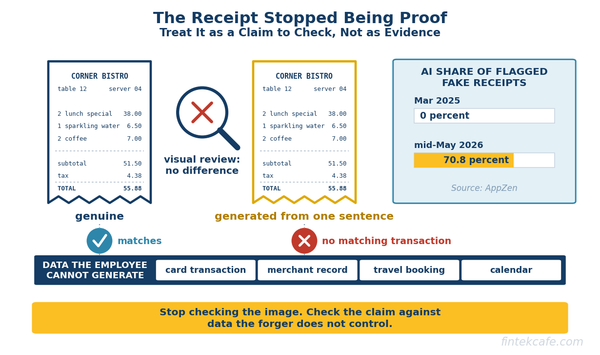
AI-Generated Fake Receipts: How Expense Fraud Changed and How Finance Teams Catch It
AI-generated fake receipts now beat visual review. How expense fraud changed, which detection still works, and the controls to use by company size.
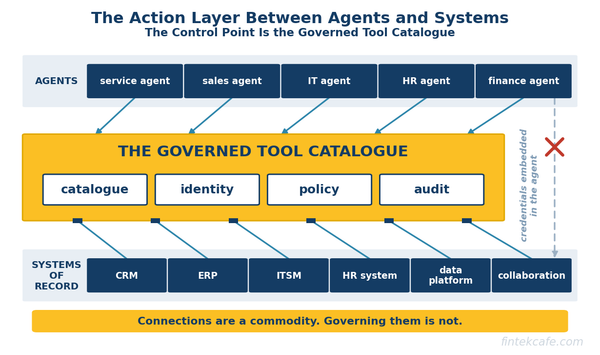
Integration Platforms Are the Quiet Winners of the Agent Era
Agents act through integrations. iPaaS and API vendors hold the connectors, credentials and audit trails, and MCP makes governing that layer worth more.