
Treasury Management for Growing Companies: Where the Cash Actually Sits
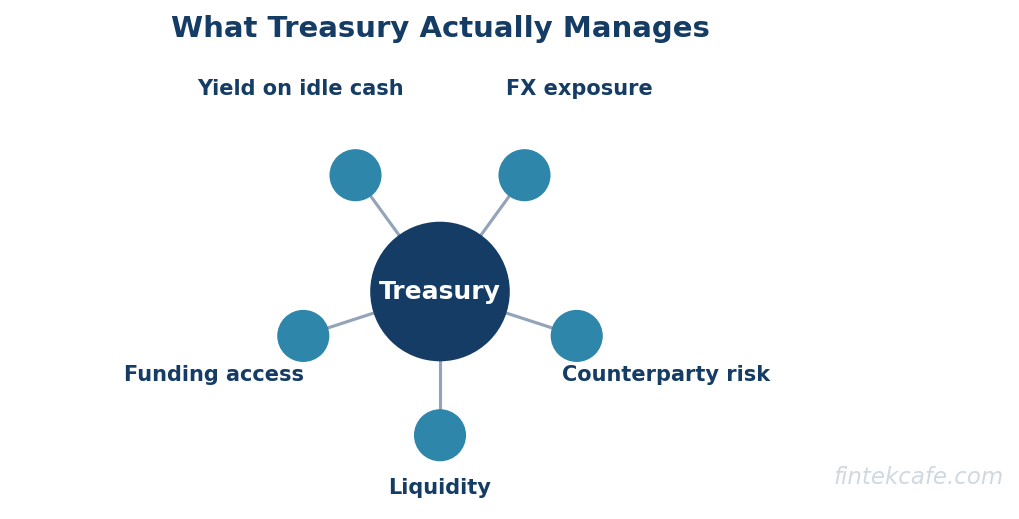
Treasury is the function nobody notices until a bank fails, a currency moves against the business, or the cash that looked available on a dashboard turns out not to be reachable when it is needed. It manages five things: liquidity (can the company pay what it owes, when it owes it), counterparty risk (is the institution holding the cash itself sound), foreign-exchange exposure (does a currency move erase a quarter's margin), yield on idle cash (is money sitting uninvested when it could safely be earning), and funding access (can the company raise more if it needs to). Most growing companies build no explicit treasury function at all until an event forces one, and the 2023 regional-bank stress in the United States, in which Silicon Valley Bank failed and several other institutions came under acute pressure within the same week, forced the issue for an entire generation of technology and startup finance leaders simultaneously. This guide covers what treasury actually manages, the growth-stage progression from a single checking account to a real function, the lessons from 2023 that have stuck, the operational layer that makes the policy real day to day, the new instruments entering the space, and when spreadsheets stop being enough.
Key Takeaways
- Treasury manages liquidity, counterparty risk, FX exposure, yield on idle cash, and funding access, and most companies address these implicitly and inconsistently until a stress event forces an explicit policy. The 2023 regional-bank crisis was that forcing event for a large share of venture-backed and growth-stage companies.
- The maturity progression is a founder checking account, then multi-bank redundancy in direct response to concentration risk, then a written treasury policy with counterparty limits and laddered instruments, then a full treasury function with dedicated systems and staff. Skipping stages under pressure is common and identifiable by the absence of a written policy at any given cash level.
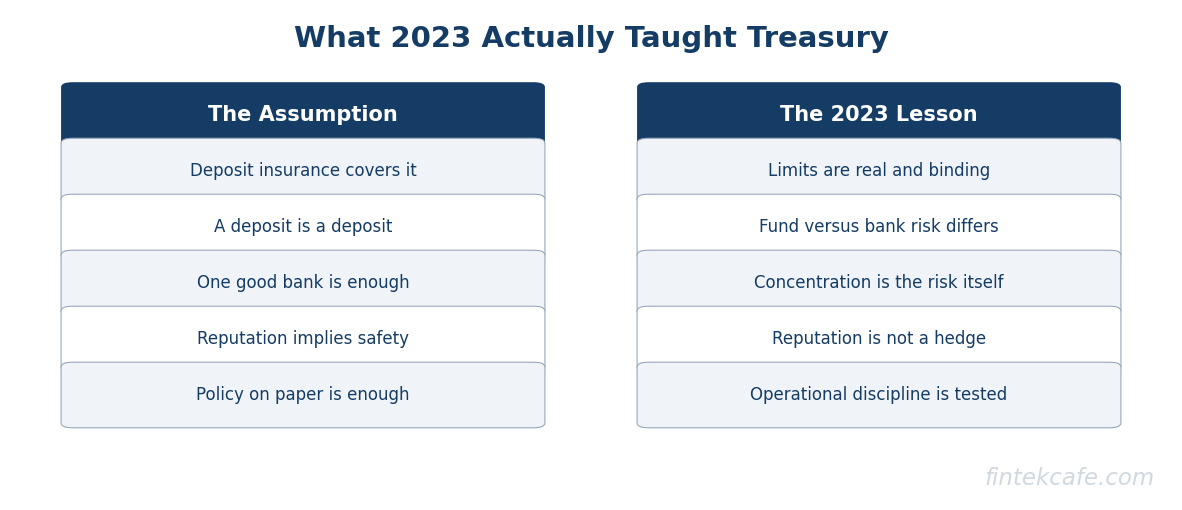
- The lessons that stuck from 2023: deposit insurance limits are real and binding at scale, a money-market fund and a bank deposit carry fundamentally different counterparty risk, sweep networks that spread cash across many insured banks solved a genuine problem, and a company's operating cash should never be concentrated in a single institution regardless of that institution's reputation.
- The operational layer, cash visibility across entities and currencies, a forecast finance actually trusts and uses, and payment controls with real separation of duties, is where treasury policy becomes real rather than aspirational; a well-written policy with no operational discipline behind it fails exactly when it is tested.
- New instruments, tokenized money-market funds offering near-continuous liquidity, and stablecoin pilots for cross-border operating float, are moving from experimental to genuinely evaluated by growth-stage treasuries, and the decision to adopt a treasury management system rather than spreadsheets and banking portals should be driven by entity and currency complexity, not by headcount or revenue alone.
What Treasury Actually Manages
Treasury is often described loosely as "managing the company's cash," which understates how many distinct risks live inside that phrase. Liquidity is the most basic: does the company have cash, in the right currency, at the right institution, at the moment an obligation is due, distinct from whether the company has cash somewhere in aggregate. Counterparty risk is the risk that the institution holding the cash, a bank, a money-market fund, a payment processor with float, is itself unsound, a risk most finance teams did not actively manage before 2023 and now cannot credibly ignore. FX exposure is the risk that a currency move between when revenue is earned in one currency and converted to another erases margin that looked secure on the day the deal closed, a real and growing concern as more growth-stage companies sell and pay across borders earlier in their life. Yield on idle cash is the opportunity cost of cash sitting in a non-interest-bearing checking account when it could safely be earning a return in an instrument with comparable liquidity. Funding access is whether the company can raise additional capital, debt or equity, if operating cash runs short, which treasury planning intersects with even though it does not fully own it.
The reason treasury is easy to under-invest in is that all five of these can look fine for a long time on the metric everyone actually watches, the bank balance, right up until one of them is suddenly not fine, and the failure is rarely gradual.
The Growth-Stage Progression
Treasury sophistication tends to track company stage in a recognizable pattern, and the risk is not being at an early stage; it is staying at an early stage past the point where the company's cash and complexity have outgrown it.
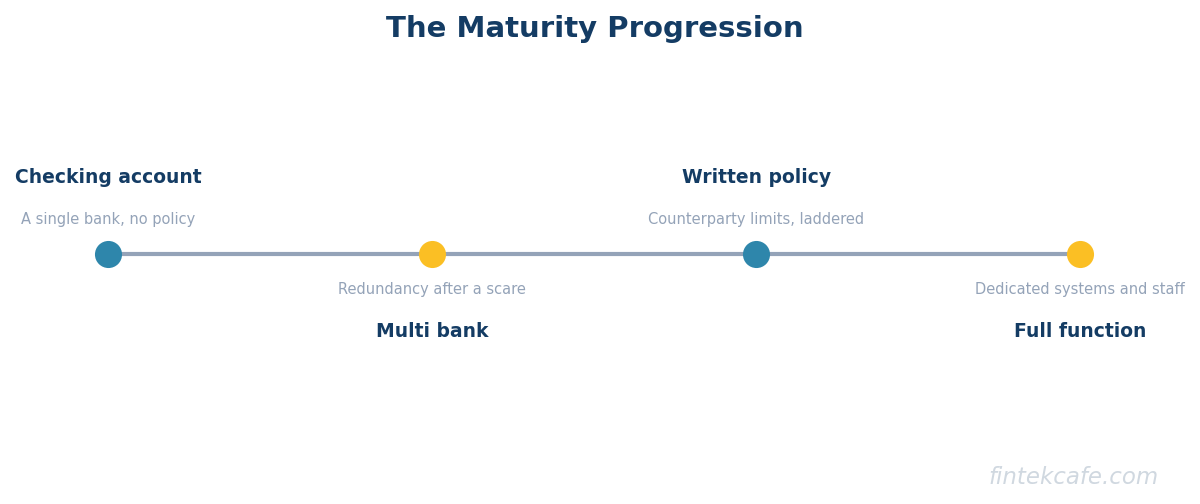
Stage one: the founder checking account. A single operating account at a single bank, managed informally, with cash movements decided ad hoc. This is entirely appropriate for a very early company and becomes a liability the moment cash balances grow large enough that a single-bank failure would be existential rather than merely inconvenient.
Stage two: multi-bank redundancy. Cash spread across more than one banking relationship specifically to avoid concentration risk, a discipline that the 2023 regional-bank stress converted from a theoretical best practice into an urgent, widely adopted response almost overnight. This stage is reactive by nature for most companies that adopted it, and it is a real improvement over stage one even without anything else changing.
Stage three: a written treasury policy. Explicit counterparty limits (no more than a defined percentage of cash with any single institution), a maturity ladder of instruments matched to known cash needs, and documented decision rules rather than case-by-case judgment calls. This is the stage at which treasury stops being reactive and becomes a policy the finance team can point to and defend, including to a board asking exactly the question 2023 taught every board to ask.
Stage four: a real treasury function. Dedicated ownership, purpose-built systems for cash visibility and forecasting, and treasury decisions made with the same rigor and reporting cadence as other core finance functions, rather than as a side responsibility layered onto whoever in finance has bandwidth.
| Stage | Typical cash level | Structure | Instruments |
|---|---|---|---|
| Founder checking account | Modest operating cash, pre- or early revenue | Single bank, informal, no written policy | Checking account only |
| Multi-bank redundancy | Cash balances material enough that one bank's failure would be a crisis | Cash spread across two or more unaffiliated banks | Checking and savings accounts, no formal instrument ladder |
| Written treasury policy | Cash sufficient to justify a formal counterparty and yield strategy | Documented counterparty limits, board-visible policy, defined roles | Money-market funds, treasury-bill ladders, insured sweep networks |
| Full treasury function | Cash and entity/currency complexity that a spreadsheet can no longer track reliably | Dedicated ownership (treasurer or finance lead with treasury as a defined mandate), systems in place | Layered instrument mix, active FX hedging where relevant, potentially a treasury management system |
The identifiable failure at any stage is a mismatch: a company with stage-three cash levels still operating stage-one structure, recognizable by the absence of any written counterparty policy despite balances large enough that a single bank's failure would be genuinely damaging.
The Post-2023 Lessons That Stuck
The regional-bank stress of March 2023 was a specific, dated event, but the lessons it taught growth-stage finance leaders have proven durable rather than fading once the immediate crisis passed.
Concentration risk is not theoretical. Companies that had the large majority of their operating cash at a single bank discovered, within a matter of days, that "our bank is well-regarded" is not a substitute for a deposit-insurance limit and a counterparty policy. This lesson generalized past the specific institutions involved: the practice of spreading cash across multiple unaffiliated banks, regardless of any individual bank's perceived strength, became standard treasury guidance almost overnight and has remained standard since.
Deposits and money-market funds are not the same risk. A bank deposit is a claim on the bank itself, exposed to that bank's solvency beyond the insured limit. A money-market fund investing in government securities, and a laddered portfolio of actual Treasury bills, carry a fundamentally different risk profile, exposure to the underlying government securities and the fund's own operational soundness, rather than to a single commercial bank's balance sheet. Treasury policies written since 2023 routinely draw this distinction explicitly, where earlier policies, if they existed at all, often did not.
Sweep networks solved a genuine, previously under-addressed problem. Insured cash sweep networks, which automatically distribute deposits across a network of participating banks to multiply the effective deposit-insurance coverage on a single account relationship, moved from a niche product to a mainstream treasury tool because they solve exactly the problem 2023 exposed: the operational inconvenience of manually maintaining dozens of separate bank relationships to achieve the same insured-coverage result. Treasury teams that adopted sweep arrangements got multi-bank insurance coverage without multiplying the operational overhead of stage two's manual multi-bank approach.
The Operational Layer
A written treasury policy is necessary and insufficient. The policy becomes real, or stays aspirational, at the operational layer, and this is where growth-stage companies most often discover gaps only when tested.
Cash visibility across entities and currencies. A company with more than one legal entity, or operations in more than one currency, needs a consolidated, current view of where cash actually sits, not a monthly reconciliation exercise that is accurate as of three weeks ago. The reconciliation discipline that makes this view trustworthy, matching internal records against processor and bank data, is covered in depth in payment reconciliation, and the same underlying discipline, proving the number on the dashboard is the number actually in the account, applies to treasury visibility generally, not just to payment settlement specifically.
A forecast finance actually trusts. A cash forecast that is technically produced every month but that nobody making a real decision actually relies on is a compliance artifact, not an operational tool. The forecasts that earn trust are built from the same granular inputs, actual accounts receivable aging, actual payment terms, actual seasonal patterns, that finance already tracks for other purposes, rather than a top-down growth-rate assumption applied to last month's balance.
Payment controls and separation of duties. The person who initiates a payment should not also be the only person who can approve it, and the systems enforcing that separation should be tested periodically rather than assumed to be working because they were configured correctly once. This control matters more, not less, as payment volume and automation increase, because automation that removes a human from the loop for speed also removes the human who would have caught an error or a fraud attempt manually.
New Instruments Arriving
Three developments are moving from experimental curiosity to genuine treasury evaluation at growth-stage companies, though at different speeds.
Tokenized money-market funds. Blockchain-based representations of shares in money-market funds, offering the same underlying government-securities exposure as a traditional money-market fund with the operational advantage of near-continuous settlement and transferability rather than being bound to traditional fund processing windows. Major asset managers have launched tokenized fund products specifically targeting this liquidity advantage, and growth-stage treasuries evaluating them are weighing the settlement-speed benefit against the relative novelty of the custody and counterparty arrangements involved.
Stablecoin treasury pilots for cross-border operating float. Companies with meaningful cross-border operations are piloting stablecoin holdings specifically for operating float, funds needed quickly in a foreign jurisdiction, where traditional correspondent banking introduces multi-day settlement delays that a stablecoin transfer can compress substantially. This use case is narrower than headline coverage sometimes implies: it targets the specific pain point of cross-border settlement speed for operating cash, not a wholesale replacement of a company's core treasury holdings, and the broader case for stablecoins in the CFO's treasury toolkit is covered in the CFO's guide to stablecoins for treasury.
Real-time settlement's effect on the cash cycle. As payment rails move toward real-time and near-real-time settlement more broadly, the traditional multi-day gap between a payment being sent and cash being available compresses, which changes how much buffer a treasury policy needs to hold against settlement-timing uncertainty. The direct implications for how treasuries should adjust liquidity buffers and forecasting as settlement speeds up are covered in real-time treasury and instant settlement, and the broader macro backdrop against which all of these yield and instrument decisions are made, how prevailing interest rates shape the return available on idle cash and the appeal of any given instrument, is covered in how interest rates affect fintech.
Counterparty Risk Checklist
| Checklist item | Why it matters |
|---|---|
| No single bank holds more than a defined percentage of total operating cash | The core lesson of 2023: reputation is not a substitute for a concentration limit |
| Deposit-insurance coverage explicitly calculated per institution, not assumed | Insurance limits apply per depositor per bank; assumptions about coverage are a common source of surprise |
| Money-market fund and government-security holdings evaluated separately from bank deposit risk | These carry a different counterparty exposure than a commercial bank deposit and should not be treated interchangeably in policy |
| Sweep network or multi-bank arrangement in place once cash exceeds single-bank insured limits by a meaningful margin | Converts manual multi-bank management into an automated, auditable arrangement |
| Counterparty limits reviewed at a defined cadence, not only after a stress event | Prevents the policy from being a one-time reaction that goes stale as balances and institutions change |
| Payment initiation and approval separated by role, tested periodically | Protects against both error and fraud as payment volume and automation grow |
When to Buy a Treasury Management System
Spreadsheets and banking-portal logins are a legitimate treasury tool for a genuinely large share of growth-stage companies, and the decision to move to a dedicated treasury management system should be driven by complexity, not by revenue or headcount as such. The signal that spreadsheets have stopped working is usually entity and currency complexity outpacing what a manually maintained spreadsheet can reconcile reliably: multiple legal entities, multiple currencies, multiple banking relationships whose balances need to be viewed consolidated and current rather than reconstructed at month-end. A company with a single entity, a single currency, and even a fairly large cash balance can often run a disciplined stage-three policy on spreadsheets and banking portals for years. A company with three entities across two currencies and five banking relationships, even at a more modest cash balance, will find the spreadsheet approach breaking down in exactly the way that produces the treasury failures this guide describes: a cash position that looks fine on the dashboard and is not actually available where and when it is needed. The purchase decision, in other words, follows operational complexity, and a company should evaluate a treasury management system when reconciling its own cash position has become a recurring source of uncertainty rather than a routine task.
FAQ
What does a treasury function actually manage?
Five things: liquidity, whether cash is available when obligations are due; counterparty risk, whether the institutions holding the cash are themselves sound; foreign-exchange exposure, whether currency moves erode margin; yield on idle cash, whether uninvested cash is earning a safe return it could be earning; and funding access, the company's ability to raise more capital if operating cash runs short. Most companies manage these implicitly and inconsistently until a stress event forces an explicit policy.
What changed in corporate treasury practice after the 2023 bank failures?
Four things became standard practice that were previously inconsistent or absent: spreading operating cash across multiple unaffiliated banks regardless of any single bank's reputation, explicitly distinguishing the counterparty risk of bank deposits from that of money-market funds and Treasury bills, adopting insured cash sweep networks to multiply effective deposit-insurance coverage without multiplying manual banking relationships, and writing down formal counterparty limits rather than relying on informal judgment.
How should a growing company decide when it needs a formal treasury policy?
The trigger is cash balance relative to deposit-insurance limits and to what a single institution's failure would cost the business, not company age or funding stage specifically. A company whose operating cash at any single bank comfortably exceeds insured coverage, and whose loss of that cash would be an existential event rather than an inconvenience, has already outgrown informal treasury management even if it has not yet formalized a policy. The identifiable gap is a mismatch between cash level and the absence of a written counterparty policy.
Are stablecoins and tokenized money-market funds actually being used for corporate treasury?
Real evaluation and piloting are happening, but narrowly and deliberately rather than as a wholesale replacement of traditional treasury holdings. Stablecoin pilots concentrate on cross-border operating float, where traditional correspondent banking settlement delays are a specific, addressable pain point. Tokenized money-market funds appeal for their near-continuous settlement compared to traditional fund processing windows. Both remain a smaller allocation alongside traditional bank deposits, money-market funds, and Treasury bills for the large majority of growth-stage treasuries.
When should a company move from spreadsheets to a treasury management system?
When entity and currency complexity, not revenue or headcount, makes reliable cash visibility hard to maintain manually: multiple legal entities, multiple currencies, and several banking relationships whose combined position needs to be viewed consolidated and current rather than reconstructed at month-end. A single-entity, single-currency company can often run a disciplined treasury policy on spreadsheets and banking portals well past the point many assume a system becomes necessary; a multi-entity, multi-currency company often needs one sooner than its cash balance alone would suggest.
Related reading on FinTekCafe
Related Articles
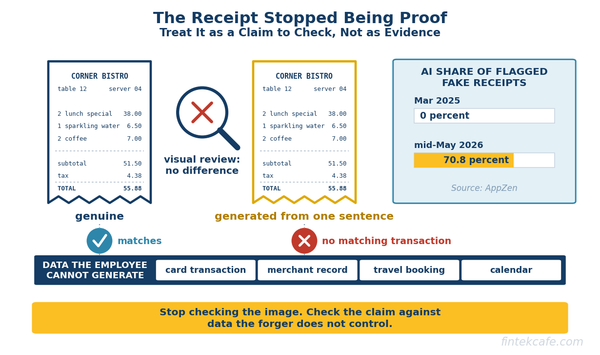
AI-Generated Fake Receipts: How Expense Fraud Changed and How Finance Teams Catch It
AI-generated fake receipts now beat visual review. How expense fraud changed, which detection still works, and the controls to use by company size.
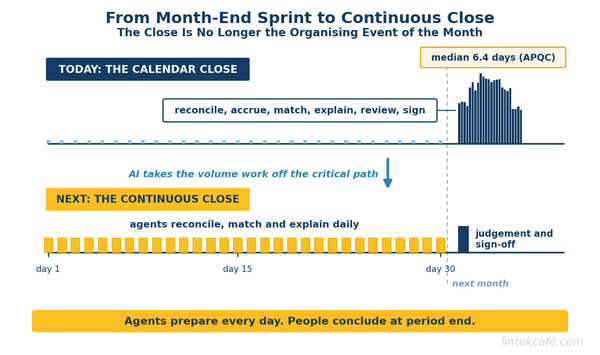
The Monthly Close Is Becoming Continuous, and the Finance Calendar Will Not Survive It
AI is taking the bottleneck work out of the month-end close. The close becomes continuous with a short sign-off, and finance, audit and the board change.
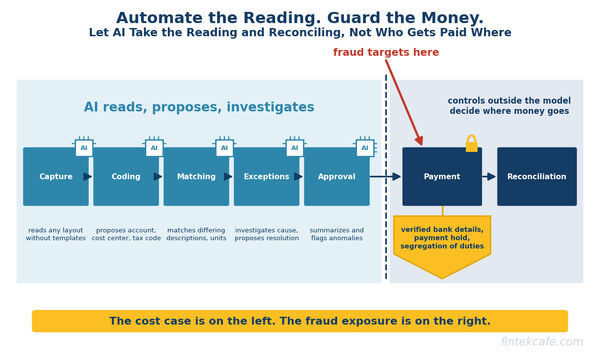
Accounts Payable Automation: What AI Can Actually Take Over in Invoice-to-Pay
What AI can take over in accounts payable, step by step from capture to payment, where the fraud risk grows, and which controls must stay outside the model.