
Real-Time Treasury: How Instant Settlement Rewires Corporate Cash Management
Corporate treasury is one of the few disciplines that was engineered around delay on purpose. The batch payment run, the end-of-day sweep, the cut-off time that closes the wire window at a fixed hour, the float that sits between when a payment leaves and when it clears: none of these are accidents. They are the rhythm that lets a treasury team net flows, forecast a closing balance, fund accounts once, and reconcile against a settled snapshot the next morning. The whole operating model assumes that money moves on a schedule the team controls.
Instant rails break that assumption. FedNow, real-time payments, and their cross-border equivalents settle in seconds, run twenty-four hours a day, seven days a week, and offer no cut-off and no float. The obvious read is that this is simply faster and therefore simply better. The contrarian read, and the one that holds up under scrutiny, is that real-time settlement is harder for treasury teams than it looks, not easier. Speed is the feature buyers see. The operating-model rewrite is the part that arrives with it, uninvited.
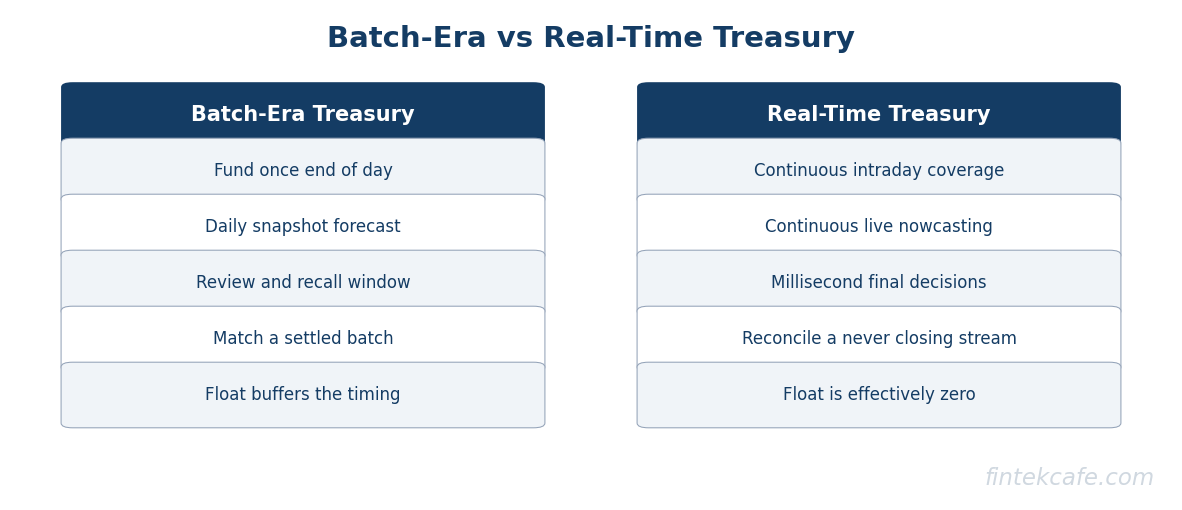
This matters because the value of instant settlement is real, but it is conditional. It accrues to the organizations that rebuild liquidity management, forecasting, fraud control, and reconciliation for a world where money never stops moving. It is a cost, not a gift, for the organizations that bolt a real-time rail onto a batch-era process and discover that the planning anchors they relied on have quietly disappeared. What follows is what the delay was actually doing, what breaks when it is removed, a side-by-side of batch-era and real-time treasury, and the questions a CFO should be putting to the bank before treating instant payments as a capability rather than a liability.
What the Delay Was Quietly Doing
Before describing what breaks, it helps to be honest about what the old rhythm provided, because most of it was load-bearing and none of it was visible on an org chart.
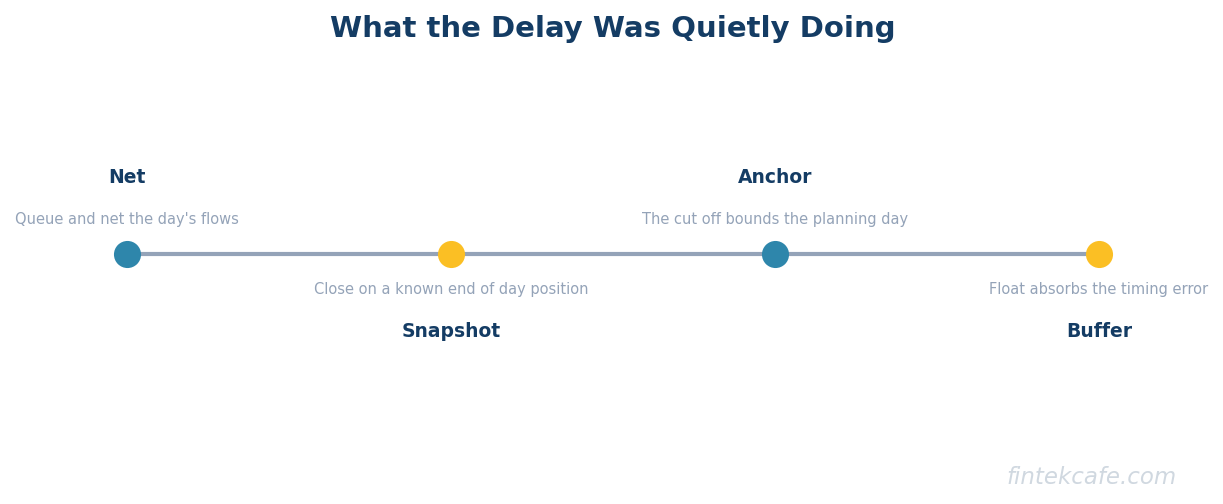
Batch processing gave treasury a natural point of consolidation. Payments queued through the day and left in a run, which meant the team could see the full set of outflows, net them against expected inflows, and fund the account once rather than reacting to each transaction. The end-of-day sweep gave a clean line under the ledger: balances concentrated, idle cash moved to where it earned a return, and the next morning opened from a known position. The cut-off time was a planning anchor disguised as an operational constraint. It told everyone, inside and outside the company, when the day's money was final, which is what made same-day forecasting tractable. And float, the gap between debit and clearing, was a small but genuine source of working capital and a buffer against timing error.
Delay, in other words, was doing four jobs at once: it created a moment to net and decide, it produced a stable snapshot to forecast and reconcile against, it set a deadline that bounded the planning problem, and it provided a margin for error. Remove the delay and all four jobs still have to be done. They just have to be done continuously, in real time, by systems and people that were organized around doing them once a day.
This is a Premium Article
Sign up for a Premium membership to read this article and get full access to strategic intelligence on technology and business.
Already a member? Sign in
Related Articles
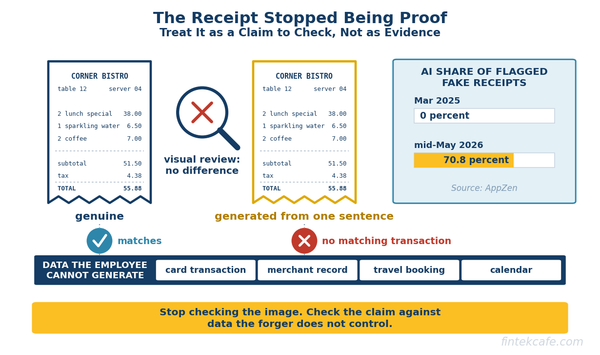
AI-Generated Fake Receipts: How Expense Fraud Changed and How Finance Teams Catch It
AI-generated fake receipts now beat visual review. How expense fraud changed, which detection still works, and the controls to use by company size.
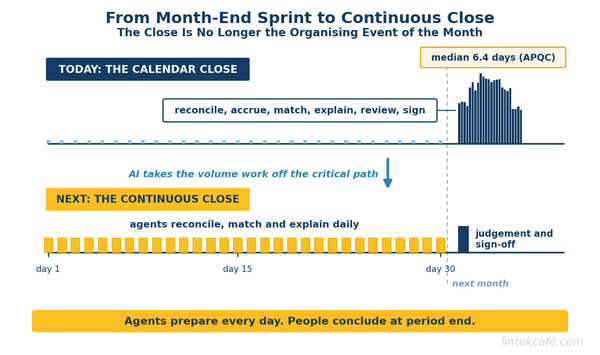
The Monthly Close Is Becoming Continuous, and the Finance Calendar Will Not Survive It
AI is taking the bottleneck work out of the month-end close. The close becomes continuous with a short sign-off, and finance, audit and the board change.
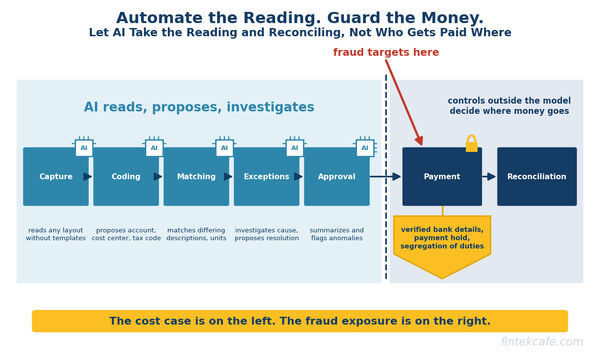
Accounts Payable Automation: What AI Can Actually Take Over in Invoice-to-Pay
What AI can take over in accounts payable, step by step from capture to payment, where the fraud risk grows, and which controls must stay outside the model.