
Scam Reimbursement Is Becoming a Cost of Running Instant Payments
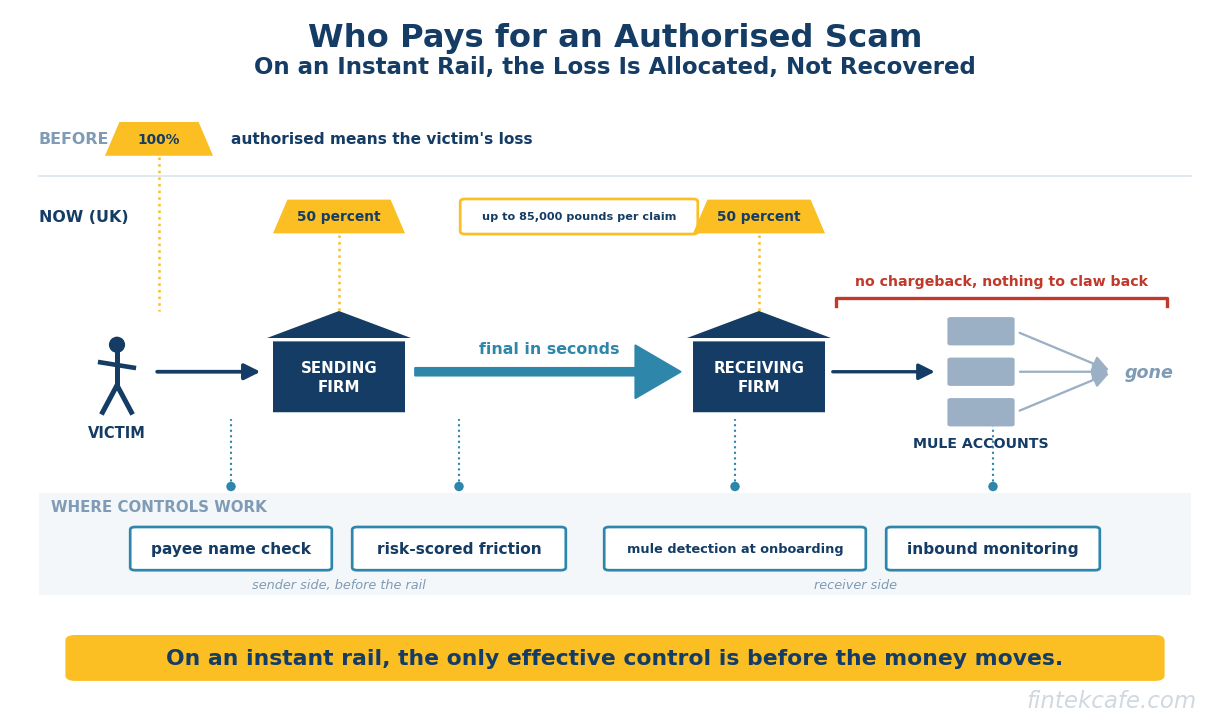
For most of the history of bank transfers, a customer who was tricked into sending money lost it. The payment was authorised, so the protections that cover stolen cards and hijacked accounts did not apply. Banks sometimes refunded victims out of goodwill or under a voluntary code, but the default was clear: authorised meant final, and final meant the victim's problem. The fraud liability explainer sets out why that line between authorised and unauthorised has decided who pays on every rail.
That default is ending, and the change is bigger than it looks. Mandatory reimbursement of authorised push payment (APP) scams turns scam losses from a customer-service problem into a line in the unit economics of instant payments. It also moves a large share of the cost to a party that has historically carried none of it: the firm that received the money. In the UK, which has run the experiment longest, the receiving firm pays half. Many of the firms with the highest rates of scam money arriving in their accounts are fintechs and e-money institutions whose business models were priced before this cost existed.
The thesis of this piece is that APP reimbursement is no longer a consumer-protection story. It is a pricing story, an onboarding story, and, for anyone selling account-to-account payments as a cheap alternative to cards, a margin story.
The UK Experiment, Two Years In
The UK's Payment Systems Regulator (PSR) made reimbursement mandatory for APP scams over Faster Payments from 7 October 2024, with a parallel requirement for CHAPS taking effect the same day. The rules require firms to reimburse in-scope consumer victims unless the customer was complicit or acted with gross negligence. The cost is split 50:50 between the sending and the receiving firm, a design choice made explicitly to give both ends of the payment a reason to stop it. The Financial Conduct Authority's Dear CEO letter of the same date made the point to every payment and e-money firm: the obligation is theirs, and so are the systems needed to meet it.
The cap is the most instructive part of the design, because it changed at the last moment and for a telling reason. The PSR originally set the maximum reimbursement per claim at 415,000 pounds. In September 2024, weeks before launch, it consulted on and then confirmed a cut to 85,000 pounds, aligned with the Financial Services Compensation Scheme limit. The argument that won was prudential: smaller payment firms said a high cap created a real risk of unprofitability or insolvency for firms on the receiving end of large scams. The PSR's analysis found 99.8 percent of claims by volume, and around 90 percent by value, fell under the lower figure. The cap was lowered not because large losses stopped mattering but because the regulator concluded some receiving firms could not survive paying their half.
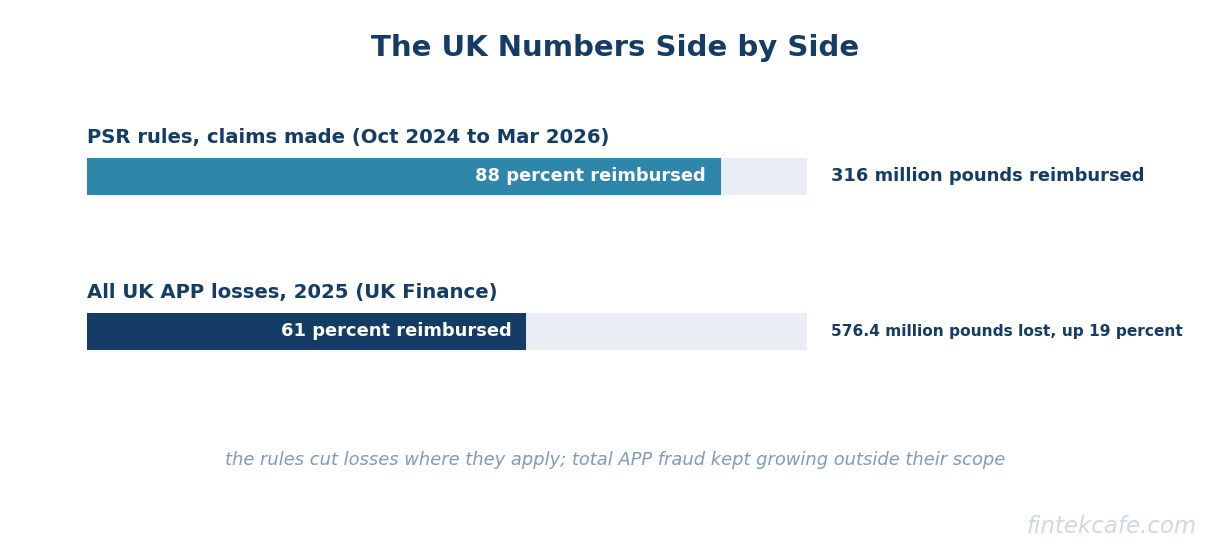
The published results show a regime that works for victims who claim. The PSR's reimbursement dashboard, covering 7 October 2024 to 31 March 2026, reports 316 million pounds reimbursed, 88 percent of the money lost in claims made under the rules, across 438,300 claims of which 301,500 were in scope. Speed has held: 82 percent of claims closed within five business days and 98 percent within 35. The first-year figure alone was 173 million pounds.
Whether it reduced fraud depends on which measure is read, and the two measures say different things. The PSR's independent evaluation by Frontier Economics, published on 1 July 2026, found that APP losses sent over Faster Payments fell by around 21 percent, about 73 million pounds a year, in the regime's first year, with nearly 35,000 fewer scams. Firms with the highest prior fraud volumes improved the most. The wider measure is less comfortable. UK Finance's Annual Fraud Report, published in June 2026, recorded APP fraud losses of 576.4 million pounds in 2025, up 19 percent, across 248,070 cases. Banks reimbursed 354.3 million pounds, 61 percent of losses. UK Finance attributes the gap with the PSR's 88 percent to scope: its data covers more payment and account types than the reimbursement rules. The PSR's own victim research, published a year in, found 71 percent of victims unaware of the policy and 49 percent never attempting to claim. Two thirds of APP cases originated online, and almost 60 percent of victims were caught by purchase scams.
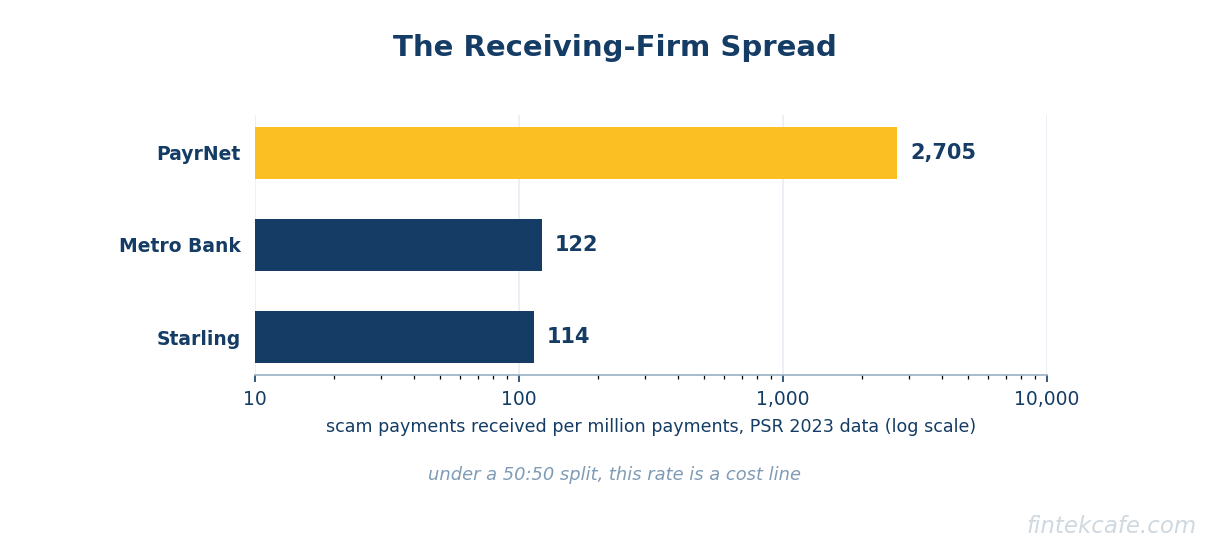
Read together, the numbers say three things an executive should hold on to. Reimbursement is now a large, recurring cost, running at hundreds of millions of pounds a year for the UK industry. Pricing fraud onto firms cut losses where the rules apply, while total APP fraud kept growing outside their scope, which is what a price signal would predict. And the cost falls unevenly, because the scam money does not arrive evenly. The PSR's performance data for 2023 showed PayrNet, an e-money firm, receiving 2,705 scam payments for every million payments it received, against 122 at Metro Bank and 114 at Starling. Under a 50:50 split, the receiving firm's fraud rate is now a cost the receiving firm pays.
The regime is still moving. HM Treasury confirmed in April 2026 that the PSR will be folded into the FCA, which inherits the reimbursement power, and a formal review is running. Treat today's parameters as a floor, not a settled end state.
This is a Premium Article
Sign up for a Premium membership to read this article and get full access to strategic intelligence on technology and business.
Already a member? Sign in
Related Articles
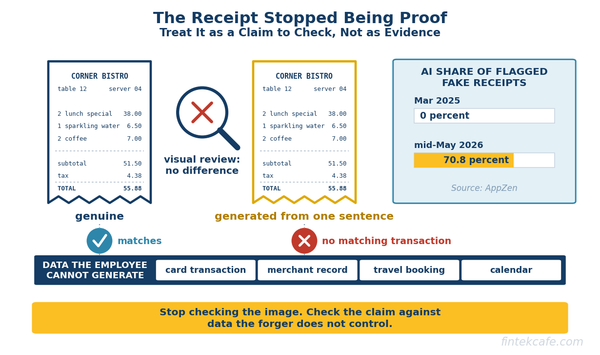
AI-Generated Fake Receipts: How Expense Fraud Changed and How Finance Teams Catch It
AI-generated fake receipts now beat visual review. How expense fraud changed, which detection still works, and the controls to use by company size.
The Monthly Close Is Becoming Continuous, and the Finance Calendar Will Not Survive It
AI is taking the bottleneck work out of the month-end close. The close becomes continuous with a short sign-off, and finance, audit and the board change.
Accounts Payable Automation: What AI Can Actually Take Over in Invoice-to-Pay
What AI can take over in accounts payable, step by step from capture to payment, where the fraud risk grows, and which controls must stay outside the model.