
Payment Reconciliation: Why the Money Arrives as One Number and a Thousand Questions

Reconciliation is the process of matching one lump-sum deposit from a payment processor against the thousands of individual orders, refunds, fees, and disputes that produced it, and it is the least glamorous, most consequential process in payment operations. Every finance team knows the moment: the bank statement shows a single number arriving from the processor, and someone has to explain how it decomposes into every sale, every refund, every fee, every chargeback, and every currency conversion that fed into it. Get reconciliation wrong and the failure is invisible at first: unmatched transactions get written off as a rounding cost of doing business, a duplicate refund goes uncaught, fee creep compounds quietly, and revenue lands in the wrong accounting period, each one a small, plausible-looking error until the audit finds them all at once. This guide covers what actually gets matched, why the deposit is so hard to decompose in the first place, the failure modes that cost real money, the three-way matching pattern that keeps them from compounding, what automation genuinely fixes versus what it hides, and the metrics that tell a CFO whether the process is under control.
Key Takeaways
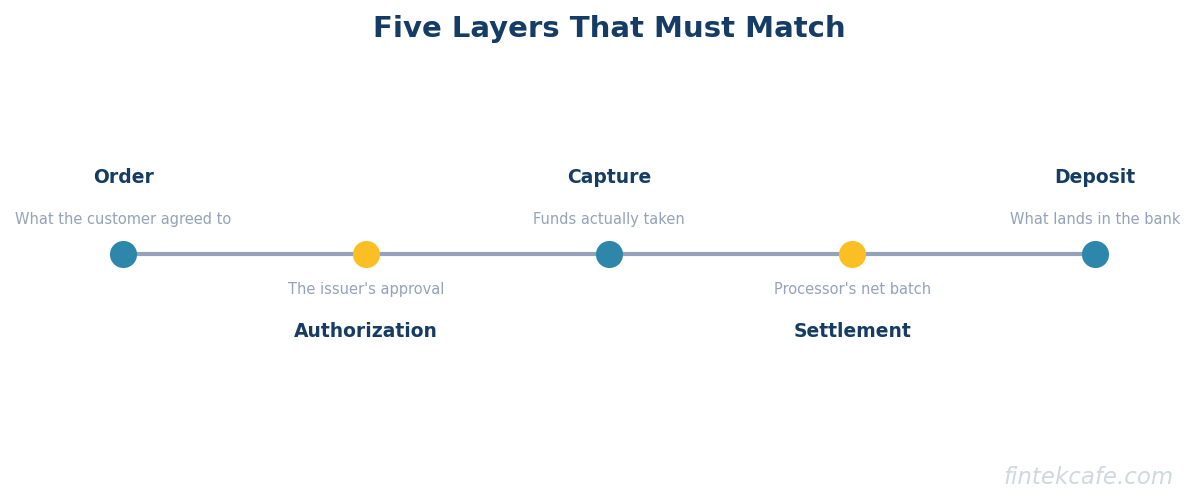
- Reconciliation matches five layers of record: the order, the authorization, the capture, the settlement, and the deposit against the general ledger, and each handoff between layers is a place a transaction can silently fail to match.
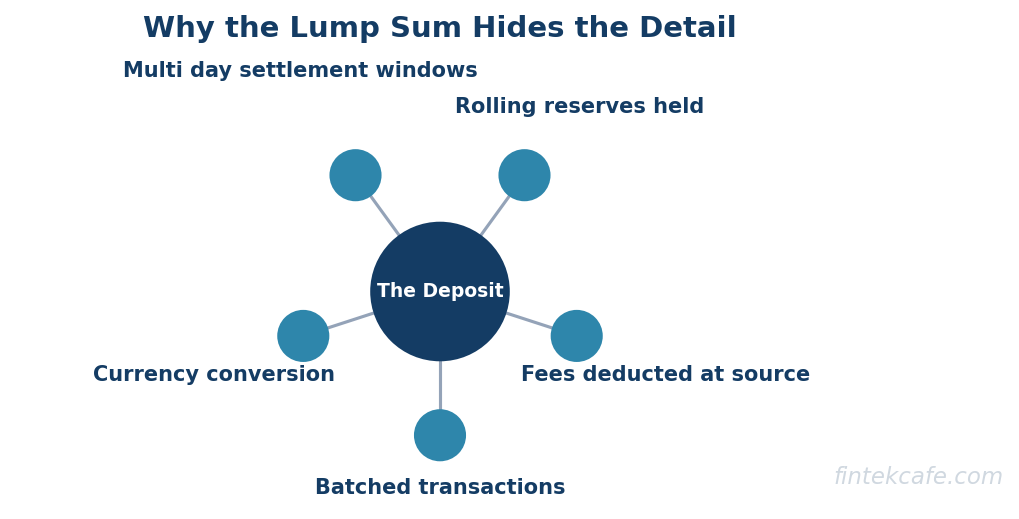
- The lump-sum deposit is hard to decompose because it is not a single-transaction event: processors batch, net-settle, deduct fees at source, hold rolling reserves, settle across multi-day windows, and convert currency on their own schedule, all before the number ever reaches the bank statement.
- The costly failure modes are quiet by nature: unmatched transactions written off as noise, duplicate refunds issued because two systems both thought a refund had not happened, fee creep nobody audits line by line, and revenue recognized in the wrong period because settlement timing does not match the accounting calendar.
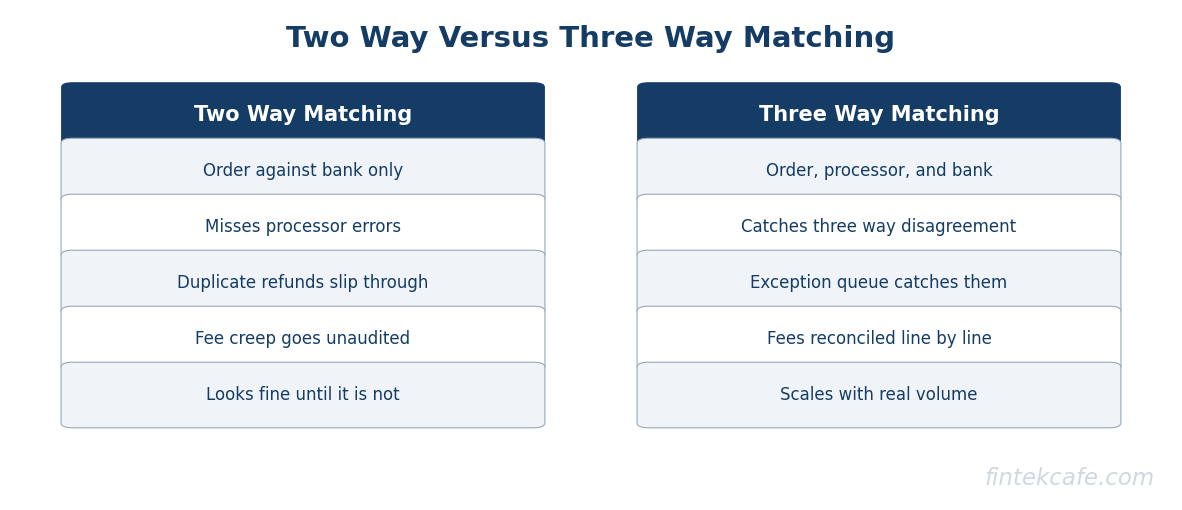
- Three-way reconciliation, matching internal order records, processor settlement reports, and bank statements against each other, plus a disciplined exception queue for what does not match automatically, is the pattern that scales; two-way matching misses the errors that only show up when all three sources disagree.
- Automation reliably solves high-volume, well-structured matching (rules-based matching on amount, date, and reference) and reliably struggles with the long tail of edge cases: partial refunds, split payments across processors, currency-conversion rounding, and multi-processor or marketplace payouts, where a human exception queue remains the load-bearing safety net.
What Reconciliation Actually Matches
Reconciliation is often described as "matching the deposit to the ledger," which understates the number of handoffs involved. A single transaction passes through five distinct records before it becomes a line in the general ledger, and each handoff is a place the chain can break.
The order. The internal system of record: what the customer bought, for how much, in what currency. The authorization. The processor's confirmation that funds are available and reserved, which is not yet a movement of money. The capture. The actual charge against the authorized funds, which can happen immediately, later, or partially, and can diverge from the original authorization amount. The settlement. The processor's internal accounting event that groups captures (and refunds, and fees) into a batch destined for payout, mechanics covered in more depth in payment gateway versus payment processor. The deposit. The actual bank transfer, a single net number representing an entire settlement batch, which is what appears on the bank statement and is the number reconciliation is usually asked to "explain."
Reconciliation's job is proving that these five records agree: that every order has a matching authorization, every authorization a matching capture (or a documented reason it does not), every capture accounted for inside a settlement batch, and every settlement batch's net accounted for inside a deposit. The failure is rarely a single dramatic mismatch; it is a slow accumulation of small breaks at each handoff, which is exactly why the process has to be systematic rather than reactive.
Why the Lump-Sum Deposit Is So Hard to Decompose
The deposit looks like it should be simple to explain: add up the day's sales, subtract the refunds, and the number should match. It rarely does, for reasons that are structural to how processors move money, not accidents of any particular system.
Batching and net settlement. Processors do not move money per transaction; they batch many transactions into a single settlement, and the deposit is the net of that batch, sales minus refunds minus fees minus reserves, collapsed into one figure. Reconstructing the batch's contents requires the processor's own settlement report, not just the bank statement.
Fee deduction at source. Processing fees are commonly deducted before the deposit arrives, rather than billed separately, which means the deposit is already net of a cost the internal books have to separately record as an expense; failing to do so is one of the most common sources of a books-versus-bank mismatch. The fee structure behind that deduction, interchange, assessments, and processor markup, is broken down in the interchange fee guide.
Rolling reserves. Processors, especially for higher-risk merchant categories, withhold a percentage of each settlement in a rolling reserve released weeks later, which means a portion of "today's sales" simply does not arrive in today's deposit at all and must be tracked as a separate receivable until it releases.
Multi-day settlement windows. A transaction captured on one day may settle two or three business days later, and weekends and holidays widen the gap further, so the deposit hitting the bank on a given day rarely corresponds to that same day's sales; it corresponds to a settlement batch closed on an earlier date.
Currency conversion timing. For cross-border sales, the processor converts currency at its own rate and its own moment, which may differ from the rate assumed when the sale was recorded internally, producing a small but real gain or loss that has to be captured as its own ledger entry rather than absorbed silently into an "unexplained difference."
Each of these mechanisms is legitimate and disclosed somewhere in the processor's settlement report. The discipline of reconciliation is ingesting that report in full, not just the deposit total, and matching against it rather than against the bank statement alone.
The Failure Modes That Cost Real Money
Reconciliation failures rarely look like fraud; they look like small operational shortcuts that compound.
Unmatched transactions written off. Under deadline pressure, a backlog of unmatched items gets closed out as a "reconciliation adjustment" rather than investigated. Occasionally this is genuinely immaterial; consistently, it is a signal that the matching process cannot keep pace with volume, and the write-off line is where real losses, duplicate charges, missed refunds owed to customers, silently accumulate.
Duplicate refunds. When customer service, an automated dispute process, and a manual finance adjustment can all issue a refund for the same order, and the systems do not share a single source of truth for "has this been refunded," the same customer gets paid twice. This is one of the most common findings in reconciliation audits precisely because each individual refund looked correct in isolation.
Fee creep. Processor fee schedules change, new fee categories appear, and downgrade fees (transactions that failed to qualify for their best interchange category, discussed in the interchange guide above) accumulate, and without a line-by-line audit against the contracted rate, the effective fee rate drifts upward over months without anyone deciding it should.
Revenue recognized in the wrong period. Multi-day settlement windows mean a sale made on the last day of a month may settle, and appear in cash, in the following month. Recognizing revenue on settlement date rather than transaction date, or vice versa inconsistently, misstates each period's numbers in a way that only surfaces at audit or close, precisely when it is most expensive to unwind.
Three-Way Reconciliation and the Exception Queue
The pattern that scales past a trivial transaction volume is three-way reconciliation: matching three independent sources against each other rather than trusting any single one. Internal records (the order and refund systems of record), processor reports (the settlement and fee detail the processor itself publishes), and bank statements (the actual cash that moved) are compared pairwise and as a set. A discrepancy that shows up in only one comparison, internal records disagree with the processor but the bank statement agrees with the processor, points to a different root cause than a discrepancy that shows up in all three.
Two-way matching, commonly just internal records against the bank statement, misses an entire class of error: a processor fee miscalculation or a settlement-batch mistake that both the processor's own report and the eventual deposit reflect identically, leaving nothing for a two-way comparison to catch, because the "wrong" number agrees with itself on both sides. Three-way matching surfaces this because the third source, internal records, still reflects what should have happened.
What does not match automatically becomes the exception queue, and the queue's discipline determines whether reconciliation is a control or a formality. A working exception queue has an aging report (how long has this item been unresolved), a named owner per exception, and a hard rule against closing an item without a documented reason, rather than a default write-off. Organizations that treat the exception queue as the real output of reconciliation, not the matched majority, catch the failure modes above before they compound; organizations that treat the matched percentage as the success metric and the queue as an afterthought are the ones an audit eventually finds.
| Record type | Source | Common breaks |
|---|---|---|
| Order | Internal system of record (order management, subscription billing) | Order created but payment never attempted; amount edited after capture; test/duplicate orders not excluded |
| Authorization | Processor, real-time | Authorized but never captured (abandoned); authorization expired before capture attempted |
| Capture | Processor, real-time | Partial capture against a full authorization; capture amount edited post-authorization; multiple captures against one order |
| Settlement | Processor settlement/batch report | Fees deducted at source not recorded internally; reserve withheld and not tracked as a receivable; batch spans a period boundary |
| Deposit | Bank statement | Currency-conversion variance; multi-day lag between settlement and deposit date; deposit combines multiple settlement batches |
| Ledger entry | Internal accounting system | Revenue recognized on the wrong date relative to settlement; refund or chargeback not yet reflected; fee expense missing or misclassified |
Automation Reality: What It Solves and Where the Tail Lives
Rules-based automated matching genuinely solves the bulk of reconciliation volume: matching by amount, date proximity, and a shared reference identifier (order number, transaction ID) clears the large majority of transactions in well-instrumented systems with no human involvement, and this is real, measurable operational leverage, not a vendor promise.
The tail is where automation predictably struggles, and it struggles for the same reason across categories: the matching key is ambiguous rather than missing. Partial refunds break simple amount-matching because the refunded amount does not equal any single captured amount. Split payments, one order paid across a gift card and a credit card, or split across processors entirely, have no single settlement record that corresponds to the order as the internal system recorded it. Currency-conversion rounding produces small, real discrepancies that are correct but do not match to the cent, and a rules engine tuned to require exact matches either misses them (false exception) or is tuned loose enough to also miss real errors (false match). Multi-processor and marketplace payouts, covered below, multiply all of these because a single order's money now flows through more than one settlement chain.
What AI-assisted matching genuinely improves on top of rules-based automation is fuzzy correlation: identifying that a partial refund, a split payment, or a rounding variance probably belongs to a specific order even without an exact key match, based on patterns across amount, timing, and customer history. What it does not do, and what an organization should not let a vendor pitch imply it does, is remove the need for a human-reviewed exception queue; a probabilistic match still needs a confirmed disposition, because reconciliation is an accounting control, and an unverified probabilistic match is not evidence, it is a guess with a confidence score attached. The honest framing: automation, rules-based and AI-assisted alike, shrinks the exception queue; it does not eliminate the need for one, and treating a shrunk queue as a solved problem is how the failure modes above return through the back door.
| Matching approach | What it solves | Where it fails | Where the exception queue still lives |
|---|---|---|---|
| Manual matching | Nothing at meaningful volume; used only below a trivial transaction count | Everything at scale | Effectively the entire process |
| Rules-based automation (amount, date, reference match) | The large majority of standard, single-processor, full-amount transactions | Partial refunds, split payments, any transaction without a clean shared key | The structural tail: ambiguous-key transactions |
| AI-assisted fuzzy matching | Probable correlation for partial refunds, rounding variances, likely-duplicate detection | Confident final disposition; regulatory and audit evidentiary standards | Confirmation of every probabilistic match before it is recorded as reconciled |
Multi-Processor and Marketplace Complexity
Reconciliation gets structurally harder, not just larger, the moment money for a single transaction flows through more than one path. A merchant using payment orchestration and multi-processor routing to route transactions across acquirers for cost or approval-rate reasons must reconcile against multiple settlement reports with different formats and schedules for what was, from the customer's perspective, one purchase, and the orchestration layer's own reporting becomes a required fourth source alongside internal records, processor reports, and the bank statement.
Marketplaces and platforms that split payments, taking a commission and paying out the remainder to a seller, add split-payout reconciliation on top: the marketplace must reconcile its own commission revenue, the seller's payout, any merchant-of-record or payment-facilitator arrangement governing who is liable for what, and the timing mismatch between when the marketplace receives funds and when it disburses them to sellers, each with its own settlement and reserve behavior. The general principle scales cleanly from the single-processor case: every additional party in the funds flow is another settlement report to ingest, another timing window to reconcile against, and another source that has to agree in the three-way (or four-way, or five-way) match before the process can be trusted.
The Metrics That Show Reconciliation Health
Four metrics, tracked monthly, tell a CFO whether reconciliation is a control or a liability waiting to surface.
Match rate. The percentage of transactions that reconcile automatically without manual intervention. A high and stable match rate indicates the rules-based layer is well-tuned; a declining match rate is an early warning that something upstream changed, a new payment method, a processor update, a new sales channel, before anyone investigated why.
Exception aging. How long unresolved items sit in the exception queue, bucketed by age. A healthy process resolves the majority of exceptions within days; a growing population of exceptions aged past thirty or sixty days is where duplicate refunds and unrecovered losses actually live, because old exceptions get written off rather than investigated.
Write-off rate. The percentage of transaction value closed out as unreconciled rather than matched or actively investigated. This is the single number most likely to hide real losses, because a write-off looks identical whether it represents an honest immaterial rounding difference or a systematic error nobody caught.
Close-cycle time. How long it takes to close the books each period, which reconciliation gates directly: a process still chasing exceptions at close is either delaying financial reporting or reporting numbers with unresolved discrepancies baked in. A shortening close cycle, at a stable or improving match rate, is the clearest available evidence that the reconciliation function is actually under control rather than merely busy.
FAQ
What is payment reconciliation?
Payment reconciliation is the process of matching internal transaction records, processor settlement reports, and bank deposits against each other to confirm that every sale, refund, fee, and chargeback is accounted for correctly. It exists because a processor's deposit arrives as a single net number representing a batch of many individual transactions, and proving that number is correct requires tracing it back through settlement, capture, and authorization to the original order.
Why is the processor's lump-sum deposit so hard to break down?
Because it is the product of several layers of processing invisible on the bank statement alone: transactions are batched and net-settled together, fees are commonly deducted before the deposit arrives, a percentage may be withheld in a rolling reserve released later, settlement can lag the original transaction by several business days, and cross-border sales carry their own currency-conversion timing. Reconstructing the deposit requires the processor's detailed settlement report, not just the bank statement total.
What is three-way reconciliation?
Three-way reconciliation compares internal transaction records, the processor's settlement report, and the bank statement against each other, rather than matching only two of the three. It catches a category of error that two-way matching misses: cases where a processor-side mistake is reflected consistently in both the processor's report and the eventual deposit, so a two-way comparison finds nothing wrong even though the internal record shows what should actually have happened.
Can reconciliation be fully automated?
Rules-based automation reliably handles the large majority of standard transactions where amount, date, and a reference identifier line up cleanly. It reliably struggles with partial refunds, split payments across payment methods or processors, currency-conversion rounding, and multi-processor or marketplace payouts, where no single clean match key exists. AI-assisted matching improves the software's ability to propose likely matches in these cases, but a human-reviewed exception queue remains necessary to confirm them, since an unconfirmed probabilistic match is not the same as a verified accounting reconciliation.
What metrics indicate reconciliation is healthy?
Four are load-bearing: match rate (the share of transactions that reconcile automatically, which should be high and stable), exception aging (how long unresolved items sit unresolved, which should skew recent), write-off rate (the share of transaction value closed out as unreconciled rather than resolved, which should be low and explained), and close-cycle time (how long books take to close, which should be short and consistent). A rising write-off rate or an aging exception queue are the earliest reliable signs that real losses are accumulating unnoticed.
Related reading on FinTekCafe
Related Articles
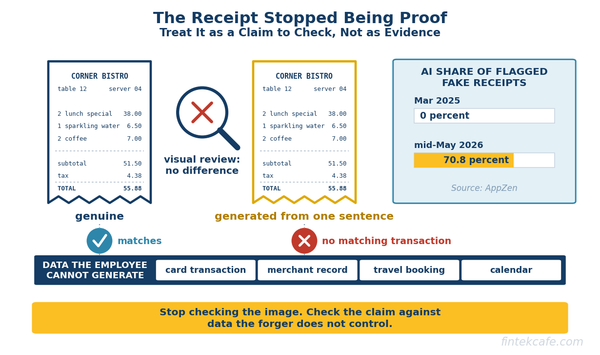
AI-Generated Fake Receipts: How Expense Fraud Changed and How Finance Teams Catch It
AI-generated fake receipts now beat visual review. How expense fraud changed, which detection still works, and the controls to use by company size.
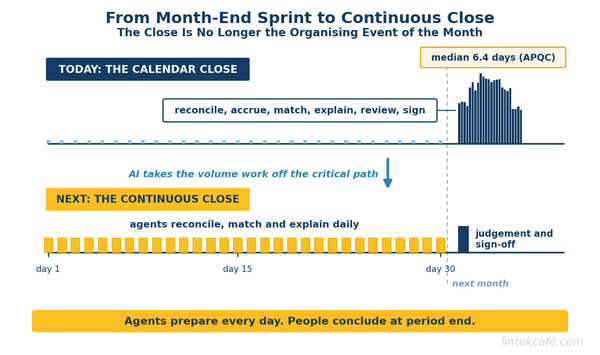
The Monthly Close Is Becoming Continuous, and the Finance Calendar Will Not Survive It
AI is taking the bottleneck work out of the month-end close. The close becomes continuous with a short sign-off, and finance, audit and the board change.
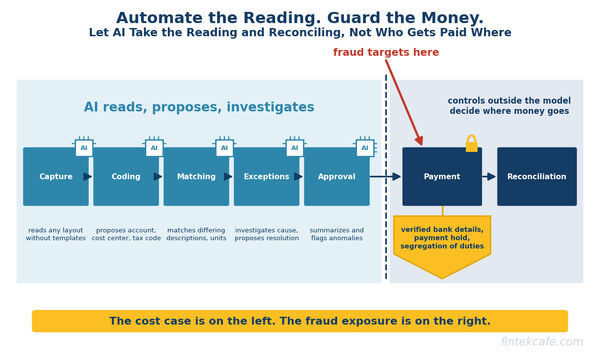
Accounts Payable Automation: What AI Can Actually Take Over in Invoice-to-Pay
What AI can take over in accounts payable, step by step from capture to payment, where the fraud risk grows, and which controls must stay outside the model.