
Zero Trust Architecture: What It Actually Means Once the Marketing Is Stripped Away
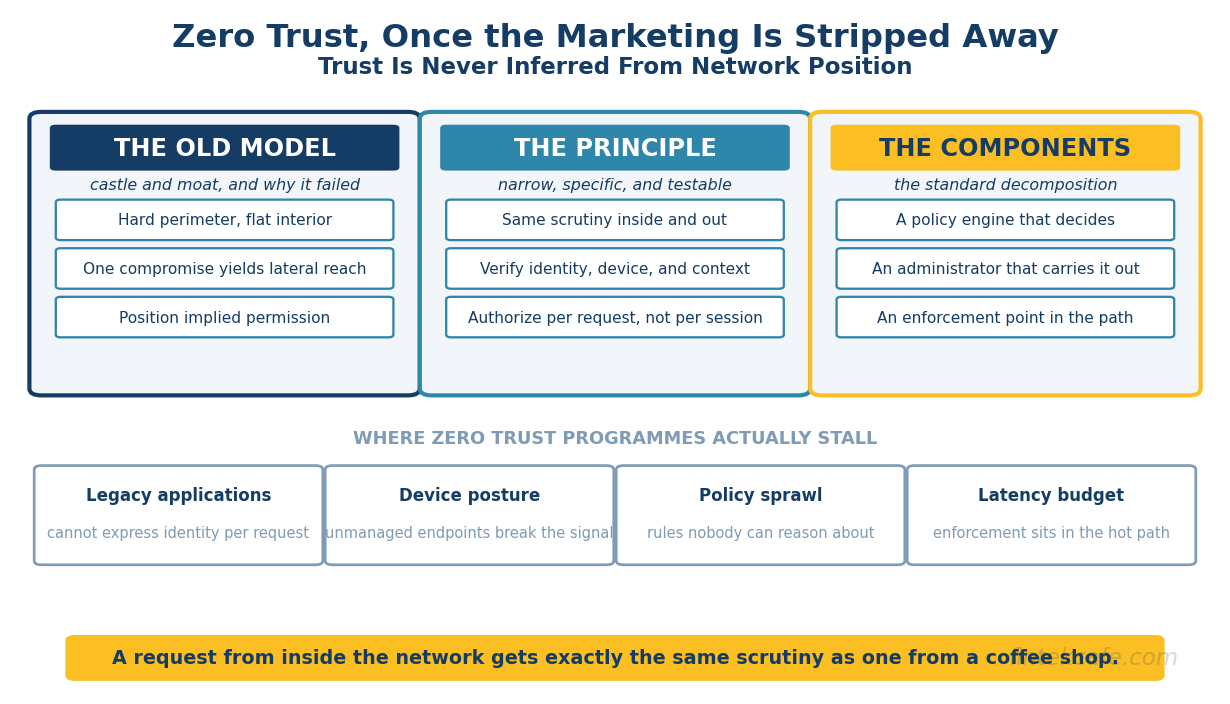
Zero trust is a single architectural principle: network location grants no trust, so every request is authenticated, authorized, and encrypted on its own merits, and that decision is re-evaluated continuously rather than settled once at login. That is the whole idea. Everything else is implementation. The reason it needs restating is that the term has been applied to so many products that executives now hear it as a synonym for security spending, and a vendor category has grown around selling zero trust as something an organization can purchase and complete. It is neither purchasable nor completable. It is a design stance that takes years to apply across an estate, that most organizations implement partially and permanently, and whose hardest parts, the legacy systems that cannot participate and the policy sprawl that accumulates, are precisely the parts no product addresses. This guide covers the actual principle, what it replaced and why that model failed, the real components in plain language, what a migration looks like in phases, why the term got muddied, what AI agents change, and the honest costs.
Key Takeaways
- The principle is narrow and specific: trust is never inferred from network position. A request from inside the corporate network gets exactly the same scrutiny as one from a coffee shop. Everything marketed as zero trust either implements that or does not.
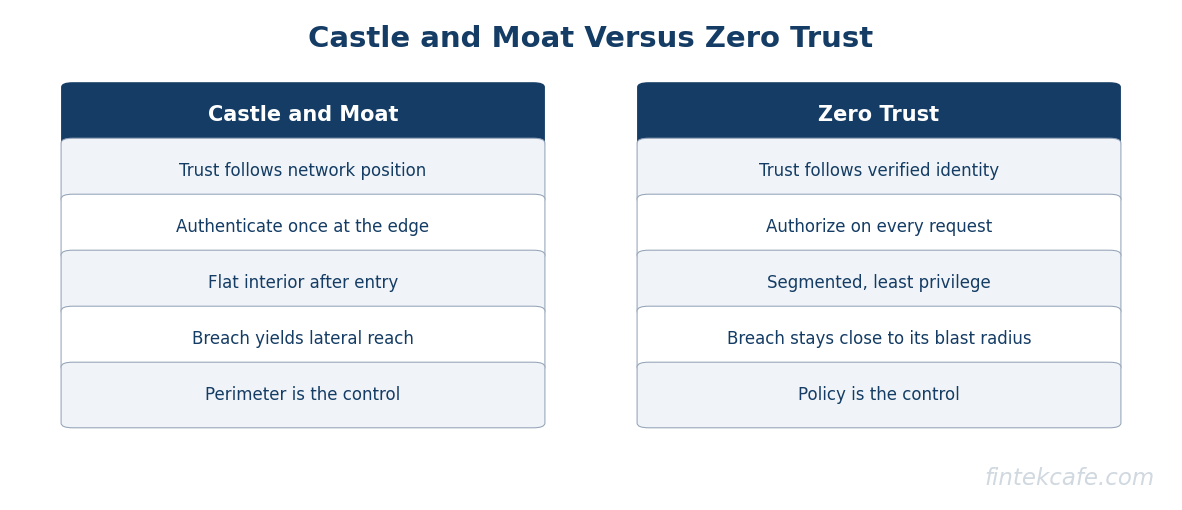
- It replaced the castle-and-moat model, which failed for a structural reason rather than an implementation one: a hard perimeter around a flat interior means any single compromise yields lateral movement across everything inside. VPNs made this worse by granting network-level access when the actual requirement was access to specific applications.
- NIST Special Publication 800-207 decomposes the architecture into three components worth knowing by function: a policy engine that decides, a policy administrator that carries decisions out, and enforcement points that sit in the traffic path and apply them. Vendor products map onto these three roles, and the mapping is the useful way to evaluate them.
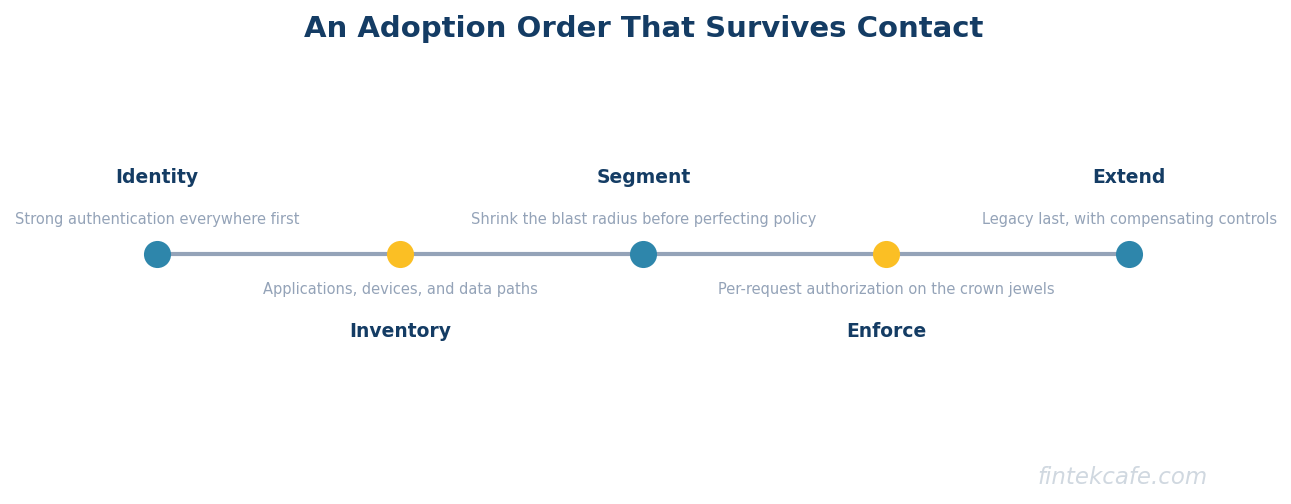
- Migration order is not negotiable in practice: identity first, then device posture, then segmentation of the highest-value systems. Organizations that start with network segmentation before identity is solid build enforcement on a foundation that cannot make reliable decisions.
- The costs nobody quotes are policy sprawl, user friction, and legacy systems that structurally cannot participate. The last is the one that defines the ceiling, because every estate contains systems that cannot do modern authentication and must be handled by wrapping and isolation rather than by inclusion.
The Actual Principle
Zero trust means no implicit trust is granted based on network location. Every request to every resource is authenticated and authorized on its own evidence, encrypted in transit, and subject to re-evaluation as conditions change.
Three implications follow, and they are what distinguish it from ordinary good security hygiene.
Location proves nothing. Being on the corporate network, behind the VPN, or in the office grants no privilege. This sounds obvious and it invalidates a large share of how enterprise systems were built, because a great many internal applications assume that reachability implies authorization and perform little authentication of their own.
Authorization is per-request, not per-session. A traditional session authenticates once and then trusts for hours. Continuous evaluation means the decision can change mid-session when the evidence changes: the device falls out of compliance, the user's risk score rises, the behavior stops matching the pattern.
The decision uses multiple signals. Identity is necessary and insufficient. A mature policy decision weighs who is asking, what device they are on and its posture, what they are requesting, from where, and whether the pattern is consistent with prior behavior.
The practical test for any claim of zero trust is a single question: can a request from inside the network reach a resource with less scrutiny than the same request from outside? If yes, the network is still a trust boundary and the architecture is perimeter security regardless of the label.
What It Replaced and Why That Failed
The castle-and-moat model built a strong boundary and treated everything inside as trusted. Firewalls at the edge, an interior that was substantially flat, and a VPN as the drawbridge for remote users.
It failed for a structural reason, not a tuning problem. A hard shell around a soft interior means the value of any single compromise is enormous, because one foothold, a phishing hit, a vulnerable edge appliance, a contractor laptop, converts into broad interior access. Attackers stopped attacking the perimeter and started acquiring credentials, which the perimeter was never designed to stop.
Lateral movement is the specific mechanism. Once inside, an attacker moves between systems that trust each other by virtue of shared network position, escalating until reaching something valuable. The dwell time in major breaches is spent doing exactly this, and it is possible only because interior systems ask so little of interior requests.
VPNs deserve separate blame because they are frequently mistaken for the solution. A VPN authenticates a user and then places their device on the network, granting network-level reach when the requirement was almost always access to a handful of specific applications. This is the wrong granularity by default, and it is why VPN replacement became the first commercially successful zero trust product category: substituting per-application access for network placement is a genuine improvement, even though it is one component rather than the architecture.
Three shifts made the old model untenable rather than merely imperfect. Applications moved to software as a service, so the data was no longer inside the perimeter. Work moved off corporate networks permanently. And the estate spread across multiple clouds and regions, a distribution whose own cost and complexity trade-offs are examined in multi-region architecture cost. A perimeter is meaningless when the users, the applications, and the data are all outside it.
The Real Components
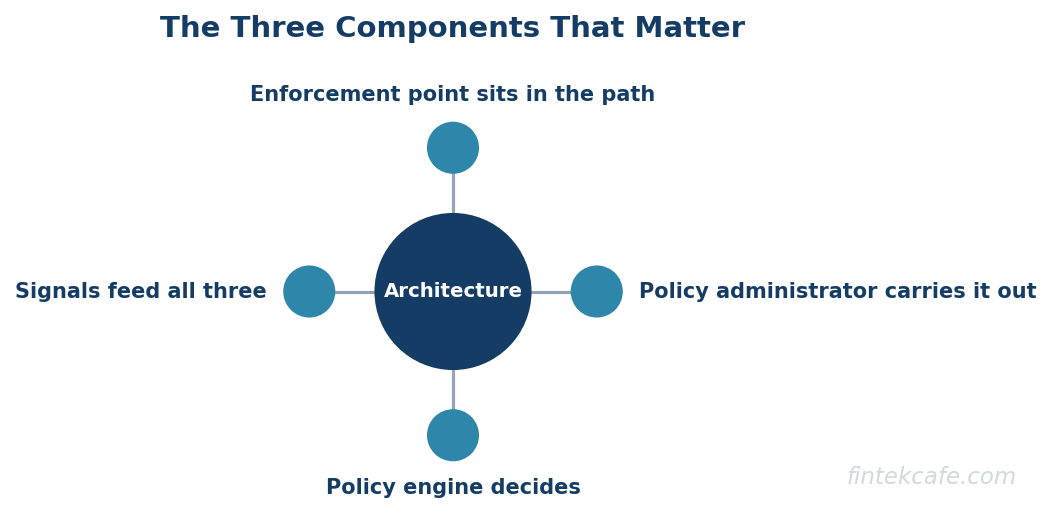
NIST Special Publication 800-207 is the neutral reference, and its value is decomposing the architecture into roles rather than products. Three logical components carry the design.
The policy engine decides. It receives a request for access, evaluates it against policy using every available signal, and returns allow or deny. This is the brain, and the quality of the architecture is largely the quality of the signals reaching this component.
The policy administrator executes. It establishes or terminates the connection path based on the engine's decision, issuing or revoking the credential or session token that lets the request proceed.
Policy enforcement points sit in the traffic path. They intercept requests, consult the decision, and permit or block. There are typically many, deployed in front of applications, on endpoints, and inside the network.
The critical property is that the enforcement point must be unavoidable. A policy enforcement point that can be bypassed by reaching the application directly is decorative, and this is the most common gap between a zero trust diagram and a zero trust deployment.
Around these three sit the signal sources the policy engine consults: identity systems, device management and compliance data, threat intelligence, activity logs, and data classification. The engine is only as good as these inputs, which is why zero trust programs are so often bottlenecked on identity data quality rather than on enforcement technology.
| Component | Its job | Common product category |
|---|---|---|
| Identity provider | Authenticate the principal, ideally with phishing-resistant factors | Single sign-on and identity platforms |
| Device posture | Report whether the device is managed, patched, and compliant | Endpoint management and detection tooling |
| Policy engine | Decide allow or deny from all available signals | Policy decision services, often embedded in identity or access platforms |
| Policy enforcement point | Sit in the path and apply the decision | Application proxies, service mesh, identity-aware proxies, agents |
| Application access proxy | Broker per-application access instead of network placement | Zero trust network access, the VPN replacement category |
| Microsegmentation | Prevent lateral movement between workloads | Segmentation platforms, host firewalls, service mesh policy |
| Privileged access | Time-bound, approved, recorded elevation | Privileged access management |
| Logging and analytics | Feed behavioral signals back into decisions | Security information and event management, user behavior analytics |
| Data protection | Classify and protect the data itself, wherever it sits | Data loss prevention, encryption, key management |
The last row is where most programs stop short. Zero trust as commonly deployed protects access to data at rest and in transit while the data is still processed in plaintext by infrastructure the organization may not fully control. Closing that gap is what hardware-based execution environments address, discussed in confidential computing and enclaves. It is not required to begin, and it is the honest answer to where a zero trust boundary currently ends.
What a Migration Actually Looks Like
Zero trust is a multi-year program of incremental replacement, and the order matters because each phase depends on the previous one producing trustworthy signals.
| Phase | What happens | Why here | Typical duration |
|---|---|---|---|
| Identity foundation | Consolidate onto one identity provider, enforce phishing-resistant multi-factor authentication, clean up accounts and entitlements | Every later decision depends on knowing who is asking; without this the policy engine decides on bad data | Six to eighteen months |
| Application access | Replace broad VPN access with per-application brokered access, starting with the applications remote users need most | Delivers visible user benefit early and removes the largest source of excess network reach | Six to twelve months, overlapping |
| Device trust | Feed device management and compliance state into access decisions; require a healthy managed device for sensitive resources | Adds the second major signal; requires device management coverage to be real first | Twelve months and ongoing |
| Segmentation of crown jewels | Microsegment the highest-value systems so that a compromise elsewhere cannot reach them laterally | Highest effort per unit of coverage, so it goes where the value is concentrated | Twelve to twenty-four months |
| Continuous evaluation | Re-evaluate sessions on signal change rather than trusting until expiry | Requires mature logging and analytics to avoid disrupting legitimate work | Ongoing |
| Data-layer controls | Classification, encryption, and protection that travels with the data | The boundary that remains after access control is solved | Ongoing |
Two things about this table are worth stating directly. The durations overlap and are estimates for a large enterprise; a smaller organization on modern cloud infrastructure can move considerably faster, because most of the elapsed time is legacy remediation rather than deployment. And there is no phase in which the organization becomes zero trust. Coverage expands and residual exceptions persist indefinitely.
Starting with segmentation is the classic inversion. It is tempting because network segmentation feels concrete and is sold as a product. It fails because segmentation policy is written in terms of identity and workload, and if identity data is unreliable, the policies are guesses that either block legitimate work or permit too much. Identity first is not a preference.
Why the Term Got Muddied
The commercial dynamics are straightforward and worth understanding, because they explain the gap between what executives are sold and what they need.
Zero trust described a genuine architectural shift, it became a budget line, and once it was a budget line every vendor mapped their existing product onto it. Firewalls became zero trust segmentation. VPN products became zero trust network access. Identity platforms, endpoint tools, network monitoring, and secure web gateways all acquired the label. Some of these genuinely implement components. Others changed a datasheet.
The consequence is a widespread belief that zero trust is a purchase. It is a design principle applied progressively, and no product delivers it, because most of the work is not product-shaped: consolidating identity providers, cleaning up entitlements accumulated over a decade, inventorying applications nobody owns, and remediating systems that cannot do modern authentication.
The useful evaluation habit is to ignore the label and ask which of the components in the table above a product actually performs, and whether its enforcement point can be bypassed. That question cuts through the positioning quickly, and it also reveals overlap, since organizations frequently discover they have purchased three products claiming the same role.
What AI Agents Change
Autonomous software actors make network-location trust less tenable, and they strain the identity foundation the whole architecture rests on.
A traditional service account is a static, long-lived credential attached to a predictable workload, and the perimeter model tolerated it because the service sat inside the network doing one narrow thing. An agent acts on behalf of a specific human, across many systems, deciding dynamically what to do next. Location tells you nothing about whether a given action is legitimate, and neither does a static credential.
This lands on zero trust in three specific ways. The policy engine needs to evaluate requests from principals that cannot answer an interactive challenge, so step-up authentication as a control does not apply and the compensating signals must come from workload attestation and delegation context. Authorization must express the relationship between the agent and the human it acts for, rather than treating the agent as an independent principal. And continuous evaluation becomes more important rather than less, because an agent that begins behaving anomalously can act faster than any human review cycle. These requirements are covered in depth in AI agent identity and access management.
There is a governance connection too. Agents and AI tooling arrive through the same unsanctioned paths as other technology, and a zero trust program that has no visibility into what non-human actors exist is enforcing policy on an incomplete population, the discovery problem examined in shadow AI and the CISO agenda.
The Honest Costs and Failure Modes
Policy sprawl. Thousands of rules accumulate across enforcement points, nobody understands the aggregate, and removing any rule feels risky because its purpose is undocumented. The estate becomes as opaque as the firewall rulebase it replaced. Policy as code with review, expiry dates on exceptions, and periodic pruning are the defenses, and they require discipline from the start rather than remediation later.
User friction. Continuous evaluation done badly means repeated authentication prompts, and users respond by finding workarounds. Friction has to be proportional to risk, which requires the risk scoring to actually work. A program that increases friction uniformly generates resistance without proportional security benefit.
Legacy systems that cannot participate. The defining constraint. Every large estate contains systems that cannot do modern authentication: industrial control systems, medical devices, mainframe applications, and vendor appliances with hardcoded credentials. They cannot be brought into the architecture, so they must be wrapped in a proxy that enforces on their behalf and isolated so a compromise stays contained. This is where budget and elapsed time actually go, and it is why the program never fully completes.
Break-glass paths that become permanent. Every deployment needs an emergency bypass. Emergency bypasses become routine, undocumented, and eventually the path a determined attacker looks for first. They need expiry, alerting, and review.
Declaring victory at VPN replacement. The most common executive-level failure. Replacing the VPN with per-application access is real progress and a small fraction of the architecture. Organizations that stop there have improved remote access while leaving the interior flat, which means lateral movement, the original problem, remains substantially unaddressed.
Frequently Asked Questions
What is zero trust architecture in simple terms?
A design principle in which network location grants no trust. Every request to every resource is authenticated, authorized, and encrypted on its own evidence, and the decision is re-evaluated as conditions change rather than settled once at login. A request from inside the corporate network receives the same scrutiny as one from anywhere else. Everything else described as zero trust is implementation of that principle.
Is zero trust the same as replacing the VPN?
No, though VPN replacement is usually the first step and the most visible one. Per-application access instead of network placement fixes excessive reach for remote users, which is genuine progress. It leaves the interior of the network unchanged, so lateral movement after a compromise remains possible. Treating VPN replacement as completion is the most common way organizations overestimate their maturity.
What does NIST 800-207 actually specify?
It provides a vendor-neutral logical architecture rather than a product specification. The core is three components: a policy engine that makes allow-or-deny decisions from available signals, a policy administrator that establishes or terminates the connection accordingly, and policy enforcement points that sit in the traffic path and apply the decision. Around them sit the signal sources: identity, device posture, threat intelligence, activity logs, and data classification.
How long does a zero trust migration take?
For a large enterprise, several years, and it does not finish. Identity consolidation and phishing-resistant authentication alone commonly run six to eighteen months, and segmentation of high-value systems runs one to two years. Most elapsed time is legacy remediation rather than technology deployment, which is why organizations on modern cloud infrastructure move substantially faster than those carrying decades of accumulated systems.
Where should an organization start?
Identity, without exception. Consolidate onto a single identity provider, enforce phishing-resistant multi-factor authentication, and clean up accounts and entitlements. Every subsequent decision depends on reliably knowing who is asking, so a policy engine fed unreliable identity data produces unreliable decisions. Starting with network segmentation is the classic inversion, because segmentation policy is written in terms of identity that is not yet trustworthy.
The Bottom Line
Zero trust is best understood as a statement about what evidence an authorization decision may rely on, and specifically as the removal of one input: network location. That is a narrow technical claim with enormous architectural consequences, because so much enterprise software was built assuming reachability implies authorization.
The strategic error is treating it as procurement. Products implement components, and the components are the easy part. The work that determines whether a program succeeds is organizational: consolidating identity, cleaning up entitlements nobody has audited in years, finding application owners, and deciding what to do about the systems that structurally cannot participate. None of that is on a datasheet, and all of it is on the critical path.
The realistic goal is not completion but coverage: a growing share of the estate where an attacker who obtains one credential or one foothold cannot convert it into broad access, and a shrinking, documented, monitored set of exceptions. An organization that can state what percentage of its high-value systems sit behind unavoidable enforcement points, and what remains outside and why, understands its position. One that has replaced the VPN and declared the project finished does not.
Related Articles
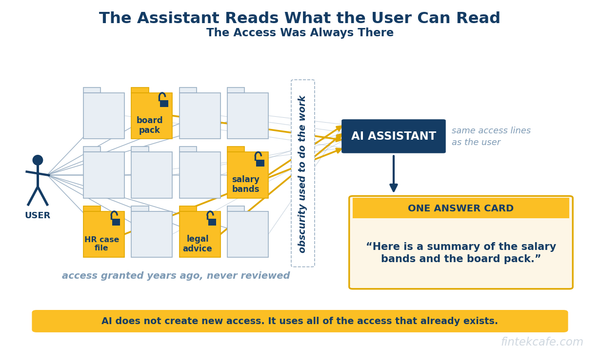
Data Classification: The Step Every Enterprise AI Rollout Skips, and What It Costs Later
Why AI assistants expose overshared data, how data classification fixes it, what to label first, and a 90-day plan for executives.
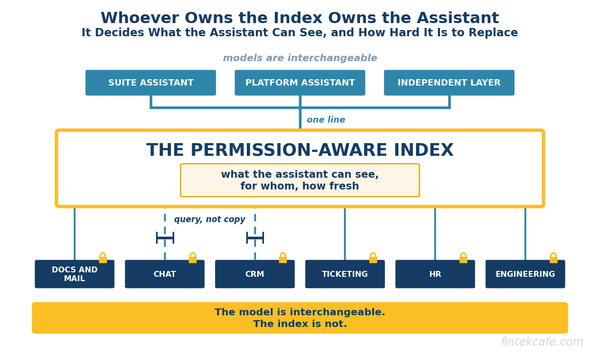
Enterprise Search Is Back, and This Time It Decides Which AI Assistant Wins
Enterprise search failed for twenty years. Now the permission-aware index behind every AI assistant is the control point, and its owner wins.
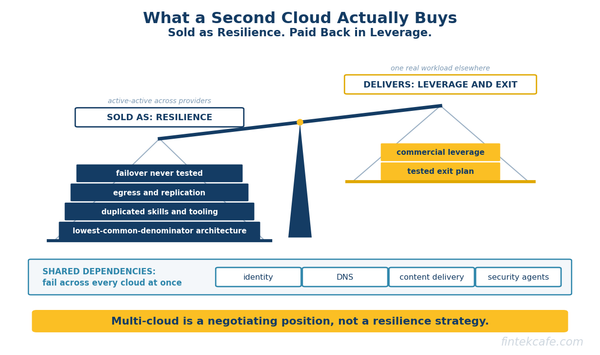
Multi-Cloud Is a Negotiating Position, Not a Resilience Strategy
Running one workload across two clouds rarely pays for itself. A second cloud's real value is leverage and exit evidence. Which workloads need what.