
Multi-Region Architecture: What Actually Justifies the Cost
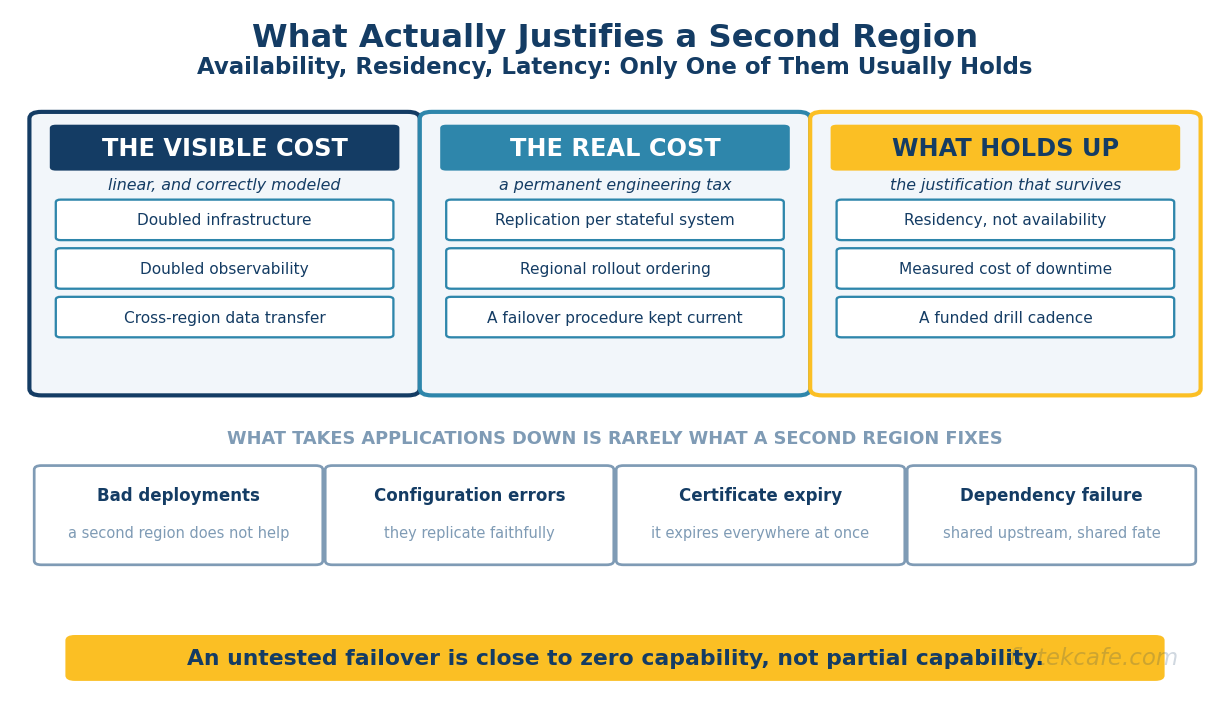
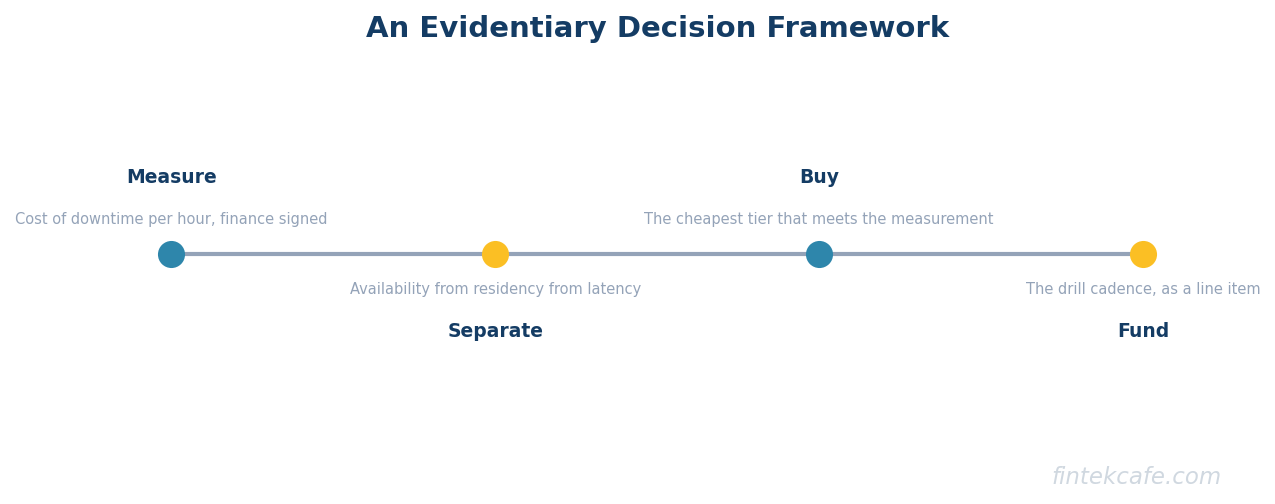
Multi-region is the most expensive default in modern infrastructure, and at most companies that have adopted it, it is a default rather than a decision. The pattern is predictable: an outage or an audit question surfaces, someone asks whether the system would survive losing a region, nobody wants to be the person who said no, and the initiative is funded on a resilience instinct that was never converted into a number. Two years later the second region is running, the failover has never been executed under load, and the engineering organization has quietly absorbed a permanent tax it never priced.
The thesis is that the bill executives approve is almost never the bill they pay. Doubling compute and storage is the visible cost, it is roughly linear, and it is the part finance models correctly. The real cost is the engineering tax: every stateful system now needs a replication strategy, every deployment needs a regional rollout order, every schema change needs to be compatible across versions running in two places, every incident has a new dimension, and the failover procedure needs continuous exercise to remain real rather than notional. That tax is paid every sprint, by the most senior engineers, forever, and it does not appear on the cloud bill.
There is a second, sharper part of the thesis. The justification that actually holds up in most organizations that genuinely need multi-region is not availability at all. It is data residency. Sovereignty and residency requirements are becoming the dominant driver, and they are a fundamentally different problem with a different architecture, because a residency requirement is not satisfied by a warm standby that could serve traffic from the wrong jurisdiction. Teams that build for availability and then discover they needed residency, or the reverse, end up with the cost of both and the benefit of neither.
What Each Tier Actually Buys
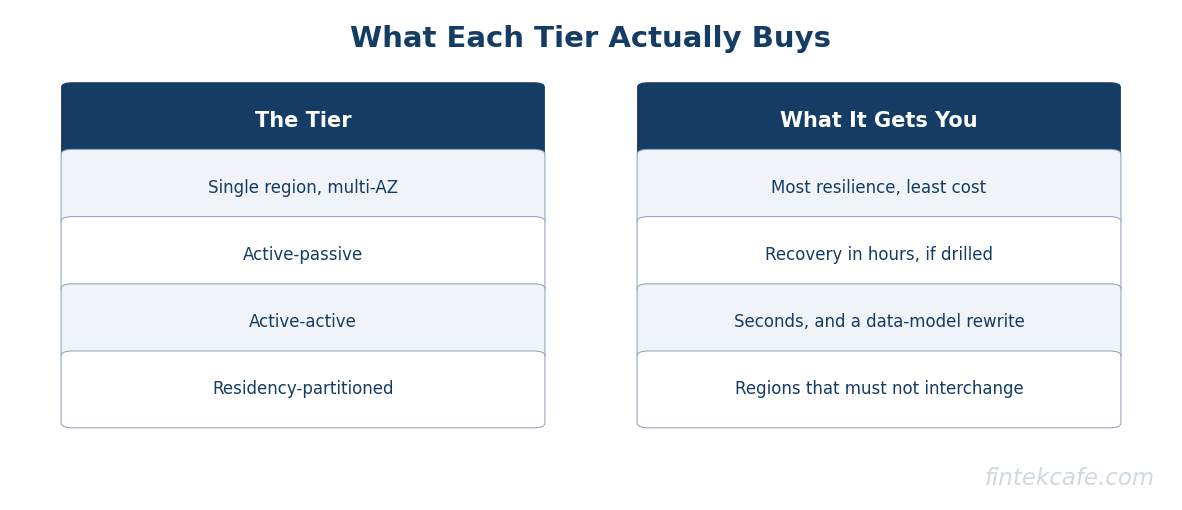
The word "multi-region" covers at least three architectures with wildly different economics, and conflating them is where most of the wasted spend originates. The honest comparison starts with the single-region baseline, because the baseline is stronger than most executives assume.
| Pattern | Honest RTO | Honest RPO | Infrastructure cost multiple | Engineering tax |
|---|---|---|---|---|
| Single region, single zone | Hours to days | Hours, or whatever the last backup holds | 1x | Minimal |
| Single region, multi-AZ | Seconds to minutes, automatic for managed services | Near zero for synchronous replication within the region | 1.2x to 1.5x, mostly storage and inter-zone transfer | Low: largely absorbed by managed services |
| Active-passive across regions | Hours in practice, not the minutes on the diagram | Minutes to hours, bounded by asynchronous replication lag | 1.6x to 2x, standby capacity plus cross-region transfer | High: replication, runbooks, drills, dual-region deploys |
| Active-active across regions | Seconds, genuinely | Near zero for the routed subset, but conflicts become an application concern | 2x to 2.5x plus significant cross-region data transfer | Very high: conflict resolution, data partitioning, permanent architectural constraint |
| Regional isolation for residency | Not an availability pattern | Not an availability pattern | 2x or more, scaling with the number of jurisdictions | High and permanent: separate data planes, separate operational surfaces |
Two rows in that table deserve the attention that usually goes to the bottom two.
Multi-AZ within a single region is where the overwhelming majority of real resilience is bought, and it is bought cheaply. The failure modes it covers, a rack, a power domain, a data hall, an individual instance or disk, are the failure modes that actually occur with meaningful frequency. Managed database services handle synchronous replication and automated failover inside a region as a configuration flag. The marginal cost is modest and the marginal engineering tax is close to zero, because the provider absorbed it.
The honest RTO column for active-passive is the one that causes arguments. The architecture diagram says minutes. Production says hours, and the gap is not incompetence, it is the accumulation of small realities: DNS and connection-pool propagation, a standby database that must be promoted and verified, caches that are cold, a message queue with in-flight work, downstream systems with hardcoded regional endpoints, and a human decision-maker who must be convinced that failing over is less risky than waiting for the primary to recover. That last item is the most underestimated component of real RTO. In a partial degradation, which is far more common than a clean regional loss, the correct decision is genuinely ambiguous, and ambiguity costs time.
This is a Premium Article
Sign up for a Premium membership to read this article and get full access to strategic intelligence on technology and business.
Already a member? Sign in
Related Articles
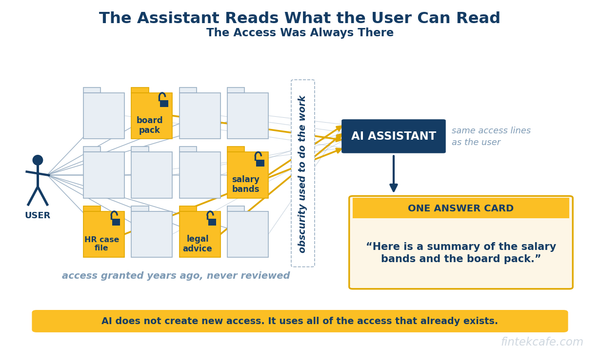
Data Classification: The Step Every Enterprise AI Rollout Skips, and What It Costs Later
Why AI assistants expose overshared data, how data classification fixes it, what to label first, and a 90-day plan for executives.
Enterprise Search Is Back, and This Time It Decides Which AI Assistant Wins
Enterprise search failed for twenty years. Now the permission-aware index behind every AI assistant is the control point, and its owner wins.
Multi-Cloud Is a Negotiating Position, Not a Resilience Strategy
Running one workload across two clouds rarely pays for itself. A second cloud's real value is leverage and exit evidence. Which workloads need what.