
Shadow AI: How Unsanctioned Tools Spread and What Governance Actually Works
Shadow AI is shadow IT with sharper teeth: the same employee-led adoption pattern, but the data leaves the perimeter permanently and the output enters decisions invisibly. When an employee expensed an unapproved SaaS subscription a decade ago, the worst case was a data silo and an unbudgeted renewal. When an employee pastes a customer contract into a consumer chatbot, the worst case is that confidential text now sits in a third party's retention window, possibly in a training corpus, with no deletion path the organization controls and no record that it happened. The response most organizations reach for first, a blanket ban, reliably fails: the productivity pull is real, and prohibition removes the visibility rather than the usage. This guide covers what shadow AI actually is, why bans backfire, the three exposure classes that require three distinct controls, the detection methods and what each one misses, and the governance model that holds up: sanctioned alternatives first, tiered approval by risk, and a maintained usage register.
Key Takeaways
- Shadow AI arrives three ways, and the three are not variations of one problem: employees using consumer tools, teams wiring unvetted models into workflows, and vendors adding AI features to software already inside the perimeter. Each needs a different control, and a policy addressing only the first leaves the other two untouched.
- Bans mistake the symptom for the cause. The employee reaching for a consumer chatbot is responding to a genuine capability gap that prohibition does not close, so usage moves to personal devices and accounts where the organization has no telemetry at all.
- Vendor-embedded AI is the class most programs miss entirely, because it does not look like adoption. It arrives as a feature release inside a tool procured two years ago, with processing terms often updated by notice rather than negotiation, and nothing internal triggers a review.
- Detection requires layering. Network telemetry misses vendor-embedded usage entirely. SaaS audit logs cover it but only where the vendor exposes them. Expense mining catches purchased seats that never touched the network. Any one method alone produces a confident and incomplete picture.
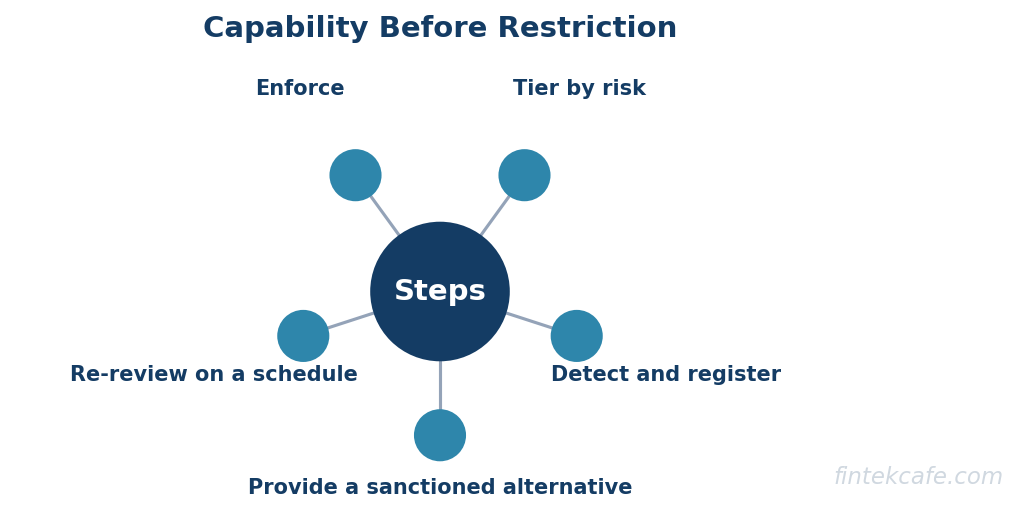
- The model that works inverts the usual order: a sanctioned alternative good enough to be chosen, before restricting anything, then approval tiered by actual risk, then a maintained usage register. Restriction-first programs generate compliance theater; capability-first programs generate visibility.
What Shadow AI Actually Is
Shadow AI is the use of AI capability inside an organization that has not passed whatever review the organization has defined for it. The definition is anchored to the review rather than to a list of tools, because a tool-based definition goes stale the week it is written. A model API unsanctioned in March may be sanctioned in June, and a fully approved collaboration suite may ship an assistant feature nobody has reviewed at all. What makes usage shadow is not the technology, it is the absence of a decision.
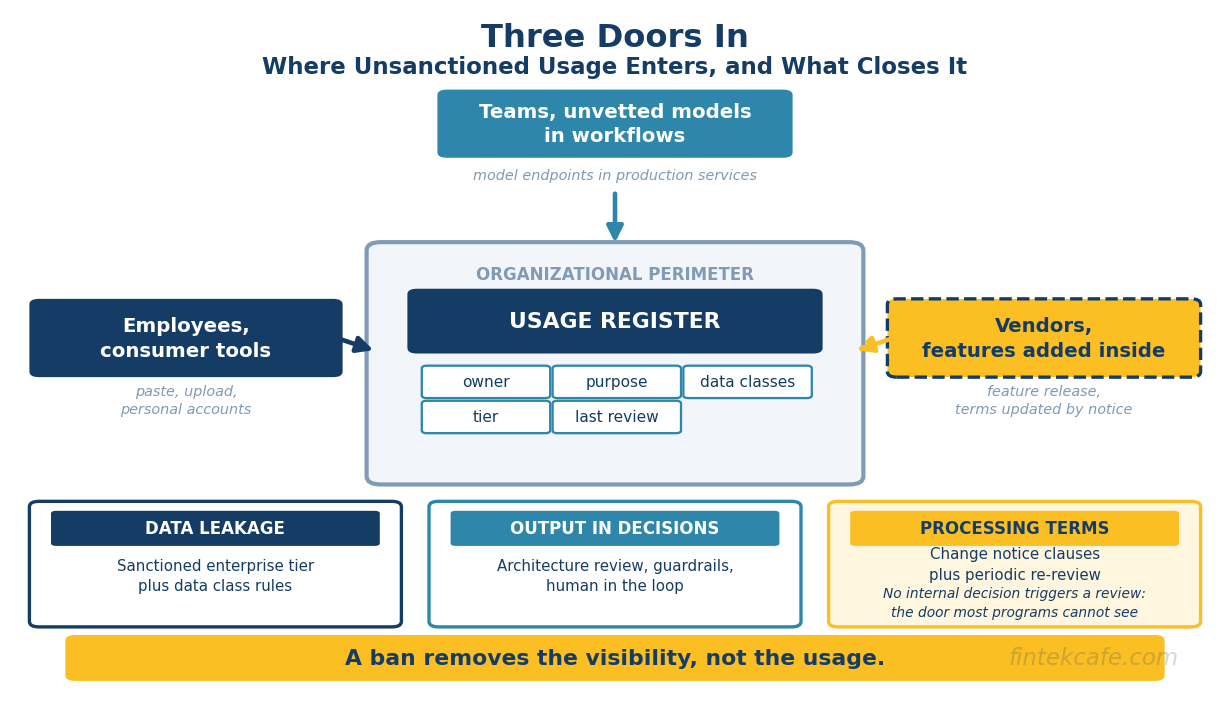
That framing matters because it reveals that shadow AI is not one phenomenon. It arrives through three structurally different doors:
Employees using consumer tools directly. A support agent pastes a customer email thread into a public chatbot to draft a reply. An analyst uploads account data to get help with a formula. This is the class everyone pictures, and the most tractable.
Teams wiring unvetted models into workflows. An engineering team calls a model API from a production service. A revenue-operations team routes inbound leads through a model to classify them. These are not casual usages, they are systems, and they persist and scale after the person who built them moves on.
Vendors adding AI to software already inside the perimeter. The support platform ships a summarization feature. The code repository adds an assistant. The meeting tool starts generating transcripts by default. Nobody procured this and nobody reviewed it, because no internal action occurred to trigger a review.
The three share a family resemblance but almost nothing operationally. Blocking consumer chatbot domains does nothing about the second class and nothing at all about the third. A review board that vets new AI vendors does nothing about the first. The first diagnostic question for any program is which of the three it currently has any visibility into.
Why Bans Fail
The instinct to prohibit is understandable: organizations that try it are responding to a poorly bounded risk with the strongest lever available. The problem is that the lever does not do what it appears to do.
A ban assumes usage is discretionary, that the employee reaching for an AI tool is doing so out of curiosity and will stop when told to. Frequently the opposite is true: it materially compresses a task, and the alternative is doing that task the slow way while a peer elsewhere does not. Prohibition does not reduce that demand, it redirects supply. Usage moves to personal devices, personal accounts, and personal phones photographing a screen, and visibility drops from partial to zero.
The second failure is subtler. A ban is a policy most organizations cannot enforce, and unenforceable policies damage the whole policy stack. Once employees learn the AI policy is widely ignored without consequence, the credibility of the security policies that genuinely are enforced erodes alongside it.
The third is competitive: prohibition suppresses the experimentation that tells an organization where AI actually helps. None of this argues for permissiveness. It argues that the goal is not to minimize AI usage but to route it where it can be observed and bounded, a different objective that produces a different program.
The Three Exposure Classes
Risk conversations about AI tend to collapse into one undifferentiated worry. Separating the exposures makes the controls obvious, because each has a distinct mechanism of harm and therefore a distinct point of intervention.
Data leakage into training sets and retention windows
The mechanism: confidential text, code, or customer records are submitted to a third-party model, and the vendor retains that input under terms the organization never negotiated. Consumer tiers default to broader retention and training use than enterprise tiers, the most important practical distinction between an employee's personal account and a corporate one.
The harm is durable in a way most data incidents are not. A misdirected email can be recalled or at least bounded. Text absorbed into a retention system or a training corpus has no reliable deletion path, and the organization cannot even enumerate what left, because there is no log of what was pasted. Regulated data and material non-public information raise this from a hygiene problem to a compliance one.
The control point is the boundary: which tools receive which data classes, under which terms, from which accounts. Sanctioned enterprise tiers with negotiated retention and no-training commitments do most of the real work here.
Unreviewed model output entering decisions
The mechanism: a model produces an output, and that output flows into a decision without a human review step calibrated to the consequence. A summary that is wrong in a small way propagates into a case note. A generated code change with a subtle flaw is merged. A classification of a loan application, a candidate, or a claim is treated as a determination rather than a suggestion.
This exposure is under-governed relative to the first because it is less visceral. Nothing leaked. But the failure surface is broader: decisions now carry no reliable provenance, and when one proves wrong there is often no record of what the model was asked or what it returned. In regulated decisions the absence of that record is itself the violation, independent of whether the decision was correct.
The control point is the decision, not the tool: the consequence class of what the output touches, and whether a human with the authority and information to overrule sits in the path. The engineering patterns for constraining what a model may do and validating what it returns are covered in AI guardrails for production systems; the governance question is which decisions require them.
Vendor-embedded AI arriving through procurement side doors
The mechanism: a vendor already inside the perimeter adds AI functionality to an existing product. The organization's data, already lawfully in that vendor's system, is now processed by a model, potentially a subprocessor's model, under terms that may have been updated by notice rather than by negotiation.
This is the class that defeats most governance programs, and the reason is structural: no internal decision triggers a review. Nobody submitted a request or signed anything new. A feature flag flipped, and the risk posture changed with no internal event to notice. Meeting transcription is the canonical example, turning ephemeral conversation into retained text at scale, often on by default.
The control point is procurement and vendor management, not the security perimeter: contractual terms requiring notice and consent for material changes in processing, periodic re-review of the existing vendor estate rather than only new purchases, and an owner responsible for reading the change notices vendors do send and nobody currently reads.
Mapping the classes to controls
| Use case | Exposure class | Primary control | Owner |
|---|---|---|---|
| Drafting external communications from customer data | Data leakage | Enterprise tier with no-training terms; data-class rules on what may be submitted | Security plus business unit lead |
| Summarizing internal documents and meetings | Leakage, secondarily output quality | Approved tool list; retention terms reviewed; default-off for sensitive meeting types | IT plus data protection owner |
| Code generation and review assistance | Output quality; leakage of proprietary code | No-training terms; human review gate before merge; provenance logging | Engineering leadership |
| Model-scored decisions on people or credit | Output entering consequential decisions | Documented human-in-the-loop; retained prompt and response logs; accuracy and bias testing | Accountable business owner plus compliance |
| Vendor-embedded AI in existing SaaS | Vendor processing terms; retention | Change-notice clauses; periodic vendor re-review; default-settings audit | Procurement plus vendor management |
The rows matter less than the last column. Every organization's use cases differ; what does not differ is that a use case with no named owner is one nobody is actually governing.
Detecting Shadow AI
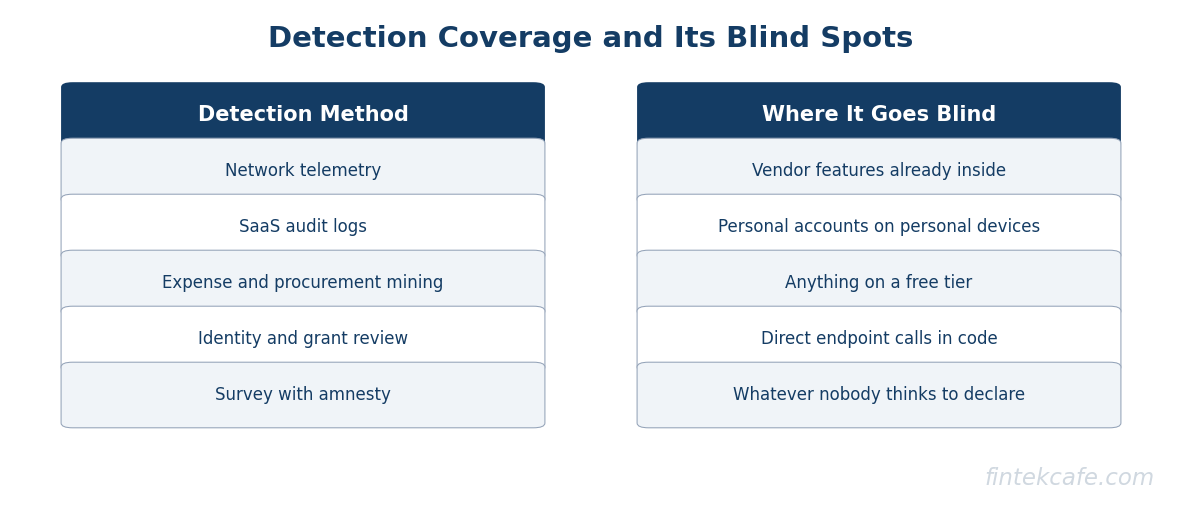
Detection is a layering problem. Each method has a real blind spot, and the blind spots do not overlap, which is why organizations relying on one method consistently conclude their exposure is smaller than it is.
Network and egress telemetry. Secure web gateways, DNS logs, and cloud access security brokers identify traffic to known AI endpoints. Fastest to stand up, since most organizations already own the tooling. Its critical gap is the vendor-embedded class: that traffic goes to the vendor's normal domain and looks identical to ordinary usage of an approved tool.
SaaS audit logs and admin consoles. Where a vendor exposes feature-level telemetry, an administrator can see which users invoked which AI features. This is the only method that meaningfully addresses the vendor-embedded class, which makes it disproportionately valuable. Its limit is coverage: many vendors expose no such logs, some gate them behind higher tiers, and the schemas differ enough that consolidation is real work.
Expense and procurement mining. Searching expense submissions and card transactions for AI vendor names surfaces individually purchased seats, common precisely because they fall below any procurement threshold. It misses free tiers entirely, a significant gap, since the free tier is both the most common and the most permissive on retention.
Identity and single sign-on telemetry. Identity provider logs reveal which applications employees authenticated into, including consented third-party OAuth grants. Those grants deserve particular attention because they may carry standing access to mailboxes, files, or repositories rather than one-time access.
Direct survey and amnesty. Asking people what they use, with a credible commitment that disclosure will not be punished, surfaces what no telemetry sees, particularly the second class where a team built something internal. Its reliability depends on whether the amnesty is believed, which is a function of track record rather than the wording of the survey.
| Method | Catches | Misses | Effort |
|---|---|---|---|
| Network and egress telemetry | Direct AI usage from managed devices | Personal devices; vendor-embedded features | Low if gateway tooling exists |
| SaaS audit logs | Feature-level usage inside sanctioned vendors, including embedded AI | Vendors exposing no logs; unsanctioned tools | Medium; per-vendor, inconsistent schemas |
| Expense and procurement mining | Individually purchased seats below the procurement threshold | Free tiers; anything not expensed | Low; recurring keyword search |
| Identity and OAuth grant review | Tools adopted with a corporate identity; standing third-party access | Anything used with a personal account | Low; usually already in the identity provider |
| Survey with amnesty | Internal builds telemetry cannot see | Whatever people choose not to disclose | Low, but depends on institutional trust |
The practical sequence is identity review and expense mining first, because both are cheap and use data already held, then network telemetry, then the slower work of SaaS audit log consolidation. The survey belongs after a sanctioned alternative exists, because asking people to disclose usage before offering them a compliant path invites them to hear the question as an accusation.
The Governance Model That Works
Three components, in this order. The order is the substance of the recommendation, because programs that invert it produce paperwork rather than visibility.
Sanctioned alternatives first
Before restricting anything, provide a path genuinely good enough for the work people are doing: an enterprise tier with negotiated retention and no-training terms, provisioned through corporate identity, available quickly enough that requesting access is not itself a deterrent. It also has to be close in capability to what people would otherwise reach for. A materially worse option does not redirect demand, it advertises that the compliant path is the slow path.
Restriction without an alternative pushes usage underground; an alternative without restriction still captures most usage, because most people prefer the sanctioned path when it works. That asymmetry is the whole argument for the ordering.
Tiered approval by risk
A single approval process applies the same friction to summarizing a public document and to deploying a model that scores credit applications. When the process is heavy, low-risk usage routes around it. When it is light, high-risk usage passes unexamined. Tiering resolves this.
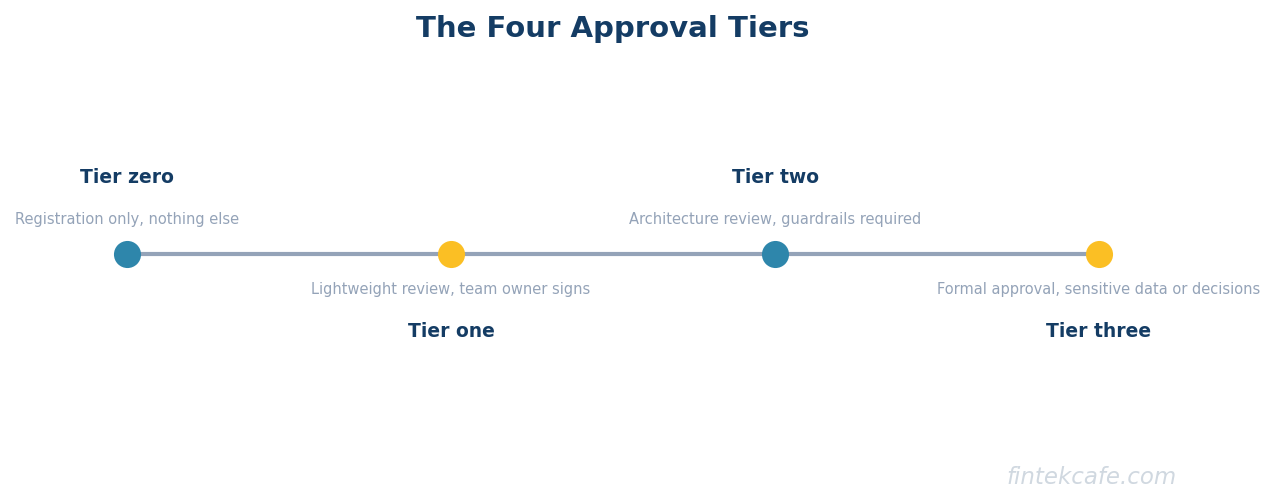
Four tiers work. Tier zero: no approval, for sanctioned tools on public or internal-general data with a human reviewing every output. Tier one: lightweight registration, for confidential internal data in sanctioned tools, requiring an owner of record. Tier two: documented review, for regulated or personal data, or output feeding a consequential decision, requiring a named owner, a documented human-in-the-loop, and retained logs. Tier three: formal review, for autonomous action without human confirmation or decisions with legal or financial consequence for individuals, requiring security, legal, and business sign-off.
Two design rules make tiering hold. The tier follows the data class and the decision consequence, never the tool, because the same tool spans tiers depending on what it touches. And tier zero must require nothing beyond registration, since the credibility of the structure depends on the light tier actually being light. The broader scaffolding these tiers sit inside, acceptable use, data classification, and escalation, is covered in the AI governance policy guide.
The AI usage register
The register is a maintained inventory: what the usage is, who owns it, what data it touches, what tier it sits in, when it was last reviewed. Unglamorous, and the component that makes everything else operable, converting governance from a series of one-time approvals into a standing view of what the organization is running.
It earns its cost at three moments. When a vendor changes terms, it answers who is affected. When a model is deprecated or a provider has an outage, it answers what breaks. When something goes wrong, it is where the response starts, the interface between governance and the operational work described in the AI incident response playbook.
Keep it minimal. A register with fifty fields per entry will not be maintained, and a stale one is worse than none because it produces false confidence. Owner, purpose, data classes touched, tier, last review date, and a link to the review is enough.
Where These Programs Break
The register goes stale. The most common failure. It is populated during the initial push and then not maintained, because nothing triggers an update. Attach updates to events that already happen: procurement renewals, architecture review, quarterly access reviews. A register maintained by voluntary effort decays reliably.
The sanctioned tool lags. Capability moves quickly, and a tool sanctioned once and never revisited becomes materially worse than what people can access personally. That gap reopens shadow usage. Re-evaluation has to be scheduled, not incidental.
Vendor-embedded AI is never re-reviewed. Procurement reviews the initial purchase and nothing after. Without periodic re-review of the vendor estate and someone accountable for reading change notices, the third exposure class stays permanently invisible.
No data-minimization path. Policy tells teams what they may not submit but offers no alternative for legitimate work on sensitive data. Masking, redaction, and synthetic substitutes give teams a way forward rather than a wall; the trade-offs of generated stand-ins for real records are examined in the synthetic data guide.
Measuring restriction rather than coverage. A program reporting blocked requests is measuring its own activity. The metrics that matter are the share of detected usage that is registered, the share of registered usage on sanctioned tiers, the time from request to access, and the trend in newly discovered unregistered usage. If discovery keeps finding surprises, coverage is the problem, not employee behavior.
Frequently Asked Questions
What is shadow AI in simple terms?
Shadow AI is any use of AI inside an organization that has not gone through whatever review the organization requires. It covers three things: employees using consumer AI tools on work data, teams building AI into workflows without review, and vendors adding AI features to software already in use. The third is most often missed, because no purchasing decision happens to trigger a review.
Is banning AI tools an effective response?
Prohibition reduces visibility more than it reduces usage. The demand behind shadow AI is a genuine productivity gap, and a ban does not close it, so usage migrates to personal devices and accounts with no telemetry. A ban also spends policy credibility the enforceable parts of the security program depend on. The better sequence is a sanctioned alternative first, then restriction of the paths it replaces.
How can an organization detect shadow AI usage?
No single method is sufficient. Network telemetry catches direct traffic to AI services from managed devices but misses vendor-embedded features entirely. SaaS audit logs are the only practical route to that class. Expense mining catches individually purchased seats, and identity and OAuth grant review catches tools adopted with a corporate login. Starting with identity review and expense mining is usually fastest, since both use data already held.
What is the difference between shadow AI and shadow IT?
The adoption pattern is the same, but three properties differ. Data submitted to a model may be retained or used for training with no deletion path the organization controls, so the exposure is durable rather than recoverable. Model output enters decisions without leaving a record, so the harm can be silent. And AI arrives inside already-approved tools through vendor feature releases, which shadow IT did not do.
Who should own AI governance?
Split ownership by exposure class rather than assigning it wholesale to one function. Security owns the data boundary and detection. Procurement owns embedded vendor AI and change notice. The accountable business owner owns decisions their function's model output touches. A central function should own the register and the tiering standard rather than approving every use case, because a single central approver becomes the bottleneck that pushes usage back into the shadows.
The Bottom Line
Shadow AI is not fundamentally a compliance problem, and treating it as one produces programs that generate documents while the exposure grows. It is a demand-routing problem. People will use capability that makes their work faster, and the only question is whether that usage happens on a path the organization can see and bound, or on one it cannot.
That reframing sets the priorities. Provide a sanctioned path good enough to be chosen, before restricting anything. Tier the friction to the actual risk. Keep a register minimal enough to survive a normal quarter. And spend detection effort on the vendor-embedded class, the one that grows without anyone deciding anything, and the one most programs cannot see at all.
Related Articles
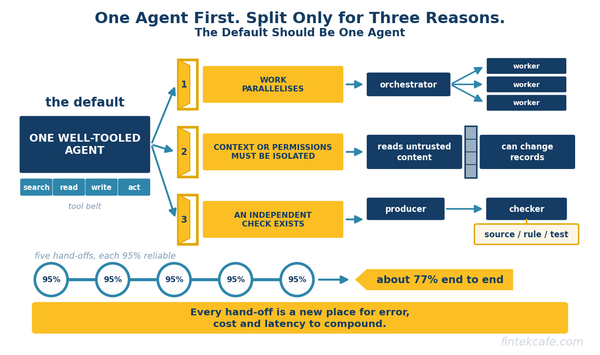
Multi-Agent Systems: When Splitting Work Across Agents Helps, and When It Multiplies Failure
Most tasks run better on one well-tooled agent. Multi-agent systems pay off only for parallel work, isolated context or independent checks.
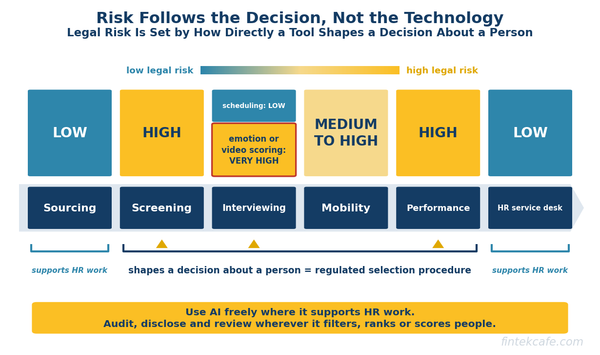
AI in Hiring and HR: Where It Helps, and Where the Legal Risk Sits
Where AI helps in hiring and HR, where legal risk concentrates, what NYC, the EU, Colorado, Illinois and California require, and which controls hold up.
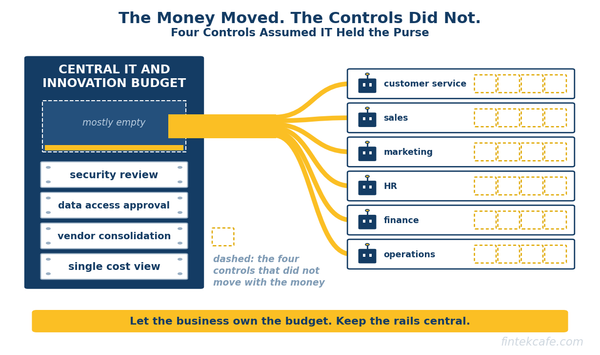
The AI Budget Is Moving From IT to the Business Lines, and Governance Has Not Followed
AI spend is moving from central IT to business lines. That ties cost to outcomes but breaks controls built for an IT-held purse. The model that works.