
Synthetic Data: When Fake Data Solves Real Enterprise Problems
Synthetic data is data generated by a model or a simulation rather than collected from real events, built to preserve the statistical properties of real data without being any real person's actual record. It has moved from research curiosity to procurement line item because it solves a problem no amount of legal drafting solves cleanly: how to get realistic data into the hands of developers, testers, and model trainers without moving real customer data into every environment that needs it. Gartner has projected that synthetic data will represent the majority of data used in AI model training well before the end of the decade, a claim that would have sounded speculative five years ago and now reads as a lagging indicator of what large model builders already do. The technology genuinely solves four enterprise jobs well, and it fails in ways that are easy to miss until an audit, a model failure, or a re-identification finding makes the failure loud. This guide covers the generation methods, where the honest wins are, where it quietly breaks, the regulatory reality, the fraud-specific double edge, and a framework for deciding whether a given use case is a fit.
Key Takeaways
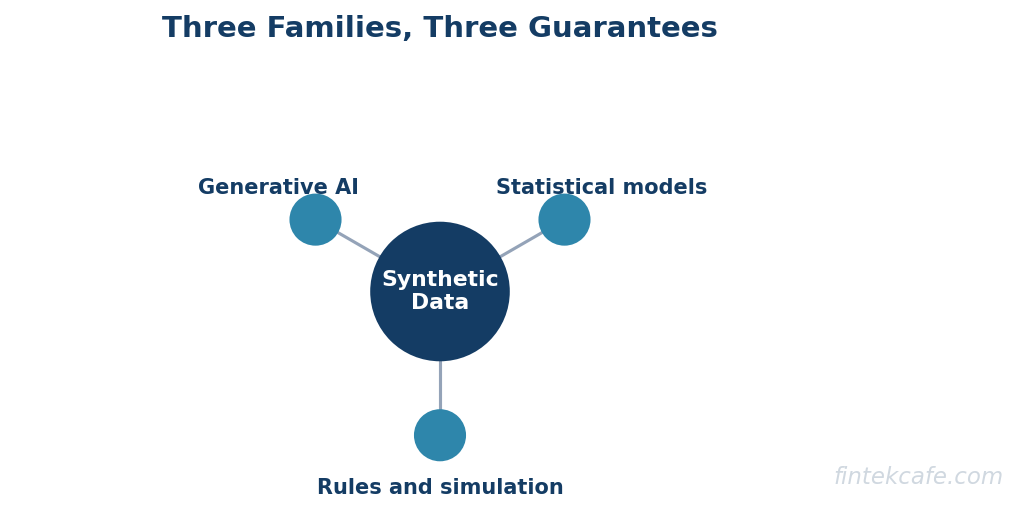
- Synthetic data comes from three families with different guarantees: rules and simulation (deterministic, fully explainable, limited realism), statistical models (captures real distributions, moderate realism), and generative AI (highest realism, hardest to audit and most prone to memorizing training examples).
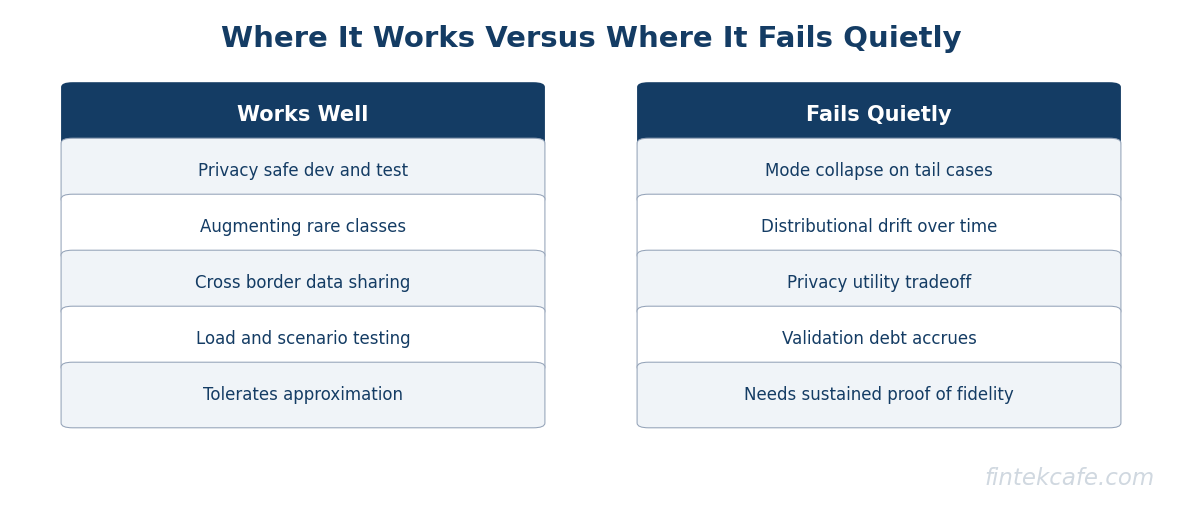
- It does four jobs well: privacy-safe development and test environments, augmenting training data for rare classes like fraud, cross-border and cross-partner data sharing without a consent negotiation, and load or scenario testing at volumes real data cannot supply. Each of these succeeds because the job tolerates approximation.
- It fails quietly in four ways: mode collapse that smooths away exactly the tail cases a fraud or risk model most needs, distributional drift as the real world moves and the generator does not, a privacy-utility tradeoff where a generator realistic enough to be useful is often close enough to memorize and leak real records, and validation debt, the unglamorous fact that proving a synthetic set is faithful is its own sustained project, not a one-time check.
- Regulatory treatment is not automatic. Synthetic data is not exempt from privacy law simply by being synthetic; GDPR-style anonymization thresholds require that re-identification be genuinely impossible, not merely inconvenient, and the EU AI Act's provenance and documentation expectations for training data reach synthetic training sets the same way they reach real ones.
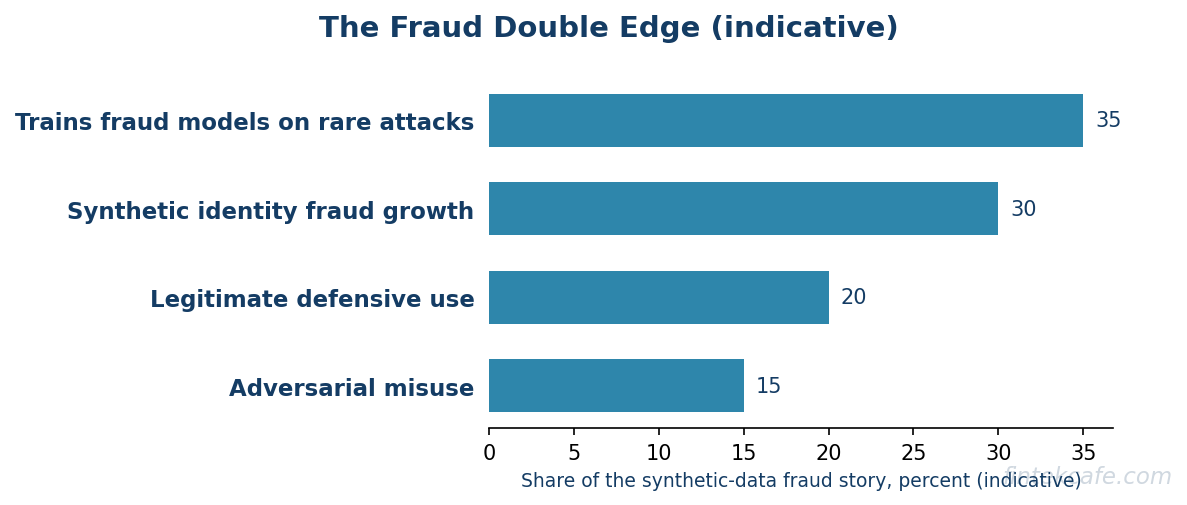
- Fraud and payments carry a double edge unique to this space: synthetic data is a legitimate and valuable tool for training fraud models on rare attack patterns, while synthetic identity fraud, fabricated identities built to pass verification, is one of the fastest-growing attack categories those same models exist to catch. The word "synthetic" means opposite things on the two sides of that sentence.
What Synthetic Data Actually Is, and the Three Ways to Make It
Synthetic data is not sanitized real data; it is manufactured data, generated to reproduce the statistical shape, correlations, and edge-case distribution of a real dataset without any row being drawn from a real event. The distinction from anonymization matters: anonymization starts with real records and tries to strip identifying information from them, a process that has repeatedly failed against re-identification attacks when enough auxiliary data exists. Synthetic generation starts from nothing and builds records that resemble the real population statistically, which changes the privacy conversation but does not automatically resolve it, a point covered below.
Three families of generation method dominate current practice, and they trade realism against explainability in a fairly clean line.
Rules and simulation. Records generated by explicit logic: a set of business rules, a simulation of a process, or a random-but-constrained sampler that respects known ranges and relationships. A synthetic transaction dataset built by simulating customers, merchants, and purchase patterns according to specified rules falls here. The strength is full explainability, every record's provenance is a rule someone wrote, and zero risk of leaking a real record, because none was ever an input. The weakness is realism: rules capture what their author thought to specify, and real populations are stranger than any rule set anticipates, which is precisely the property that matters most for the harder use cases below.
Statistical models. Techniques that fit a statistical model, a copula, a Bayesian network, a mixture model, to a real dataset's distributions and correlations, then sample new records from the fitted model. This captures real statistical structure the simulation approach cannot anticipate in advance, at a moderate realism level and a moderate, more traceable privacy exposure than the third family, because the model is typically simpler and easier to audit for what it memorized.
Generative AI. Deep generative models, generative adversarial networks and, increasingly, diffusion and transformer-based approaches, trained on real data to produce synthetic records with the highest achievable realism, including subtle correlations no rule author or simpler statistical model would capture. This is also the family with the least auditability and the sharpest version of the privacy-utility tradeoff: the same model capacity that lets it capture fine-grained realistic structure is the capacity that lets it memorize specific real training examples closely enough to regenerate something that functions as a re-identification of a real person.
Where Synthetic Data Genuinely Wins
Four use cases account for the overwhelming majority of legitimate enterprise deployment, and each one succeeds for the same underlying reason: the job tolerates a data set that is realistic enough rather than requiring it to be real.
Privacy-safe development and test environments. Developers and QA teams need data that behaves like production data, without the compliance burden, breach exposure, and access-control overhead of giving every developer laptop a copy of real customer records. Synthetic test data, generated to match the shape and edge cases of production without containing any real customer's information, has become a standard control precisely because it removes an entire category of exposure at the cheapest point in the pipeline, before code ever reaches a system with a real customer in it.
ML training augmentation for rare classes. Fraud, rare disease presentations, and other low-frequency-but-high-consequence events are exactly the cases where real historical data is thinnest, because by definition they do not happen often. A model trained overwhelmingly on the common case learns the common case well and the rare case poorly, which is the opposite of what a fraud or risk model needs. Synthetic augmentation, generating additional examples of the rare class, gives the model more to learn from without waiting years to accumulate more real fraud. The application connects directly to how production fraud systems are built and evaluated, covered in real-time fraud detection in payments and in the enterprise evaluation harness guide, because an augmented training set is only as good as the evaluation that proves the model generalizes from it to real attacks, not just to more synthetic examples that look like the ones it was fed.
Cross-border and cross-partner data sharing without consent hell. Sharing real customer data across a border, or across a partnership boundary, routinely triggers a stack of consent, contractual, and regulatory requirements that can take months to clear, precisely the timeline a joint fraud-model project or a cross-entity analytics initiative cannot survive. Synthetic data that preserves the statistical relationships partners need to collaborate, without moving any real individual's record across the boundary, sidesteps the consent negotiation because there is no real individual's data in transit. This works cleanly when the partners genuinely only need the statistical shape; it works less cleanly, and deserves scrutiny, when the "statistical shape" a partner actually needs is close enough to the real data that the synthetic set is doing more identification work than the label implies.
Load and scenario testing. Testing a system's behavior under Black Friday volume, a regional outage, or a coordinated attack pattern requires data volumes and scenario combinations that real historical data usually cannot supply on demand, either because the volume never happened yet or because the specific combination of conditions being tested is deliberately rare. Synthetic generation at scale, calibrated to the shape of real traffic, is the practical way to stress a system against a future it has not experienced yet.
| Job | Fit | Risk if misapplied | Validation requirement |
|---|---|---|---|
| Dev/test environments | Strong | Low: no real records exposed | Confirm no real record was memorized verbatim; periodic re-check as generators are retrained |
| ML training augmentation (rare classes) | Strong, with caveats | Moderate: model may learn synthetic artifacts rather than real attack patterns | Evaluate on real held-out rare-class examples, never only on synthetic test data |
| Cross-border/partner sharing | Moderate to strong | Moderate to high: re-identification if the generator overfit or the "statistical shape" needed is itself identifying | Formal re-identification risk assessment before cross-border transfer; documented per applicable privacy regime |
| Load/scenario testing | Strong | Low: purely operational, no real-identity exposure typically | Confirm scenario coverage matches real tail-risk conditions, not just average-case volume |
Where It Fails Quietly
The failure modes below are dangerous precisely because they do not announce themselves; a synthetic dataset that has failed in one of these ways still looks complete, still passes a superficial glance, and still generates plausible-looking rows.
Mode collapse. Generative models, especially adversarial architectures, are prone to converging on the most common patterns in the training data and under-representing or entirely missing the rare, unusual combinations, the very tail cases a fraud, risk, or safety model exists to catch. A synthetic fraud dataset that mode-collapsed will look statistically reasonable in aggregate while systematically failing to include the novel attack patterns that matter most, which means a model trained on it will look validated and be blind to exactly what it was built to see.
Distributional drift. A generator is fit to a snapshot of the real world. The real world moves, customer behavior shifts, new products launch, fraud patterns evolve, and the generator, unless retrained on a disciplined schedule, keeps producing data that reflects an increasingly stale reality. A synthetic dataset that was faithful on the day it was generated can be meaningfully wrong six months later with no visible change to the data itself.
The privacy-utility tradeoff and re-identification risk. This is the sharpest and most counterintuitive failure: the more realistic and useful a generative model's output, the more likely it is that the model has memorized specific real training examples closely enough to reproduce something that functions as that person's real record. Published research on generative models has repeatedly demonstrated membership-inference and reconstruction attacks that recover real training data from models presented as producing purely synthetic output. A generator advertised as fully private because "no real records are output" can still leak real information through outputs that are statistically indistinguishable from, or reconstructible into, actual individuals, particularly for outlier individuals whose records the generator had fewer similar examples to blend them into.
Validation debt. Proving a synthetic dataset is faithful, that it preserves the distributions, correlations, and tail behavior that matter for the intended use, is not a checkbox; it is an ongoing project requiring statistical comparison against real data, downstream model performance comparison, and re-identification testing, repeated whenever the generator or the underlying real data changes. Organizations that budget for generating synthetic data but not for validating it accumulate a debt that surfaces exactly when it is most expensive: after a model trained on unvalidated synthetic data fails in production, or after an audit asks for the re-identification risk assessment that was never done.
The Regulatory Read
Synthetic data does not receive automatic favorable treatment from privacy law simply by being labeled synthetic. Under GDPR and comparable regimes, data qualifies as anonymized, and falls outside the regulation's scope, only if re-identification is genuinely impossible using reasonably available means, not merely difficult. Regulators and courts have taken this standard seriously against real-data anonymization for years, and the same standard applies to synthetic data that turns out to be susceptible to reconstruction or membership-inference attacks: the label "synthetic" does not substitute for the actual re-identification risk assessment, which is why organizations relying on synthetic data for cross-border transfer or partner sharing should document that assessment rather than assume the label clears it.
The EU AI Act adds a second, newer thread: providers of general-purpose AI models face documentation and transparency obligations about training data under the obligations phased in from August 2025, and those provenance expectations do not carve out an exception for training data that happens to be synthetic. An organization training or fine-tuning models on synthetic data inherits the same obligation to understand and document what went into that data, including, transitively, what real data the generator itself was trained on, as it would for real data directly.
The practical governance implication connects directly to the broader AI policy question of what gets approved and how: synthetic data generation and use should sit inside the same controls-based governance structure covered in the AI governance policy guide, with model and generator approval, data-boundary rules for what feeds a generator, and an audit trail for what the generator produced and where it went, rather than being treated as an automatic privacy exemption that sits outside normal data governance.
The Fraud-and-Payments Double Edge
Payments and fraud is the sector where the word synthetic carries two opposite meanings, and conflating them is a real operational risk. On the defensive side, synthetic data is a legitimate and increasingly standard tool for training fraud-detection models on attack patterns too rare in real history to learn from directly, augmenting the thin tail of confirmed fraud cases with generated examples that preserve the statistical signature of known attacks. On the offensive side, synthetic identity fraud, fabricated identities built from a mix of real and invented personal information, designed specifically to pass identity verification and credit-onboarding checks, has become one of the fastest-growing fraud categories, because the same generative techniques that build useful training data can build convincing fake identities. The identity-verification systems this attack targets, and the KYC processes meant to catch it, are covered in KYC and identity verification, and the uncomfortable symmetry is direct: an organization's synthetic-data program and an attacker's synthetic-identity operation can draw on overlapping technique, which is a reason to keep fraud-model synthetic-data generation under the same governance rigor as any other sensitive AI pipeline, not a lighter one.
A Fit-Assessment Framework: Real Versus Synthetic
The decision between real and synthetic data for a given use case reduces to a small number of questions, asked in order, and the honest answer is often a hybrid rather than a clean either-or.
| Question | If yes, lean toward | If no, lean toward |
|---|---|---|
| Does the use case need exact real values, or does it tolerate statistically realistic approximations? | Synthetic (dev/test, load testing, aggregate analytics) | Real data, handled under normal controls |
| Is the population's rare tail the part that matters most (fraud, rare disease, edge-case failures)? | Real data augmented with validated synthetic examples, never synthetic alone | Real historical data may already be sufficient |
| Does the data need to leave a jurisdiction, entity, or consent boundary it cannot otherwise cross? | Synthetic, with a documented re-identification assessment before transfer | Real data, cleared through normal consent and transfer mechanisms |
| Is the downstream consumer a regulator, auditor, or legal process that requires the actual record? | Real data; synthetic cannot substitute | Synthetic may be acceptable |
| Has anyone validated that the synthetic generator preserves the tail behavior and cannot be reconstructed to real records? | Proceed only after validation exists, not before | Treat as unvalidated and high-risk regardless of intended use |
The single most common mistake the framework surfaces is skipping the last row: organizations adopt synthetic data for its privacy and convenience benefits and defer the validation work indefinitely, which converts a genuine solution into an unaudited liability wearing the reassuring label of "no real data was used."
FAQ
What is synthetic data?
Synthetic data is data generated by rules, statistical models, or generative AI rather than collected from real events, designed to preserve the statistical properties, distributions, and correlations of a real dataset without any record corresponding to a real individual or transaction. It is used for development and testing, machine learning training augmentation, cross-border and cross-partner data sharing, and load testing, precisely because those jobs tolerate realistic approximation rather than requiring exact real records.
Is synthetic data automatically compliant with privacy regulations like GDPR?
No. Data only qualifies as anonymized and outside GDPR's scope if re-identification is genuinely impossible by reasonably available means, and research has repeatedly shown that highly realistic generative models can memorize and leak information about real training records through reconstruction or membership-inference attacks. Organizations using synthetic data for cross-border transfer or sensitive sharing should conduct and document a formal re-identification risk assessment rather than assume the "synthetic" label satisfies the legal standard on its own.
What is mode collapse and why does it matter for fraud models?
Mode collapse is a failure mode in generative models where the generator converges on the most common patterns in its training data and under-represents or omits rare, unusual combinations. For a fraud or risk model, the rare combinations are usually the ones that matter most, novel attack patterns, edge-case behavior, so a synthetic dataset that has mode-collapsed will look statistically plausible while systematically missing exactly the cases a model trained on it needs to learn to catch.
Can synthetic data be used to train fraud-detection models safely?
Yes, and it is an established and valuable practice, particularly for augmenting the thin population of confirmed real fraud examples with generated examples that preserve known attack signatures. The safeguards that make it safe are validating the synthetic set against real held-out fraud examples rather than only against other synthetic data, watching for mode collapse on the rare classes the model most needs, and never relying on synthetic data as the sole source of ground truth for evaluating whether the resulting model actually catches real-world attacks.
What is the difference between synthetic data and synthetic identity fraud?
Synthetic data, used defensively, is a generation technique for producing realistic but non-real records to support development, testing, or model training. Synthetic identity fraud is an attack technique that uses similar generative methods to fabricate a fake identity, often blending real and invented personal information, specifically to pass identity verification and credit-onboarding checks. The term is identical; the intent and target are opposite, and organizations building synthetic-data pipelines for legitimate purposes should be aware that the same underlying techniques are actively used against their own identity-verification systems.
Related reading on FinTekCafe
Related Articles
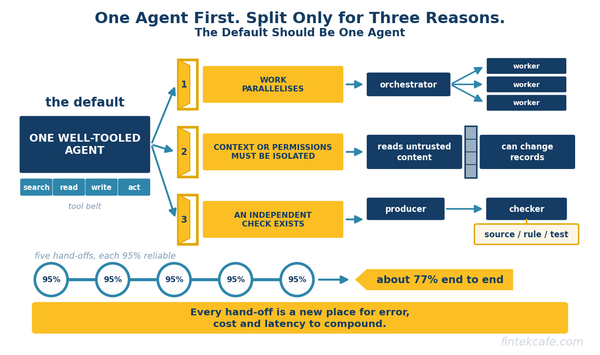
Multi-Agent Systems: When Splitting Work Across Agents Helps, and When It Multiplies Failure
Most tasks run better on one well-tooled agent. Multi-agent systems pay off only for parallel work, isolated context or independent checks.
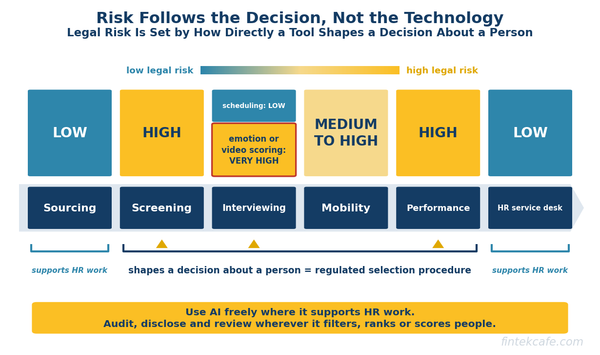
AI in Hiring and HR: Where It Helps, and Where the Legal Risk Sits
Where AI helps in hiring and HR, where legal risk concentrates, what NYC, the EU, Colorado, Illinois and California require, and which controls hold up.
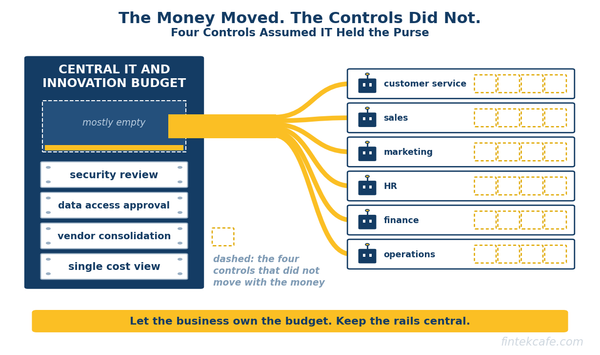
The AI Budget Is Moving From IT to the Business Lines, and Governance Has Not Followed
AI spend is moving from central IT to business lines. That ties cost to outcomes but breaks controls built for an IT-held purse. The model that works.