
LLM Release Management: How to Ship Prompt and Model Changes Without Breaking Production
LLM release management is the practice of changing a production LLM feature without silently breaking it. An LLM feature has four parts that change independently: the prompt, the model version, the tools and retrieval it calls, and the data it reads. A change to any one of them can alter behaviour in ways no unit test covers, because the output is language, not a return value. The fix is to release all four as one versioned artifact, gate every release on an evaluation set sliced by the cases that matter, and roll out with behavioural metrics rather than error rates.
As of the week of October 5, 2026, most teams already have the pieces: an eval harness, a feature-flag system, an observability stack. What they usually lack is the discipline that joins them into a release process. This guide sets out that process: the working model, the rules that follow from it, the release patterns that survive non-deterministic output, and a build order a team can start this week.
Why LLM Features Break Differently
Conventional software breaks loudly. A changed function signature fails compilation, a bad deploy spikes the error rate, a regression fails a test. LLM features break quietly. The request succeeds, the latency is normal, the response is well-formed, and the answer is worse.
The public record shows how easily this happens, even to the model providers themselves.
The same model name can change behaviour. Researchers at Stanford and UC Berkeley compared the March 2023 and June 2023 versions of GPT-4 and found that accuracy at identifying prime versus composite numbers fell from 84% to 51% between the two, under the same product name (Chen, Zaharia and Zou, arXiv 2307.09009). Any application relying on the floating name inherited that change without shipping anything.
Small prompt edits can move results a long way. A study presented at ICLR 2024 found that meaning-preserving formatting changes to a few-shot prompt, such as separators, spacing and casing, produced accuracy differences of up to 76 points on LLaMA-2-13B, and that the sensitivity persisted with larger models and instruction tuning (Sclar et al., arXiv 2310.11324). A prompt "cleanup" is a behavioural change.
Good offline evals do not guarantee good behaviour. In April 2025 OpenAI rolled back a GPT-4o update four days after release because it had become sycophantic. In its follow-up, OpenAI said its offline evaluations and A/B tests had looked good, that expert testers had said the model "felt" slightly off, and that it had no deployment evaluation tracking sycophancy specifically (OpenAI, "Expanding on what we missed with sycophancy").
Infrastructure changes can degrade output with no model change at all. Anthropic's September 2025 postmortem described three infrastructure bugs that intermittently degraded Claude's responses between August and early September, affecting up to 16% of Sonnet 4 requests in the worst hour. Its evaluations "simply didn't capture the degradation users were reporting, in part because Claude often recovers well from isolated mistakes," and the stated fix included running evaluations continuously on production systems (Anthropic engineering).
The lesson from all four: behaviour is the thing that ships, so behaviour is the thing a release process has to test, gate and monitor.
The Four Things That Change
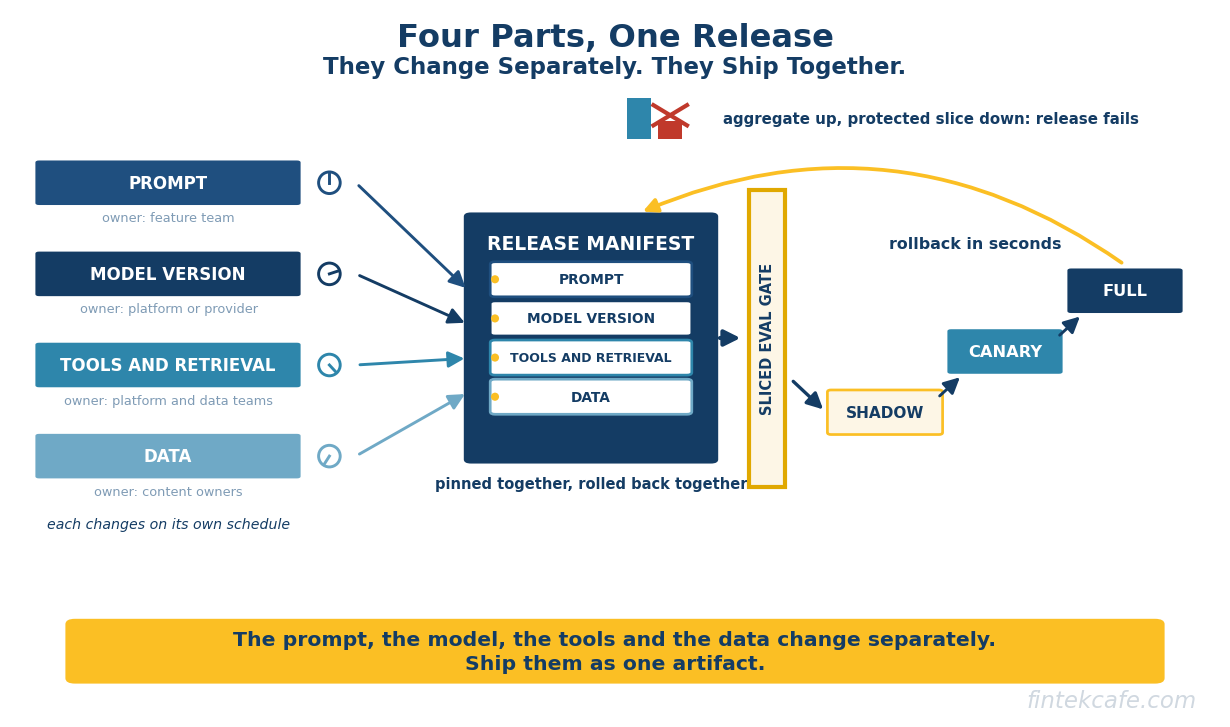
An LLM feature is the combination of four components, and each has its own change rate and its own owner.
- The prompt: the system prompt, templates, few-shot examples, and output format instructions. Changed often, usually by the product or application team.
- The model version: the provider, model, dated snapshot, and inference parameters such as temperature and reasoning effort. Changed rarely by choice and sometimes by the provider.
- The tools and retrieval: tool definitions and descriptions, the retrieval pipeline, chunking and ranking, and any routing logic. Changed by platform or data teams, often without the feature team's involvement. The design principles for the tool layer are covered in the guide to tool design for agents.
- The data: the documents in the index, the reference tables, the knowledge base the feature reads. Changed continuously by people who rarely think of their edits as a software release.
The core claim follows directly. A prompt tested against one model is a different artifact on another model. The same holds for a prompt tested against one retrieval configuration or one version of the knowledge base. The unit of release is the combination, not any single part.
What Can Break, and What Gate Each Change Needs
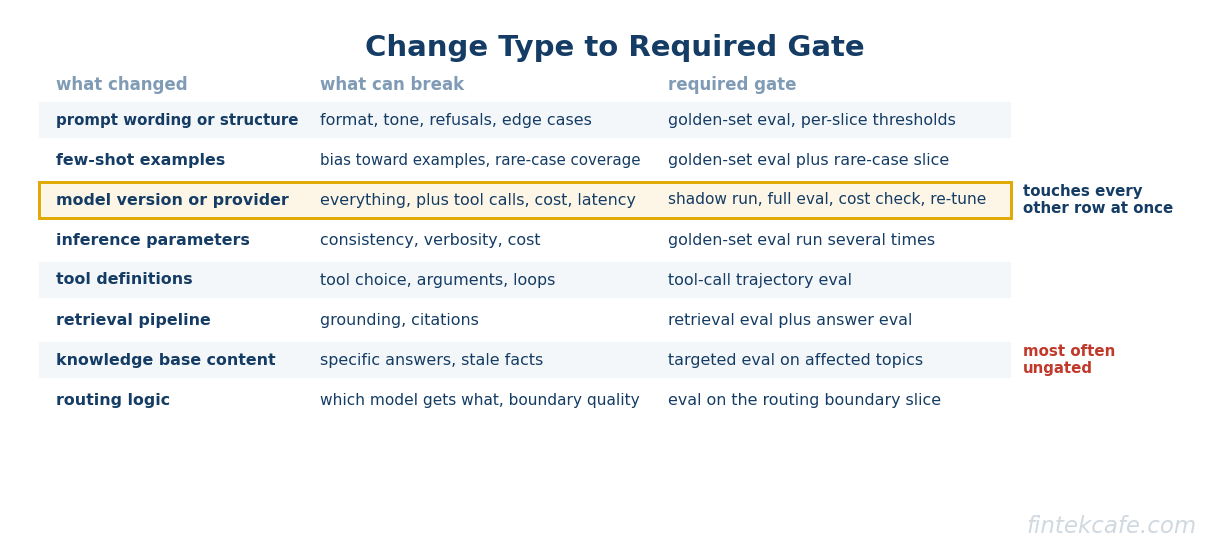
Each type of change fails in its own way, so each needs a gate matched to it. The table is the core of the release policy.
| What changed | What can break | Required gate |
|---|---|---|
| Prompt wording or structure | Format compliance, tone, refusal rate, edge-case handling, instruction priority | Full golden-set eval with per-slice thresholds; diff review of outputs on the regression slice |
| Few-shot examples | Output bias toward the examples, format drift, loss of coverage on rare cases | Golden-set eval plus a check on the rare-case slice specifically |
| Model version or provider | Everything above, plus tool-call behaviour, output length, cost per request, latency, safety behaviour | Shadow run on live traffic, full eval, cost and latency comparison, prompt re-tuning budget |
| Inference parameters | Consistency, verbosity, reasoning depth, cost | Golden-set eval run several times to measure variance, not once |
| Tool definitions or descriptions | Which tool is chosen, argument formatting, unnecessary calls, loops | Tool-call trajectory eval: correct tool, correct arguments, call count within bounds |
| Retrieval pipeline (chunking, ranking, index) | Grounding, citation accuracy, answers that were right yesterday | Retrieval eval (did the right document come back) plus answer eval on questions tied to known documents |
| Knowledge base content | Answers to specific questions, stale or contradictory facts | Targeted eval on the affected topics; content owners notified of which features read their data |
| Routing logic between models | Which requests reach which model, cost mix, quality on the boundary cases | Eval on the routing boundary slice; per-route quality and cost dashboards (see model routing in production) |
Two rows deserve emphasis. The model-version row carries the heaviest gate because a model change touches every other row at once. The knowledge-base row is the one most often ungated, because the people editing the data do not know it is an input to a model.
Rule 1: Version the Four Together
Every release is a manifest that pins all four components. At minimum, the manifest records the prompt version, the exact dated model snapshot and its parameters, the tool and retrieval configuration version, and a pointer to the data version or index build. The feature references the manifest, not the individual parts.
Three practices make this work.
- Pin dated snapshots, never floating aliases, in production. An alias that tracks "the latest" version turns the provider's release into your release, with no gate. The prime-number result above is what that looks like.
- Store prompts as code. Prompts belong in version control with review, history, and the ability to diff, not in a database field edited through an admin screen.
- Make the manifest the rollback unit. Rolling back means pointing the feature at the previous manifest. If rollback requires reconstructing which prompt went with which model, it will be slow when speed matters most.
Rule 2: Gate Every Release on Evals, Sliced by the Cases That Matter
The eval gate is a golden set per feature, with a regression threshold per metric and per slice, run in continuous integration on every manifest change. The mechanics of building the harness itself are covered in the guide to building an LLM evaluation harness, and the executive framing in what AI evals are. The release-specific rules are these.
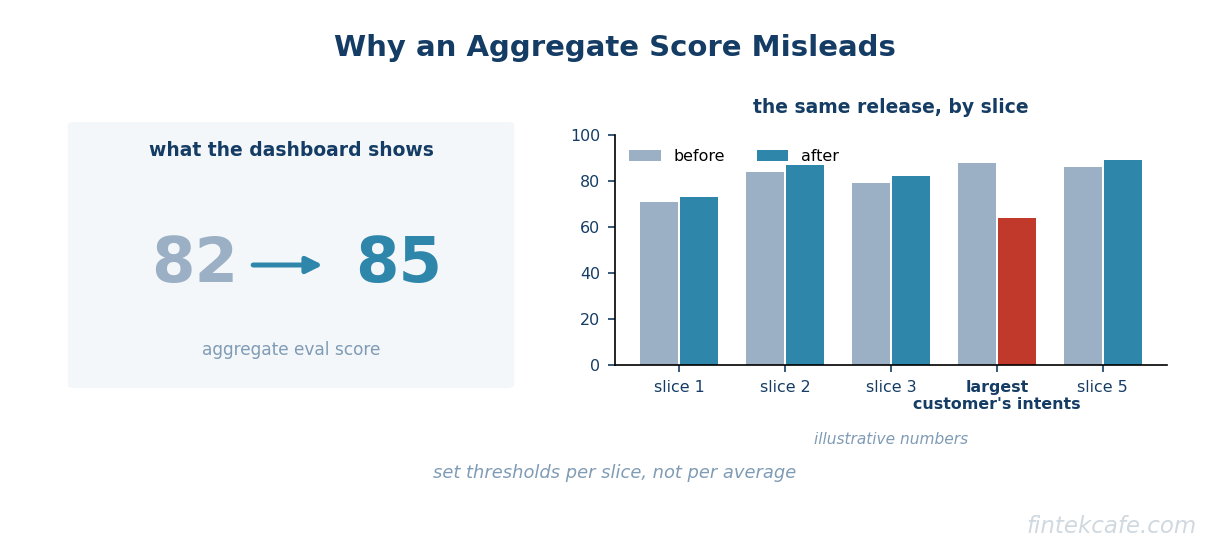
An aggregate score hides the cases that matter. A change can raise the average and break the ten cases your largest customer depends on. Slice the golden set by the dimensions that carry risk: customer segment, language, question type, high-stakes intents, and known historical failures. Set thresholds per slice. A release that improves the aggregate and regresses a protected slice fails.
Every production incident becomes a test case. The golden set should grow from real failures, not only from cases the team imagined in advance. This is the single cheapest way to stop the same failure shipping twice.
Measure variance, not a single run. Non-deterministic output means one run of the eval is one sample. For changes that touch parameters or models, run the set several times and compare distributions, or the gate will pass and fail on noise.
Separate hard gates from review signals. Format compliance, safety checks, and protected-slice regressions should block automatically. Softer quality scores, including model-graded ones, should trigger human review of the output diffs rather than blocking on their own, because a grader model has its own drift.
Rule 3: Borrow Release Patterns, but Change What They Measure
Software delivery already solved staged rollout. The patterns carry over to LLM features; the metrics do not. The general mechanics are covered in the guide to progressive delivery and feature flags.
Shadow runs. Send a copy of live traffic to the new manifest, discard its responses, and compare them with production. This is the only way to test against the real distribution of requests before any user sees the change. Compare output length, refusal rate, tool-call patterns, format validity, cost per request, and a sampled quality score. Shadow runs cost money, so size them to what the change risks.
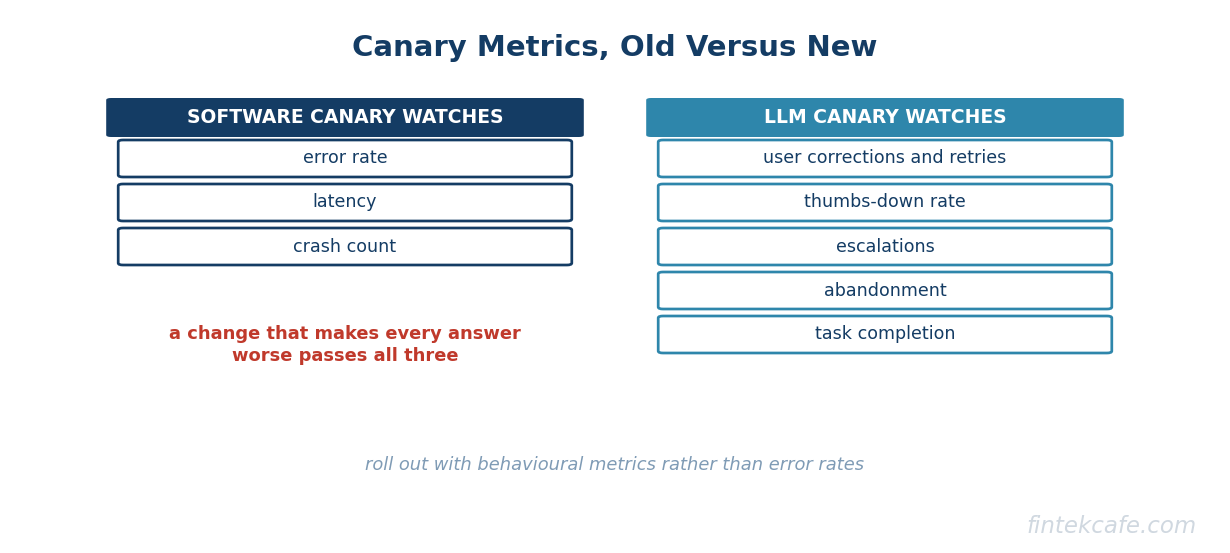
Canaries with behavioural metrics. A conventional canary watches error rates and latency. An LLM canary that watches only those will pass a change that makes every answer worse. Watch the behavioural signals instead: user corrections and retries, thumbs-down rate, escalation to a human, abandonment, and downstream task completion.
Feature flags per prompt version. Put the manifest behind a flag so exposure can be widened by segment, and so a single customer or cohort can be moved back without a deploy.
Fast rollback. Rolling back should be a flag change measured in seconds, not a redeploy measured in hours. Rehearse it. A rollback path that has never been used is an assumption.
The OpenAI sycophancy case shows why the canary metric matters. The problem was visible in how users experienced the model over time, not in the short-term signals the release gated on.
The Model-Upgrade Problem
Model upgrades deserve their own section because they are the change a team is least in control of.
Providers retire models on their own schedule. OpenAI's published policy gives at least six months' notice before retiring a generally available model, at least three months for specialized variants, and as little as two weeks for preview models. On June 11, 2026, it notified developers that several GPT-5 and o3 snapshots would be removed from the API on December 11, 2026 (OpenAI deprecations). Pinning protects against silent change. It does not protect against a deadline, so every pinned snapshot needs a planned migration date.
A new model changes cost as well as quality. Anthropic's pricing documentation notes that its newer models use a tokenizer producing approximately 30% more tokens for the same text (Anthropic pricing). A like-for-like list price can still mean a higher bill per request. Compare cost per request on real traffic in the shadow run, not list prices.
Budget for re-tuning. Prompts are tuned, often unconsciously, to the quirks of the model they were written against. Treat a model upgrade as a prompt project, not a configuration change: schedule time to re-tune, re-run the full eval, and expect some slices to regress before they improve.
The upgrade procedure that follows from this:
- Track every pinned snapshot's retirement date in the same place as certificate and licence expiries.
- When a candidate model appears, run it in shadow against the current manifest with no prompt changes, to see the raw difference.
- Re-tune the prompt against the new model and build a new manifest.
- Run the full sliced eval and a cost comparison.
- Canary the new manifest with behavioural metrics, then widen.
- Keep the old manifest deployable until the old snapshot is actually retired.
Monitoring After Release
Evals test what you predicted. Monitoring catches what you did not. The instrumentation stack is covered in the guide to LLM observability; the leading signals for release health are these.
- Output length distribution. A sudden shift in response length is often the first visible sign of a prompt or model change behaving differently.
- Refusal and hedge rate. A rise suggests a safety behaviour or instruction-priority change; a fall can mean guardrails stopped working.
- Tool-call patterns. Changes in which tools are called, how often, and how many calls per request indicate the model is reasoning about the task differently.
- Cost per request. Tracked per manifest, not per month, so a costly change is attributed to the release that caused it.
- User corrections. Edits, retries, regenerations and rephrased questions are the closest thing an LLM feature has to an error rate.
Tie every metric to the manifest version. When a signal moves, the first question is which release it followed, and the answer should take seconds.
Ownership and Change Approval, Scaled to Risk
Not every change needs the same process. Scale approval to what the feature does and what the change touches.
| Feature risk | Example | Prompt change | Model or retrieval change |
|---|---|---|---|
| Low | Internal summarisation, drafting aids | Feature team approves on green eval | Feature team approves on green eval plus shadow comparison |
| Medium | Customer-facing assistant, search answers | Peer review of output diffs plus green eval | Shadow run, canary, and sign-off from the feature owner |
| High | Advice, pricing, eligibility, anything regulated or binding | Named owner sign-off, protected-slice review, documented change record | Full procedure above plus risk or compliance sign-off and a rehearsed rollback |
Two ownership rules prevent most gaps. First, every feature has a single named owner for the manifest, even when four teams own its components. Second, teams that own shared components (the retrieval platform, the knowledge base, the tool catalogue) publish a list of which features read them and notify those owners before changes. The choice of whether a feature should be an agent or a fixed workflow also changes the risk profile, as the agent versus workflow decision guide sets out: fixed workflows have fewer ways to drift.
The Release Checklist
| Step | Question it answers | Blocks release if |
|---|---|---|
| Manifest created | Are all four components pinned? | Any component is floating or unrecorded |
| Diff reviewed | What actually changed, and who owns it? | Change touches a shared component with unnotified dependants |
| Sliced eval passed | Did any protected slice regress? | A protected slice falls below threshold, even if the aggregate rises |
| Variance checked | Is the result stable across runs? | Run-to-run variance exceeds the measured improvement |
| Cost compared | What does this cost per request on real traffic? | Cost rises beyond the agreed budget without sign-off |
| Shadow run reviewed (model, retrieval, or high-risk changes) | How does it behave on the live distribution? | Behavioural metrics diverge beyond agreed bounds |
| Rollback confirmed | Can the release be reverted in seconds? | Previous manifest is not deployable |
| Canary monitored | Do real users experience it as better? | Corrections, escalations or thumbs-down rise in the canary cohort |
| Change recorded | Can this release be reconstructed later? | No record of approver, eval results and manifest version |
A Build Order a Team Can Start This Week
Teams do not need all of this at once. The order below delivers the most protection per week of effort.
- Pin every model snapshot in production and list the retirement dates. One day of work; removes silent provider changes immediately.
- Move prompts into version control and create a manifest file per feature. Two to three days.
- Build a golden set of 50 to 200 cases per feature, seeded from real traffic and past incidents, sliced by risk. One to two weeks, and the most valuable step on this list.
- Wire the eval into CI with per-slice thresholds, blocking on protected slices. A few days once the set exists.
- Put manifests behind feature flags and rehearse a rollback. A few days.
- Add release-health dashboards keyed to manifest version: length, refusals, tool calls, cost, corrections.
- Add shadow runs for model and retrieval changes, starting with the highest-risk feature.
- Formalise approval by risk tier once the mechanics are in place, so the process describes what the team already does.
Key Takeaways
- An LLM feature has four independently changing parts: prompt, model version, tools and retrieval, and data. A change to any one can silently alter behaviour, so the unit of release is the combination.
- Version all four together in a manifest, pin dated model snapshots rather than floating aliases, and make the manifest the rollback unit.
- Gate every release on a golden set sliced by risk, with per-slice thresholds. An aggregate score can rise while the cases that matter most break.
- Shadow runs, canaries, feature flags and fast rollback all carry over from software delivery, but canaries must watch behavioural signals such as corrections and escalations, not just errors and latency.
- Model upgrades are prompt projects with a deadline. Providers retire snapshots on published schedules, new models can change cost per request, and prompts need re-tuning.
- Monitor output length, refusal rate, tool-call patterns, cost per request and user corrections, all tied to the manifest version.
- Scale approval to feature risk, give every feature a single manifest owner, and require shared-component owners to notify the features that depend on them.
FAQ
How often should prompts be versioned?
Every change to a production prompt should create a new version, including formatting and whitespace changes. Research presented at ICLR 2024 found meaning-preserving formatting changes moved accuracy by up to 76 points on one model, so there is no such thing as a cosmetic prompt edit.
Should production use a model alias like "latest"?
No. Floating aliases hand the release decision to the provider. Pin a dated snapshot in production, track its retirement date, and upgrade deliberately through shadow runs, re-tuning and a sliced eval. Aliases are fine in development, where tracking the newest model is the point.
How large does a golden set need to be?
Start with 50 to 200 cases per feature, drawn from real traffic and past incidents and sliced by risk, then grow it with every production failure. Coverage of the high-stakes slices matters more than total size. A set of 5,000 easy cases can pass a change that breaks the 20 that matter.
What is the difference between LLM release management and LLM observability?
Release management controls change before and during rollout: versioning, eval gates, shadow runs, canaries and rollback. Observability watches behaviour after release. They meet at the manifest version: every monitored signal should be attributable to the release that preceded it.
How should a team handle a forced model retirement?
Treat the retirement date as a project deadline set months in advance. Run the replacement in shadow early, budget time to re-tune prompts, run the full sliced eval and a cost comparison on real traffic, and keep the old manifest deployable until the old snapshot is actually switched off.
Related Articles
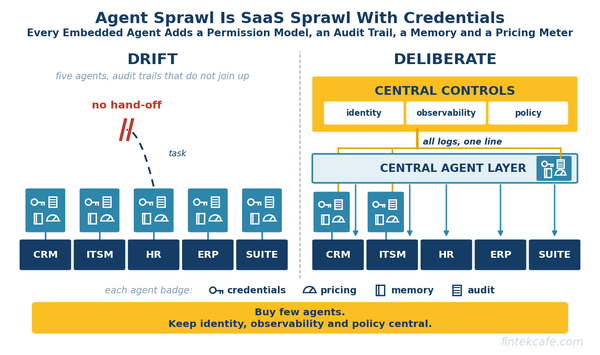
Every Software Vendor Now Sells an Agent, and Most Enterprises Should Buy Very Few of Them
Buying an agent from every system of record recreates SaaS sprawl one layer up. How CIOs should choose, and which controls must stay central.
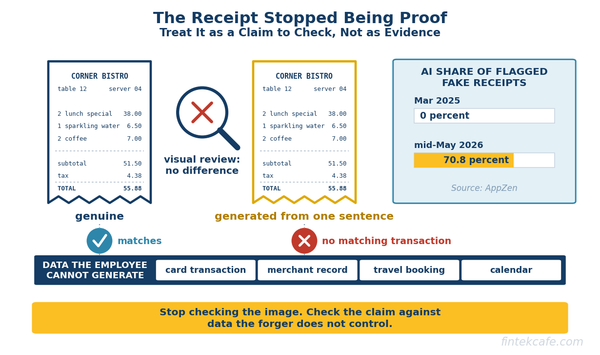
AI-Generated Fake Receipts: How Expense Fraud Changed and How Finance Teams Catch It
AI-generated fake receipts now beat visual review. How expense fraud changed, which detection still works, and the controls to use by company size.
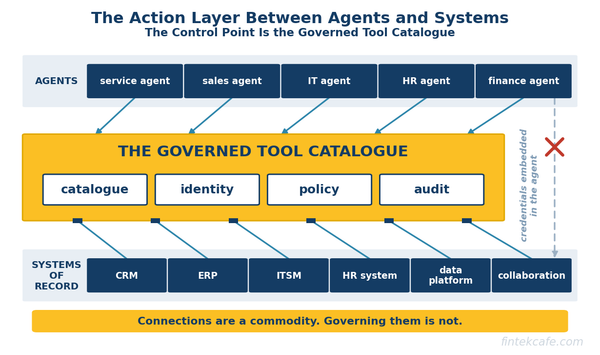
Integration Platforms Are the Quiet Winners of the Agent Era
Agents act through integrations. iPaaS and API vendors hold the connectors, credentials and audit trails, and MCP makes governing that layer worth more.