
What Are AI Evals? The Test Sets That Decide Whether Your AI Ships

What Are AI Evals? The Test Sets That Decide Whether Your AI Ships
Roughly 70 percent of enterprise AI pilots launched between 2023 and 2025 did not reach durable production, according to vendor-reported and analyst surveys aggregated through early 2026. Most of those failures were not model failures. They were eval failures: the team had no rigorous mechanism to measure whether the model outputs were good enough to deploy. The model performed exactly as configured; the team simply lacked an instrument to detect that the configuration was wrong.
This is the eval problem. Evaluation frameworks, known in the industry as "evals," are the structured test sets and scoring processes that determine whether an AI system is ready to ship, ready to update, and safe to keep running in production. They are unglamorous infrastructure, rarely featured in vendor demos and almost never mentioned in AI transformation roadmaps. They are also the single most reliable predictor of whether an AI project survives its first year in production.
For executives sponsoring AI initiatives, understanding what evals are and what maturity looks like is not a technical detail. It is essential context for assessing project risk, setting realistic timelines, and knowing which questions to ask the team delivering the work.
Why Vibe Checks Silently Kill Projects
The dominant evaluation method in most enterprise AI deployments is what practitioners call a "vibe check": a developer or product manager prompts the system several times, the outputs look acceptable, and the team ships. This method works until it catastrophically does not.
Vibe checks fail for three structural reasons.
Confirmation bias in sampling. Teams naturally probe inputs they expect the system to handle well. Edge cases, adversarial inputs, and requests that reflect distribution shift go untested until a customer encounters them in production. The sample of inputs a developer chooses during informal review is never representative of the full range of production traffic.
No regression baseline. When a prompt is revised or the underlying model is updated, there is no quantitative record of prior performance to compare against. Teams have no mechanism to distinguish genuine improvement from regression. A model swap that looks like an upgrade in informal testing may have degraded performance on an input class that matters to a specific customer segment.
Inconsistent human judgment. Research on inter-rater agreement consistently shows that humans disagree at significant rates when evaluating subjective text quality. When evaluation depends on informal review by a rotating set of team members using no shared rubric, the resulting signal is noisy and unreliable as a basis for deployment decisions.
The failure cascade from these gaps is predictable. An AI product launches with acceptable initial quality. A prompt update slightly degrades performance on a specific input class. Nobody detects it because the regression set is either absent or too narrow. Months later a high-value customer complains. By that point the root cause is nearly impossible to trace without proper evaluation records.
The Three Tiers of AI Evaluation
Mature evaluation systems use three complementary layers. Each catches failure modes the others miss. All three are necessary for AI systems that run in production beyond the pilot stage.
Tier 1: Offline Regression Sets
The foundation of any evaluation program is a curated dataset: a collection of inputs paired with expected outputs, acceptable-output criteria, or automated scoring rubrics. Teams run the full model pipeline against this dataset before every significant change, including prompt edits, model version upgrades, retrieval configuration changes, and system prompt modifications.
A well-constructed regression set covers four categories:
- Golden path inputs: representative requests the system must always handle correctly
- Edge case inputs: requests near the boundary of intended scope
- Adversarial inputs: prompts designed to surface hallucinations, off-topic responses, or scope violations
- Regression anchors: specific inputs that failed in production previously and were fixed; these must never regress
Scoring strategy depends on output type. Deterministic outputs, such as SQL queries that either return the correct rows or do not, support binary pass/fail scoring. Open-ended generation requires rubric-based scoring across dimensions such as factual accuracy, format compliance, and relevance to what the user actually asked.
The Golden-Dataset Problem
Building a regression set requires labeling expected outputs. This creates the golden-dataset problem: the dataset is expensive to construct, subjective to label, and structurally incomplete relative to production traffic.
Three dimensions characterize the problem.
Coverage. No fixed dataset covers the full distribution of real-world inputs. Production traffic drifts as user behavior changes, business policies evolve, and product scope expands. A dataset built at launch is partially stale within months.
Label quality. Human raters disagree, particularly on tone, nuance, and borderline acceptability. A dataset labeled by one subject-matter expert will differ systematically from one labeled by another. Without inter-rater calibration processes, the dataset ground truth is effectively the opinion of whoever happened to do the labeling.
Staleness. Beyond coverage gaps, the ground truth itself changes. A financial services AI trained on regulatory guidance from one year needs its test set updated when guidance changes the next year. An AI configured to reflect a product feature that was later removed will score "correct" answers on questions the product no longer supports.
Mature organizations treat the golden dataset as a living artifact with an owner, a documented review cadence, and a clear process for routing production failures back into future test cases. Treating the dataset as a one-time deliverable is one of the most common and costly evaluation mistakes.
Tier 2: LLM-as-Judge
Human review is too slow and too expensive for regression testing at scale. LLM-as-judge uses a separate, typically more capable language model to evaluate the outputs of the production model against a defined rubric.
The approach works well for dimensions that are difficult to automate with rule-based logic:
- Faithfulness: does the response accurately reflect the source documents provided to the model?
- Relevance: does the response address what the user actually asked?
- Tone and format compliance: does the response match the specified voice, length, and structural requirements?
- Scope adherence: does the response stay within the intended topic area?
LLM-as-judge is not a free lunch. Judge models carry known biases: a preference for longer responses, a tendency to favor confident-sounding answers over appropriately hedged ones, and a positional bias toward whichever option appears first when comparing alternatives in a ranked evaluation. These biases can corrupt scores in ways that are difficult to detect without deliberate calibration.
Before trusting LLM-as-judge scores in automated deployment pipelines, teams should validate the judge against a held-out set of human-labeled examples. If the judge's scores align with human rater scores at a rate comparable to human inter-rater agreement on the same rubric, the judge is a reliable signal. If alignment is substantially lower, the rubric or the judge model requires adjustment before it is used to gate deployments.
Tier 3: Online Production Scoring
Offline regression tests and LLM judges evaluate the model under controlled conditions against known inputs. Production scoring extends evaluation to live traffic, where the model encounters inputs no test set fully anticipates.
Common techniques include the following.
Implicit signals: user thumbs-up and thumbs-down ratings, session abandonment rates, and escalation-to-human rates in customer service deployments. These signals are noisy but available at scale without additional labeling cost.
Sampling-based human review: a random or stratified sample of production conversations routes to human reviewers on a regular cadence. This catches distribution shift that offline tests miss because it surfaces failure modes not yet represented in the regression set.
Canary deployments: new model configurations receive a small share of production traffic while the existing configuration serves the rest. Quantitative comparison identifies regressions before they affect the full user base.
Guardrail monitoring: production-deployed classifiers for topic violations, PII exposure, and content policy compliance log every trigger. A spike in guardrail activations is an early warning of distribution shift or coordinated adversarial use.
The Vendor Landscape
Several purpose-built evaluation platforms have emerged, each suited to a different organizational profile.
LangSmith (from LangChain) offers tight integration with the LangChain orchestration ecosystem. Its tracing and debugging interface makes it straightforward to inspect individual chain executions and correlate them with evaluation failures. Best suited to teams already using LangChain who want to add observability and evaluation without a separate integration project.
Braintrust focuses on dataset management, versioned prompt experiments, and automated LLM-as-judge scoring. Teams can run the same dataset against multiple model configurations and produce side-by-side quantitative comparisons. Well suited to teams iterating rapidly on prompts and needing rigorous evidence before committing to a configuration change.
Humanloop emphasizes human-in-the-loop review workflows. The platform manages routing of model outputs to subject-matter experts for annotation and tracks labeling progress. Better suited to regulated domains, such as legal, medical, or compliance applications, where expert review is a compliance requirement rather than an optional quality gate.
Patronus AI specializes in automated red-teaming and safety evaluation. The platform generates adversarial test sets and runs them against production models on a scheduled cadence. Purpose-built for organizations that must document AI safety testing to satisfy internal risk governance or emerging regulatory requirements.
Arize Phoenix is an open-source observability and evaluation platform. Teams with a preference for self-hosted infrastructure, or with existing MLOps tooling they want to extend rather than replace, find Arize Phoenix the most natural integration point.
For context on building the broader organizational AI capability, see How to Build an AI Strategy and Building an AI Center of Excellence. For an understanding of the agent-level systems that evaluation pipelines must cover, see What Are AI Agents.
The Buy-vs-Build Decision
Most teams that build internal evaluation tooling from scratch underestimate the ongoing maintenance cost. Evaluation platforms require schema management, result storage, visualization, alerting, and integrations with deployment pipelines. These are solved problems in purpose-built vendors.
Work through four questions to identify the right path.
How many AI use cases run in production? One or two narrow use cases may be manageable with a custom script and a spreadsheet. Three or more use cases sharing common evaluation infrastructure almost always justify a vendor platform.
How frequently do models or prompts change? Teams updating prompts weekly cannot sustain manual evaluation at that cadence. Automation is required.
Does the use case require regulatory documentation of evaluation results? Platforms that maintain immutable audit trails of evaluation runs reduce compliance burden materially compared to homegrown solutions with no audit history.
Does the team have capacity to maintain infrastructure? Open-source options such as Arize Phoenix offer full control at the cost of operational responsibility. Managed SaaS platforms trade some configurability for reduced overhead.
The Evaluation Maturity Model
Organizations move through five stages as evaluation practice matures.
Stage 0: No Evals. Output quality is assessed entirely through informal observation. There are no documented test cases, no regression baselines, and no systematic method for catching quality degradation. Failures surface when customers complain.
Stage 1: Ad Hoc Test Cases. A developer maintains a small collection of test inputs and expected outputs in a spreadsheet. Evaluation is manual, runs only before major releases, and reflects the personal experience of whoever built the list. Coverage is narrow and ungoverned.
Stage 2: Automated Regression Suite. A curated dataset of dozens to several hundred examples runs automatically on each deployment. Pass/fail scoring is automated for deterministic outputs. Rubric-based scoring for open-ended generation remains manual or is absent.
Stage 3: LLM-as-Judge Integration. Automated scoring covers open-ended outputs through a calibrated judge model. Evaluation runs on every code change or prompt update. Deployment pipelines block on regression thresholds. The team has formal definition of what constitutes a passing score.
Stage 4: Production Feedback Loop. Online production scoring feeds real-world failures back into the offline regression set. The golden dataset grows continuously from production experience rather than developer intuition alone. Sampling-based human review provides calibration data for the judge model on a recurring schedule.
Stage 5: Continuous Evaluation Culture. Evaluation is a first-class engineering discipline with dedicated ownership and executive visibility. Evaluation results drive model selection, prompt architecture, and retrieval design decisions. Red-teaming exercises run on a scheduled cadence and surface failure modes before customers encounter them. Regulatory compliance relies on documented evaluation artifacts with full audit trails.
Most enterprise organizations with production AI deployments operate between Stage 1 and Stage 3. Stage 4 and Stage 5 represent the standard for high-stakes deployments in financial services, healthcare, and regulated sectors broadly.
For related context on prompt design, see Prompt Engineering for Business and Agentic AI: An Executive Guide.
A Sample Eval Scorecard
A practical scorecard for a retrieval-augmented generation (RAG) application might structure evaluation across six dimensions.
| Dimension | Scoring Method | Target | Blocking Threshold |
|---|---|---|---|
| Faithfulness to source | LLM-as-judge | 0.90 or above | Below 0.80 |
| Response relevance | LLM-as-judge | 0.85 or above | Below 0.75 |
| Format compliance | Rule-based | 0.98 or above | Below 0.95 |
| Latency (p95) | Automated | Under 3 seconds | Over 5 seconds |
| Guardrail hit rate | Automated | Under 0.01 | Over 0.03 |
| Human review agreement | Human sample | 0.80 or above | Below 0.70 |
Thresholds should be calibrated to business context, not borrowed from another organization's scorecard. A customer-facing application requires higher faithfulness standards than an internal research assistant used by trained analysts. Setting thresholds by default values is a common error that produces either excessive blocking of safe deployments or insufficient blocking of risky ones.
Key Takeaways
- Most enterprise AI project failures are evaluation failures, not model failures: the model did what it was configured to do, and the team had no instrument to detect that the configuration was wrong.
- The three eval tiers, offline regression sets, LLM-as-judge, and online production scoring, address different failure modes; all three are necessary for production AI systems past the pilot stage.
- The golden-dataset problem requires treating test sets as living artifacts with governance, not one-time deliverables.
- LLM-as-judge must be calibrated against human raters before its scores are trusted in automated deployment gates.
- Most enterprise organizations operate at Stage 1 to Stage 3 of evaluation maturity; Stage 4 and Stage 5 require dedicated ownership and organizational commitment to evaluation as an engineering discipline.
- The buy-vs-build decision turns on use case volume, rate of model change, and regulatory documentation requirements.
FAQ
What is the minimum viable eval setup for a new AI project?
Start with a curated set of 50 to 100 test cases covering golden path inputs, known edge cases, and at least five adversarial prompts. Automate scoring for deterministic outputs. Add LLM-as-judge for open-ended outputs once the baseline is in place. This foundation is achievable in one to two weeks and prevents the majority of production regressions.
How many test cases does a production eval suite need?
Coverage matters more than raw count. A customer service application handling dozens of intent categories requires more cases than a focused code-generation tool with a narrow scope. A practical starting target is enough cases to cover the top 80 percent of production request types, with a defined process for adding new cases whenever a production failure surfaces.
Can LLM-as-judge replace human review entirely?
LLM-as-judge reduces the volume of human review required at scale. It does not replace human review for calibration, for high-stakes output decisions, or for domains where expert knowledge is required to assess correctness such as legal analysis or clinical documentation. Treat LLM-as-judge as a scalable first-pass filter, not a complete substitute for human judgment.
How do AI evals differ from traditional software testing?
Traditional software tests verify deterministic expected outputs: a function either returns the correct value or it does not. AI outputs are probabilistic and often evaluated on subjective dimensions such as tone, relevance, and helpfulness. This requires scoring rubrics and statistical thresholds rather than binary pass/fail logic, and introduces human rater disagreement as a first-class engineering concern.
What should an executive sponsor ask the AI team about their evaluation practice?
Four questions surface the most critical gaps: Do you have a documented regression test set? How do you detect when a model or prompt change caused a quality regression? What are your current scores on your key quality dimensions, and what are the blocking thresholds? When did a production failure last cause a new test case to be added to the suite?
Related Articles
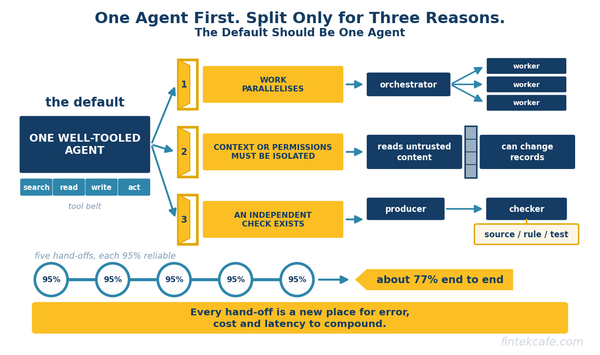
Multi-Agent Systems: When Splitting Work Across Agents Helps, and When It Multiplies Failure
Most tasks run better on one well-tooled agent. Multi-agent systems pay off only for parallel work, isolated context or independent checks.
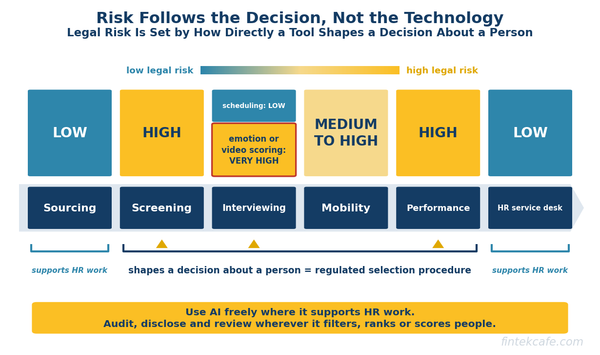
AI in Hiring and HR: Where It Helps, and Where the Legal Risk Sits
Where AI helps in hiring and HR, where legal risk concentrates, what NYC, the EU, Colorado, Illinois and California require, and which controls hold up.
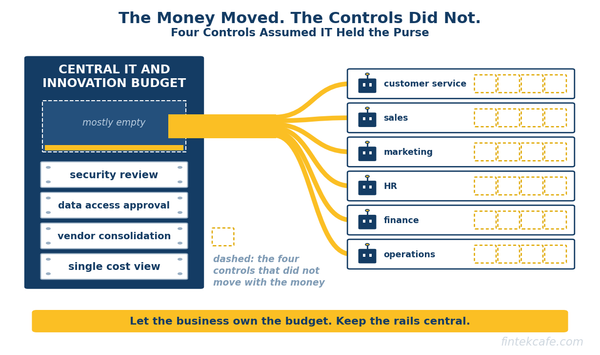
The AI Budget Is Moving From IT to the Business Lines, and Governance Has Not Followed
AI spend is moving from central IT to business lines. That ties cost to outcomes but breaks controls built for an IT-held purse. The model that works.