
AI in Marketing: What Generative AI Changes in Content, Campaigns and Brand Risk
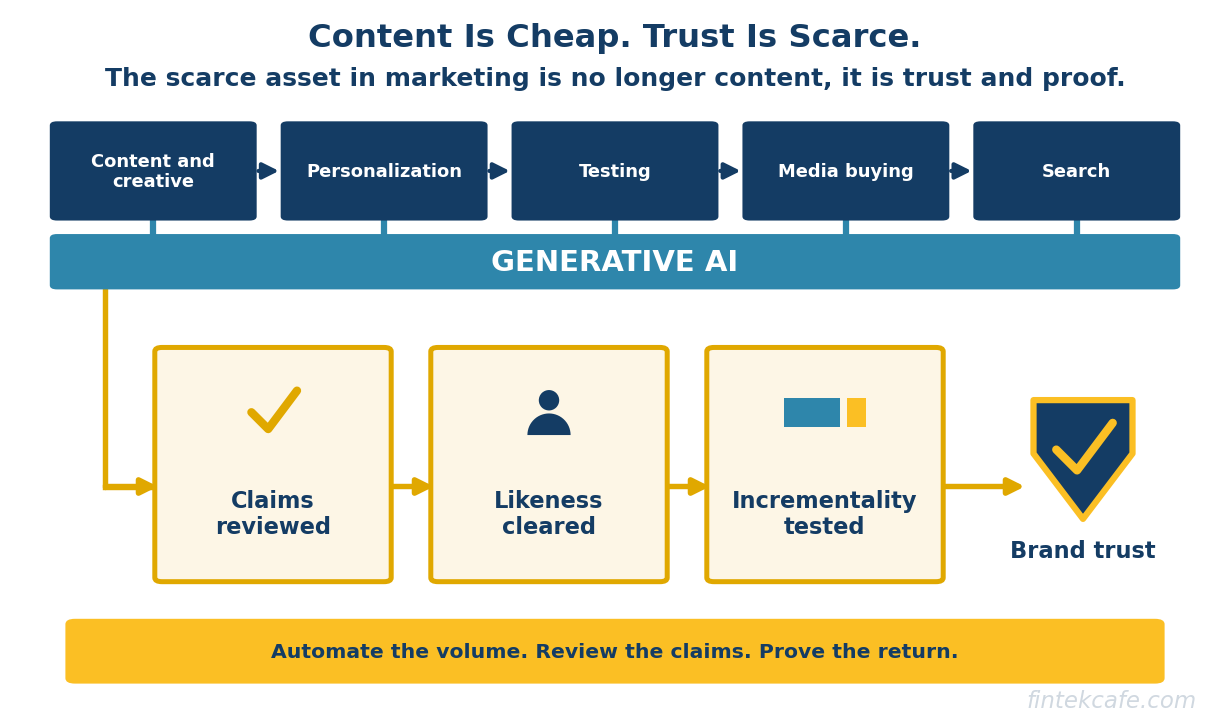
AI in marketing has moved past the question of whether generative AI can produce content. It can, cheaply and at volume, and the controlled evidence shows real gains: in a study published in Science in July 2023, 453 professionals using ChatGPT finished writing tasks about 40 percent faster with output rated about 18 percent better. The harder questions are second-order: what happens to brand voice, legal exposure and measurement when every competitor can do the same. Marketing was the first function to adopt generative AI at scale, and it is now the first to hit those problems. The position taken here: the scarce asset in marketing is no longer content, it is trust and proof. Organizations that spend their AI productivity savings on review and on incrementality testing will outperform those that spend them on more volume.
Key Takeaways
- Generative AI now touches every stage of the marketing workflow: content and creative, personalization, testing, search and media buying. The platforms themselves, through Google Performance Max and Meta Advantage+, are automating the buying.
- The independent evidence supports speed gains and modest quality gains on bounded tasks. It does not support the claim that AI-drafted copy beats expert copy. A 2024 Management Science study found that letting the model write hurt expert ad writers.
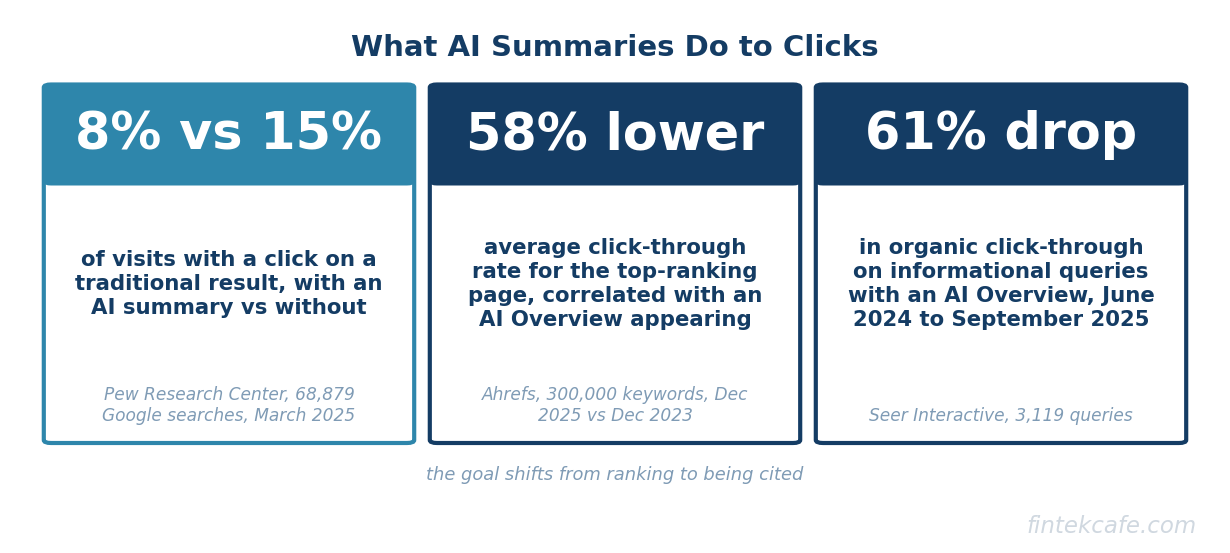
- Search is changing under marketing's feet. Pew Research found in July 2025 that users clicked a traditional result on 8 percent of visits when an AI summary appeared, against 15 percent when none did.
- The legal floor has risen. The FTC's rule on fake reviews has applied since October 21, 2024, and the EU AI Act's transparency obligations in Article 50 have applied since August 2, 2026.
- The decision rule: automate production and variation, require brand and legal review for anything that makes a claim or depicts a person, and keep positioning, crisis communication and final creative judgement human.
Why Marketing Hit the Second-Order Problems First
Marketing adopted generative AI early because most of its output is language and images, and a wrong draft costs little until it is published. Product descriptions, subject-line variants and campaign backgrounds are exactly the bounded tasks where models perform well.
Budget pressure accelerated it. Gartner's 2025 CMO Spend Survey, published in May 2025 and based on 402 marketing leaders surveyed in February and March 2025, found marketing budgets flat at 7.7 percent of company revenue, with 59 percent of CMOs saying they lacked the budget to meet their objectives. In the same survey, 49 percent of CMOs reported time efficiency gains from generative AI and 40 percent reported cost reduction, and 22 percent said it had reduced their reliance on external agencies for creative and strategy work.
Flat budgets plus nearly free content produce the second-order problems. When content is cheap for everyone, volume stops differentiating, channels fill up, brand voice drifts, and attribution breaks because the platforms doing the buying also grade the results.
What AI Does Across the Marketing Workflow
Content and creative production
The most mature use. Models draft blog posts, product descriptions, emails, social posts, headlines and scripts; image and video models produce backgrounds, product shots and localized variants. The productive pattern is a human brief, a model draft and a human edit. The unproductive pattern is publishing the draft.
Personalization and segmentation
Personalization used to mean swapping a first name into a template. Now a model can write a different email for each segment, adjusted for industry, role and buying stage. The same capability powers outbound sales sequences, which is why marketing and sales automation are converging; the controls that apply to AI sales agents and automated prospecting apply equally to AI-personalized marketing email.
Campaign testing
A team can now test thirty headlines instead of three. The limit is no longer production but traffic: each variant needs enough impressions for a reliable result, and more variants without more traffic produces noise that looks like insight.
Media buying inside platform AI
The largest shift is happening inside the ad platforms. Google describes Performance Max as "a goal-based campaign type that allows you to access all Google Ads inventory" from a single campaign, across Search, YouTube, Display, Discover, Gmail and Maps. The advertiser supplies goals, budgets and creative assets; Google's models decide where, when and to whom the ads run. After years of advertiser complaints about opacity, Google added channel-level reporting, search terms reporting and campaign-level negative keyword lists to Performance Max during 2025, according to its Google Ads help center.
Meta's equivalent is the Advantage+ suite, which automates audience targeting, placement and increasingly the creative itself. The Wall Street Journal reported in June 2025 that Meta aims to let brands fully automate ad creation and targeting by the end of 2026. On its second-quarter 2026 earnings call in July 2026, Meta said the Advantage+ suite had passed an annual revenue run rate of more than 75 billion US dollars, as reported by MediaPost and PPC Land.
The implication: a large share of media decisions is now made by a platform model optimizing toward the conversion signal the advertiser provides. If that signal is weak, such as a form fill rather than a qualified lead, the model will efficiently buy more of the wrong thing.
SEO when the search engine answers the question
Search is the channel most disrupted. Google's AI Overviews and AI Mode answer many informational queries directly, and the independent evidence on clicks is consistent in direction:
- Pew Research Center, July 22, 2025: browsing data from 900 US adults covering 68,879 Google searches in March 2025. When an AI summary appeared, users clicked a traditional result on 8 percent of visits, against 15 percent when no summary appeared. They clicked a link inside the summary itself on just 1 percent of visits. Google disputed the framing.
- Ahrefs, February 4, 2026: across 300,000 keywords, the presence of an AI Overview correlated with a 58 percent lower average click-through rate for the top-ranking page, comparing December 2025 with December 2023. Its April 2025 study had found 34.5 percent.
- Seer Interactive, September 2025: on 3,119 informational queries across 42 client organizations, organic click-through on queries with an AI Overview fell 61 percent between June 2024 and September 2025, and paid click-through fell 68 percent. Brands cited inside the AI Overview earned about 35 percent more organic clicks than brands that were not cited.
The last finding is the strategic one. When search answers the question, the goal shifts from ranking to being cited, which rewards original data, clear positions and named sources. AI-generated volume content is, almost by definition, the least citable kind.
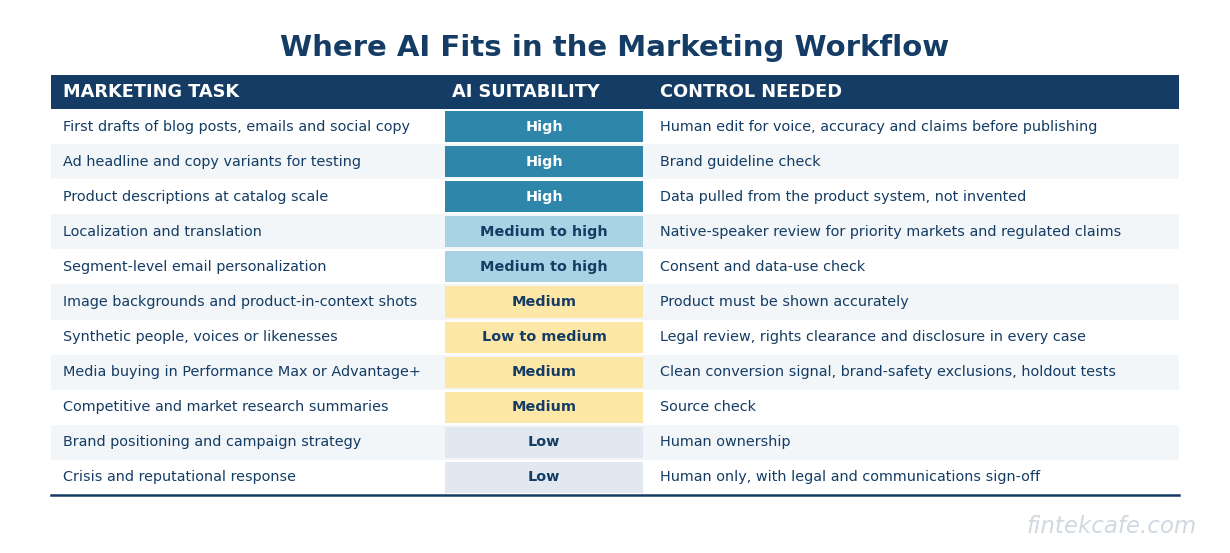
The marketing task table
| Marketing task | AI suitability | Control needed |
|---|---|---|
| First drafts of blog posts, emails and social copy | High | Human edit for voice, accuracy and claims before publishing |
| Ad headline and copy variants for testing | High | Brand guideline check; claims reviewed against approved list |
| Product descriptions at catalog scale | High | Data pulled from the product system, not invented; sample audit |
| Localization and translation | Medium to high | Native-speaker review for priority markets and regulated claims |
| Segment-level email personalization | Medium to high | Consent and data-use check; suppression lists enforced |
| Image backgrounds and product-in-context shots | Medium | Product must be shown accurately; no altered features |
| Synthetic people, voices or likenesses | Low to medium | Legal review, rights clearance and disclosure in every case |
| Media buying in Performance Max or Advantage+ | Medium | Clean conversion signal, brand-safety exclusions, holdout tests |
| Competitive and market research summaries | Medium | Source check; never cite a figure the model cannot link |
| Brand positioning and campaign strategy | Low | Human ownership; AI as a sounding board only |
| Crisis and reputational response | Low | Human only, with legal and communications sign-off |
What the Evidence Says About Productivity and Quality
The evidence on AI in marketing falls into three categories with very different weight. Executives should keep them separate.
Independent studies
The strongest evidence comes from controlled experiments. Noy and Zhang's study in Science (July 2023) gave ChatGPT to half of 453 college-educated professionals doing occupation-specific writing tasks such as press releases, short reports and sensitive emails, with marketers among the occupations tested. Time fell about 40 percent and quality, graded by evaluators in the same fields, rose about 18 percent. The authors noted they did not fact-check the output, which matters: published marketing copy is held to a factual standard that the experiment did not test.
Chen and Chan, in Management Science (2024), tested how people write ads with a large language model, measuring results with real social media click rates. Using the model as a sounding board, giving feedback on a human draft, improved ads written by non-experts. Using it as a ghostwriter produced no significant benefit and hurt expert writers, an effect the authors attribute to anchoring on the model's draft. That is the most useful single finding for a marketing leader: the gain depends on how the tool is used and by whom.
At larger scale, Fang, Yuan, Zhang, Donati and Sarvary ran randomized field experiments with millions of users on a cross-border online retail platform during 2023 and 2024, posted to arXiv in October 2025 and revised through June 2026. Across seven workflows including advertising and customer service, sales effects ranged from no detectable impact to 16.3 percent, depending on how much the AI added beyond what the platform already did. Gains came mainly from higher conversion, and return rates and customer ratings did not worsen.
Surveys and vendor figures
Surveys such as Gartner's tell executives what marketing leaders believe: the 49 percent reporting time savings is a perception, not a measurement. Vendor figures are weaker still as evidence of return. Meta's Advantage+ run rate measures how much advertising flows through its automated products, not whether that advertising produced incremental sales. Both are evidence of adoption, not of effect.
Where It Fails
Brand voice drift
Each generated asset can be on-brand enough to pass a quick review, while the brand as a whole drifts toward the generic register every model shares. The drift is worst where generation is decentralized: regional teams, agencies and individual employees using tools the central team never approved. The same governance pattern applies here as in managing shadow AI across the enterprise: find the tools in use, provide approved ones with the brand guidelines built into the prompt, and make the approved path easier than the workaround.
Factual errors in published copy
Models produce fluent text that is sometimes false. In marketing, a false statement in published copy is not a model error; it is the company's claim. In May 2025, a syndicated summer reading list produced by King Features, a Hearst subsidiary, ran in the Chicago Sun-Times and the Philadelphia Inquirer recommending books that did not exist, as reported by NPR on May 20, 2025. The freelance writer acknowledged using AI. The controls that catch this, grounding output in approved sources, verifying every specific claim, and sampling published output, are covered in how to control AI hallucinations.
Copyright and likeness
Two risks sit here. The first is ownership. The US Copyright Office's copyrightability report of January 29, 2025 concluded that, with generally available technology, prompts alone do not make the user the author of the output, though human selection, arrangement and perceptible human input can be protected. A purely generated logo, jingle or mascot may therefore not be protectable, weakening the company's ability to stop copies.
The second is likeness. Tennessee's ELVIS Act, effective July 1, 2024, was the first US state law protecting an individual's voice against unauthorized AI imitation. At the federal level, the NO FAKES Act (S. 4591, introduced May 20, 2026) passed the Senate Judiciary Committee by voice vote on June 18, 2026, but an attempt to pass it by unanimous consent on September 30, 2026 failed when Senator Ted Cruz objected, according to the Congressional Record as reported by legal press. It is not law, but using a voice or face resembling a real person without consent carries reputational risk under any statute.
Disclosure rules
United States. The FTC's Trade Regulation Rule on the Use of Consumer Reviews and Testimonials (16 CFR Part 465) took effect on October 21, 2024. It prohibits fake reviews and testimonials, explicitly including those generated by AI that misrepresent the reviewer's existence or experience, along with buying fake social media indicators. Knowing violations can carry civil penalties of up to 53,088 US dollars each, the 2025 inflation-adjusted maximum, which the FTC confirmed in September 2026 it would keep for 2026. On December 22, 2025, the FTC sent warning letters to ten unnamed companies about potential violations of the rule. On the same day it set aside its 2024 consent order against Rytr, an AI writing tool that had offered a review-generation feature, saying the order unduly burdened AI innovation. The signal for executives is that the tool vendor may not be the target; the brand that publishes a fake review still is.
European Union. Article 50 of the EU AI Act sets transparency obligations that have applied since August 2, 2026. Among them, deployers that publish deepfakes, meaning AI-generated or manipulated images, audio or video that resemble real people, places or events, must disclose that the content is artificial, with lighter treatment for evidently artistic or satirical work. Providers of generative systems must mark output in a machine-readable way. The Digital Omnibus on AI, adopted as Regulation (EU) 2026/1744 and published in the Official Journal in July 2026, delayed the high-risk system rules to December 2027 but left Article 50 largely on schedule, adding a grace period to December 2, 2026 for machine-readable marking by systems already on the market. Under Article 99(4) of the Act, breaches of Article 50 can be fined up to 15 million euros or 3 percent of worldwide annual turnover, whichever is higher, with the lower figure applying to small and medium-sized firms.
Reputation sets a stricter standard than either rule. When Guess ran an advertisement in the August 2025 print edition of Vogue featuring AI-generated models, disclosed only in small print, the backlash centered on the disclosure as much as on the models. Coca-Cola's AI-generated holiday advertisements drew criticism in 2024 and again in 2025. In both cases the legal exposure was minimal; the brand cost was not.
The brand-risk table
| Content type | Exposure | Required review |
|---|---|---|
| Internal drafts and briefs | Low | None beyond the author |
| Organic social posts with no product claims | Low to medium | Brand voice spot check; community manager approval |
| Blog and SEO content | Medium | Editor review; every number and named source verified |
| Paid ads with product or performance claims | High | Claims checked against substantiation file; legal for regulated categories |
| Comparative advertising naming competitors | High | Legal review in every case |
| Reviews, testimonials and endorsements | High | Must be real customers; no AI generation of reviews or reviewer identities |
| Synthetic people, voices or likenesses | High | Legal review, consent or licence on file, visible disclosure |
| Content in the EU depicting realistic people or events | High | Article 50 disclosure check before publishing |
| Regulated categories: health, financial products, alcohol, children | Very high | Compliance and legal sign-off; human-written core claims |
The Measurement Problem
When every competitor can produce unlimited content and the platforms automate the buying, the old measurement model breaks in three places.
First, the platform grades its own results. Performance Max and Advantage+ use their own attribution and are incentivized to claim sales that would have happened anyway, particularly from existing customers and branded searches.
Second, saturation lowers response. If every company in a category sends three times as many emails because writing them is free, engagement falls for everyone, and the first adopter's measured gains disappear.
Third, search loses its base signal: an AI Overview that cites the brand may build awareness with no click recorded.
The answer is incrementality: holdout tests in which a random group sees no campaign, geographic experiments, and media mix models independent of platform attribution. They cost money and patience, and they are the only way to tell the CFO what AI-driven spend actually produced. The finance side of that conversation is set out in how CFOs should measure AI ROI.
The Decision: Automate, Review, Keep Human
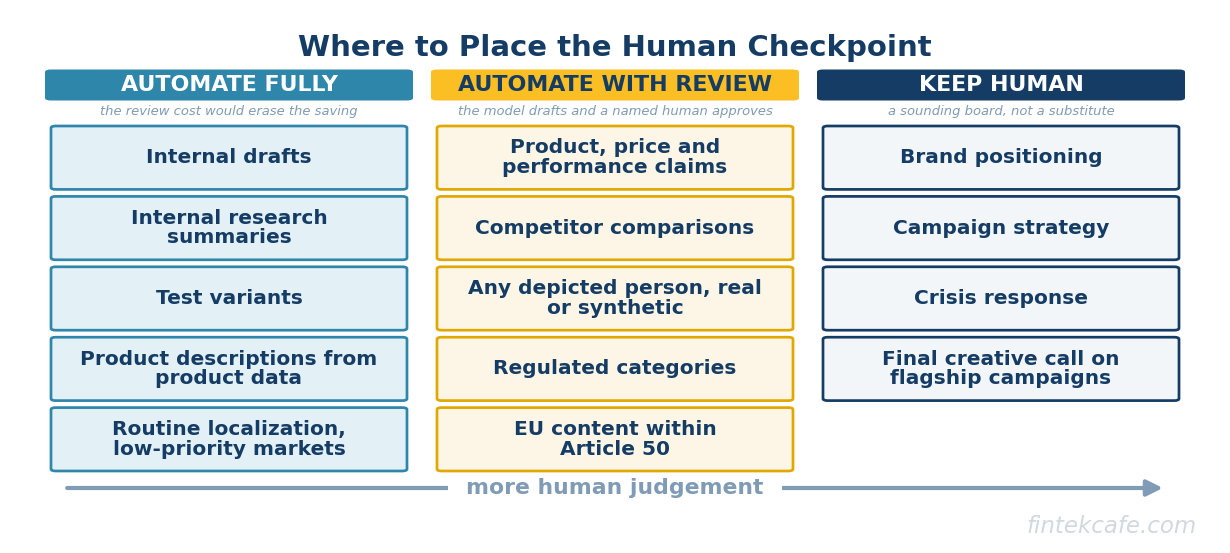
The decision is no longer whether to use generative AI in marketing. It is where to place the human checkpoint.
Automate fully: internal drafts, research summaries for internal use, variant generation for testing, product descriptions drawn from structured product data with sample audits, and routine localization for low-priority markets. The risk is low and the review cost would erase the saving.
Automate with brand and legal review: any published content that makes a claim about a product, a price, a performance figure or a competitor; any content that depicts a person, real or synthetic; any content in a regulated category; and any content for EU audiences that falls within Article 50. Here the model drafts and a named human approves.
Keep human: brand positioning, campaign strategy, crisis response, and the final creative call on flagship campaigns. The evidence on expert ghostwriting supports this: the model is a good sounding board for strategy and a poor substitute for it.
These rules belong in the company AI policy, with approved tools, data rules and review thresholds, as set out in how to write an enterprise AI governance policy.
The Position, and Its Tradeoff
The position: treat AI productivity in marketing as a budget to reinvest, not as a reason to produce more. Put the savings into three things: review capacity for claims and likeness, incrementality testing that does not depend on platform attribution, and original material, such as proprietary data, research and clear positions, that AI search engines cite and competitors cannot generate.
The tradeoff is real. A team that reviews every claim and runs holdout tests will publish less and move slower than a competitor flooding the same channels, and for a quarter or two that competitor may post better platform-reported numbers. The bet is that platform numbers are the wrong scoreboard, that saturated channels punish volume, and that one fabricated review or undisclosed synthetic spokesperson costs more than a year of saved copywriting fees. Where brand matters little and price decides everything, volume may be the rational choice.
Frequently Asked Questions
How is generative AI used in marketing?
To draft copy, create images and video, personalize email by segment, generate test variants, localize content and summarize research. Inside the ad platforms, Google Performance Max and Meta Advantage+ use AI to decide targeting, placement and increasingly the creative.
Does AI-generated marketing content perform better than human-written content?
Not reliably. Controlled studies show AI makes writing faster and helps less experienced writers. A 2024 study in Management Science found that when the model wrote the ad copy, expert writers performed worse than when they used it only for feedback. Results depend on how the tool is used.
Do companies have to disclose AI-generated marketing content?
It depends on jurisdiction and content type. In the EU, Article 50 of the AI Act has required disclosure of deepfakes since August 2, 2026. In the US, there is no general AI disclosure rule for advertising, but the FTC prohibits AI-generated fake reviews and testimonials, and deceptive advertising law applies to synthetic content that misleads.
How are AI Overviews affecting marketing traffic?
Independent studies show fewer clicks when an AI summary appears. Pew Research found users clicked a traditional result on 8 percent of visits with an AI summary against 15 percent without, and Ahrefs measured a 58 percent lower click-through rate for top-ranking pages. Being cited inside the summary partly offsets the loss.
The Bottom Line
Generative AI has made marketing content cheap, and the platforms are automating the buying. Advantage shifts from production to judgement: which claims the company stands behind, whose face and voice it uses, and how it proves spend produced revenue. Automate the volume work, put a named reviewer in front of every claim and likeness, keep strategy human, and measure with experiments rather than platform dashboards. The winners will be the companies whose content is worth citing, not the ones that publish the most.
Related Articles
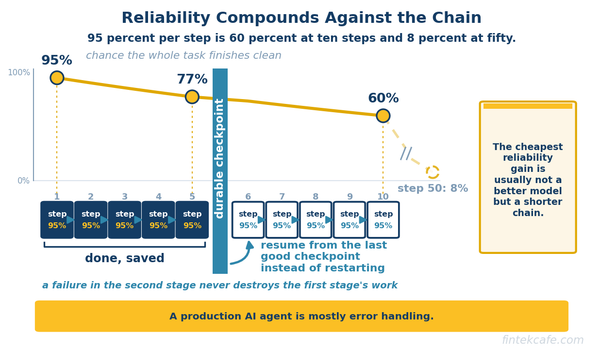
Agent Error Handling: How to Design AI Agents That Fail Safely and Recover Cleanly
Agents with 95 percent reliable steps finish 60 percent of ten-step tasks. A practitioner guide to failure classes, recovery patterns, and reversibility.
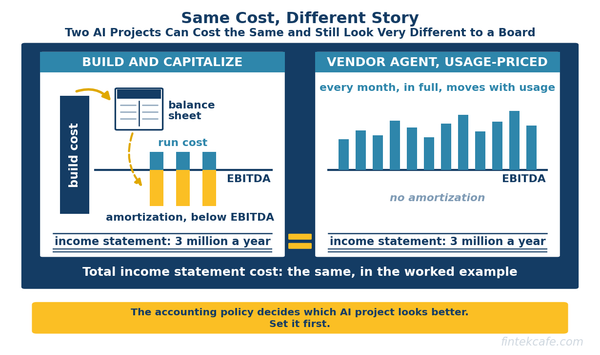
Capitalize or Expense: How AI Spending Lands on the Income Statement, and Why It Changes the Business Case
Accounting treatment quietly decides which AI projects look attractive. What can be capitalized, what cannot, and the policy a CFO should set first.
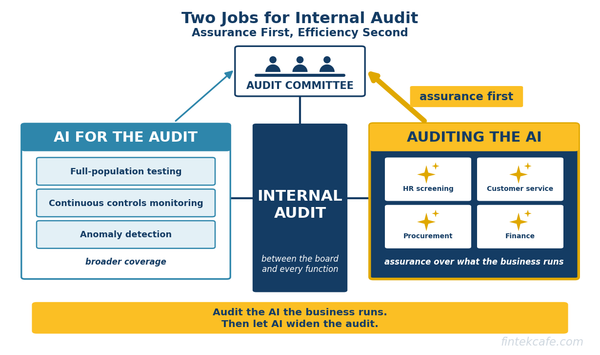
AI in Internal Audit: How Auditors Use It, and How to Audit the AI the Business Already Runs
AI in internal audit: full-population testing, continuous monitoring, where evidence breaks down, and an assurance checklist for the AI your business runs.