
Why Most Enterprise Knowledge Graphs Fail (And What Top AI Teams Do Differently)
Every large enterprise AI program now has a knowledge-graph project somewhere on its roadmap. The pitch is consistent: a unified semantic layer powering RAG, search, analytics, and agent workflows from a single source of truth. Plausibly more than two thirds of those projects, based on public post-mortems and practitioner accounts through 2025-2026, will be cancelled, descoped, or quietly archived at the six-month mark. The pattern is recurrent enough to treat as a category rather than isolated incidents.
The contrarian read is that knowledge graphs are not failing because the technology is immature. The technology has worked at production scale inside Palantir, JPMorgan's CIO group, Google, Amazon, and a handful of national-security and pharma organizations for more than a decade. They are failing because the procurement and execution pattern that works in those organizations is structurally different from what most 2026 enterprise AI teams are running.
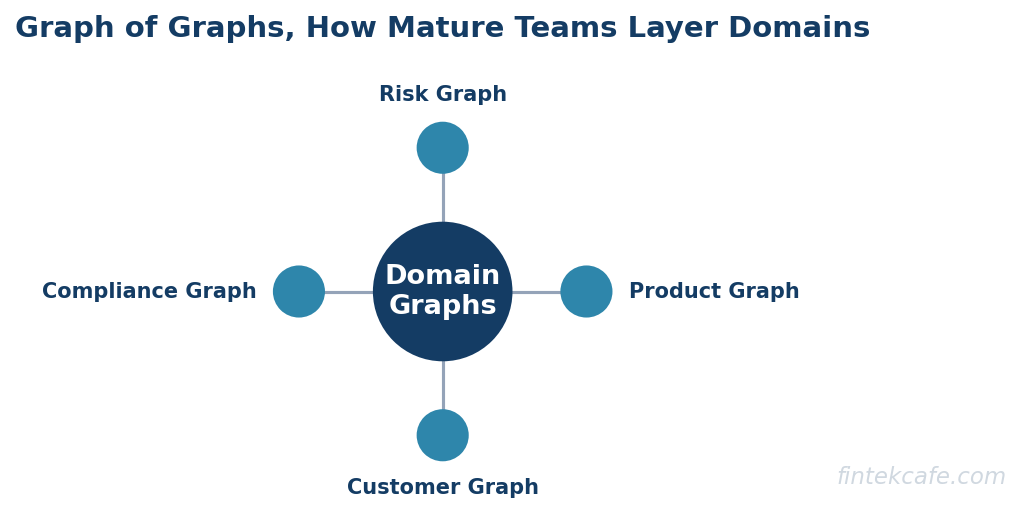
This article walks through the three recurring failure modes, the operating model the organizations who have built durable graphs use instead, the graph-of-graphs pattern emerging as the consensus 2026 architecture, the build-versus-buy reality, and a ninety-day diagnostic for whether the organization actually has a knowledge-graph problem or an information-architecture problem with a graph-shaped budget.
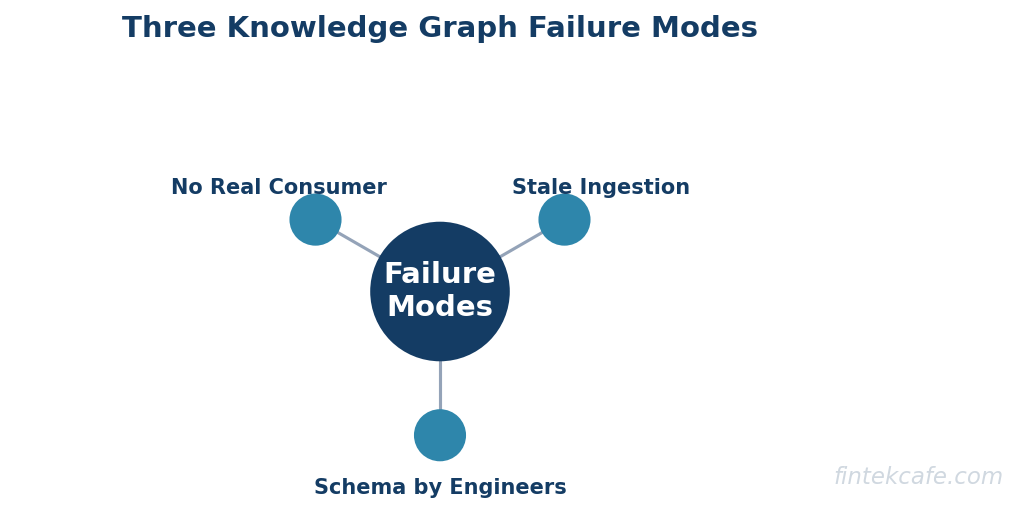
The Three Failure Patterns
Failure Pattern One: Schema Designed by Data Engineers, Not Domain Experts
The first and most consequential failure mode is the schema designed without enough domain weight. A knowledge graph schema is a model of the business. The entities, the relationships, the cardinalities, and the temporal semantics encode what the organization considers a customer, a product, a transaction, a contract, an obligation, and a risk. Getting the model right requires sustained input from the people who actually run those business processes, not just from the data engineers tasked with implementing the graph.
The dominant 2025-2026 anti-pattern is a graph schema built primarily by the data-engineering team, often by reverse-engineering the existing warehouse schema into a property-graph or RDF model. The result is structurally a graph and semantically a denormalized warehouse: same entities, same foreign-keyed relationships, none of the new semantic relationships that would have justified the graph in the first place.
Diagnostic signal: ask the data team how many domain experts (in legal, risk, compliance, product, operations) have meaningfully shaped the schema. If the answer is "we showed them the diagrams and they nodded," the schema is not domain-driven and the project is at the start of the typical six-month death spiral.
The Palantir pattern at major financial institutions illustrates the alternative. Foundry deployments at JPMorgan, Morgan Stanley, and several large insurers structurally embed domain experts (Forward Deployed Engineers paired with subject-matter experts) in the schema design for months, not days. The ontology that emerges encodes the customer's business semantics in a way that survives turnover. The technology is incidental; the operating model is the differentiator.
Failure Pattern Two: Ingestion Pipelines That Cannot Keep Up With Source-of-Truth Changes
The second failure mode is the ingestion gap. A knowledge graph is only useful if it is current relative to the systems-of-record that feed it. A six-hour-old graph of customer relationships is fine for some analytics, useless for fraud decisioning, and actively harmful for any agent workflow that takes action based on the graph state.
Building the ingestion pipeline correctly is a meaningful engineering investment. The pipeline must handle schema evolution in source systems, entity resolution across heterogeneous representations of the same business entity (a customer in Salesforce, a counterparty in the trading system, an obligor in the risk system), conflict resolution when sources disagree, and bitemporal handling so the graph represents what was true at any historical point.
The dominant anti-pattern is treating ingestion as an afterthought: the team builds the graph, points a few ETL jobs at it, declares the pipeline solved, and four months later the graph has drifted enough from systems-of-record that consumers do not trust the data. The trust loss is irreversible without rebuilding the pipeline, and the political cost of rebuilding usually exceeds the project's remaining political capital.
The pattern that works: treat ingestion as the primary engineering investment, not the graph database itself. Serious organizations spend two to three times as much engineering effort on ingestion as on the graph. Change-data-capture, deterministic entity resolution with provenance, structured conflict-resolution rules, and bitemporal modeling are not optional.
Failure Pattern Three: No Clear Consumer
The third failure mode is the most common and the hardest to diagnose at project kickoff. A knowledge graph project that is funded as a horizontal capability (a "semantic layer for AI" with no specific named consumer) reliably underdelivers because the schema decisions, the ingestion priorities, and the query patterns all depend on what the graph is for, and a graph with no specific consumer optimizes for none of them.
A typical kickoff has three or four hopeful consumers in the room: a RAG team grounding LLM outputs, a search team wanting entity-aware retrieval, an analytics team needing multi-hop queries, and an agent team wanting a structured world model. Each has different latency, freshness, schema, and access-pattern needs. The graph schema that serves one well usually serves the others poorly.
The graph-as-shared-infrastructure pattern is the canonical failure mode: no consumer fully trusts it, no consumer fully owns it, no consumer fights for it at budget time. By the time the consumers have built their own purpose-built indexes alongside the graph, the central graph has become an expensive operational burden with no clear user.
The pattern that works in serious organizations is the opposite: the graph is funded by a single specific consumer, with a defined business outcome, and the architecture is designed for that consumer's needs first. Other consumers are added incrementally and explicitly, with each addition triggering a deliberate evaluation of whether the new requirements can be served by the existing graph or whether a separate graph-shaped capability is needed.
This is a Premium Article
Sign up for a Premium membership to read this article and get full access to strategic intelligence on technology and business.
Already a member? Sign in
Related Articles
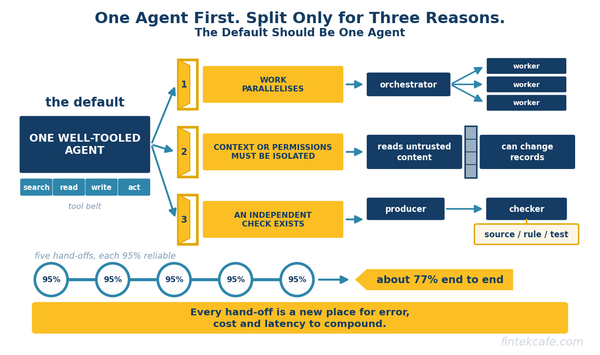
Multi-Agent Systems: When Splitting Work Across Agents Helps, and When It Multiplies Failure
Most tasks run better on one well-tooled agent. Multi-agent systems pay off only for parallel work, isolated context or independent checks.
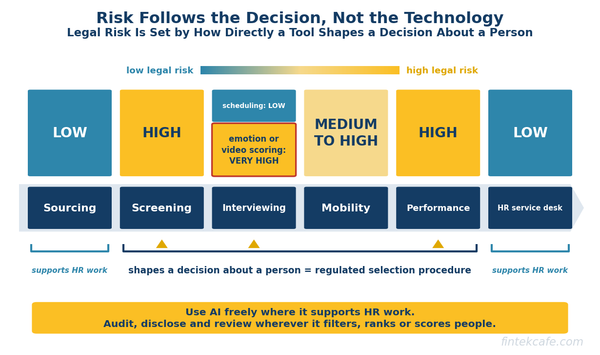
AI in Hiring and HR: Where It Helps, and Where the Legal Risk Sits
Where AI helps in hiring and HR, where legal risk concentrates, what NYC, the EU, Colorado, Illinois and California require, and which controls hold up.
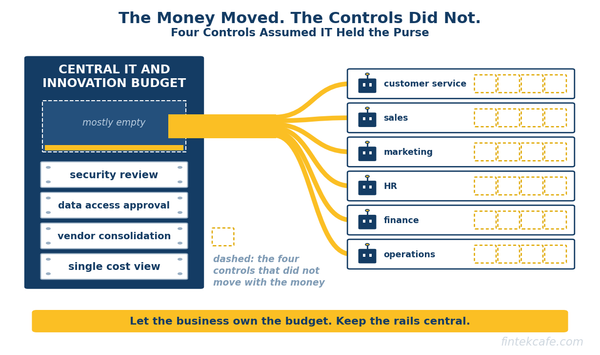
The AI Budget Is Moving From IT to the Business Lines, and Governance Has Not Followed
AI spend is moving from central IT to business lines. That ties cost to outcomes but breaks controls built for an IT-held purse. The model that works.