
Service Mesh in 2026: Istio vs Linkerd vs Cilium for Financial Workloads
Key Takeaways
- Service mesh adoption stalled in 2022 and 2023 because the operational tax (a second sidecar per pod, a second control plane, a second cert authority) exceeded the benefits for most teams. In 2026 each of the three leading meshes solved a different piece of that tax.
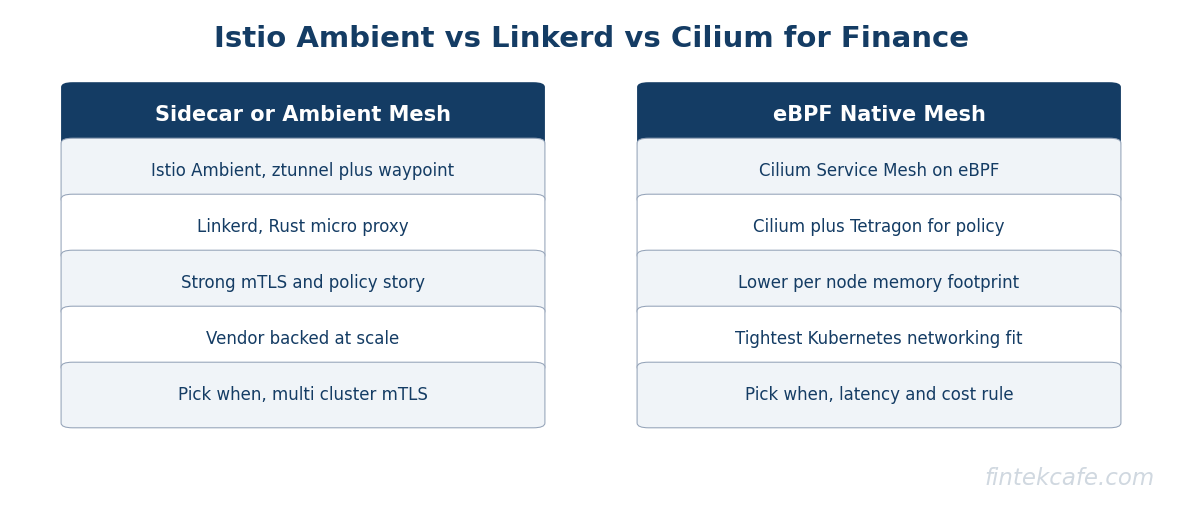
- Istio shipped ambient mode, which removes the per-pod sidecar and replaces it with a node-level proxy plus a per-namespace gateway. Linkerd doubled down on Rust and simplicity, with the smallest data-plane footprint of the three. Cilium pushed mutual TLS into eBPF, eliminating the user-space proxy on the encryption path for many workloads.
- For financial workloads the calculus changed because mutual TLS by default, traffic audit, and PCI scope reduction now arrive without the prior operational tax. The three meshes deliver these capabilities through different architectures, and the choice depends on how the team already runs its platform.
- The decision is not which mesh is best in the abstract. It is which mesh fits the team. Istio for teams that need policy depth and run on cloud Kubernetes. Linkerd for teams that prioritize operational simplicity over feature surface. Cilium for teams already running its CNI and willing to live on eBPF.
- Service mesh remains the wrong answer for small clusters, monolithic deployments, and teams without an existing platform-engineering function. The decision tree should start with whether the team is ready, not with which product is shiniest.
Why Service Mesh Adoption Stalled
The service mesh wave arrived in 2018, peaked in conference talks in 2020, and quietly stalled in 2022. The reasons were operational, not conceptual. The case for a mesh (mutual TLS without code changes, fine-grained traffic policy, request-level observability) was always sound. The cost of getting there in early Istio releases was a sidecar Envoy proxy injected into every pod, doubling pod count, doubling memory footprint, complicating debugging, and introducing a new failure mode every time a pod started.
The Linkerd 2 rewrite in Rust reduced the per-pod overhead but did not change the fundamental shape. Both meshes asked teams to run a second control plane, a second certificate authority, and a second data path next to the application. For platforms with twenty services, the tax was visible and the team often opted out. For platforms with two hundred services, the tax was even more visible, and the team often opted out for a different reason: the operational risk of a mesh-wide misconfiguration was unbounded.
The honest read of 2023 was that most production Kubernetes installations did not run a service mesh, and the ones that did either inherited the decision from a prior platform team or had a regulated workload that effectively required it. Financial services were over-represented in the latter group because mutual TLS by default and per-call traffic audit are the kind of controls that compliance teams stop asking about once they exist.
What Changed in 2024 and 2026
Three architectural shifts moved the cost-benefit ratio.
Istio ambient mode. In late 2024 Istio's ambient mode reached general availability. The architecture removed the per-pod sidecar and replaced it with two pieces: a node-level proxy (ztunnel) handling layer-4 mutual TLS and a per-namespace gateway (waypoint) handling layer-7 policy when needed. The result is that workloads get mutual TLS without sidecar injection, without restarting pods, and without the per-pod memory footprint. Teams can opt into layer-7 policy on the namespaces that need it and skip it on the namespaces that do not.
Cilium service mesh on eBPF. Cilium pushed parts of the mesh into the kernel. Mutual TLS authentication is handled by a small user-space agent, but the encryption path uses kernel primitives (IPsec or WireGuard) rather than a user-space proxy. For teams already running Cilium as their container network interface (CNI), enabling the mesh adds capability without adding a parallel data path. The trade-off is feature surface: Cilium's mesh handles traffic encryption and basic identity well but lags Istio on layer-7 policy depth.
Linkerd's micro-proxy maturity. Linkerd took the opposite path. Rather than push into the kernel, it doubled down on a tiny Rust proxy (linkerd2-proxy) and a deliberately narrow feature set. The 2025 releases tightened resource footprint and operational surface. The pitch is honesty: Linkerd does fewer things than Istio, but the things it does require less day-two operational work.
The three approaches now represent three different bets about where the mesh tax should live. The 2026 question is no longer whether the tax is acceptable. It is which form of the tax fits the team.
The Three Architectures
Istio Ambient
Istio ambient runs ztunnel as a DaemonSet on every Kubernetes node. Pod-to-pod traffic is intercepted at the node level, encrypted with mutual TLS, and decrypted at the receiving node. No per-pod sidecar is required. For workloads that need layer-7 policy (HTTP routing, JWT validation, fine-grained authorization), a waypoint proxy is deployed per namespace or per service account.
The architecture is the most feature-rich of the three. It is also the most complex. Two data planes (ztunnel and waypoint) coexist. Configuration spans both. The benefit is that teams can pay the layer-7 cost only where they need it.
Linkerd
Linkerd uses one data plane: a Rust-based micro-proxy injected as a sidecar. The control plane (linkerd-destination, linkerd-identity, linkerd-proxy-injector) is small and deliberately constrained. Mutual TLS is on by default. Layer-7 features (retries, timeouts, traffic split) are supported but the feature set is narrower than Istio's.
The pitch is operational simplicity. The data plane is one component. The configuration surface is small. The trade-off is that some advanced policy patterns (request authentication with external identity, mesh-level rate limiting) require additional tooling.
Cilium Service Mesh
Cilium's mesh extends its existing eBPF data plane. Mutual TLS uses kernel-level encryption (IPsec or WireGuard) keyed by SPIFFE identities. Layer-7 policy is supported via an Envoy sidecar deployed only where needed. The architecture inherits Cilium's CNI properties: high throughput, low latency, deep network observability.
The fit is strongest for teams already running Cilium as their CNI. For teams using a different CNI, adopting Cilium for the mesh means changing the CNI as well, which is a much larger commitment.
Comparison Matrix
| Dimension | Istio Ambient | Linkerd | Cilium |
|---|---|---|---|
| Data-plane footprint | Node-level ztunnel + per-namespace waypoint | Per-pod Rust micro-proxy | Kernel eBPF + optional Envoy |
| mTLS approach | Sidecar-free (ztunnel) | Sidecar (Rust) | Kernel (IPsec or WireGuard) |
| Layer-7 policy | Deep (HTTP, JWT, AuthZ) | Moderate | Moderate (via Envoy) |
| Observability | Rich (Prometheus, OpenTelemetry, Jaeger) | Built-in dashboards, Prometheus | Hubble (network + L7) |
| Multi-cluster | Mature (primary-remote, mesh federation) | Supported (mc-mirror) | Supported (Cluster Mesh) |
| Operational complexity | High (two data planes) | Low (one component) | Moderate (depends on CNI fit) |
| Best fit | Large platform teams, multi-tenant clusters | Small to mid-size platforms, simplicity-first teams | Teams already on Cilium CNI |
| Worst fit | Small teams without platform-eng function | Teams needing deep layer-7 policy | Teams committed to a different CNI |
The matrix is a starting point, not a verdict. The decision turns on factors not captured in a feature table: who runs the platform, what the existing tooling is, and whether the team has the operational maturity to absorb the mesh's day-two work.
Why Financial Workloads Are Different
Three properties of financial-services platforms change the calculus.
Mutual TLS by default is a regulatory expectation, not a feature. PCI DSS requires encryption of cardholder data in transit. The principle of least privilege means service-to-service traffic should authenticate at both ends. Building these controls in application code, in 2026, is not a defensible choice. The mesh is the cheapest way to deliver them uniformly across hundreds of services.
Audit trails matter more than performance optimization. A payment platform spends more on compliance reporting than on infrastructure. A mesh that surfaces per-call traffic logs, identity-aware metrics, and policy-enforcement events reduces the cost of producing audit evidence. The observability story is often the buying decision.
PCI scope reduction is a board-level outcome. If service-to-service traffic is encrypted at the mesh layer and the mesh-level identity is mapped to the application identity, the scope of the PCI cardholder-data environment can be drawn more tightly. Smaller PCI scope means fewer systems in the audit, lower audit cost, faster releases for non-PCI services. The mesh is one of the few infrastructure investments that pays back in compliance dollars rather than performance dollars.
These properties are the reason financial-services platforms over-index on service mesh adoption despite the operational cost. The shift to ambient, eBPF, and simplified data planes has not removed the operational cost. It has lowered the threshold at which the compliance payoff exceeds it.
A Decision Framework for Financial Platforms
The decision tree for which mesh to deploy has four branches.
Branch one: Do you have a platform-engineering function with at least three engineers dedicated to Kubernetes infrastructure? If no, the answer is to stop. Service mesh without a platform team is a failure mode regardless of which product is chosen. The lower-cost path is to deliver mutual TLS in code (mTLS libraries are mature) and revisit the mesh decision when the platform team exists. Treating the service catalog and the platform team as prerequisites is the right shape.
Branch two: Are you already running Cilium as your CNI? If yes, Cilium's mesh is the lowest-friction path. Adding the mesh adds capability without adding a parallel data path. If no, adopting Cilium for the mesh means changing the CNI, which is a much larger project than choosing a mesh.
Branch three: Do you need deep layer-7 policy (JWT validation, fine-grained AuthZ, external identity integration)? If yes, Istio ambient is the strongest fit. The waypoint architecture lets the team pay the layer-7 cost only where needed. If no, Linkerd is the lowest-operational-cost option.
Branch four: How many clusters does the platform span? Single cluster favors Linkerd's simplicity. Multi-cluster favors Istio's mature federation story. Cilium's Cluster Mesh has matured enough that it is no longer a disqualifier for multi-cluster setups, but Istio still has the broader feature set.
The decision is best made by writing down the answers, not by running a proof of concept. A proof of concept always shows that all three meshes work in a clean environment. The interesting differences appear in the second year of operation, which a proof of concept cannot reveal.
When Service Mesh Is Wrong for You
A mesh is the wrong answer in four cases.
Small clusters. Below roughly fifty services or fifty pods, the mesh tax exceeds the benefit. Mutual TLS in code is achievable. Observability can be handled with existing tooling. The platform overhead does not justify the operational cost.
Predominantly monolithic deployments. A platform running three large monoliths and a handful of microservices does not need a mesh. The intra-monolith traffic is already in-process. The inter-monolith traffic is small enough to handle with application-level TLS and a simple ingress.
Teams without operational depth. A mesh is a high-leverage tool. It is also a high-blast-radius tool. A misconfigured authorization policy can take down every service in a cluster. Teams without on-call maturity, change-management discipline, and a tested rollback path will hurt themselves with any of the three meshes.
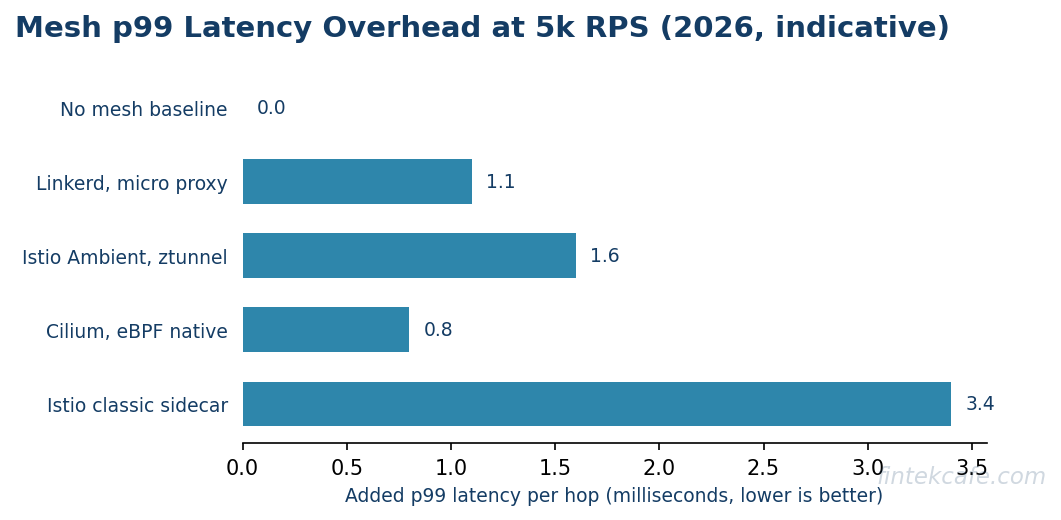
Workloads where latency is paramount. Even the lightest mesh adds a few hundred microseconds of per-hop latency. For low-latency trading systems, market-data fan-out, or real-time fraud scoring on the hot path, that overhead can be the difference between meeting and missing a service-level objective. The right answer for those workloads is often to keep them out of the mesh entirely and run the mesh for the rest of the platform.
The connecting principle is honest self-assessment. The mesh is a force multiplier for platforms that are already mature. It is an accelerant of dysfunction for platforms that are not. The underlying architecture decisions (workload boundaries, deployment topology, identity model) are downstream of how the team thinks about microservices and monoliths and how it runs its DevOps practice. A mesh does not fix those decisions. It surfaces them.
What This Means for Financial Platforms in 2026
The 2026 question is no longer whether to adopt a service mesh. It is whether the platform team has earned the right to. For platforms with a mature platform-engineering function, a clear policy of mutual TLS by default, and a regulatory landscape that demands PCI scope reduction, the answer is yes and the choice is between Istio ambient (deepest policy), Linkerd (simplest operations), and Cilium (best fit on eBPF). For platforms still consolidating their Kubernetes story, the answer is to delay and revisit when the underlying conditions are met.
The connection to core banking modernization is direct. The migration off legacy core systems creates the conditions where a mesh starts to earn its keep: more services, more inter-service traffic, more regulatory scrutiny. Banks that are mid-migration in 2026 should be making the mesh decision now, not as an afterthought to the broader platform plan.
FAQ
Is Istio still the default service mesh in 2026?
Istio is still the most-deployed mesh in production and has the largest feature surface. Ambient mode removed the biggest historical objection (per-pod sidecar overhead). For platforms that need deep layer-7 policy and have the platform-engineering function to operate it, Istio remains the default. For smaller teams, Linkerd's simplicity is often the better fit.
Does eBPF replace service mesh?
No. eBPF is a kernel mechanism that lets a mesh implement parts of its data path more efficiently. Cilium uses eBPF for the encryption path and for network policy. It still relies on a user-space agent for identity and on Envoy for layer-7. The right framing is that eBPF changes how a mesh is built, not whether one is needed.
What is the difference between sidecar and ambient mode?
Sidecar mode injects a proxy container into every application pod. Ambient mode removes the per-pod sidecar and runs the proxy at the node level (for layer-4 mutual TLS) and per-namespace (for layer-7 policy, only when needed). Ambient mode reduces per-pod overhead and simplifies pod lifecycle but adds complexity at the platform level.
Can a service mesh replace an API gateway?
Not cleanly. A service mesh handles east-west traffic (service-to-service inside the cluster). An API gateway handles north-south traffic (external clients to the cluster). The two have overlapping features (TLS termination, routing, authentication) but different scopes. Most production platforms run both.
How long does it take to roll out a service mesh in a financial platform?
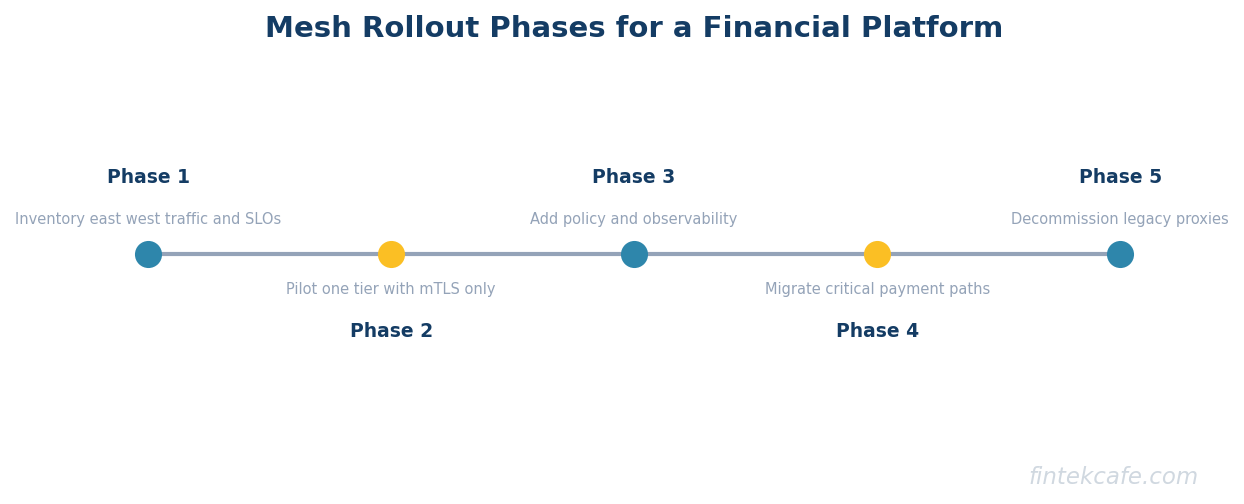
A realistic timeline is six to twelve months for a platform with 100 to 300 services, assuming a dedicated platform-engineering team. The work is not the mesh installation. It is the per-service onboarding, the policy migration, the certificate-issuance integration, and the incident-response runbook. Treating it as a one-quarter project is the most common cause of stalled rollouts.
Related reading on FinTekCafe
- Cloud Computing Explained: What Every Business Leader Needs to Know
- What Is a Service Catalog? The Platform-Engineering Primer
- Service Mesh: When You Actually Need One
- Microservices vs Monoliths: What Executives Need to Know
- DevOps Explained: How Modern Companies Build and Ship Software
- Core Banking Systems: The Technology That Runs Every Bank
Related Articles
Integration Platforms Are the Quiet Winners of the Agent Era
Agents act through integrations. iPaaS and API vendors hold the connectors, credentials and audit trails, and MCP makes governing that layer worth more.
What Happens to Your Data Inside AI Systems: Retention, Deletion and the Copies Nobody Tracks
Every AI feature copies company data into prompts, logs, embeddings and memory. Where each copy lives, what vendors retain, and how to make deletion real.
Data Classification: The Step Every Enterprise AI Rollout Skips, and What It Costs Later
Why AI assistants expose overshared data, how data classification fixes it, what to label first, and a 90-day plan for executives.