
Disaster Recovery Planning: What Technology Leaders Actually Need
Disaster recovery is the capability to restore technology systems after a major failure, and the operative word is capability: a plan that has never been executed is a document, not a capability. Every DR decision reduces to two numbers set per system, the recovery time objective (how long the business can survive without the system) and the recovery point objective (how much data the business can afford to lose), and those two numbers select from an architecture ladder whose rungs differ in cost by an order of magnitude or more. The stakes are well documented: the Uptime Institute's outage analysis has found that a clear majority of significant outages cost over one hundred thousand USD, with a growing share exceeding one million. Boards ask about disaster recovery the week after a headline outage, and most organizations answer with a binder. This guide covers what a real answer looks like: honest objectives, an architecture matched to them, evidence from testing, and an inventory of the cloud-era failure modes the classic playbook does not cover.
Key Takeaways
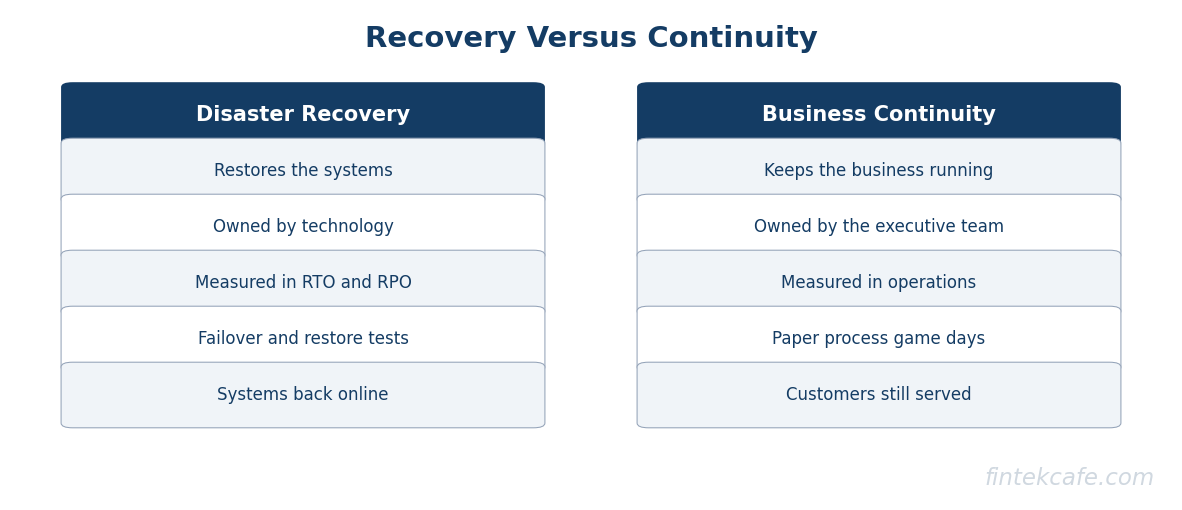
- Disaster recovery restores systems; business continuity keeps the business operating while they are down. Both are needed, they are different disciplines, and a technology leader who conflates them will be handed responsibility for decisions, like which business processes can run on paper, that belong to the whole executive team.
- RTO and RPO are business decisions expressed in technical units. Set them per system tier, not globally: a global "four-hour RTO for everything" either bankrupts the infrastructure budget or is quietly fictional, and it is usually the second.
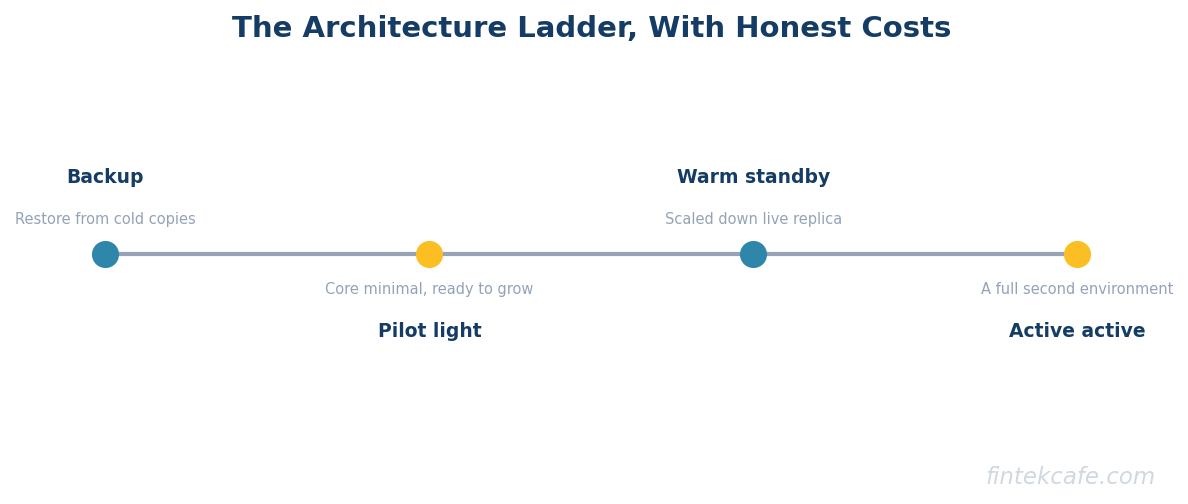
- The architecture ladder runs backup/restore, pilot light, warm standby, active-active. Each rung roughly multiplies cost: from single-digit percent of production cost at the bottom to a full second environment plus engineering complexity at the top. The most common error is buying one rung of ambition and assuming two rungs of capability.
- Untested DR is fiction. The evidence from real incidents is consistent: backups that never restored, runbooks that reference systems that no longer exist, failovers that had never been exercised under load. A restore test schedule and periodic game days are the difference between a capability and a hope.
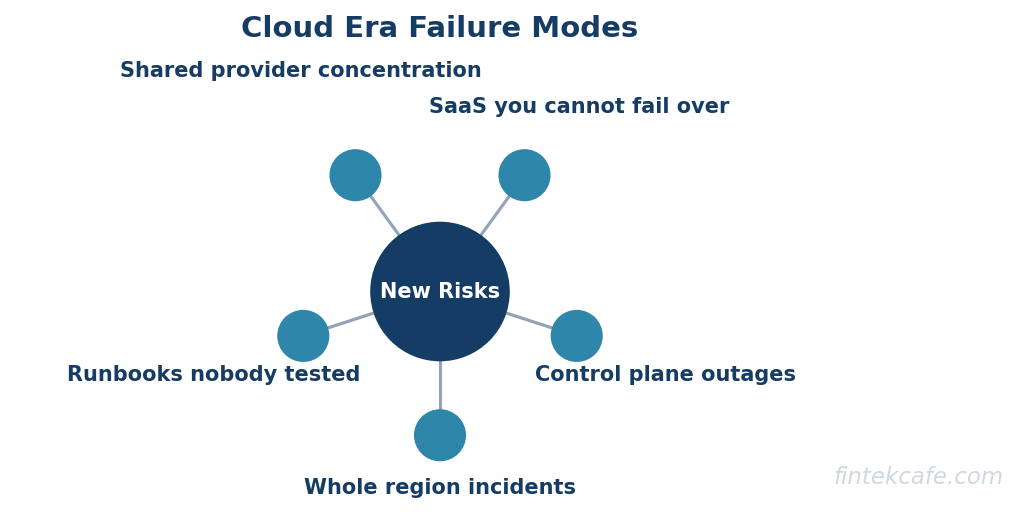
- Cloud-era failures break the old playbook's assumptions: whole-region incidents, control-plane outages that disable the recovery tooling itself, SaaS dependencies that cannot be failed over by the customer at all, and concentration risk when your providers share providers. Regulators, most explicitly the EU's DORA regime in force since January 2025, now treat these as board-level operational-resilience obligations in financial services.
Disaster Recovery Is Not Business Continuity
The two terms travel together and get used interchangeably, which suits nobody. Disaster recovery is a technology discipline: restoring systems, data, and infrastructure after a serious failure. Business continuity is an organizational discipline: keeping critical business functions running during the disruption, including the parts that have nothing to do with servers, like whether the call center has a script for the outage, whether payments can be authorized manually below a threshold, and who is empowered to communicate with customers and regulators.
The distinction matters to a technology leader for a self-interested reason: if the organization has no business-continuity function, the DR plan silently becomes the business-continuity plan, and the CTO inherits accountability for decisions that were never theirs to make. The clean division of labor: the business decides what must keep functioning and at what cost, expressed as recovery objectives per business process; technology translates those into per-system objectives and builds to them; and the residual gap, what will simply not work for a while, is accepted in writing by the executives who own the risk. A DR program without that written acceptance is a program where the gap is discovered live.
The Two Numbers That Drive Everything: RTO and RPO
Every disaster recovery architecture is an answer to two questions. Recovery time objective (RTO): how long after a failure until the system must be serving again. Recovery point objective (RPO): how much recent data the business can afford to lose, measured backward in time from the failure. A four-hour RTO with a fifteen-minute RPO means: down for at most four hours, and at most the last fifteen minutes of transactions are gone.
Both numbers are business decisions wearing technical clothes, and the correct way to set them is per system, by asking what an hour of downtime and a minute of lost data actually cost in each case. Payment authorization and order capture justify aggressive numbers. The analytics warehouse, internal wikis, and the reporting layer do not, and pretending they do multiplies the DR budget for no risk reduction. The practical instrument is a tiering exercise:
| Tier | Typical systems | RTO | RPO | What that implies |
|---|---|---|---|---|
| 0: Life-of-business | Payment processing, order capture, core ledger, auth | Minutes | Near zero | Active-active or hot standby; continuous replication; automated failover |
| 1: Critical | Customer-facing apps, fulfillment, support tooling | Under 4 hours | Under 15 minutes | Warm standby; frequent replication; rehearsed failover runbook |
| 2: Important | Internal apps, reporting, batch pipelines | Under 24 hours | Under 4 hours | Pilot light or restore from backup; daily rehearsed restores not required per system |
| 3: Deferrable | Dev/test, archives, analytics sandboxes | Days | 24 hours | Backup/restore only; recovery is a queue, not an emergency |
Two disciplines keep the table honest. First, the tier list is reviewed with the business annually, because systems migrate tiers as the business changes and nobody files a ticket when they do. Second, dependencies are mapped: a tier-0 system that depends on a tier-2 system for startup, a configuration store, a secrets manager, an internal DNS, has a real tier of 2, and this dependency inversion is among the most common findings when recovery is actually exercised.
The DR Architecture Ladder, With Honest Costs
Recovery architectures form a ladder of four patterns, and each rung buys recovery speed with money and complexity. The honest framing for an executive is cost multiples, not feature lists.
| Pattern | How it works | Realistic RTO | Cost, as a multiple of doing nothing | The catch |
|---|---|---|---|---|
| Backup and restore | Data backed up off-site or cross-region; infrastructure rebuilt on demand | Many hours to days | Low single-digit percent of production cost | Rebuild time is always longer than estimated; restores must be tested or they do not exist |
| Pilot light | Core data replicated continuously; minimal infrastructure kept warm, scaled up on failover | One to a few hours | Roughly 10 to 20 percent of a second environment | Scale-up depends on the cloud having capacity and automation that works untested |
| Warm standby | A scaled-down but fully functional copy runs continuously; traffic switches and standby scales to full | Minutes to an hour | Commonly 30 to 60 percent of production cost | Config drift between primary and standby is the silent killer; must be deployed to in lockstep |
| Active-active | Two or more full environments serve live traffic simultaneously | Near zero for infrastructure failures | Two times production or more, plus significant engineering complexity | Data consistency across regions is a hard distributed-systems problem; the architecture must be designed for it, not retrofitted |
Three observations keep organizations from mispurchasing on this ladder. First, the ladder is per tier, not per company: the right shape for most enterprises is active-active or warm standby for tier 0, pilot light for tier 1, and plain backups below, which is dramatically cheaper than uniform ambition. Second, active-active is an architecture, not a checkbox: it constrains how state is managed everywhere, which is why it is realistic for systems designed around asynchronous, event-driven patterns and painful to retrofit onto a shared-database design; the architectural prerequisites overlap heavily with the trade-offs covered in when event-driven architecture is worth it and in the microservices versus monolith decision. Third, the rung you have is the rung you have tested, not the rung you have provisioned. A warm standby that has never taken production traffic is a pilot light with better billing.
Untested DR Is Fiction
The recurring pattern across published postmortems is not that organizations lacked DR plans; it is that the plan's first full execution was the disaster itself. The specific failure modes repeat with numbing regularity. Backups that ran for years but were never restored, discovered corrupt or incomplete at the moment of need; the restore-that-never-ran is the classic. Runbooks that reference decommissioned systems, renamed accounts, and colleagues who left. Failover automation that fails on a permissions change made eighteen months ago. Standby environments that drifted from production until the application no longer started on them. Recovery credentials stored inside the system being recovered.
The countermeasure is a testing ladder that matches ambition. At minimum: scheduled restore tests, where a backup is actually restored to a clean environment and the application actually runs against it, on a calendar, with results reported. Above that: component failover tests, where individual tier-0 and tier-1 systems are deliberately failed over during a controlled window. Above that: game days, where a realistic scenario, a region loss, a corrupted primary database, a ransomware detonation, is run end to end with the real people and real runbooks, and the findings are treated like incident findings. Mature organizations add continuous chaos testing on the systems that claim the highest tiers, on the logic that a failover exercised weekly by a machine is the only failover that can be trusted at 3 a.m.
For an executive, one metric summarizes the whole section: time since last successful full restore, per tier-0 and tier-1 system. If the answer is "never" or "unknown," the DR budget is buying documentation. The same metric belongs in due diligence when acquiring a company, alongside the rest of the technology examination covered in the executive guide to technical due diligence: a target's claimed recovery capability is worth exactly its testing evidence.
Cloud-Era Failure Modes the Old Playbook Misses
The classic DR playbook was written for a world where the disaster was yours: your data center flooded, your hardware died. The cloud moved the failure domain, and several new modes sit outside the plan entirely. The basics of that shared-responsibility shift are covered in the primer on how cloud computing works; the DR-relevant consequences are these.
Whole-region incidents. Regions fail rarely but not never, and a multi-availability-zone deployment inside one region, the default resilience posture, shares more fate than the marketing implies: some regional services, capacity pools, and networking layers are region-scoped. Tier-0 claims require cross-region evidence.
Control-plane outages. The subtlest cloud failure mode is the one where your workloads are healthy but the cloud's management layer is not: consoles, APIs, and deployment tooling are degraded, which means the automation your failover depends on may be unavailable precisely when it is needed. Recovery plans that require creating new infrastructure during the incident inherit this dependency; plans that only require redirecting traffic to already-running capacity largely do not. This distinction quietly moves organizations up the ladder for their top tier.
SaaS dependencies you cannot fail over. The modern enterprise runs on SaaS for identity, communication, source control, deployment, monitoring, and payroll, and a customer cannot fail over a SaaS vendor; there is no standby Salesforce. The realistic mitigations are contractual (resilience commitments, transparency into the vendor's own DR), architectural (avoiding hard runtime dependencies on SaaS in tier-0 paths, keeping a break-glass identity path if the identity provider is down), and procedural (business-continuity workarounds per critical SaaS product). The widely felt security-software incident of July 2024, which grounded flights and closed hospital systems worldwide via a single vendor's faulty update, made the general point better than any tabletop exercise: the disaster arrived through a dependency no customer's DR plan could fail over from.
Concentration risk. Diversification can be illusory: your multi-vendor stack may share a DNS provider, a CDN, a certificate authority, or an upstream cloud underneath the brands. Financial regulators have converged on this as a systemic concern. In the EU, the Digital Operational Resilience Act (DORA), applying to financial entities since January 2025, requires firms to map critical third-party ICT dependencies, set impact tolerances, test recovery against severe-but-plausible scenarios, and report major incidents, with critical technology providers themselves brought under direct oversight; UK regulators imposed comparable operational-resilience obligations, with firms required to remain within defined impact tolerances by March 2025. For financial-services leaders, the regulatory translation is blunt: untested DR is no longer just risk, it is non-compliance.
What a Real Answer to the Board Looks Like
A technology leader asked "are we prepared for a disaster" after a headline outage has a strong answer available if, and only if, the program above exists. It sounds like this: systems are tiered with business-agreed recovery objectives; tier-0 runs cross-region with automated failover exercised on a schedule; the last full restore test of each critical system is dated within the quarter; the top five SaaS and concentration dependencies are mapped with documented workarounds; and here are the two gaps we have accepted in writing, with the cost of closing them. That answer is one page. The binder version, and the global-four-hour-RTO version, are what organizations present when the honest one-pager would be embarrassing, and boards have learned to tell the difference.
FAQ
What is the difference between disaster recovery and business continuity?
Disaster recovery is the technology discipline of restoring systems and data after a major failure. Business continuity is the broader organizational discipline of keeping critical business functions operating during the disruption, including manual workarounds, communications, and decision authority. DR is one component of business continuity; an organization with excellent DR and no continuity planning can restore its servers while still failing its customers.
What are RTO and RPO?
Recovery time objective (RTO) is how quickly a system must be restored after a failure; recovery point objective (RPO) is how much recent data the business can afford to lose, measured backward from the failure. A four-hour RTO with a fifteen-minute RPO means at most four hours down and at most fifteen minutes of data lost. Both should be set per system tier based on business impact, because uniform global targets are either unaffordable or fictional.
Which disaster recovery pattern should an organization choose?
Choose per tier, not globally. Active-active or hot standby is justified for the handful of systems where minutes of downtime cost real revenue or regulatory standing; warm standby or pilot light fits critical but not life-of-business systems; plain backup and restore is the right answer for everything else. The ladder's cost spans from single-digit percent of production cost to more than double it, so uniform ambition is the most expensive mistake available.
How often should disaster recovery be tested?
Restore tests for critical systems should run on a schedule, at least quarterly for top tiers, and a full game-day exercise, simulating a realistic scenario end to end with real people and runbooks, at least annually. The systems claiming the fastest recovery deserve the most frequent exercise, up to routine automated failover. A backup that has never been restored and a failover that has never run should be treated as nonexistent.
What is DORA and does it apply to disaster recovery?
The Digital Operational Resilience Act is the EU regulation, applying to financial entities since January 2025, that turns operational resilience from good practice into legal obligation. It requires financial firms to map critical technology dependencies including third parties, set impact tolerances, test recovery against severe-but-plausible scenarios, and report major incidents, and it places critical technology vendors under direct regulatory oversight. For in-scope firms, documented and tested DR is part of compliance, not just risk management.
Related reading on FinTekCafe
Related Articles
Integration Platforms Are the Quiet Winners of the Agent Era
Agents act through integrations. iPaaS and API vendors hold the connectors, credentials and audit trails, and MCP makes governing that layer worth more.
What Happens to Your Data Inside AI Systems: Retention, Deletion and the Copies Nobody Tracks
Every AI feature copies company data into prompts, logs, embeddings and memory. Where each copy lives, what vendors retain, and how to make deletion real.
Data Classification: The Step Every Enterprise AI Rollout Skips, and What It Costs Later
Why AI assistants expose overshared data, how data classification fixes it, what to label first, and a 90-day plan for executives.