
Legacy System Modernization: Strategies That Do Not Blow Up
A legacy system is not a system that is old; it is a system the organization can no longer change safely, and modernization is the discipline of buying back that ability to change without betting the company on a rewrite. The decision is expensive in both directions. Modernizing too eagerly burns years and credibility on migrations whose benefits were aesthetic: industry studies have repeatedly found large IT modernization programs running dramatically over budget and under-delivering, with McKinsey's long-cited joint research with Oxford finding large IT projects running 45 percent over budget while delivering less value than planned, and a substantial minority overrunning so badly they threaten the company. Waiting too long converts the system into a hostage: the last engineer who understands it retires, the vendor ends support, the auditor writes the finding, and every integration the business wants becomes a negotiation with a black box. This guide covers when modernization is actually justified, the strategy ladder with honest cost and risk profiles, why the strangler-fig pattern is the default for systems that matter, what AI genuinely changes, and how to fund the work as risk retirement rather than an IT wish.
Key Takeaways
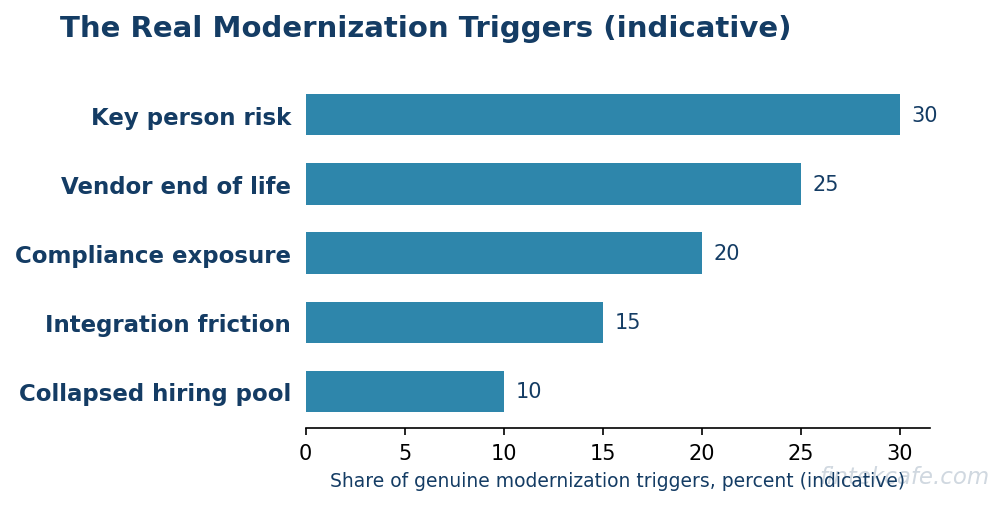
- Legacy is a business-risk category, not an aesthetic judgment. The real triggers are key-person risk, vendor end-of-life, compliance exposure, integration friction, and a collapsed hiring pool. Age alone is not a trigger: a stable, understood, changeable old system is an asset.
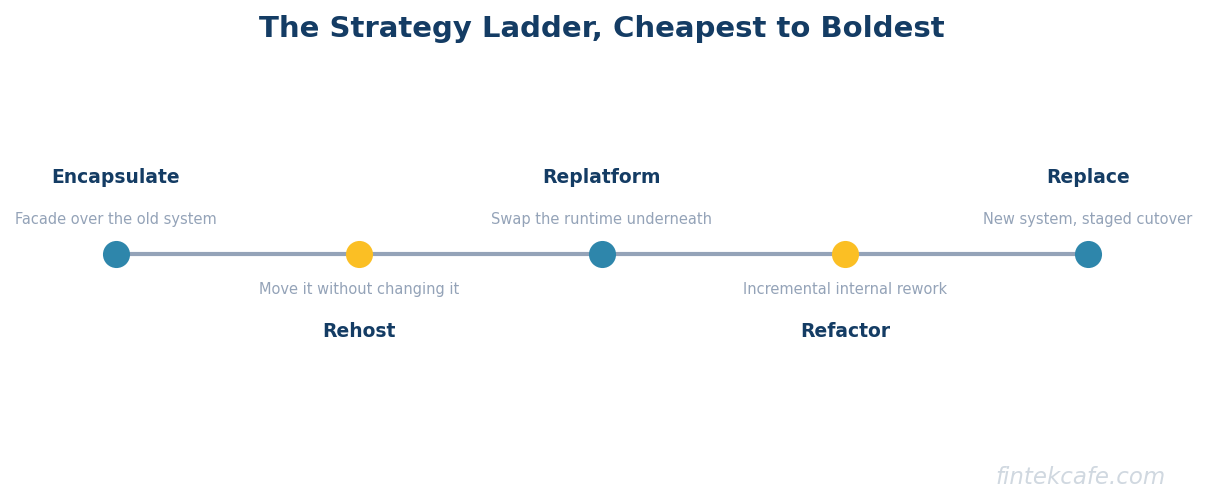
- The strategy ladder runs encapsulate, rehost, replatform, refactor incrementally, replace, retire, and each rung buys more change-ability at higher cost and risk. Most portfolios need several rungs applied to different systems, not one strategy applied to everything.
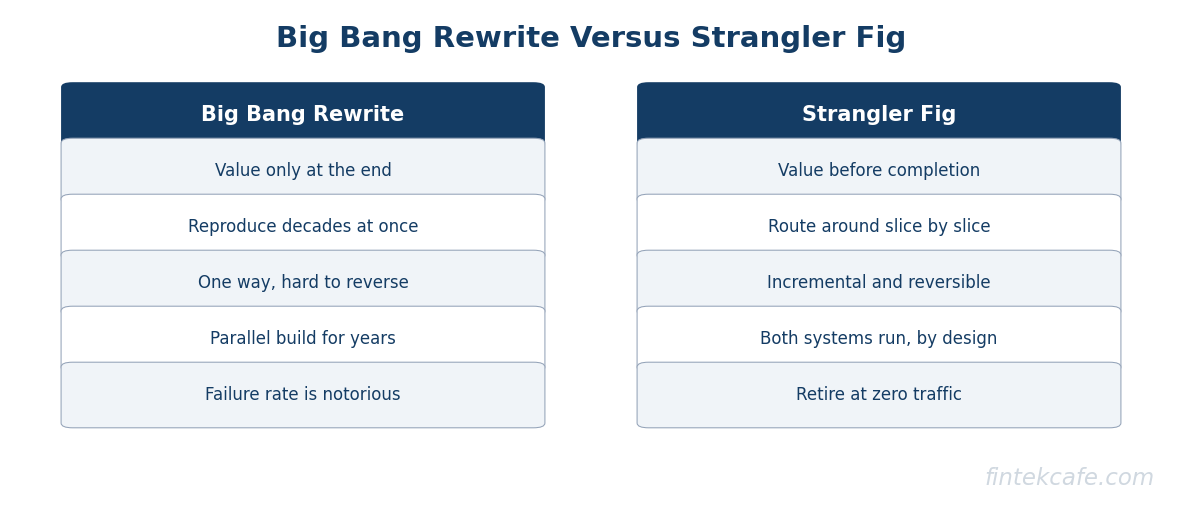
- Big-bang rewrites of critical systems fail at a rate no other executive decision would survive: the failure mode is a multi-year parallel build that must reproduce decades of undocumented behavior before it can even start delivering value. The burden of proof belongs on the rewrite, not on the alternatives.
- The strangler-fig pattern, put a facade in front, route around the old system slice by slice, retire it when traffic reaches zero, is the default for critical systems because it is incremental, reversible, and delivers value before completion. Its price is a long period of running both systems and a routing layer that must be engineered seriously.
- AI genuinely accelerates the understanding and testing of old code, which lowers the cost of every strategy. It does not remove the hard risk, validating that new behavior matches old behavior, and auto-translated codebases relocate that risk rather than eliminating it. Fund modernization as measurable risk retirement, sequenced by risk-times-value, and boards will fund the curve.
Legacy Is a Risk Category, Not an Age
The word legacy gets used as an insult by engineers who prefer newer tools, which is exactly why executives should ignore the aesthetic version of the argument. A twenty-year-old system that is documented, stable, testable, and still cheap to change is not a problem; it is infrastructure that finished paying for itself years ago. The COBOL core at many banks processes enormous daily volume with reliability most modern stacks would envy. Age is a correlate of risk, not the risk itself.
The real triggers are five, and each is measurable. Key-person risk: the number of people who can safely change the system, trending toward one or zero; when the count is two and their tenure is thirty years, the clock is not metaphorical. Vendor end-of-life: announced end of support for the platform, database, or hardware underneath, which converts a stable system into an unpatched one on a known date. Compliance exposure: the system cannot produce the logging, access control, or resilience evidence regulators now demand, a gap that widens as regimes like DORA raise the operational-resilience bar. Integration friction: every new product feature that touches the system costs multiples of what it should, because the system has no APIs and its data model is hostile; this is the trigger that shows up in product velocity rather than in IT metrics. Hiring-pool collapse: the skills market for the stack has thinned to the point where each hire is a search project, and each departure is a small crisis.
A useful discipline is to score each candidate system on those five triggers plus business criticality, because the combination, not any single factor, makes the case. This is the same lens a buyer applies during technical due diligence, turned inward: unmanaged legacy risk is a liability the organization is transferring to its own future, and the scoring exercise makes the liability visible before it prices itself.
The Strategy Ladder, With Honest Costs
Modernization is not one decision; it is a ladder of six strategies, and the right answer is almost always a portfolio: different rungs for different systems, chosen by trigger and criticality rather than by fashion.
| Strategy | What it is | Typical trigger | Cost | Risk | Timeline |
|---|---|---|---|---|---|
| Encapsulate | Wrap the system in APIs; leave internals untouched | Integration friction, but the core is stable | Low | Low | Months |
| Rehost | Move as-is to new infrastructure (lift-and-shift) | Hardware or data-center end-of-life | Low to moderate | Low to moderate | Months |
| Replatform | Move with limited changes (new database, managed runtime) | Platform end-of-life, cost pressure | Moderate | Moderate | Months to a year |
| Refactor incrementally | Restructure the code and architecture piece by piece, in place or via strangler routing | Change-cost is the trigger; system logic is worth keeping | Moderate to high, spread over time | Moderate, taken in small doses | Years, delivering value throughout |
| Replace | Retire in favor of a commercial product or a new build | Logic is commodity (HR, finance ops) or unsalvageable | High | High | Years |
| Retire | Decommission; migrate the residual data | Usage has quietly fallen to near zero | Low | Low | Months |
Three notes keep the ladder honest. First, encapsulation is underrated: for a stable core whose only crime is being hard to integrate with, an API facade buys most of the business value at a tenth of the cost, and it is a prerequisite step for almost everything above it. Second, rehosting disappoints when it is sold as modernization rather than as what it is, a data-center exit that changes none of the change-cost economics; the system is exactly as hard to modify in the cloud as it was in the basement. Third, replacement with a commercial product is the right rung precisely when the system embodies no differentiation, and the classic replacement failure is discovering mid-project that two decades of custom workflow were, in fact, the differentiation.
Why big-bang rewrites fail. The full rewrite, freeze the old system, build the new one in parallel, cut over on a weekend, has a failure record that would end careers in any other capital-allocation category, and the mechanism is structural rather than a matter of execution quality. The old system's true specification is not its documentation; it is decades of accumulated behavior, edge cases, and quiet fixes that no one has ever enumerated. A parallel rewrite must reproduce that specification in full before it can deliver its first unit of value, which means years of spend with zero feedback from production, on a schedule anchored to an estimate made when the least was known. Meanwhile the old system cannot actually freeze, because the business keeps moving, so the rewrite chases a target that recedes. The pattern shows up across decades of postmortems and does not respect team quality. The burden of proof always belongs on the rewrite: it is occasionally right, for small systems, genuinely unsalvageable code, or true platform dead-ends, and it should have to prove those conditions rather than assume them.
The Strangler Fig: The Default for Systems That Matter
The pattern that has emerged as the default for modernizing critical systems takes its name from the strangler fig, which grows around a host tree and eventually replaces it. The mechanics: put a routing facade in front of the legacy system so all consumers go through it; pick one capability slice, build it in the new architecture, and route that slice's traffic to the new implementation; verify, then pick the next slice; retire the old system when its traffic reaches zero, which happens as a consequence rather than as an event.
The properties that make this the default are exactly the ones the big bang lacks. It is incremental: value ships with the first slice, not after the last one. It is reversible: any slice that misbehaves routes back to the old implementation, converting each migration step from a bet into an experiment. It learns: each slice teaches the team about the hidden behavior of the old system while the blast radius is one slice wide. And it funds itself politically: a program that demonstrates progress quarterly survives budget cycles that a two-years-to-first-value program does not.
The honest costs: both systems run for the duration, with double infrastructure and a data-consistency problem wherever old and new share state; the routing facade is real engineering, not a proxy config; and slicing requires the old system's capabilities to be separable at all, which is the first thing to validate. The pattern also has a failure mode of its own, the immortal hybrid: organizations that stop at eighty percent migrated, leaving the hardest slices on the old system indefinitely and paying both systems' costs forever. The countermeasure is executive, not technical: the program is not done until the old system is retired, and the retirement date has an owner. Slicing works best along boundaries that would make sense as service boundaries anyway, which is where the reasoning in the microservices versus monolith decision applies, and slices that communicate through events rather than shared state migrate cleanest, one of the cases examined in when event-driven architecture is worth it.
What AI Changes, and What It Does Not
AI-assisted engineering has genuinely moved the economics of modernization in two places. Code understanding: models are now good at reading an unfamiliar codebase and producing explanations, call graphs, and documentation drafts, which attacks the single scarcest resource in legacy work, comprehension of what the system actually does. Teams report meaningful compression of the archaeology phase that used to consume the first year of any serious program. Test generation: models generate characterization tests, tests that capture what the system currently does, rather than what the spec says, at a volume no team would write by hand, and a thick characterization suite is precisely the safety net every strategy on the ladder depends on.
What AI does not do is remove the hard risk. The vendor pitch of the moment, auto-translate the COBOL core to Java and be done, misunderstands where the risk lives. Translation was never the bottleneck; mechanical transpilers have existed for decades, and they produce what practitioners call JOBOL, Java with COBOL's soul, syntactically new and architecturally unchanged. The bottleneck is validation: proving the new system reproduces the old one's behavior, including the behavior nobody documented, under production diversity of inputs. An AI-translated codebase still owes exactly that proof, so the risk has been relocated from writing code to verifying it, and verification was always the expensive part. AI helps there too, via generated tests and traffic-comparison tooling, but the residual is irreducible: someone must decide how much behavioral evidence is enough to cut over a system the business runs on. The sober framing for a technology leader: AI lowers the cost of every rung on the ladder, perhaps substantially, and changes the correct choice of rung rarely.
Sequencing and the Board Conversation
Sequence by risk times value, not by age. The oldest system is not the first target; the first target maximizes the product of trigger severity, business criticality, and feasibility of slicing. A common and defensible opening move is the highest-traffic integration bottleneck: encapsulate it, put the facade in place, and the facade then becomes the beachhead for whatever deeper strategy follows. Systems with severe triggers but low criticality can often go straight to replace-or-retire; systems with mild triggers and high criticality get characterization tests and monitoring now, migration later. The portfolio review repeats annually, because triggers move: a vendor announcement or a resignation letter can re-rank the queue overnight.
Fund it as risk retirement, not as an IT wish. The board conversation fails when it is framed as engineers wanting newer tools, and it works when it is framed the way the board already thinks about risk: here are the systems, here are the five triggers scored, here is the concentration of revenue running through systems that two people can maintain, here is what an unsupported platform does to our regulatory posture and our disaster recovery evidence, and here is the curve, spend per quarter against risk retired per quarter, that the strangler program delivers. Modernization framed as measurable risk retirement, with quarterly slices as proof of progress, competes credibly for capital. Modernization framed as a rewrite with a two-year horizon and a promise competes with everything else the company could do with the money, and loses, usually correctly.
| Scoring dimension | Tolerate (for now) | Modernize (queue it) | Act immediately |
|---|---|---|---|
| Key-person depth | Several fluent maintainers | Two or three, aging tenure | One, or zero after the next retirement |
| Vendor status | Supported, roadmap alive | Support horizon announced | End-of-life dated or passed |
| Compliance posture | Evidence produced on demand | Gaps papered with compensating controls | Audit findings open, regime deadlines near |
| Change cost | Features land in normal time | Multiples of comparable systems | Teams route around the system entirely |
| Hiring pool | Skills available at market rate | Thin, salary premium rising | Searches fail; contractors only |
| Business criticality | Low: candidate for retire/replace | Moderate: replatform or refactor | High: strangler fig, never big-bang |
FAQ
What counts as a legacy system?
A legacy system is one the organization can no longer change safely or affordably, regardless of age. The operational markers: changes take multiples of the time they should, few or no current staff understand the internals, the vendor or platform is at or near end-of-support, and integrations require workarounds. An old system that is documented, testable, and cheap to change is not legacy in any sense that should drive spending; a five-year-old system nobody dares touch is.
Why do big-bang rewrites of legacy systems fail so often?
Because the old system's real specification is decades of undocumented behavior, and a parallel rewrite must reproduce all of it before delivering any value. That means years of spend with no production feedback, against a moving target, on estimates made at the point of maximum ignorance. Industry research on large IT programs consistently finds severe cost overruns and value shortfalls at this scale. Rewrites are occasionally justified, for small, unsalvageable, or dead-platform systems, but the burden of proof belongs on the rewrite.
What is the strangler-fig pattern?
The strangler-fig pattern modernizes a system incrementally: a routing facade is placed in front of the legacy system, individual capability slices are rebuilt in the new architecture, traffic is switched slice by slice with the ability to route back if a slice misbehaves, and the old system is retired when its traffic reaches zero. It is the default for critical systems because it delivers value early, keeps every step reversible, and surfaces hidden behavior one slice at a time. Its costs are running both systems for the duration and engineering the facade properly.
Can AI modernize legacy code automatically?
AI materially accelerates two parts of the work: understanding old code (explanations, call graphs, documentation) and generating characterization tests that capture current behavior. Auto-translation of whole codebases is real but solves the cheap part; the expensive part was always validating that new behavior matches old behavior under production conditions, and translated code still owes that proof. Treat AI as a cost reducer on every strategy, not as a strategy in itself.
How should modernization be pitched to a board?
As risk retirement with a measurable curve. Score each system on key-person risk, vendor status, compliance exposure, change cost, and hiring pool; weight by business criticality; and present spend per quarter against risk retired per quarter, with incremental delivery (strangler slices) as the proof mechanism. Boards fund quantified risk reduction on a visible schedule. What they correctly decline is a two-year rewrite whose first evidence of progress is scheduled for its end.
Related reading on FinTekCafe
Related Articles
Data Classification: The Step Every Enterprise AI Rollout Skips, and What It Costs Later
Why AI assistants expose overshared data, how data classification fixes it, what to label first, and a 90-day plan for executives.
Enterprise Search Is Back, and This Time It Decides Which AI Assistant Wins
Enterprise search failed for twenty years. Now the permission-aware index behind every AI assistant is the control point, and its owner wins.
Multi-Cloud Is a Negotiating Position, Not a Resilience Strategy
Running one workload across two clouds rarely pays for itself. A second cloud's real value is leverage and exit evidence. Which workloads need what.