
Merchant Underwriting: Why Payment Processors Reject Good Businesses
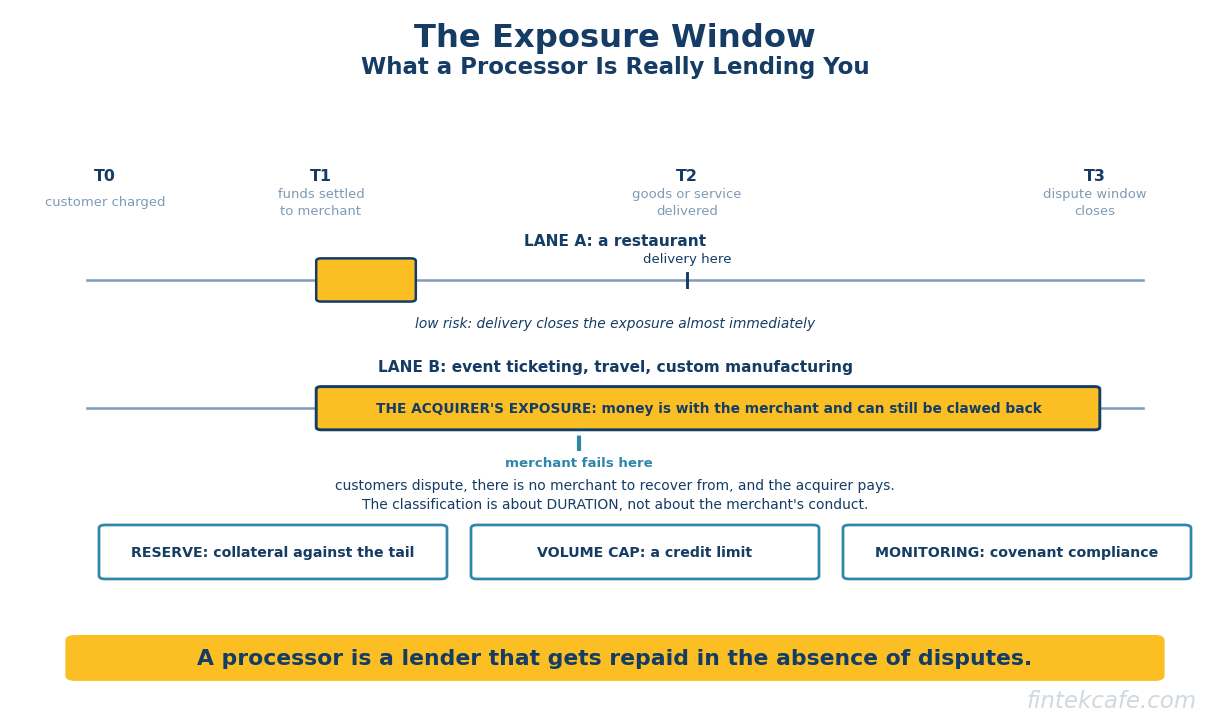
A payment processor is not evaluating whether a business is legitimate. It is deciding whether to extend it credit, because that is what accepting card payments on a merchant's behalf actually involves. This single reframing explains nearly every outcome founders find inexplicable: the profitable company declined, the reserve imposed on a business with no chargebacks, the account terminated after a good quarter. When a customer disputes a charge, the money is pulled back from the merchant. If the merchant has spent it, cannot cover it, or has ceased trading, the acquirer absorbs the loss. The acquirer is therefore exposed to every dollar it has settled that could still be clawed back, and its underwriting is an assessment of that exposure. Understood that way, the decisions stop looking arbitrary. The variable that drives most of them is not the industry or the founder's credit score but the gap between when a customer is charged and when they receive what they paid for, because that gap is the window in which the acquirer is carrying the risk. This guide covers what is actually being underwritten, why sound businesses get declined, how reserves work and how to negotiate them, what happens after approval, and what to prepare.

Key Takeaways
- Merchant underwriting is credit underwriting wearing an operational disguise. The acquirer settles funds to the merchant before the dispute window closes, so it is lending against a liability that can return for months. Every rule follows from that exposure.
- Delivery timing is the hidden variable that explains most decisions. A restaurant delivers instantly and the exposure closes almost immediately. An event ticketing business charges today for something eleven months away, so the acquirer carries a claw-back risk for the whole period. That is why entire legitimate industries are classed high risk.
- Most rejections are not judgments about the business. Adjacency to a prohibited category, a model that does not fit the aggregator terms a provider offers, a thin file with no processing history, and a mismatch between the stated and observed business are the common causes, and all four are addressable.
- Reserves are collateral, not a penalty. A rolling reserve withholds a share of settlement for a set period and releases continuously; a capped reserve accumulates to a fixed ceiling and stops. Both are negotiable on terms, on step-down schedule, and against evidence, and almost nobody negotiates them.
- The severe outcome is not rejection, it is termination for cause and placement on the industry list of terminated merchants, which is retained for five years and makes obtaining processing elsewhere extremely difficult. Misrepresenting the business model is the fastest route there, which makes early disclosure a commercial decision rather than an ethical one.

What Processors Actually Underwrite
The commercial arrangement is not obvious from the outside. A merchant sells something, the customer pays by card, and money arrives in the merchant's account in a day or two. What has happened is that the acquirer has advanced funds against a transaction that remains reversible.
Card networks give cardholders the right to dispute a transaction long after it settles, commonly up to around one hundred and twenty days from the transaction or from the expected delivery date, and longer in some circumstances. If the dispute succeeds, the funds are taken back from the merchant. If the merchant cannot pay, the acquirer covers it. The dispute mechanics themselves are covered in how chargebacks work, and the broader question of which party bears fraud loss on each rail is mapped in payment fraud liability.
The acquirer's exposure at any moment is therefore roughly the volume it has settled that remains disputable, and its underwriting question is whether the merchant will be able and present to cover a claw-back. Two failure scenarios dominate, and neither involves dishonesty.
The merchant fails while holding customer obligations. A company that has taken payment for goods not yet shipped or services not yet rendered goes under. Customers dispute, there is no merchant to recover from, and the acquirer pays. This is the scenario every underwriting rule is built around.
Dispute volume exceeds the merchant's capacity. A product problem or a shipping failure generates disputes faster than the business can absorb, and the shortfall lands upstream.
This is the acquiring side of the card system, and it is worth seeing as the mirror of the issuing side. An issuer underwrites a cardholder's ability to pay, through the stack described in how card issuing works. An acquirer underwrites a merchant's ability to repay if transactions reverse. Both are credit decisions about parties that have already received value.
Fraud matters, and it is secondary. A merchant with a fraud problem and a healthy balance sheet is a manageable account. A merchant with no fraud, no chargebacks, and a long delivery horizon may still be declined, because the exposure is structural rather than behavioral.

The Risk Model
Underwriters weigh a consistent set of factors, and each maps to the same underlying question of how much could come back and whether the merchant will be there to cover it.
| Factor | Why it matters | What reduces it |
|---|---|---|
| Time between charge and delivery | Defines how long the acquirer carries claw-back exposure; the single largest driver | Charge closer to delivery, bill in instalments, or accept a reserve sized to the gap |
| Industry classification | The assigned merchant category code carries loss statistics the acquirer prices against | Ensure the code genuinely matches the business rather than a rougher approximation |
| Average transaction value | Large tickets mean fewer disputes but a bigger loss per event, and a thinner cushion | Demonstrated history at that ticket size; segmenting high-value flows separately |
| Monthly volume relative to company size | Exposure scaled against the balance sheet available to absorb it | Financial statements, funding evidence, or a phased volume ramp |
| Processing history | Prior chargeback and refund performance is the strongest available predictor | Statements from a previous processor, even a few months |
| Financial strength | Determines whether claw-backs can be covered from resources rather than by the acquirer | Audited or reviewed financials, bank statements, or a personal guarantee |
| Refund and cancellation policy | Generous, clearly communicated refunds resolve complaints before they become disputes | Publish it plainly, make refunds easy, and evidence that in the application |
| Recurring billing model | Subscriptions with unclear renewal terms produce disputes at a well-documented rate | Explicit renewal notices, simple cancellation, and clear descriptor text |
| Cross-border and multi-currency | Higher fraud rates, harder recovery, and more complex regulatory exposure | Segment by geography and demonstrate performance per corridor |
| Descriptor clarity | Cardholders dispute charges they do not recognise on a statement | A descriptor matching the trading name customers actually know |
Delivery timing deserves the emphasis it rarely gets. Founders commonly assume high risk means disreputable, and the classification is largely about duration. Travel booked months ahead, event ticketing, custom manufacturing, furniture, annual prepaid subscriptions, and crowdfunding all sit in high-risk tiers for the same structural reason: the acquirer is carrying a liability for an extended period during which the business could fail. Nothing about the merchant's conduct is in question.
Why Good Businesses Get Rejected
Prohibited-list adjacency. Every acquirer maintains prohibited and restricted category lists, and automated screening flags businesses that resemble a listed category even when they are not one. Supplement companies get read as nutraceuticals, hemp-derived products as controlled substances, firearms accessories as firearms, financial education as investment advice. The decline is frequently a pattern match rather than a considered judgment, which is why a clear written description of what is and is not sold changes outcomes.
Aggregator model mismatch. Payment facilitators and aggregators onboard merchants under a shared master account with standardised terms, which is what makes signup fast. That model carries a narrower acceptable-risk band than a dedicated merchant account, so a business outside the band is declined by the aggregator and perfectly bankable through a direct account with underwriting. The distinction between these models, and who carries the liability in each, is covered in merchant of record versus payment facilitator. Being turned down by an aggregator is not a verdict on bankability.
Thin file. A new entity with no processing history, no financials, and no track record gives the underwriter nothing to price. This is not suspicion, it is absence of evidence, and it is why early-stage companies frequently start with reserves or lower volume caps that relax with demonstrated performance.
Model mismatch. The application describes one business and the observed activity looks like another: unexpected ticket sizes, unexpected geographies, unexpected volume. This triggers review and is the most dangerous category, because it can be read as misrepresentation.
Ownership and control checks. Sanctions screening, adverse media, and prior terminated accounts associated with the principals. A founder with a previous business on the terminated-merchant list carries that into every subsequent application.
Capacity rather than risk. Sometimes the acquirer is simply not writing new business in a category, or has concentration limits. The rejection carries no information about the merchant at all.
Reserves and Holds
A reserve is collateral against the claw-back tail. It is not a fine and not an accusation, and treating it as either forecloses the negotiation that is usually available.
| Reserve type | How it works | Typical use | Effect on cash |
|---|---|---|---|
| Rolling reserve | A percentage of each settlement is withheld and released after a fixed period, continuously revolving | The default for elevated-risk accounts and long delivery horizons | Permanent working capital drag proportional to the rate and hold period |
| Capped reserve | Withholding continues until a fixed ceiling is reached, then stops | Where exposure is bounded and quantifiable | Temporary drag during accumulation, then none |
| Upfront reserve | A deposit posted before processing begins | Thin-file merchants, or where the acquirer wants collateral in place from day one | Immediate cash requirement, released on exit or step-down |
| Delayed settlement | Funds held longer before payout rather than a percentage withheld | Where the concern is delivery completion rather than aggregate exposure | Extends the cash conversion cycle without reducing total receipts |
| Ad hoc hold | Settlement frozen in response to a specific trigger such as a volume spike or dispute cluster | Incident-driven, often without warning | Severe and unpredictable; the outcome to avoid through communication |
Three points are worth more attention than they usually get.
Reserves are negotiable, and most merchants never try. The rate, the hold period, the ceiling, and the step-down schedule are all commercial terms. A step-down, meaning an agreement that the rate falls at defined performance milestones, is often obtainable simply by asking for it at signing, and almost never granted later without being requested.
The cost is working capital, and it should be modelled. A rolling reserve at a given percentage held for six months means that share of half a year's revenue is permanently unavailable while volume is flat, and grows while volume grows. For a business scaling quickly, the reserve consumes cash exactly when cash is scarcest, which surprises founders who read it only as a percentage.
Ad hoc holds are the real danger. A scheduled reserve is a financing cost. A sudden freeze triggered by an unexplained volume spike can be existential, and the usual cause is a change the acquirer was not told about. Communicating an expected promotion, launch, or seasonal peak in advance costs one email.
After Approval: Monitoring and Termination
Approval is the beginning of a monitored relationship. Two layers of oversight run continuously.
Acquirer-level monitoring applies velocity rules and thresholds: transactions per period, ticket size ceilings, volume against the approved forecast, refund rates, and dispute ratios. Breaching a threshold typically triggers review, additional documentation requests, a reserve adjustment, or a hold.
Network-level monitoring programmes operate above the acquirer. The card networks track merchant chargeback and fraud ratios and place merchants exceeding published thresholds into remediation programmes with escalating monthly fines, mandatory action plans, and eventual termination if the ratios do not come down. The pressure this creates on the acquirer flows directly to the merchant, which is why an acquirer becomes abruptly less accommodating as ratios approach a threshold.
The outcome to avoid is termination for cause. A merchant terminated for excessive chargebacks, fraud, or misrepresentation is placed on the industry database of terminated merchants maintained for exactly this purpose. Listings are retained for five years, are visible to every acquirer during underwriting, and make obtaining processing extremely difficult regardless of what has changed. Reasonable people disagree about the fairness of the mechanism; nobody disagrees about its consequences.
Two operational implications follow. The dispute ratio is a denominator as well as a numerator, so a volume decline can push a merchant over a threshold with no change in dispute count at all, which catches seasonal businesses. And refunds are cheaper than disputes in every dimension: a refunded transaction does not enter the ratio, while a disputed one does even when the merchant wins.
The High-Risk Processor Market
Businesses that cannot obtain standard processing have a specialist market available, and it functions differently in ways worth pricing before entering.
Rates are materially higher, reserves are standard rather than exceptional, and monthly minimums and account fees are common. Underwriting is more thorough and considerably more willing to engage with an unusual model rather than pattern matching it to a decline. Contracts are often longer with meaningful early termination provisions.
Two structural features distinguish the segment. Merchants frequently run multiple merchant identifiers across acquirers to distribute volume, both for redundancy and to keep any single account below monitoring thresholds. This is standard practice, and using it deliberately to evade a network programme is not, which is a line worth understanding clearly. And the relationship is closer, with the acquirer often expecting regular reporting and advance notice of changes.
The decision is arithmetic. If specialist processing costs a few percent more on the discount rate and a reserve consumes some months of working capital, that is a quantifiable cost to compare against not accepting cards. For many businesses in long-delivery categories it is simply the price of the model.
The Founder Playbook
Prepare before applying. Assemble processing statements from any prior provider, recent financial statements or bank records, the published refund and cancellation policy, a clear written description of the product and how and when it is delivered, ownership and identity documentation, and a realistic volume and average ticket forecast. Underwriters decline for missing evidence far more often than for evidence they dislike.
Disclose the awkward parts early and precisely. If the model involves long delivery horizons, prepayment, marketplace flows, or anything adjacent to a restricted category, state it in the application. Disclosure at application is a risk to be priced, usually with a reserve. The same fact discovered later is misrepresentation, and misrepresentation is the fastest route to termination for cause and a five-year listing. This is a commercial calculation, not a moral one.
Forecast honestly. Underwriting approves a volume band. Exceeding it substantially triggers review even when the business is thriving. Forecast realistically and communicate before a planned spike.
Ask for the step-down at signing. A schedule reducing the reserve rate at defined performance milestones is much easier to obtain as part of the initial agreement than as a later concession.
Instrument the ratios from day one. Track chargeback count and ratio, refund rate, and authorisation rate monthly against the relevant thresholds. Discovering a ratio problem when the acquirer raises it means months of deterioration have already accumulated in the denominator.
Appeal with new evidence, not argument. Restating the case rarely changes an outcome. Additional financials, a personal guarantee, an offer to accept a higher reserve, a lower initial volume cap, or several months of clean processing history from elsewhere all change the exposure calculation. Asking which specific factor drove the decision is a reasonable question, and the answer is frequently narrower and more fixable than expected.
Do not stack applications. Applying to many providers simultaneously after declines creates a pattern visible in shared databases and reads badly. Understand the reason for one decline before submitting the next.
Frequently Asked Questions
Why was my merchant account rejected when my business is legitimate?
Legitimacy is rarely the question. The usual causes are adjacency to a prohibited category triggering automated screening, a model outside the narrow band an aggregator can accept, a thin file with no processing history or financials to price against, a mismatch between the described and observed business, or an acquirer that is simply not writing new accounts in that category. The most common underlying driver is a long gap between charge and delivery, which extends the acquirer's claw-back exposure.
What is a rolling reserve?
A percentage of each settlement withheld by the acquirer and released after a fixed period, revolving continuously as new transactions replace released ones. It is collateral against future chargebacks rather than a penalty. Because it holds back a share of revenue for the whole period, it is a permanent working capital cost while volume is flat and grows as volume grows. The rate, hold period, and step-down schedule are negotiable, and most merchants never ask.
Why are some legitimate industries classed as high risk?
Almost always because of the delay between payment and delivery, not reputation. An acquirer settles funds to the merchant while the transaction stays disputable for months, so a business charging today for something delivered in six months leaves the acquirer carrying claw-back exposure for that whole period. Travel, event ticketing, custom manufacturing, and annual prepaid subscriptions all sit in high-risk tiers for that structural reason.
What happens if a merchant account is terminated?
Termination for cause, meaning excessive chargebacks, fraud, or misrepresentation, results in placement on an industry database of terminated merchants that acquirers check during underwriting. Listings are retained for five years and make obtaining processing elsewhere very difficult regardless of subsequent changes. This is the outcome worth organising to avoid, and misrepresenting the business model at application is the fastest route to it.
How can a business improve its odds of approval?
Arrive with evidence. Prior processing statements, financial statements, a published refund policy, a precise description of what is sold and when it is delivered, and a realistic volume forecast address most declines, which are usually caused by absent evidence rather than unacceptable risk. Disclose long delivery horizons or restricted-category adjacency openly, since disclosure gets priced as a reserve while later discovery gets treated as misrepresentation.
The Bottom Line
The mental model worth carrying is that a payment processor is a lender that gets repaid in the absence of disputes. Every rule that seems arbitrary from the merchant's side follows from that: the reserve is collateral, the volume cap is a credit limit, the monitoring is covenant compliance, and the delivery-horizon question is an assessment of how long the loan stays outstanding.
That reframing changes what a founder should do. The instinct is to argue that the business is trustworthy, which addresses a question the underwriter is not primarily asking. The effective response is to reduce measurable exposure or supply evidence that prices it: processing history, financial strength, a shorter gap between charge and fulfilment, a clearer refund path, a willingness to accept a reserve or a phased volume ramp.
The asymmetry at the end is the part most worth internalising. A rejection is a delay and a redirect toward a different provider or a specialist market. A termination for cause is a five-year constraint on the entire business. Almost everything in the playbook, and disclosure most of all, is about staying firmly on the survivable side of that line.
Related Articles
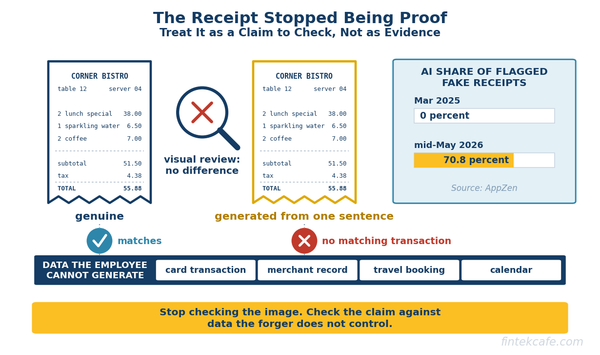
AI-Generated Fake Receipts: How Expense Fraud Changed and How Finance Teams Catch It
AI-generated fake receipts now beat visual review. How expense fraud changed, which detection still works, and the controls to use by company size.
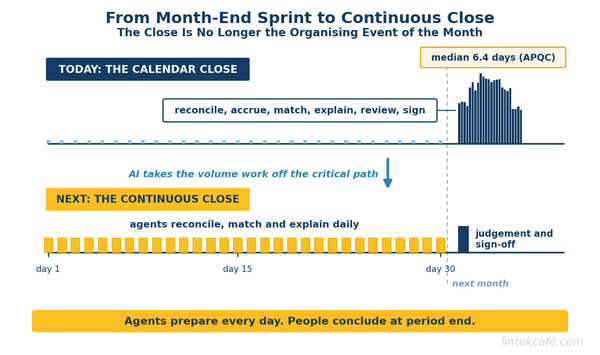
The Monthly Close Is Becoming Continuous, and the Finance Calendar Will Not Survive It
AI is taking the bottleneck work out of the month-end close. The close becomes continuous with a short sign-off, and finance, audit and the board change.
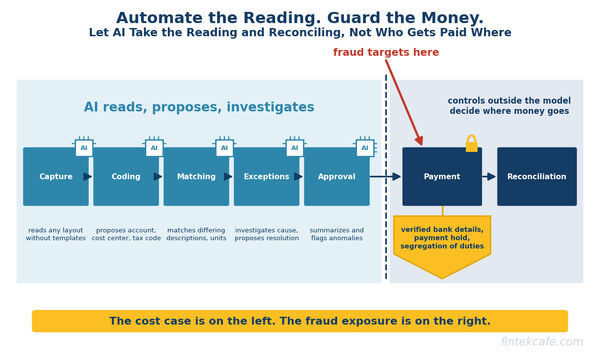
Accounts Payable Automation: What AI Can Actually Take Over in Invoice-to-Pay
What AI can take over in accounts payable, step by step from capture to payment, where the fraud risk grows, and which controls must stay outside the model.