
Master Data for AI: Why Agents Fail on Bad Reference Data, and What to Fix First
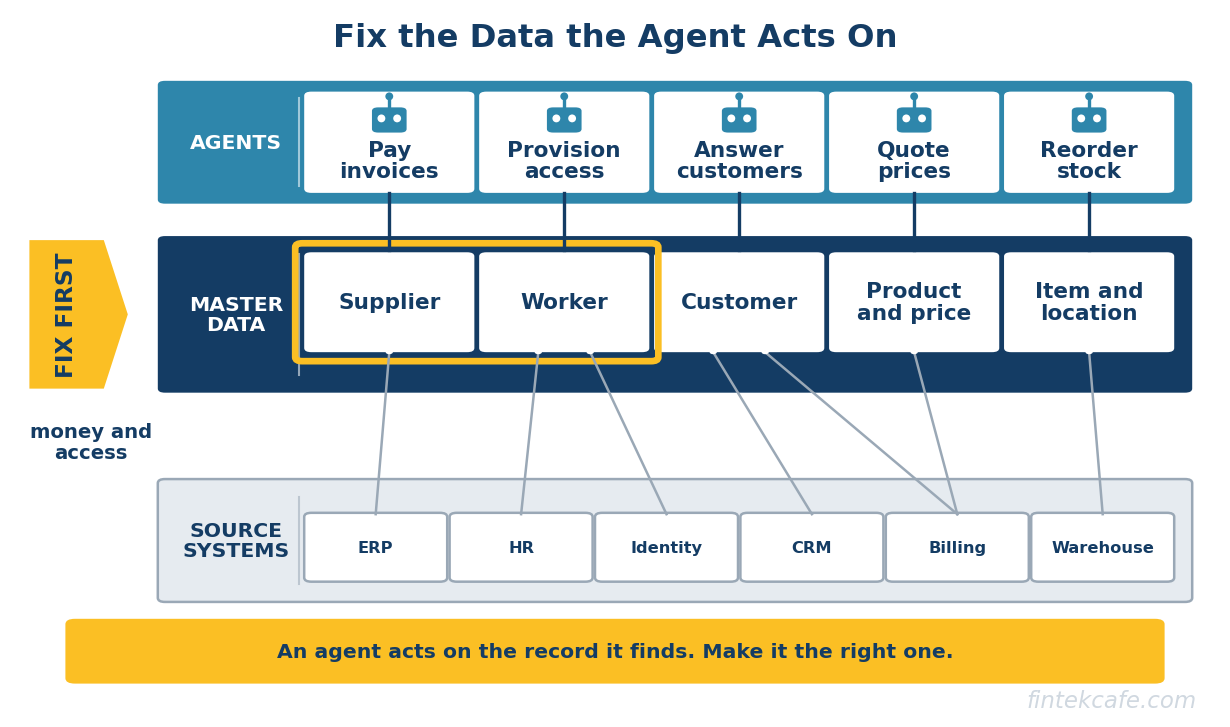
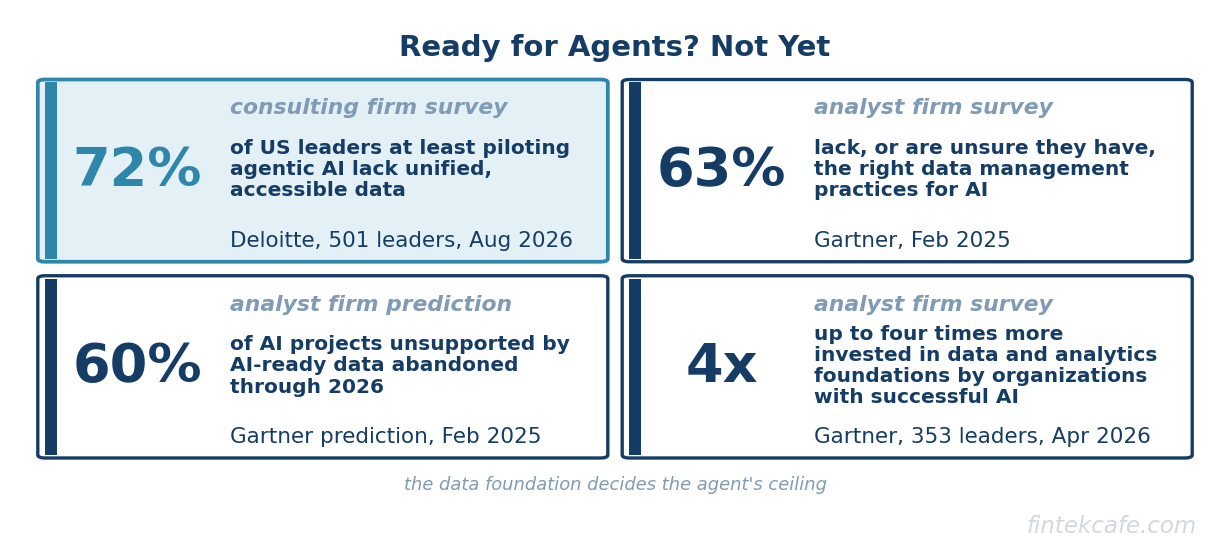
Master data is the shared set of records that describe who and what a business deals with: customers, suppliers, products, employees, locations and accounts. AI agents act on those records directly, and when the records are duplicated, stale or inconsistent, an agent does not pause the way an experienced employee does. It acts on the wrong record, at machine speed. Deloitte's August 2026 survey of 501 US leaders whose organizations were at least piloting agentic AI found that 72 percent say they lack unified, accessible data. The position taken here: before an agent is allowed to act alone, the master data domain it depends on must meet a defined quality bar, and the domains that move money and access (suppliers and employees) should be fixed first, ahead of the domains that only shape answers.
Key Takeaways
- Master data matters more with agents than with dashboards. A dashboard shows a wrong number to a person who may notice; an agent pays, ships, grants access or quotes on the wrong record.
- The evidence on readiness is consistent: Gartner reported in February 2025 that 63 percent of organizations lack, or are unsure they have, the right data management practices for AI, and predicted that through 2026 organizations will abandon 60 percent of AI projects unsupported by AI-ready data.
- The common failures are old: duplicate suppliers that enable duplicate payments, former employees who keep access, and answers that contradict the company's own records.
- The vendor market consolidated quickly: Salesforce completed its purchase of Informatica in November 2025, and SAP completed its purchase of Reltio in May 2026. Both pitch master data as the foundation for agents.
- Fix domains in order of what an agent can do with a bad record: money and access first, customer-facing answers second, analytics last. Map every agent use case to the domain it depends on and set a minimum bar before it runs unattended.
What Master Data Is, in Plain Terms
Gartner defines master data as "the least number of consistent and uniform sets of identifiers and extended attributes" that describe the core entities of the enterprise, with examples such as customers, suppliers, sites, hierarchies and the chart of accounts. Put simply, it is the reference layer every other system assumes is correct.
Three kinds of data are worth separating:
| Kind of data | What it is | Example | Changes |
|---|---|---|---|
| Master data | The core entities the business deals with | A supplier, its tax ID, its bank account | Slowly, and every change matters |
| Reference data | Codes and lists that classify other data | Country codes, currency codes, units of measure | Rarely |
| Transaction data | Events that use the master and reference data | An invoice, an order, a service ticket | Constantly |
Master data management, or MDM, is the discipline that keeps the first category consistent across systems. Gartner describes it as a business discipline in which business and IT work together on the uniformity, accuracy, stewardship, governance and accountability of the shared master data. MDM fails when treated as an IT cleanup with no business owner.
Why every large company has the problem
A customer exists in the CRM, billing, the support desk and the e-commerce platform. An employee exists in HR, payroll, the identity directory and a dozen software tools. Each system keeps its own copy, and the copies drift. People work around the drift: a clerk who sees two similar supplier records checks before paying. An agent has none of that tacit knowledge unless someone gives it to the agent explicitly.
Why Agents Make Bad Master Data Expensive
Analytics tolerated bad master data because a person stood between the number and the action. Agents remove that person. That changes the economics in three ways.
Speed turns a defect into a pattern. A clerk who pays a duplicate invoice makes one error. An agent processing thousands of invoices a day against a supplier master with duplicates makes the same error every time the pattern recurs, until someone notices in reconciliation.
Agents choose records with confidence they do not have. When a lookup returns two plausible matches, a person hesitates and asks. An agent typically picks one and proceeds, unless it was explicitly designed to stop when match confidence is low.
Errors move from reports to customers and counterparties. Salesforce's State of Data and Analytics report, published November 4, 2025, found that 89 percent of data and analytics leaders with AI in production had experienced inaccurate or misleading AI outputs. Salesforce sells data products, so this is a vendor-sponsored figure, but it matches the independent surveys.
The independent evidence points the same way. Gartner's April 16, 2026 release, based on a survey of 353 data, analytics and AI leaders conducted in November and December 2025, said organizations with successful AI initiatives invest up to four times more in data and analytics foundations. Gartner analyst Rita Sallam put it directly: "Without trust in the data, outputs and decisions of AI models and agents, there is no value from AI." Deloitte's August 2026 survey adds the agent-specific view: beyond the 72 percent lacking unified data, 70 percent said they do not feel they can trust and govern agents, and only 42 percent rated their data foundation as prepared.
What bad data costs, and how solid those numbers are
Treat the widely quoted cost figures with care. Gartner's estimate that poor data quality costs organizations at least 12.9 million dollars a year comes from 2020 research and is presented as a floor. Thomas Redman's estimate in MIT Sloan Management Review in November 2017, 15 to 25 percent of revenue, rests on Experian research and consultant estimates. The 3.1 trillion dollar US figure quoted in Harvard Business Review in 2016 is an IBM estimate whose method was never published. None of these measures agents. The defensible statement is narrower: the documented failures below are the ones agents will repeat faster.
The Failure Patterns Agents Inherit
Duplicate suppliers and duplicate payments
Duplicate supplier records are the oldest master data failure in finance. The US Postal Service Office of Inspector General found in a March 2008 review that its supplier master file held 9,560 potential duplicate suppliers, 3 percent of active non-employee suppliers. It warned that poor maintenance of the master file "increases the risk of creating duplicate suppliers and potentially issuing duplicate payments," and that the payables system could not identify duplicate payments made under different supplier numbers. The Tennessee Valley Authority's Inspector General reported in April 2020 that it found duplicate vendors in a master file of 45,508 vendors and recommended fixed-interval cleanup of duplicate and inactive vendors.
The lesson for agents is mechanical. An accounts payable agent pays whichever supplier record it matches. If the same supplier exists twice with different bank details, duplicate detection that keys on the supplier number will miss it, and fraudsters exploit the same weakness when they request a bank detail change.
Former employees who keep access
Employee master data drives access. When the HR record says someone has left and the identity system does not, access survives. Block disclosed in an April 4, 2022 SEC filing that a former employee downloaded Cash App reports on December 10, 2021, after their employment ended, affecting about 8.2 million current and former customers who were notified. The filing said the employee "had regular access to these reports as part of their past job responsibilities," and that the reports were accessed without permission after the employment ended.
Agents raise the stakes because they hold credentials of their own and act on behalf of people. An agent that provisions access from a stale HR record extends the same failure. The access side of that problem is covered in identity and access management for AI agents.
Customer-facing answers that contradict the company's own records
In Moffatt v. Air Canada, decided February 14, 2024, British Columbia's Civil Resolution Tribunal held the airline responsible for its website chatbot, which told a customer that bereavement fare refunds could be claimed after travel when the airline's own policy page said otherwise. The tribunal rejected the argument that the chatbot was a separate entity. This was a conflict between two versions of a policy, not a master data defect in the narrow sense, and a small-claims ruling, not binding precedent. The principle still applies to product and price data: when an agent answers from one copy of a record and the invoice uses another, the company owns the answer the agent gave.
Stale operational attributes
The quieter failures sit in attributes: a supplier lead time that was true two years ago, a unit of measure that differs between purchasing and the warehouse, an asset record missing its last service date. Supply chain agents that order within limits are only as good as the lead times and units they read, which is why supply chain planning agents list master data as their first failure mode. Field service has the same dependency on the asset and location record, as covered in AI in field service and maintenance.
What AI Now Does for Master Data Itself
The irony of the agent era is that AI is also the best new tool for fixing master data. Three jobs have changed.
- Matching and deduplication. Deciding whether "Acme Industrial Ltd" and "ACME Ind. Limited, Leeds" are the same supplier used to take hand-tuned rules. Machine learning scores candidate pairs and routes uncertain ones to a person. This is the most mature AI use in MDM, with the clearest payback.
- Enrichment. Models fill missing attributes from documents and external sources, such as product classifications or registration numbers. The risk: a confident wrong attribute is worse than a blank, because a blank is visibly incomplete.
- Stewardship queues. Agents triage queues of suspected duplicates and change requests, propose merges and draft changes for a steward to approve. Vendors are moving toward agents that act without a steward on low-risk changes.
The vendor landscape after consolidation
The MDM market changed ownership faster in 2025 and 2026 than in the previous decade. All product claims below are vendor announcements.
- Informatica (Salesforce). Salesforce announced the purchase on May 27, 2025, at an equity value of about 8 billion dollars, and completed it on November 18, 2025, saying it brings Informatica's MDM services to the Salesforce platform. Informatica announced CLAIRE Agents, including a Data Quality Agent, in May 2025, and in May 2026 announced "Agentic Multidomain MDM," which it describes as autonomous agents that cleanse, steward and enrich master data in real time, with availability planned for the fourth quarter of 2026.
- Reltio (SAP). Reltio made its AgentFlow agents generally available on October 20, 2025. SAP announced on March 27, 2026 that it would acquire Reltio and completed the deal on May 7, 2026, without disclosing terms. SAP said Reltio becomes a core capability of SAP Business Data Cloud while remaining available on its own, which matters for companies whose master data lives largely outside SAP.
- Others. SAP says its Joule assistant can carry out Master Data Governance tasks from natural-language requests. Profisee offers a native MDM workload inside Microsoft Fabric. Tamr remains independent and positions itself as AI-native MDM.
Gartner revived its Magic Quadrant for Master Data Management Solutions on April 6, 2026, the first edition since 2021, covering 20 vendors. Informatica, Reltio, Profisee, Stibo Systems and Semarchy have each announced a Leader placement.
The consolidation has a practical implication. When the CRM or ERP vendor owns the MDM tool, the golden record tends to gravitate toward that platform. That can be convenient, or it can deepen lock-in to the vendor whose agents will consume the data.
The Operating Model: Owners, Stewards and Architecture
Technology does not fix master data. Ownership does.
Data owners by domain
Each domain needs a named business owner with authority over its rules: procurement for suppliers, HR for workers, the commercial leader for customers and products, the controller for the chart of accounts. The owner decides what a valid record is, who may change it and what bar applies. When nobody owns the supplier master, nobody can say whether an agent may trust it.
Stewards and queues
Stewards resolve suspected duplicates, approve changes and chase missing fields. AI makes them faster, not unnecessary. The design question is which changes an AI may apply alone (address standardization, format fixes) and which a steward must approve (merges of high-spend suppliers, bank detail changes, termination dates).
Golden record or registry
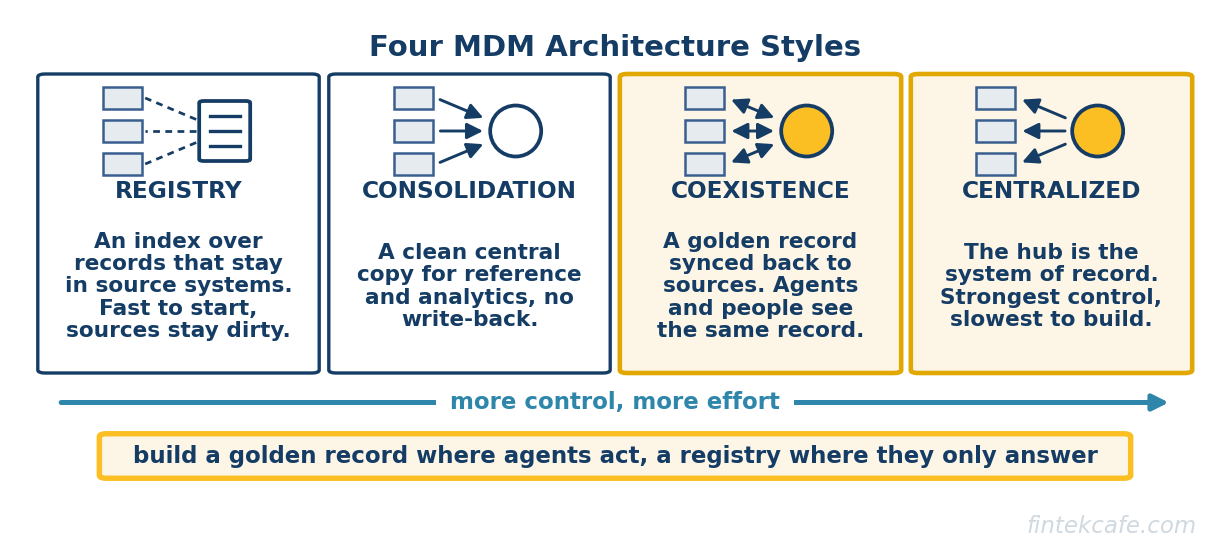
MDM architectures fall into a few recognized styles:
| Style | How it works | Fits when | Agent implication |
|---|---|---|---|
| Registry | An index links records that stay in their source systems | Sources cannot be changed quickly | Agents get a cross-reference, but source data stays dirty |
| Consolidation | A central hub builds a clean copy for reference and analytics, with no write-back | Reporting and analytics are the priority | Agents can read the clean copy, but operational systems still hold errors |
| Coexistence | The hub keeps a golden record and synchronizes it back to sources | Several systems must stay in step | Agents and people see the same record |
| Centralized | The hub is the system of record where records are created | One domain needs strict control | Strongest control, slowest to implement |
A golden record is the single, authoritative version of an entity assembled from the best attributes across sources. It is the right target for domains where agents take actions. A registry is a faster start and often enough where agents only answer questions. The common mistake is building a golden record for every domain at once.
The contract between the master data and the systems that consume it should be explicit: which fields, what freshness, what happens when a field is missing. That is the job of data contracts, and the sensitivity of each field is set by data classification for AI readiness.
The Decision: Which Domain to Fix Before Which Agent
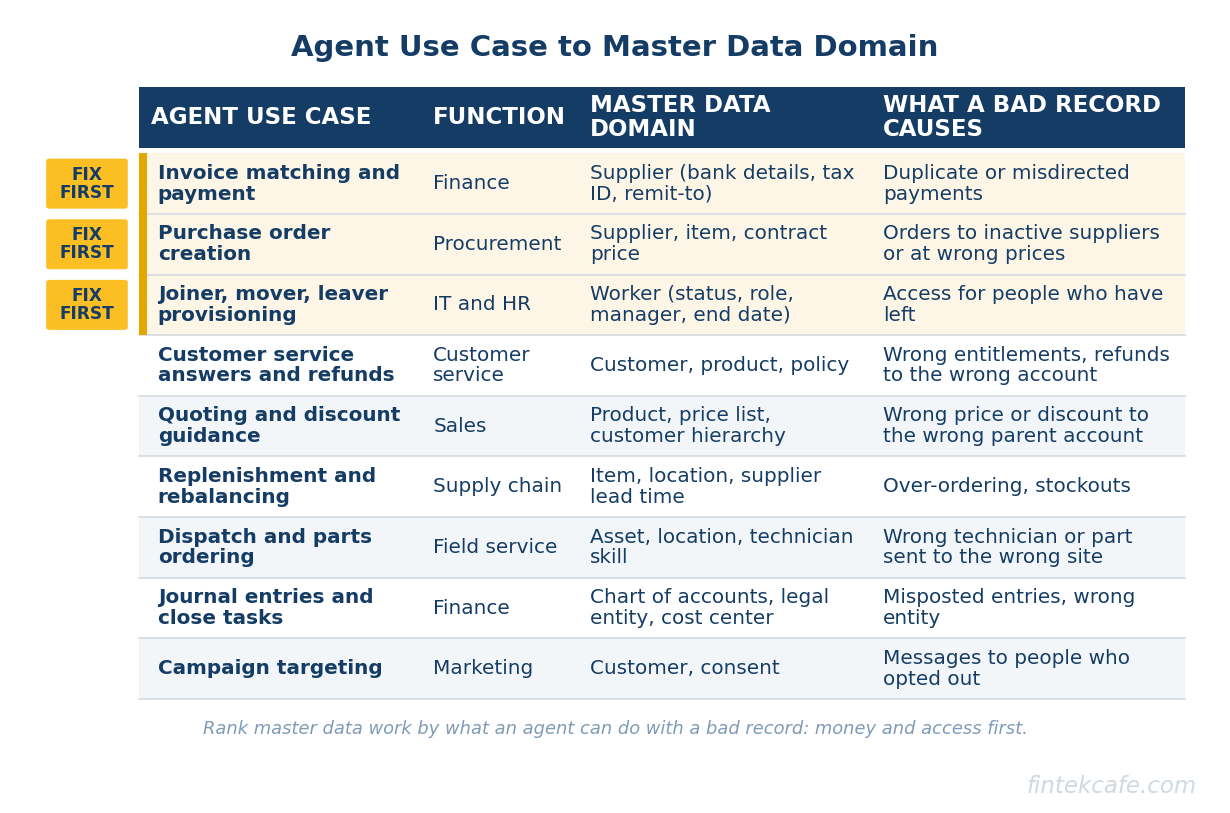
Rank master data work by what an agent can do with a bad record, not by which domain is messiest. The table below maps common agent use cases across functions to the domain each depends on, what a bad record causes, and the minimum bar this article recommends before the agent runs without a person reviewing each action.
| Agent use case | Function | Master data domain | What a bad record causes | Minimum bar before the agent acts alone |
|---|---|---|---|---|
| Invoice matching and payment | Finance | Supplier (bank details, tax ID, remit-to) | Duplicate or misdirected payments | Duplicate scan on all active suppliers, bank changes verified outside the system, one owner for the supplier master |
| Purchase order creation | Procurement | Supplier, item, contract price | Orders to inactive suppliers or at wrong prices | Active flag maintained, items linked to contracts, units of measure aligned |
| Joiner, mover, leaver provisioning | IT and HR | Worker (status, role, manager, end date) | Access for people who have left | HR system is the source of truth, termination flows to identity the same day, contractor records included |
| Customer service answers and refunds | Customer service | Customer, product, policy | Wrong entitlements, refunds to the wrong account | One customer identifier across support and billing, product and policy content from a single published source |
| Quoting and discount guidance | Sales | Product, price list, customer hierarchy | Wrong price or discount to the wrong parent account | Customer hierarchy maintained, price lists versioned, retired products blocked |
| Replenishment and rebalancing | Supply chain | Item, location, supplier lead time | Over-ordering, stockouts | Lead times reviewed on a schedule, units of measure consistent across systems |
| Dispatch and parts ordering | Field service | Asset, location, technician skill | Wrong technician or part sent to the wrong site | Installed-base records tied to locations, service history attached to the asset |
| Journal entries and close tasks | Finance | Chart of accounts, legal entity, cost center | Misposted entries, wrong entity | Hierarchies owned by the controller, changes logged and approved |
| Campaign targeting | Marketing | Customer, consent | Messages to people who opted out | Consent stored with the customer record, suppression applied before send |
Three rules follow from the table.
Fix money and access first. A bad supplier or worker record moves cash or grants access, and both are hard to reverse. A payment to the wrong bank account may be unrecoverable.
Let quality gate autonomy, not the calendar. An agent should run in propose-only mode until its domain meets the bar. When the bar is met, autonomy expands; when a quality check fails, the agent drops back to proposing. That ties the agent rollout to measured data quality rather than to a launch date.
Teach agents to refuse. Every agent that looks up master data should stop and escalate when it finds two plausible matches, a record missing a required field, or a record changed in the last few days on an attribute that moves money. A refusal costs minutes. A confident wrong action costs far more.
How to sequence the work
- Inventory the agents and the master data domains each reads or writes.
- Score each domain on the worst action an agent can take with a bad record and on measured quality: duplicate rate, completeness, age of last update.
- Assign owners for the top two domains before buying any tool.
- Publish the bar for each domain and wire it to the agents, so autonomy depends on a quality check, not a quarterly meeting.
The Position, and Its Tradeoff
The position: no agent should act alone on a master data domain that has no owner and no measured quality bar, and suppliers and workers should be fixed before customers and products.
The tradeoff is time. Gating autonomy on data quality will slow some agent rollouts by months, and MDM can become a perfection project that never ends. The answer is a minimum bar, not a perfect one, applied domain by domain in the order of the agent use cases. The alternative is to let agents discover the data problems in production, where every discovery is a payment, an access grant or a customer answer. Gartner's prediction that organizations will abandon 60 percent of AI projects unsupported by AI-ready data through 2026, and its June 2025 prediction that more than 40 percent of agentic AI projects will be canceled by the end of 2027, describe what that path tends to cost.
Frequently Asked Questions
What is master data management in simple terms?
Master data management is the discipline of keeping one consistent version of the core records a business depends on, such as customers, suppliers, products, employees and accounts, across all the systems that use them. It combines ownership rules, stewardship work and software that matches, merges and synchronizes records.
Why do AI agents need clean master data?
Agents act on records directly, without the judgment a person uses to spot a duplicate or a stale entry. When a supplier exists twice or a former employee still shows as active, an agent pays, provisions or answers based on the wrong record, and repeats the error at volume until someone notices.
Which master data domain should a company fix first for AI?
Start with the domains where a bad record moves money or grants access, usually suppliers and workers, because those errors are the hardest to reverse. Customer and product data come next for customer-facing agents. Domains used only for reporting can wait.
Do companies need a golden record before deploying agents?
Not for every domain. A registry that links records across systems is often enough for agents that only answer questions. A golden record, synchronized back to the source systems, is worth building for the domains where agents take actions such as payments, orders or access changes.
The Bottom Line
Agents turn master data from a reporting nuisance into an operational control. The failures they inherit are old ones: duplicate suppliers, former employees with live access and answers that contradict the company's own records. What changes is speed and scale. The vendors have consolidated around the idea that master data is the foundation for agents, and the surveys agree that most organizations are not ready. Executives who name an owner for each domain, set a minimum quality bar, fix money and access first, and tie each agent's autonomy to that bar will get agents that act on the right record, and agents that stop when they cannot tell which record is right.
Related Articles
The Review Bottleneck: When Coding Agents Write Faster Than Engineers Can Approve
Coding agents made writing code cheap. Reviewing and owning it did not get cheaper. Why approval is the new constraint and what a CTO should change.
AI for Software Testing: What QA Agents Can Take Over, and Where Human Testers Still Matter
AI software testing for executives: what QA agents can generate and maintain, why AI-written tests miss bugs, and which tests to automate or keep human.
Everyone Is a Developer Now: Why AI App Builders Are the Next Shadow IT, and How to Say Yes Safely
AI app builders let any employee ship working software. That is shadow IT with a bigger blast radius. A paved-road policy that says yes without the breach.