
The Review Bottleneck: When Coding Agents Write Faster Than Engineers Can Approve
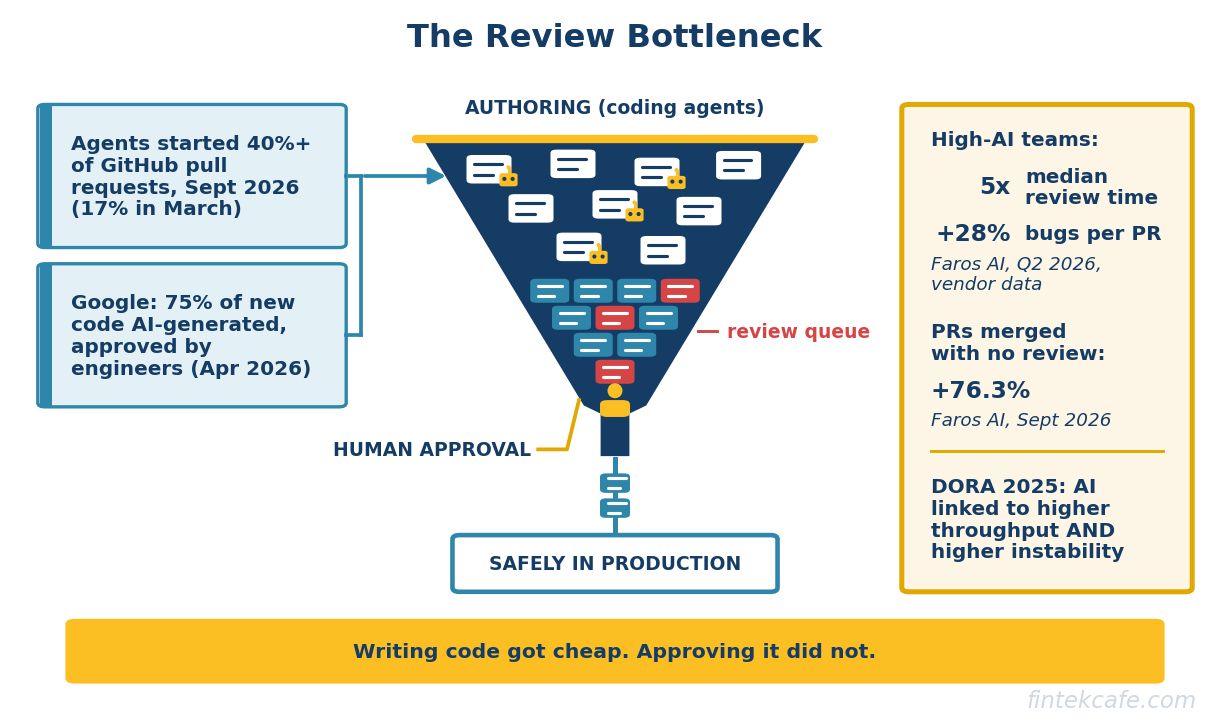
By September 2026, more than 40 percent of pull requests on GitHub started with a coding agent's first draft, up from 17 percent in March, according to GitHub's Octoverse 2026 report (October 28, 2026). That is about 110 million agent-started pull requests in a single month, roughly six times March's volume, and GitHub describes its own detection as a floor. At Google, Sundar Pichai told the Cloud Next conference in April 2026 that 75 percent of all new code at the company is now AI-generated and approved by engineers, up from 50 percent the previous autumn.
Note the last four words of that sentence: approved by engineers. Every one of those lines still needs a person to read it, understand it, accept responsibility for it and be paged when it breaks. The cost of writing code has collapsed. The cost of reviewing, testing and owning it has not.
The thesis of this piece: the constraint in software delivery has moved from authoring to approval, and organizations that keep measuring engineering output in pull requests or lines of code will ship more risk, not more value. The executive who owns delivery now has to manage a queue, not a typing speed. The winners will be the organizations that redesign review as a deliberate, risk-tiered control system with named human owners, rather than the ones that let a flood of agent-authored changes hit a review process designed for human-paced work.
This is not only a software-company problem. Every enterprise that runs internal platforms, apps, data pipelines or automation now has agents producing changes faster than engineers can verify them, and the pattern is spreading to apps built by business teams in HR, finance, marketing and operations.
The Numbers: Authoring Accelerated, Approval Did Not
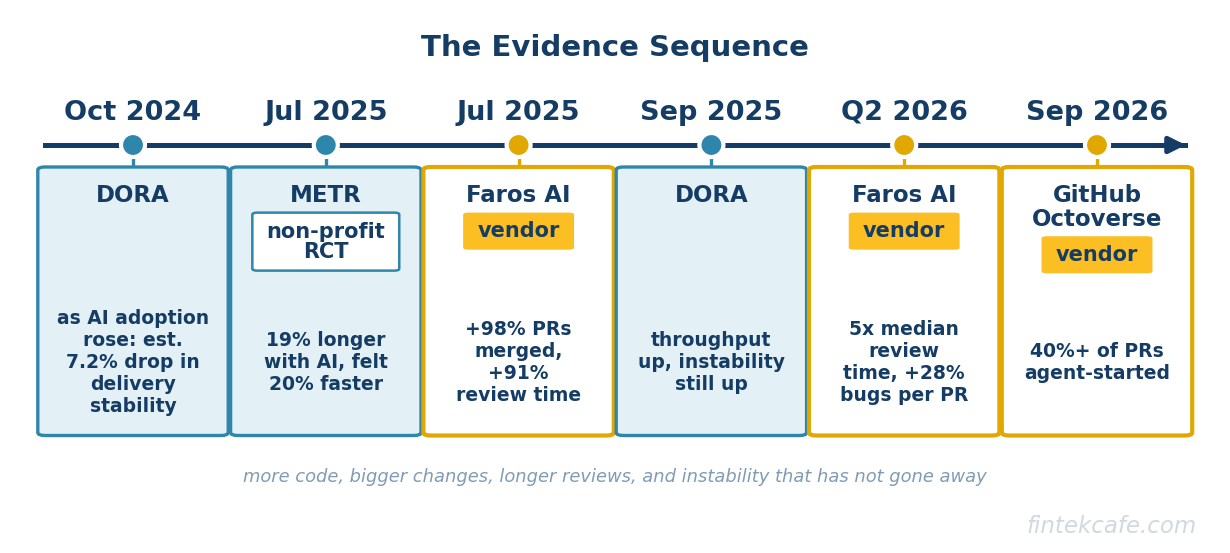
The evidence is now consistent across independent and vendor sources, and it points in one direction: more code, larger changes, longer reviews and, so far, more instability. The sources differ in rigour and in who paid for them, so they are separated below.
| Source (date) | Who ran it | Key finding |
|---|---|---|
| GitHub Octoverse 2026 (Oct 28, 2026) | GitHub, which sells Copilot | Agents started more than 40 percent of pull requests in September 2026; 1.3 billion pull requests merged in the year to September 30 |
| DORA, Accelerate State of DevOps (Oct 2024) | Google Cloud research team, about 39,000 respondents | As AI adoption rose, an estimated 1.5 percent drop in delivery throughput and a 7.2 percent drop in delivery stability |
| DORA, State of AI-assisted Software Development (Sept 2025) | Google Cloud, nearly 5,000 respondents | AI adoption now linked to higher throughput, but still linked to higher instability |
| Faros AI, AI Productivity Paradox (July 23, 2025) | Engineering-metrics vendor, 10,000+ developers on 1,255 teams | High-adoption teams merged 98 percent more pull requests; review time rose 91 percent; pull request size rose 154 percent |
| Faros AI, The Acceleration Whiplash (Q2 2026) and The Speed Trap (Sept 18, 2026) | Same vendor, about 22,000 developers on 4,000 teams | High adoption linked to five times the median review time and 28 percent more bugs per pull request; pull requests merged with no review up 76.3 percent |
| METR randomized trial (July 10, 2025) | Non-profit research group, 16 experienced developers, 246 tasks | Developers took 19 percent longer with AI tools, while believing they were 20 percent faster |
Read the table as a sequence rather than a list. (GitHub's 2026 figures include private repositories and new definitions, so they do not compare directly with earlier editions.) In 2024, Google's DORA research found that rising AI adoption came with an estimated 7.2 percent reduction in delivery stability. Its 2025 report, the latest edition of the survey, found that the throughput penalty had reversed, with AI adoption now associated with higher throughput, but the instability had not gone away: AI remained associated with increased instability. DORA's framing is that AI is an amplifier, strengthening whatever practices an organization already has. That is a polite way of saying that weak review and testing practices get weaker faster.
The Faros AI data, from a vendor that sells engineering analytics and so has an interest in the problem being visible, makes the mechanism concrete. Its July 2025 baseline found that teams with high AI adoption completed 21 percent more tasks and merged 98 percent more pull requests, but review time rose 91 percent and pull requests grew 154 percent larger; across the companies studied, the team-level gains did not show up as company-level improvement in delivery metrics. Faros named the bottleneck directly: human approval. Its 2026 data, drawn from about 22,000 developers on 4,000 teams and comparing high and low adoption within the same organizations, shows the strain growing: five times the median review time, pull requests 51 percent larger, 28 percent more bugs per pull request and deployments per week down 11.7 percent, even as task throughput rose 33.7 percent (The Acceleration Whiplash, Q2 2026). By September 2026, Faros reported that pull requests merged with no review at all were up 76.3 percent, against a 31.3 percent rise six months earlier (The Speed Trap, September 18, 2026).
The METR trial is the strongest single study on perception. In a randomized controlled design, experienced open-source developers working on large codebases they knew well took 19 percent longer to finish tasks when AI tools were allowed. Before the study they had forecast a 24 percent speed-up, and afterwards they still believed AI had made them about 20 percent faster. METR is careful to say this does not prove AI slows most developers, and the tools it tested date from early 2025. Its February 24, 2026 update reported that a follow-up could not produce a reliable estimate, largely because developers increasingly declined to work without AI, and said developers are likely more sped up now than in early 2025. The durable lesson is narrower and more useful: self-reported productivity is not evidence, because the people doing the work cannot feel where the time goes.
Put together, the picture is clear enough to act on. Authoring capacity has grown by multiples. Review capacity, which is human attention, has grown barely at all. The gap between the two is where the risk accumulates.
This is a Premium Article
Sign up for a Premium membership to read this article and get full access to strategic intelligence on technology and business.
Already a member? Sign in
Related Articles
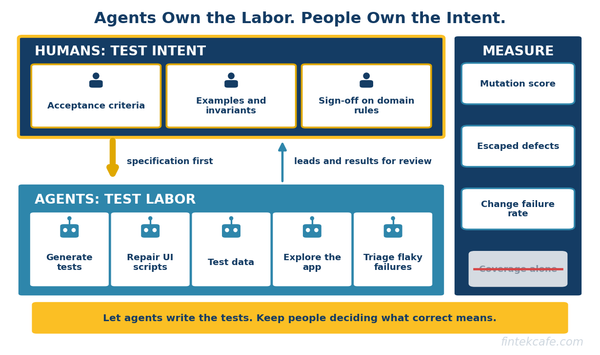
AI for Software Testing: What QA Agents Can Take Over, and Where Human Testers Still Matter
AI software testing for executives: what QA agents can generate and maintain, why AI-written tests miss bugs, and which tests to automate or keep human.
Everyone Is a Developer Now: Why AI App Builders Are the Next Shadow IT, and How to Say Yes Safely
AI app builders let any employee ship working software. That is shadow IT with a bigger blast radius. A paved-road policy that says yes without the breach.
AI for Legacy Code Migration: What Agents Can Modernize, and Where Rewrites Still Fail
AI legacy code migration for executives: what agents do well, where COBOL rewrites still fail, and when to wrap, translate, rewrite or retire a system.