
AI in Supply Chain: What Planning and Logistics Agents Can Decide, and What Planners Must Keep
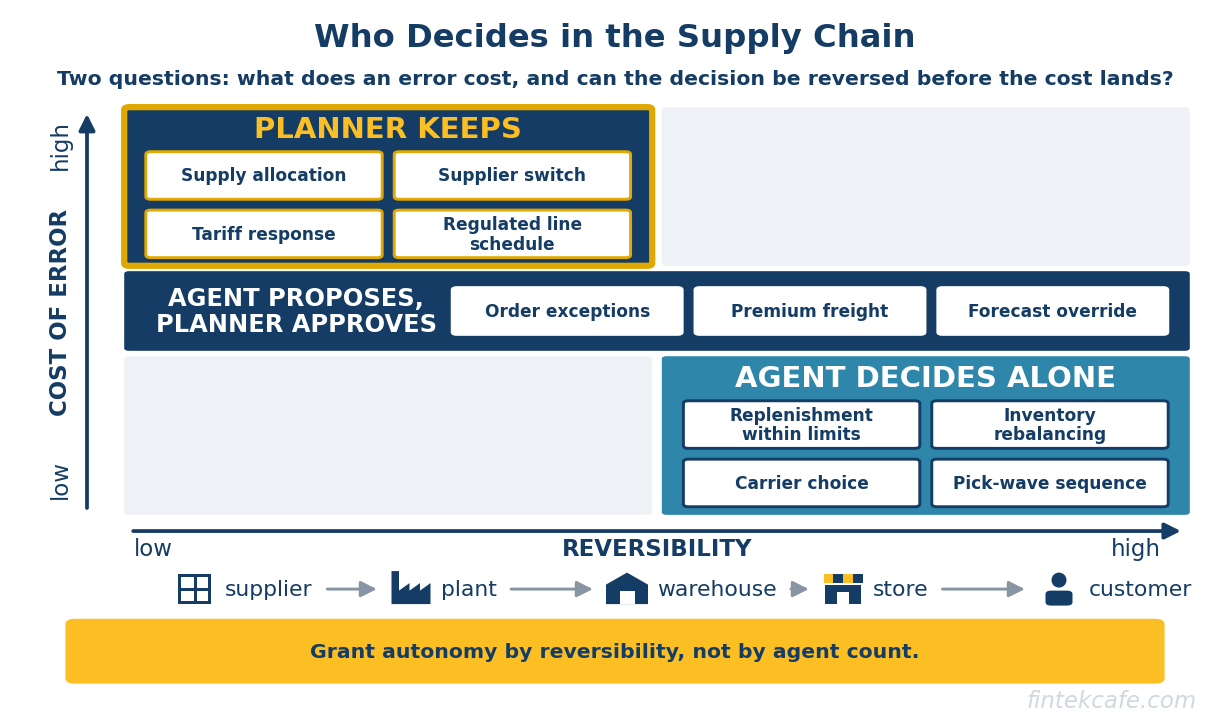
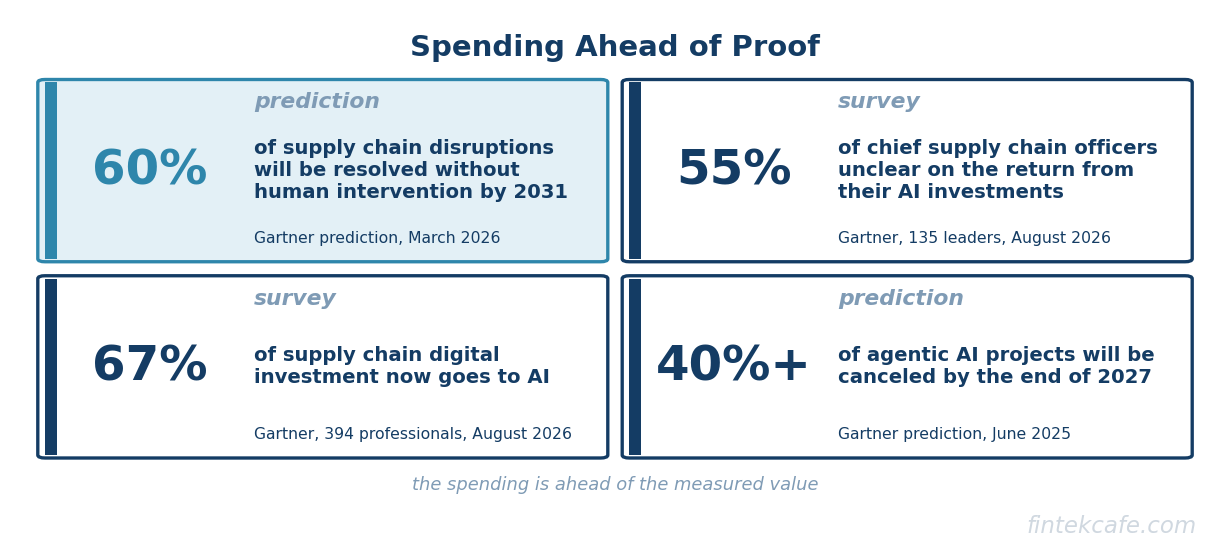
AI in supply chain means software that forecasts demand, sets inventory, monitors suppliers, routes freight and resolves order exceptions, and it is now moving from recommending decisions to taking them. Gartner predicted in March 2026 that by 2031, 60 percent of supply chain disruptions will be resolved without human intervention. In the same release, Gartner said that for now, immature technology and data problems should restrict full automation to low-risk decisions. That caveat is the whole management question. The position taken here: autonomy in the supply chain should be granted by reversibility and cost of error, not by how many agents a vendor ships. Agents can safely execute bounded, reversible decisions today. Allocation of scarce supply, supplier changes and responses to new trade rules should stay with planners, with agents preparing the options.
Key Takeaways
- Supply chain has the longest AI record of any operations function, because demand forecasting has used machine learning for years. What is new is agents that act on the forecast.
- Every major planning and execution vendor shipped agents in 2025: SAP, Oracle, Blue Yonder, Kinaxis, o9 and Manhattan Associates. Their results so far are vendor-reported.
- Independent evidence is thinner than the marketing. Gartner reported in August 2026 that 55 percent of chief supply chain officers in one survey were unclear on the return from their AI investments.
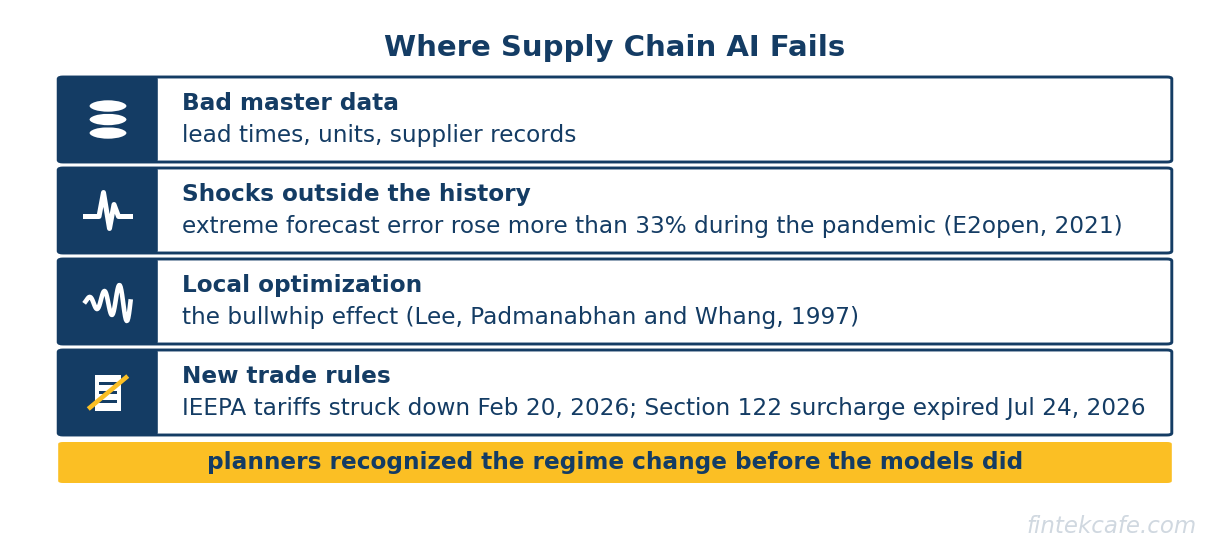
- AI fails in predictable places: bad master data, shocks outside the training history, local optimization that amplifies swings upstream, and trade rules the model has never seen.
- Sort decisions into three tiers by cost of error and reversibility: the agent decides alone, the agent proposes for approval, or the planner keeps the decision.
Why Supply Chain Is the Test Case for Decision Agents
Supply chain planning was data-driven long before generative AI. Statistical forecasting, inventory optimization and route optimization are decades old. That history makes the function a useful test for the next step: letting software act rather than advise.
The pressure to take that step is real. Gartner surveyed 509 supply chain leaders between July and October 2025 and reported in February 2026 that 55 percent expect agentic AI to reduce the need for entry-level hiring, and 86 percent said adoption will require new ways to develop talent pipelines. Gartner also found that high-performing organizations had adopted agentic AI at significantly higher rates across procurement, production, logistics, warehouse management and planning. That is a correlation, not proof that agents caused the performance.
The other pressure is volatility. McKinsey's 2025 Supply Chain Risk Pulse, a survey of about 100 supply chain leaders, found tariffs dominated their attention, with 43 percent planning to shift more of their supply chain footprint to the United States within three years. The same survey found most companies understand their supply chain risks only up to their tier-one suppliers. Respondents named demand forecasting, inventory optimization and supply planning as the top generative AI use cases.
An agent that acts on a forecast is only as good as the forecast, and forecasts are weakest exactly when conditions change. That tension runs through every decision below.
What AI Does Across the Chain
Demand sensing and forecasting
Machine learning forecasts combine order history with signals such as promotions, prices, weather and point-of-sale data. Demand sensing refreshes the short-term forecast daily or more often. The evidence that this helps is strongest in stable conditions and weakest during shocks, a point covered in the failure section. Agents add a layer on top: they explain forecast changes in plain language, flag the items with the largest deviations and draft overrides for a planner to accept.
Inventory and replenishment
Replenishment is where agents act most often, because the decisions are frequent, bounded and correctable. Walmart's July 17, 2025 release described a "Self-Healing Inventory" system that detects overstocks in Mexico City stores and reroutes supply to the stores that need it, and said that system alone had saved more than 55 million dollars. That is the company's own figure, not an audited one, but the pattern is instructive: the agent moves stock within the network, inside limits, and each move can be reversed.
Supplier risk monitoring
Supplier monitoring reads news, weather, shipping and financial signals to flag suppliers at risk before orders are late. Its value depends on knowing who the suppliers' suppliers are, which most companies do not, according to McKinsey's 2025 survey. AI can scan the signals, but it cannot monitor a tier-two supplier nobody has mapped.
Transport routing and carrier selection
Route optimization is the oldest success story. UPS has said for years that its ORION routing system saves about 100 million miles and 10 million gallons of fuel a year, and a 2026 Trellis article reported the company now credits it with about 9 million gallons a year. These are UPS's own estimates. Carrier selection among contracted carriers on standard lanes is a similar, bounded choice that agents can make within rules.
Warehouse operations
In the warehouse, AI plans labor, sequences pick waves and investigates inventory discrepancies. Manhattan Associates announced agents for these jobs at its Momentum conference on May 20, 2025, including a Labor Optimizer Agent and a Wave Inventory Research Agent, with general availability planned for fall 2025.
Exception handling in order management
Most planner time goes to exceptions: a late shipment, a short receipt, a missing advance shipping notice. Oracle's October 15, 2025 release described agents in its Fusion Cloud supply chain applications for exactly this work, including a Planning Advisor for Exceptions and Notes and an ASN Creation Assistant. Exception triage is a good fit: the agent gathers context, proposes a resolution and routes it.
The task table
| Task | What AI does | Maturity | Main control |
|---|---|---|---|
| Demand forecasting | Statistical and ML forecasts, explanation of changes | High in stable periods, low in shocks | Forecast accuracy tracking, planner override |
| Demand sensing | Daily short-term forecast refresh | Medium to high | Bias monitoring by item and channel |
| Replenishment | Orders within min and max limits | High | Order limits, approved supplier list |
| Inventory rebalancing | Moves stock between sites | Medium to high | Value and volume caps per move |
| Supplier risk monitoring | Scans external signals for at-risk suppliers | Medium | Mapped supplier network beyond tier one |
| Routing and carrier selection | Routes, assigns contracted carriers | High | Contracted rates, service-level rules |
| Warehouse labor and waves | Plans labor, sequences picks | High | Shift rules, safety constraints |
| Order exceptions | Triage, context gathering, draft resolution | Medium | Approval routing, audit log |
| Supply allocation | Scenarios for constrained supply | Low as an autonomous task | Planner decision with documented rules |
What the Vendors Now Ship
Every major vendor announced agents in 2025. All of the following are company announcements, and the adoption and benefit claims attached to them have not been independently verified.
- SAP announced more than 40 Joule agents across its applications at Sapphire in May 2025, and at SAP Connect in October 2025 introduced three new Joule agents for supply chain management and a new SAP Supply Chain Orchestration product.
- Oracle announced role-based agents in Fusion Cloud Supply Chain and Manufacturing on January 30, 2025, and added agents for planners, managers and logistics teams on October 15, 2025, which it said come at no additional cost.
- Blue Yonder launched five agents in its Cognitive Solutions platform at ICON in May 2025, including an Inventory Ops Agent that points planners to supply and demand mismatches, and demonstrated a Tariffs Agent at the same event.
- Kinaxis previewed agents in its Maestro platform at Kinexions in April 2025, launched prebuilt Maestro Agents on October 17, 2025, and announced Maestro Agent Studio for building custom agents in February 2026.
- o9 Solutions said on June 3, 2025 that its agentic capabilities, built on its Enterprise Knowledge Graph, were generally available.
- Manhattan Associates announced agents for stores, labor and warehouse inventory on May 20, 2025.
Two cautions apply. First, Gartner predicted in June 2025 that more than 40 percent of agentic AI projects will be canceled by the end of 2027, citing rising costs, unclear business value and insufficient risk controls, and warned of "agent washing," where existing assistants and automation are rebranded as agents. Second, the vendor that owns the planning system will naturally argue that its agents should act inside it. Whether a given step needs an agent at all, or a deterministic rule, is a separate question covered in the agent versus workflow decision guide.
What the Independent Evidence Says
Separate the evidence into three kinds.
Consultancy estimates. McKinsey's April 2021 article "Succeeding in the AI supply-chain revolution" reported that early adopters of AI-enabled supply chain management improved logistics costs by 15 percent, inventory levels by 35 percent and service levels by 65 percent compared with slower-moving competitors. These figures are widely quoted. They compare early adopters with others, which mixes the effect of AI with the effect of being the kind of company that adopts early, and they predate agents.
Surveys. Gartner reported on August 5, 2026 that 55 percent of chief supply chain officers, in a survey of 135 senior leaders conducted from January to April 2026, were unclear on the return from their AI investments, while a separate survey of 394 supply chain professionals, conducted from November 2025 to February 2026, found 67 percent of supply chain digital investment now goes to AI. Spending is running ahead of measured value.
Vendor benchmarks. E2open's forecasting benchmark, published in September 2021 and covering more than 200 billion dollars of fast-moving consumer goods, found demand planning error rose more than 20 percent and extreme error more than 33 percent during the pandemic, while service levels fell from 99 percent to 83 percent. It reported that AI and real-time data cut forecast error by 32 percent. That last figure comes from a vendor measuring its own category of product.
The honest reading: forecasting and routing gains are well established; autonomous decision-making in planning is too new for independent outcome data. Executives should ask for a holdout comparison before accepting any vendor's savings figure, a discipline that applies equally to the demand plan and to AI forecasting in the finance function, which consumes it.
Where It Fails
Bad master data
Agents act on lead times, units of measure, minimum order quantities and supplier records. If those are wrong, a fast agent makes wrong decisions faster. A hospital supply chain director at Baptist Health Princeton told Becker's Hospital Review that forecasting and procurement automation show promise but are often undermined by inconsistent data. The same is true in every industry: master data cleanup is the unglamorous prerequisite.
Shocks outside the training history
A model learns from history. When demand moves in ways the history never showed, the model fails. Bain, writing in Harvard Business Review, described how COVID-19 "shattered" the forecasts retailers and consumer goods suppliers relied on, and E2open's 2021 benchmark measured the rise in extreme forecast error. Planners recognized the regime change before the models did, because they could read the news and call customers.
Optimizing one node at the expense of the chain
An agent that optimizes one site's inventory can make the whole chain worse. Hau Lee, V. Padmanabhan and Seungjin Whang described this in "The Bullwhip Effect in Supply Chains" in Sloan Management Review in spring 1997: small changes in consumer demand turn into large swings in orders further upstream, a pattern Procter and Gamble saw in its Pampers diaper business, where consumer use was steady. Multiple agents each optimizing a local objective can recreate the bullwhip at machine speed unless their goals are set at the network level.
Trade rules the model has never seen
US trade policy changed repeatedly in 2025 and 2026. The Supreme Court ruled on February 20, 2026, in Learning Resources, Inc. v. Trump, that the International Emergency Economic Powers Act does not authorize tariffs. The administration replaced those duties with a temporary surcharge under Section 122 of the Trade Act of 1974, effective February 24, which expired on July 24, 2026 after Congress did not extend it, and was largely replaced by Section 301 duties, according to UHY and the American Bar Association's procurement law publication. Refund litigation over the original duties continues. No model trained on prior years has seen a sequence like this. Re-sourcing and country-of-origin decisions need trade compliance and human judgement; an agent can model the landed-cost scenarios.
Planning software failure is not new
In 2001 Nike blamed its i2 Technologies demand planning system for a large sales and earnings shortfall, after the system ordered too many of some shoes and too few of others, as CIO magazine and Baseline reported. The cutover was not complete when Nike began planning a season on it. The lesson has not changed: a planning system that acts on bad data or an unstable implementation can damage a season before anyone notices.
The Decision: What an Agent May Decide Alone
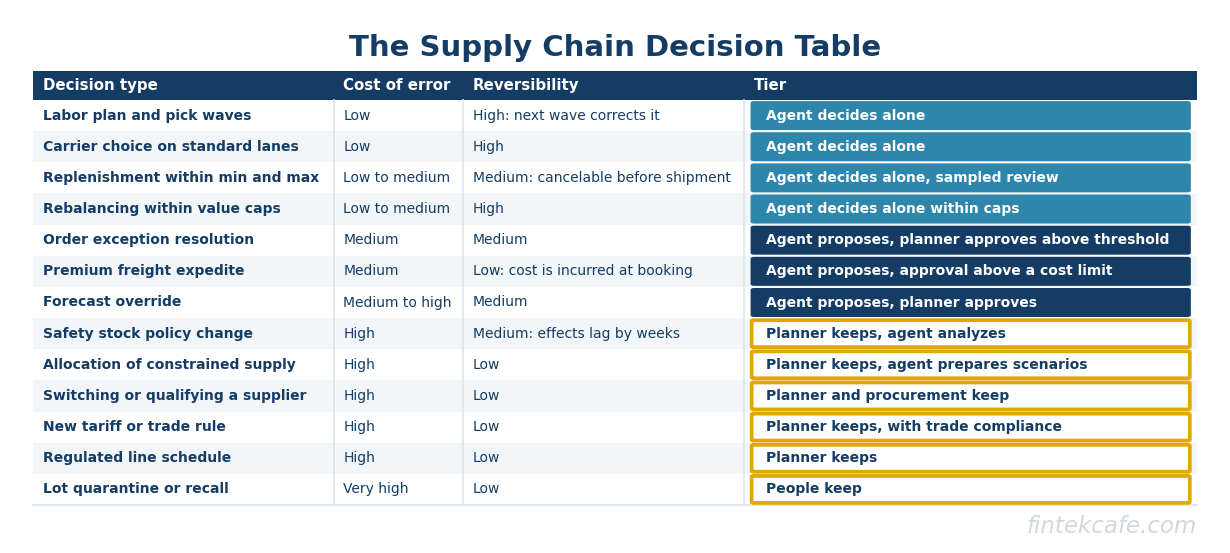
Classify each decision by two questions. What does an error cost? Can the decision be reversed before the cost lands?
| Decision type | Cost of error | Reversibility | Tier |
|---|---|---|---|
| Warehouse labor plan and pick-wave sequence within a shift | Low | High: next wave corrects it | Agent decides alone |
| Carrier choice among contracted carriers on standard lanes | Low | High | Agent decides alone |
| Replenishment orders within min and max limits from approved suppliers | Low to medium | Medium: cancelable before shipment | Agent decides alone, sampled review |
| Inventory rebalancing between sites within value caps | Low to medium | High | Agent decides alone within caps |
| Order exception resolution (short receipt, missing notice) | Medium | Medium | Agent proposes, planner approves above threshold |
| Premium freight expedite | Medium | Low: cost is incurred at booking | Agent proposes, approval above a cost limit |
| Forecast override for a promotion or new product | Medium to high | Medium | Agent proposes, planner approves |
| Safety stock policy change | High | Medium: effects lag by weeks | Planner keeps, agent analyzes |
| Allocation of constrained supply among customers | High: customer relationships | Low | Planner keeps, agent prepares scenarios |
| Switching or qualifying a supplier | High | Low | Planner and procurement keep |
| Response to a new tariff or trade rule | High | Low | Planner keeps, with trade compliance |
| Production schedule change on a regulated line | High | Low | Planner keeps |
| Lot quarantine or recall | Very high | Low | People keep |
Three design rules make the tiers work.
Autonomy needs limits written in units the business understands. "Within min and max," "under a value cap per move," "only contracted carriers." When a limit is crossed, the decision moves up a tier automatically. The approval step itself needs design, not just a button, as covered in how to design human approval for agents.
Every autonomous action needs a log and an undo. Planners must see what the agent did and why, and be able to reverse it. That is the difference between a correctable mistake and an incident, a topic covered in how agents should handle errors and recover.
Supplier decisions belong with procurement controls. When an agent's proposal involves a new supplier, a new price or a contract change, it crosses into spend control, where the rules in agentic procurement and spend control apply.
Examples Across Industries
Manufacturing. SAP's Sapphire 2025 announcements, as reported in coverage of the event, included a maintenance planning agent that adjusts schedules from real-time data and a shop floor supervisor agent for production disruptions. Adjusting a maintenance window inside a plan is reversible; changing the production schedule of a validated line is not, and stays with the planner. Nike's 2001 experience remains the reminder of what an unstable planning system does to a product season.
Retail. Walmart's Self-Healing Inventory rebalances stock between stores within the network, the clearest public example of an agent acting alone on a reversible decision. Promotional forecasts and allocation of scarce products across regions remain planner calls, because the cost of getting them wrong lands on customers and on margins at once.
Healthcare. When Hurricane Helene shut Baxter's North Cove, North Carolina plant in late 2024, hospitals lost a major source of IV fluids. A University of Michigan team built a projection model in about 24 hours from Michigan Medicine order data to estimate how soon products would run out, according to the university. GHX built an AI model to predict IV solution shortages after the same event, Modern Healthcare reported in March 2025. The stakes are clear in Vizient's June 2025 survey of 132 health systems: managing drug shortages cost hospitals nearly 900 million dollars in labor in 2023 and about 20 million hours. Forecasting the shortage suits an agent; deciding which patients get the conserved supply, or which substitute product is clinically acceptable, does not.
Distribution. Routing and carrier assignment are mature, as UPS's ORION figures show. The decisions that stay human in distribution are commercial: which customers get product when supply is short, and when to pay for premium freight to protect a key account.
The Position, and Its Tradeoff
The position: grant autonomy by reversibility and cost of error, and invest first in master data and exception workflows, not in the number of agents. Let agents execute bounded, reversible decisions such as replenishment within limits, rebalancing, carrier choice and warehouse sequencing. Keep allocation, supplier changes, policy changes and trade responses with planners, supported by agents that prepare the scenarios.
The tradeoff is real. This path produces smaller headline savings than a vendor's fully autonomous demo, and planners keep a heavier workload for longer. There is also a risk that the "propose for approval" tier turns into rubber-stamping when approvals pile up, which removes the human check while keeping the delay. The answer is to keep the approval queue small by moving decisions down a tier once their error rate is measured, not to remove the tier. The alternative, letting agents act on irreversible decisions before the data and the controls are ready, exposes the organization to exactly the errors that are hardest to undo. Gartner's own advice in March 2026 was to expand autonomy in a controlled manner, starting with low-risk decisions.
Frequently Asked Questions
How is AI used in supply chain planning?
AI forecasts demand, sets replenishment orders, monitors supplier risk, optimizes routes and carrier choices, plans warehouse labor and triages order exceptions. The newest step is agents that execute some of these decisions, within limits, rather than only recommending them.
Can AI agents make supply chain decisions without humans?
Some, safely. Decisions that are low-cost and reversible, such as replenishment within limits, inventory rebalancing between sites and carrier choice among contracted carriers, can run autonomously with logging. Gartner predicted in March 2026 that 60 percent of disruptions will be resolved without human intervention by 2031, but advised restricting full automation to low-risk decisions for now.
Why do AI demand forecasts fail during disruptions?
Models learn from historical patterns. A pandemic, a plant shutdown or a sudden tariff change creates demand and supply patterns that are not in the history, so the model extrapolates the wrong pattern. E2open's 2021 benchmark found extreme forecast error rose more than 33 percent during the pandemic.
What should executives fix before deploying supply chain agents?
Master data (lead times, units, supplier records), visibility beyond tier-one suppliers, written decision limits for each agent, and a log with an undo for every autonomous action. Without these, agents act quickly on bad inputs.
The Bottom Line
Supply chain is where AI has proven itself as a forecaster and an optimizer, and it is now where agents are being handed decisions. The capability is real and the vendors are ready. The evidence on returns is not yet, and the failure modes are well known: bad data, unprecedented shocks, local optimization and changing trade rules. Executives who sort decisions by cost of error and reversibility, give agents the reversible ones within written limits, and keep the irreversible ones with planners will capture most of the value while keeping the mistakes that matter in human hands.
Related Articles
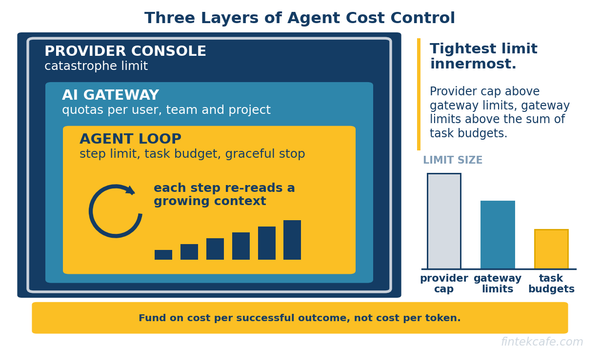
Agent Cost Control: How to Budget, Meter and Cap What AI Agents Spend
Agent cost is variable and heavy-tailed. How to budget per task, meter by owner, and cap spend without killing tasks that are 95 percent done.
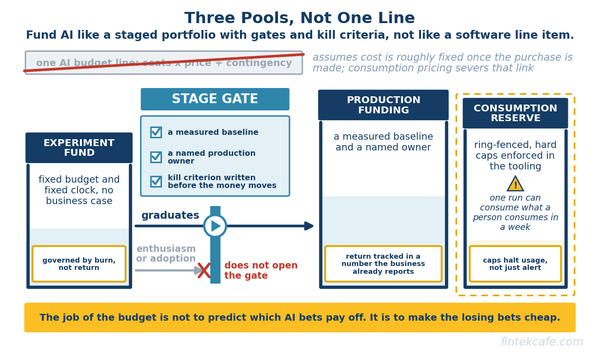
Budget Season for AI: How CFOs Should Fund Next Year's AI Without Funding Every Pilot
AI requests arrive from every function at once, priced in seats, consumption and services. Fund AI like a staged portfolio, not a software line item.
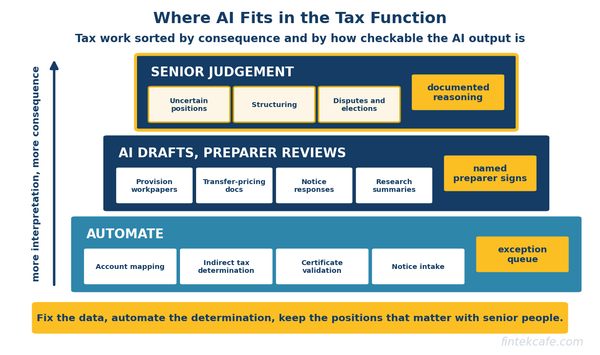
AI in the Tax Function: What Corporate Tax Teams Can Automate, and Where Judgement Stays
AI in corporate tax: what to automate, what needs preparer review, what stays with senior judgement, plus a data-readiness check for heads of tax and CFOs.