
API Versioning and Deprecation: How Platforms Change Without Breaking Their Customers
Every platform eventually faces the same trap: the API that made it successful becomes the API it cannot change, because every integration built against it is a promise the platform did not realize it was making. API change management looks like a technical decision, versioning schemes, deprecation timelines, migration tooling, but it is a business problem wearing technical clothes. Every breaking change a platform ships externalizes cost onto every customer whose integration depends on the old behavior, and every change the platform avoids making, for fear of that cost, accretes internally as debt the platform's own engineers now have to work around. The tension does not resolve; it gets managed, and the platforms that manage it well are distinguished less by clever versioning schemes than by disciplined policy, honest telemetry, and migration tooling that treats the customer's cost of changing as a first-class engineering problem. This guide covers the versioning strategies and their real trade-offs, what a credible deprecation policy actually contains, how a consumer should build to survive a vendor's changes, what AI adds to both sides, and the metrics a platform team should be tracking before the next breaking change is even proposed.
Key Takeaways
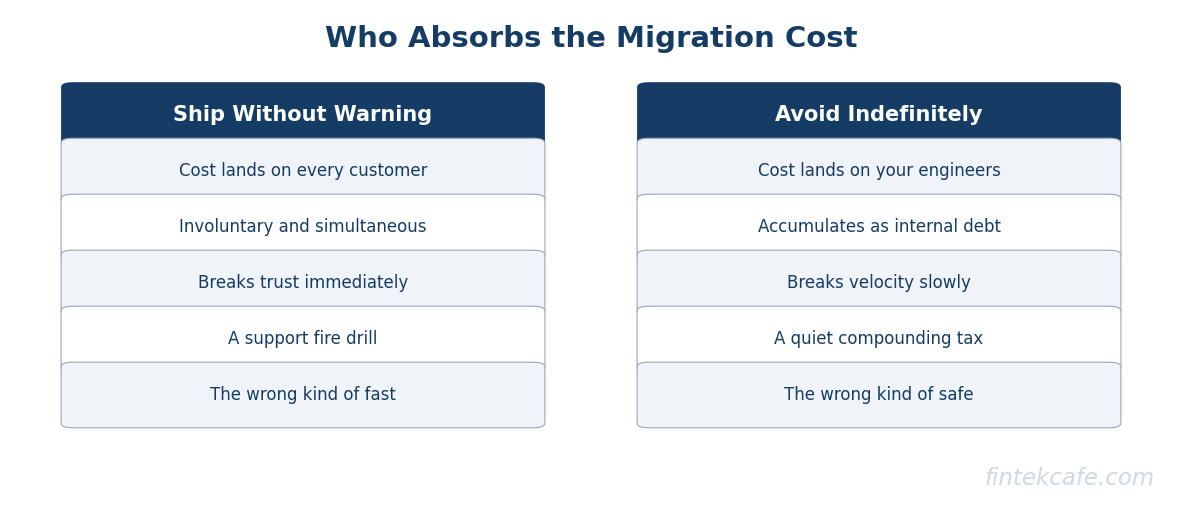
- API versioning is a cost-allocation decision disguised as a technical one. A breaking change shipped without warning moves the migration cost onto every customer simultaneously and involuntarily; a change avoided indefinitely moves the cost onto the platform's own engineers as accumulating internal debt. Every strategy below is really a choice about who absorbs that cost and on what timeline.
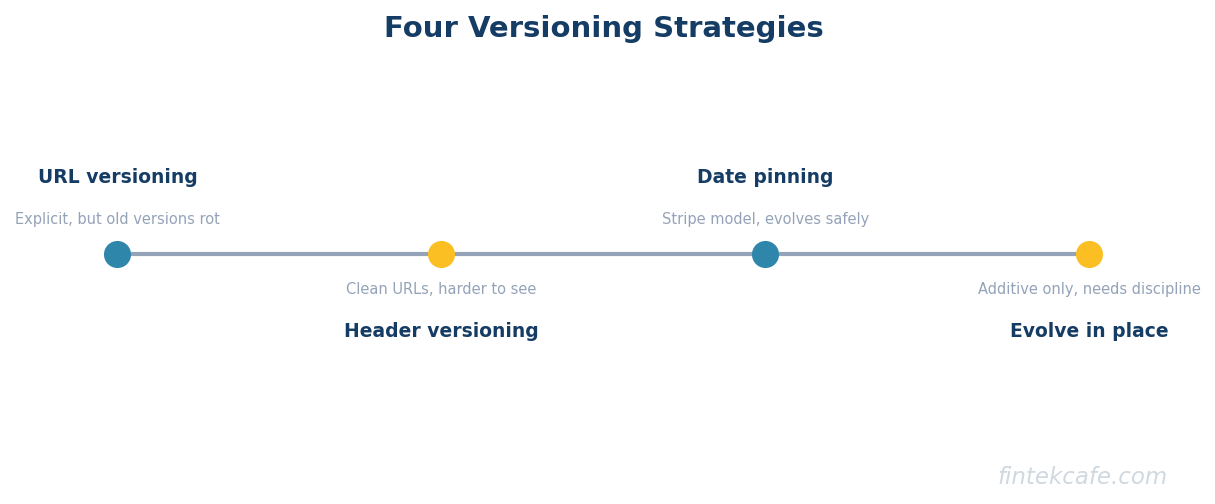
- Four strategies dominate practice, each with a real trade-off: URL versioning (explicit and simple, but tempts a platform to let old versions rot indefinitely), header versioning (cleaner URLs, harder for customers to see which version they are on), date-based version pinning (Stripe's model: customers pin a date and the platform evolves safely around them), and evolve-in-place with additive-only changes (avoids explicit versions entirely, but requires real discipline about what counts as additive).
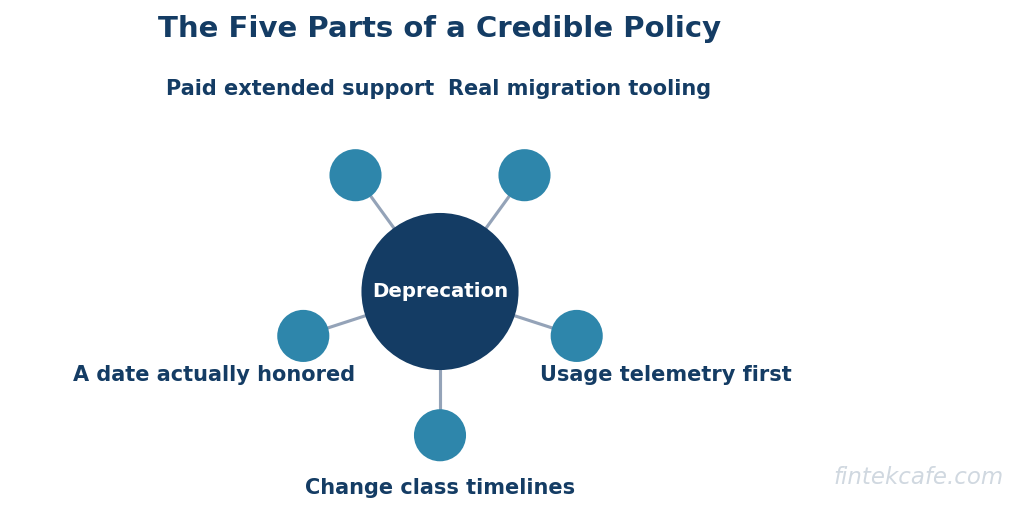
- A credible deprecation policy has five load-bearing parts: change-class-specific timelines, usage telemetry gathered before any removal date is set, migration tooling that does real work rather than just documenting the change, a paid extended-support tier for customers who cannot move on the standard clock, and a hard removal date the platform actually honors.
- Consumers of someone else's API are not powerless: contract tests that fail loudly the moment a dependency's behavior shifts, an abstraction layer between the vendor's API and the rest of the codebase, and a maintained inventory of every external dependency and its deprecation calendar convert an unpredictable vendor risk into a scheduled, budgeted one.
- AI changes the object being versioned without changing the underlying discipline: a model version is now the thing that silently breaks integrations the way an API version used to, and an agent consuming an API on a schedule with no human noticing shifts the versioning burden further onto machine-readable deprecation signals rather than a changelog a person reads once a quarter.
Why This Is a Business Problem, Not a Technical One
The instinct to treat API versioning as an engineering decision, pick a scheme, document it, move on, misses where the actual cost lands. A breaking change to a widely integrated API does not cost the platform much to ship; it costs every downstream customer time, testing, and risk to absorb, on a timeline the platform chose and the customer did not. Multiply that by hundreds or thousands of integrations and the platform has, in effect, imposed an unbudgeted engineering tax on its own customer base, at a moment of its own choosing.
The opposite failure is equally real and less visible: a platform that fears breaking customers avoids changing the API at all, and the cost does not disappear, it relocates inside the platform. Internal engineers build increasingly elaborate compatibility shims to support behavior the API never should have promised, new features get bent to fit an old data model because changing the model would break existing integrations, and the platform's own velocity slows under the weight of promises it is still keeping to integrations nobody remembers building. Both failure modes are cost-allocation failures. The organizations that manage this well do not have a magic versioning scheme; they have made a deliberate, disclosed decision about how much cost lands on customers, how much lands internally, and on what schedule, and they have built the telemetry and tooling to make that decision with real data rather than guesswork.
The Versioning Strategies and Their Real Trade-offs
Four strategies account for the overwhelming majority of production API design, and each buys a different balance of explicitness, customer burden, and platform flexibility.
| Strategy | How it works | What it buys | The real cost |
|---|---|---|---|
| URL versioning (/v1/, /v2/) | Version number embedded directly in the endpoint path | Maximum explicitness; trivial for a customer to see and pin their version | Tempts platforms to let old versions accumulate indefinitely, since each lives at its own stable path with no natural pressure to retire |
| Header versioning | Version specified in a request header rather than the URL | Cleaner, version-agnostic URLs; easier to route internally | Customers must remember to set the header explicitly; version drift is invisible until something breaks, because nothing in the URL reminds anyone what version is in use |
| Date-based version pinning | Customers pin to a release date; the platform evolves behavior between dates without forcing anyone off their pinned date until it is formally retired | The platform can ship continuous improvement without breaking anyone actively pinned to an earlier date; customers move forward on their own schedule | Requires substantial internal machinery to serve many pinned dates simultaneously; the platform must actually maintain the discipline of testing every dated version, which is real, ongoing engineering cost |
| Evolve-in-place, additive-only | No explicit version at all; the API only ever adds new optional fields and endpoints, never removes or changes existing ones | Simplest possible consumer experience: nothing to pin, nothing to migrate for additive changes | Requires genuine, sustained discipline about what counts as additive; "just adding a field" quietly breaks a client that assumed a fixed response shape, and eventually some change is not additive and the strategy has no answer for it |
Stripe's date-based versioning is the reference implementation most platform teams cite, precisely because it resolves the URL-versioning problem, indefinite version accumulation, without imposing the header-versioning problem, invisible drift: a customer's account is explicitly pinned to a dated version they chose, visible in their dashboard, and the platform absorbs the cost of maintaining behavioral compatibility across many pinned dates so that no customer is forced to move on the platform's schedule. The trade-off is that this only works with serious internal investment in testing every supported date against every change, which is why smaller platforms rarely attempt it and larger ones increasingly do.
The choice of strategy interacts with the platform's underlying architecture more than most teams initially assume: a platform built as a set of independently deployable services, the trade-offs examined in microservices versus monoliths, has an easier time supporting multiple API versions concurrently than a monolith where every version lives in the same deployable artifact, and the progressive-delivery infrastructure many platforms already run for feature rollout, covered in feature flags and progressive delivery, is directly reusable for versioning: routing different API-version traffic to different code paths is the same mechanism as routing different feature-flag cohorts to different code paths.
What a Credible Deprecation Policy Contains
A deprecation policy that exists only as a paragraph in a terms-of-service document is not a policy; it is a disclaimer. A policy customers can actually plan around has five parts, and platforms that skip any one of them tend to discover the gap during the deprecation itself, at the worst possible time to discover it.
Timelines by change class. Not every change deserves the same notice period. A field rename affecting a handful of integrations does not need the same runway as retiring an entire authentication mechanism affecting every customer. A credible policy defines change classes in advance, minor additive, behavioral change, endpoint removal, authentication or protocol change, and commits to a minimum notice period per class, so customers know what to expect before any specific deprecation is announced rather than negotiating the timeline each time.
Usage telemetry before any removal date is set. A platform that does not know how many customers, and which ones, are still calling a deprecated endpoint is setting a removal date on faith. Instrumenting real usage before committing to a date turns "we think this is safe to remove" into "these forty-three accounts are still calling it, and here is our outreach plan," which is the difference between a deprecation that goes smoothly and one that generates a support crisis on removal day.
Migration tooling that does real work. A changelog entry describing the new shape of an endpoint is documentation, not tooling. Real migration support looks like automated linters that flag deprecated-endpoint usage in a customer's own codebase, dual-write or dual-read compatibility shims that let a customer verify the new behavior against production traffic before cutting over, and, for the largest or highest-value customers, direct engineering support. The investment scales with how much the deprecation would otherwise cost customers to absorb unaided.
An extended-support-for-money tier. Some customers, often the largest and most integrated, genuinely cannot move on the platform's standard clock; their own release cycles, regulatory obligations, or internal prioritization do not align. A paid extended-support tier that keeps a deprecated version running past the general removal date, at a price that reflects the platform's real cost of maintaining it, converts an impossible standoff, force them off or leave the old version running for everyone forever, into a commercial arrangement both sides can accept.
A removal date the platform actually honors. The single most corrosive thing a deprecation policy can do is announce a removal date and then quietly extend it repeatedly under customer pressure, because doing so teaches every customer that deprecation announcements are not real, which destroys the credibility every future deprecation policy depends on. A policy that sets fewer deadlines but keeps every one it sets is worth more, to the platform and to its customers' planning, than one that sets aggressive deadlines it routinely slips.
| Checklist item | Why it matters | Failure signal if missing |
|---|---|---|
| Change-class-specific notice periods published in advance | Sets customer expectations before any specific deprecation, not during it | Customers discover the timeline only when the deprecation is announced |
| Usage telemetry instrumented before a removal date is set | Prevents committing to a date the platform cannot actually verify is safe | Removal causes unexpected breakage in accounts nobody knew were still calling the endpoint |
| Automated tooling to detect deprecated-endpoint usage in customer code | Converts migration from a reading exercise into an actionable one | Customers rely on manually re-reading changelogs and miss usages |
| Extended-support tier available for a fee | Resolves the standoff with customers who structurally cannot move on schedule | Platform either delays removal for everyone or forces an impossible customer conflict |
| Removal dates honored once announced | Preserves the credibility of every future deprecation announcement | Customers learn to ignore deprecation notices because past ones were never enforced |
The Consumer Side: Building Integrations That Survive
An organization consuming someone else's API is not at the platform's mercy by default; the exposure is largely a function of how the integration was built. Three defenses convert an unpredictable vendor dependency into a scheduled, budgeted risk.
Contract tests. Automated tests that assert the specific behavior the integration actually depends on, this field exists, this status code means this, this response shape, run continuously against the live vendor API rather than only against a mock. A vendor's silent behavior change fails a contract test immediately, which converts a production incident discovered by a customer complaint into a caught regression discovered by CI, on the organization's own schedule.
An abstraction layer. Code that isolates the vendor's specific API shape behind an internal interface the rest of the codebase actually depends on means a vendor version migration touches one layer instead of every call site scattered through the application. This is the same architectural instinct that makes a system easier to migrate off a legacy dependency generally, the reasoning covered in technical due diligence around integration risk applies just as directly to an organization's own dependency hygiene as it does to evaluating an acquisition target's.
A maintained dependency inventory. A list of every external API the organization depends on, its version or pinned date, its published deprecation policy, and the calendar date its current version is guaranteed to remain supported, reviewed on a schedule rather than discovered reactively. Most organizations that get blindsided by a vendor deprecation were not blindsided by the deprecation notice itself; they were blindsided because nobody had connected that notice to the fact that three internal systems still depended on the version being removed.
What AI Changes
AI-driven APIs inherit the entire versioning and deprecation discipline, with one genuinely new failure mode layered on top. Model versions are the new API versions, and a silent model swap, a provider updating "the same" endpoint to route to a newer model version without a corresponding version bump, is a breaking change of exactly the kind this discipline exists to manage, except it often ships without any of the five deprecation-policy elements above: no notice period, no usage telemetry, no migration tooling, because the provider may not think of a model update as an API change at all. Organizations depending on a model API should treat model-version pinning with the same seriousness as endpoint versioning, and where a provider does not offer explicit pinning, should build their own regression-detection layer, closely related to the quality-monitoring practice covered in LLM observability, specifically to catch the version-change failure mode a traditional API contract test was never designed to see.
Agents consuming APIs shift the burden again. A human developer reading a deprecation notice and planning a migration is a slow but reliable process; an autonomous agent calling an API on a schedule, with no human in the loop reading changelogs, needs the deprecation signal to be machine-readable and the agent's tooling to actually check for it, or the agent will keep calling a removed endpoint until something downstream fails loudly. This is an emerging design requirement for platforms exposing APIs to agentic consumers, and it connects to the broader protocol question of how agents discover and adapt to the tools available to them, covered in MCP, the Model Context Protocol: a versioning and deprecation signal an agent can query programmatically is becoming as necessary as one a human developer can read in documentation.
Governance Metrics Platform Teams Should Track
Three metrics, tracked continuously rather than only during an active deprecation, tell a platform team whether its versioning discipline is actually working.
Version spread. How many distinct versions are live in production simultaneously, and how the count trends over time. A widening spread signals that deprecations are not completing, either because timelines are too generous, tooling is too weak, or removal dates are not being honored; a narrowing spread signals the discipline is working.
Time-on-deprecated. The median and long-tail duration customers spend on a version after it has been marked deprecated but before they migrate off it. A long tail here is where extended-support-tier revenue and migration-tooling investment should concentrate, because it identifies exactly which customers structurally cannot move on the standard clock.
Breaking-change frequency. How often the platform ships a change that actually breaks existing integrations, whether announced as a version bump or not. This is the metric most likely to be quietly gamed, by labeling more changes as "non-breaking" than customers would agree with, which is why it should be validated against customer-reported incidents and support tickets, not just the platform's own internal classification of its own changes.
FAQ
What is the difference between URL versioning and date-based version pinning?
URL versioning embeds an explicit version number in the API path, such as /v1/ or /v2/, making the version obvious but tempting a platform to let old versions accumulate indefinitely with no natural pressure to retire them. Date-based version pinning, the model Stripe popularized, lets customers pin to a specific release date; the platform can then evolve behavior between dates without forcing customers off their pinned version until it is formally and separately retired, at the cost of significant internal engineering investment to maintain compatibility across many pinned dates simultaneously.
What should a good API deprecation policy include?
Five elements: notice-period timelines that vary by how disruptive the change class is, usage telemetry gathered before any removal date is committed to, migration tooling that does real work rather than just documenting the change, an extended-support tier for customers who structurally cannot move on the standard timeline, and, most importantly, a removal date the platform actually honors once announced. A policy that consistently extends its own deadlines under pressure teaches customers to ignore future deprecation notices, which undermines every deprecation that follows.
How can a company protect itself from a vendor's breaking API changes?
Three defenses convert unpredictable vendor risk into scheduled risk: contract tests that run continuously against the live vendor API and fail immediately when behavior changes, an internal abstraction layer that isolates the vendor's specific API shape so a version migration touches one code layer instead of every call site, and a maintained inventory of every external API dependency with its deprecation policy and support-end date, reviewed on a regular schedule rather than discovered only when a deprecation notice arrives.
Why are AI model versions considered a new kind of API versioning problem?
Because a provider updating which underlying model actually serves an endpoint is functionally a breaking change, behavior, quality, and output format can all shift, but it frequently ships without any of the deprecation-policy elements a traditional API version change would require: no advance notice, no usage telemetry, no migration tooling, often because the provider does not internally treat a model update as equivalent to an API version bump. Organizations depending on model APIs should pin explicitly where the provider allows it and build their own quality-regression monitoring to catch silent model swaps that a standard contract test would not detect.
How does an autonomous AI agent change API deprecation requirements?
An agent calling an API on a schedule has no human reading changelogs or deprecation notices, so a deprecation signal that only exists as human-readable documentation is invisible to it; the agent will keep calling a removed endpoint until something fails. Platforms expecting agentic consumers increasingly need machine-readable deprecation signals the agent's own tooling can query and act on programmatically, shifting deprecation communication from documentation a person reads once toward a protocol-level capability an automated consumer can check continuously.
Related reading on FinTekCafe
Related Articles
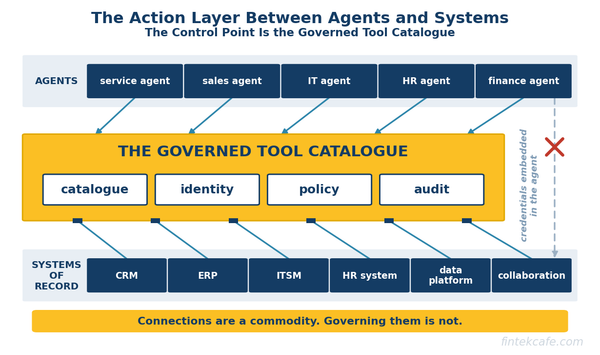
Integration Platforms Are the Quiet Winners of the Agent Era
Agents act through integrations. iPaaS and API vendors hold the connectors, credentials and audit trails, and MCP makes governing that layer worth more.
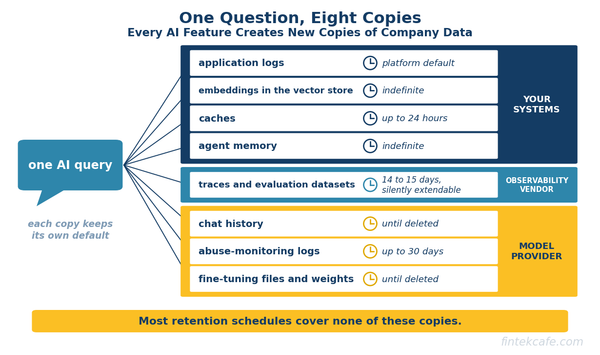
What Happens to Your Data Inside AI Systems: Retention, Deletion and the Copies Nobody Tracks
Every AI feature copies company data into prompts, logs, embeddings and memory. Where each copy lives, what vendors retain, and how to make deletion real.
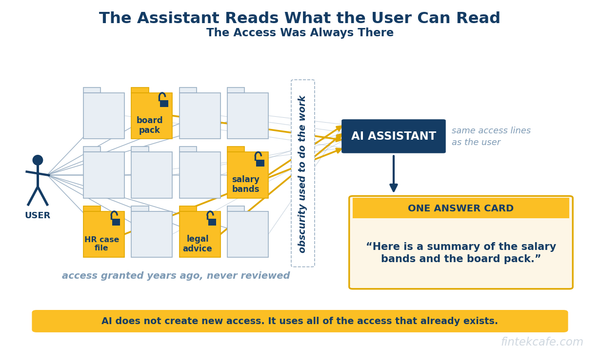
Data Classification: The Step Every Enterprise AI Rollout Skips, and What It Costs Later
Why AI assistants expose overshared data, how data classification fixes it, what to label first, and a 90-day plan for executives.