
What Is MCP? The Model Context Protocol Reshaping How LLMs Talk to Enterprise Tools
Key Takeaways
- The Model Context Protocol (MCP) is an open standard that lets any large language model client talk to any tool, data source, or workflow through a single, common interface. It is becoming the USB-C of LLM integration.
- MCP replaces the worst part of the current AI stack: a thicket of bespoke function-calling adapters, vendor-specific plugins, and brittle prompt-glued API calls that every team rebuilds from scratch.
- The protocol is most valuable inside the enterprise, not outside it. The real prize is a governed internal MCP catalog that lets every approved agent reach every approved system through one set of authentication, audit, and capability scoping rules.
- Treat MCP servers like APIs, not like prompts. Apply the same product thinking around ownership, versioning, SLOs, and access control. The teams that do this will compound; the teams that do not will spawn a new generation of shadow integrations.
- The build-versus-buy question for MCP servers is rarely about engineering hours. It is about who owns the underlying system of record. Build the servers that wrap your unique systems, buy or adopt open source for everything commodity.
The Real Problem MCP Solves
For most of the last two years, every enterprise AI initiative has hit the same wall. The model is fluent, the use case is obvious, and the path from prompt to outcome runs straight through somebody else's API. Connecting a single chatbot to a single CRM is easy. Connecting twenty agents to forty systems, each with its own authentication, schema, and rate limits, is a full-time platform team.
The first wave of solutions was bespoke. Every team wrote its own function-calling adapters, its own JSON schemas, and its own glue code to translate between the model and the target system. Every model vendor added a slightly different way to describe tools. Every IDE plugin reinvented the same wheel. The integration tax on enterprise AI quietly grew faster than the model bills.
The Model Context Protocol exists to collapse that tax. Originally proposed by Anthropic in late 2024 and now supported by most major model vendors, agent frameworks, and IDE tools, MCP defines a single open specification for how an AI client describes what it needs and how a tool server responds. One client can speak to many servers. One server can serve many clients. The whole point is to make integration boring.
That last word matters. Boring integration is the precondition for serious enterprise AI. If every new agent requires a custom adapter, the program stalls at pilot. If new tools can be plugged into a catalog and consumed by any approved agent, the program compounds.
What MCP Actually Is
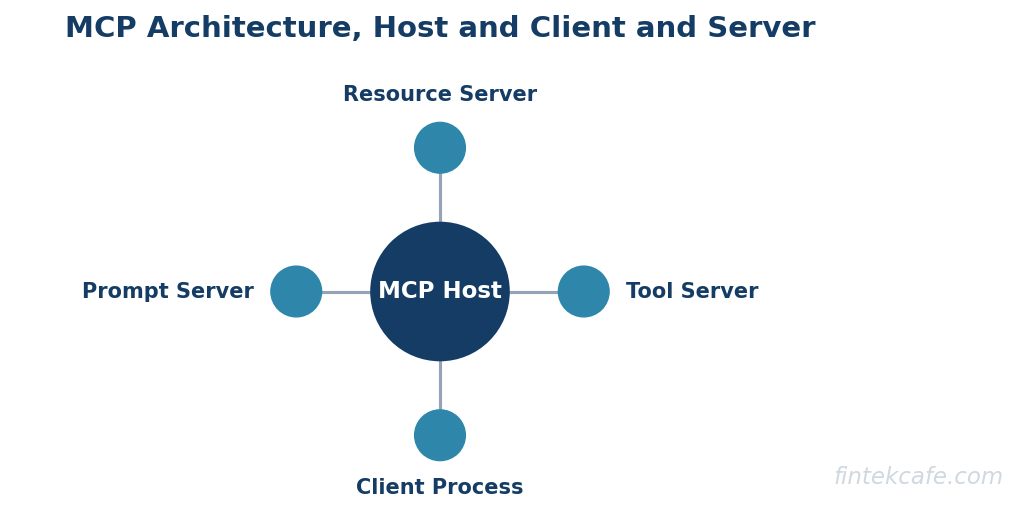
MCP is a protocol, not a product. It sits between an AI client (a chat application, an IDE, an agent runtime) and a tool server (a wrapper around an API, database, file system, or workflow). The protocol specifies how the two sides discover each other, exchange capabilities, and call functions.
The specification organizes capabilities into three primitives.
Tools are functions the model can invoke. Each tool has a name, a description, and a JSON schema for its inputs. The server executes the tool and returns a structured result. This is the closest analog to function calling as it existed before MCP, but standardized across vendors.
Resources are read-only data the model can pull into context. A resource has a URI, a content type, and a payload. Files, database rows, dashboards, and search results all fit this primitive. The model treats resources as context to read, not actions to take.
Prompts are reusable prompt templates that the server exposes to the client. A "summarize this customer ticket" prompt or a "draft a regulatory disclosure" prompt can live on the server, be versioned with the underlying system, and be invoked by any compliant client. This is the least-used primitive today and the most underrated.
The protocol supports two transports. Standard input and output (stdio) is used when the client and server run on the same machine, which is common for IDE plugins and developer tooling. Server-Sent Events (SSE) over HTTP is used when the server runs remotely, which is the dominant transport for enterprise deployments. The specification has been moving toward streamable HTTP as the default for remote work, with stdio reserved for local processes.
The whole protocol is intentionally narrow. It does not specify how the server authenticates upstream, how it logs, or how it scales. It specifies only the interface between client and server. That narrowness is the source of its leverage.
What MCP Is Not
The protocol is also worth understanding by what it deliberately leaves out.
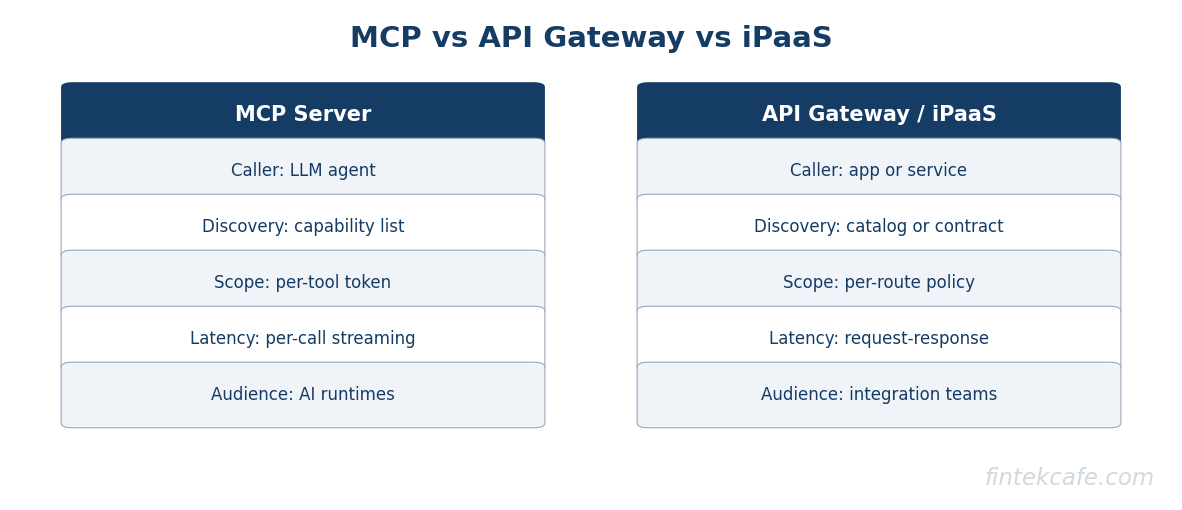
It is not an API gateway. It does not handle rate limiting, request routing, or upstream load balancing. Those responsibilities still belong to the gateway in front of the underlying systems.
It is not an integration platform as a service. Tools like MuleSoft, Workato, and Tray automate complex multi-step workflows across systems. MCP exposes one capability at a time and leaves orchestration to the client or agent runtime.
It is not an identity provider. MCP servers authenticate upstream systems however they choose, and they enforce capability scoping however they choose. The protocol carries no opinion about whether the server uses OAuth, mTLS, service accounts, or short-lived tokens.
It is not a memory layer. The client decides what to remember across calls. MCP carries no state between sessions beyond what is exposed as a resource.
Each of these omissions is a strength. The reason MCP is spreading is precisely that it does not try to be the whole stack. It plugs into the stack that exists.
The Vendor Landscape in 2026
The current landscape clusters into four groups.
Model vendors. Anthropic published the original specification and ships first-class MCP support in Claude. OpenAI added MCP support across its desktop applications and Agents SDK in 2025. Google, Meta, and the open-weight model ecosystem have followed. Inside an enterprise, this means a single internal MCP catalog can be consumed by every approved model without rewriting the integration.
Agent and IDE runtimes. Claude Code, Cursor, VS Code, JetBrains, Continue, Cline, and a long tail of agent frameworks now consume MCP servers natively. Developers can register a server once and use it from every tool that speaks the protocol.
Infrastructure platforms. Cloudflare, Vercel, Render, and the major cloud vendors have shipped hosting primitives for remote MCP servers, including authentication, observability, and rate limiting. Identity providers have begun publishing reference servers that scope capabilities to verified user identity.
System-of-record vendors. GitHub, Slack, Atlassian, Notion, HubSpot, Stripe, and most of the major SaaS vendors now publish first-party MCP servers for their products. The quality varies. The first-party servers usually solve authentication and rate limiting cleanly but often expose a small subset of the full API. Community servers fill the gaps.
The pattern is clear. The protocol has won the integration layer for AI clients. What remains contested is the layer above (orchestration, agent frameworks, governance) and the layer below (system-specific server quality, security models).
Where MCP Fits in the Enterprise Integration Stack
To place MCP correctly inside an existing enterprise stack, picture three concentric rings.
The innermost ring is the system of record. Core banking ledger, CRM, HR system, data warehouse. These do not change because of AI. They expose APIs, often through an API gateway. The gateway handles rate limiting, basic authentication, and traffic shaping. Nothing about MCP replaces this layer.
The middle ring is the integration layer. Historically this has been a mix of iPaaS platforms, ESBs, and bespoke microservices. MCP servers live here, alongside (not instead of) those tools. An MCP server is a lightweight adapter that exposes a curated set of capabilities from the system of record. It calls the underlying API, applies business logic, and returns a structured result.
The outermost ring is the AI consumption layer. Chat applications, IDE assistants, internal agents, customer-facing copilots. These are MCP clients. They discover servers, request capabilities, and orchestrate multi-step work.
The boundary between rings is where the governance lives. An MCP server is the right place to enforce that a customer-service agent can read account balances but cannot move money, that a marketing agent can read campaign data but not write to the production CRM, that a developer agent can search the codebase but not deploy to production. The server expresses capability surfaces. The client requests subsets of those surfaces. The platform team curates the catalog.
This is the architectural insight worth internalizing. MCP servers are not just adapters. They are policy enforcement points. Teams that treat them as policy points end up with a governed AI estate. Teams that treat them as quick-and-dirty wrappers end up with shadow agents calling production APIs with overly broad credentials.
A Decision Framework: MCP Server vs Existing API
Not every system needs an MCP server. The cleanest decision rule has three parts.
Will multiple AI clients consume this system within twelve months? If only one agent will ever touch the system, a direct API call from that agent is faster to build and easier to reason about. If three teams already want access and the count is growing, an MCP server pays for itself immediately. The protocol is a coordination tool. It earns its keep when there is coordination to do.
Does the system require business logic beyond the raw API? Most enterprise APIs are too low level for AI consumption. A salesforce.com REST call returns a wall of fields. An AI agent benefits from a server that exposes "find_open_opportunities_for_account" and "draft_renewal_email," not "query_object_v59." The server is the place to encode the curation. The same logic applies to data warehouses: the right primitive is "metric lookup," not "execute arbitrary SQL."
Is access control nontrivial? If every caller has the same permissions, a shared API key behind the gateway is fine. If access depends on the calling user, the calling agent, the data row, or the action, an MCP server with proper capability scoping is the only sane place to enforce it. The alternative is encoding access control in prompts, which is not access control at all.
If two of the three answers are yes, build an MCP server. If only one is yes, a thin function-calling adapter is probably enough for now.
The Build-versus-Buy Framework for Servers
Once a team decides to put an MCP server in front of a system, the next question is whether to build it, adopt an open source community server, or use the vendor's first-party server.
A simple matrix helps.
Buy or adopt the vendor's first-party server when: the system is a commodity SaaS product (GitHub, Slack, Notion, Stripe), the vendor's server covers the capabilities the organization needs, and the authentication model fits the organization's identity provider. This is the path of least resistance and the fastest time to value.
Adopt a high-quality open source server when: the vendor has not shipped a first-party server, an active community project exists, the project has a credible maintainer, and a security review confirms the server does not expose more surface area than the organization wants. Many of the most useful servers (filesystem, git, Postgres, Snowflake) fall here.
Build internally when: the system is proprietary, the business logic is genuinely unique, the access control rules cannot be expressed in a generic server, or compliance requires that the integration code be under the organization's control. Most banks, insurers, and healthcare organizations will end up building servers for their core platforms regardless of what is available externally.
The mistake to avoid is building generic servers. Wrapping Slack in a custom MCP server because the first-party one is missing one capability is a maintenance burden, not a differentiator. Contribute the capability upstream and adopt the vendor server.
The Security Model: Where the Risk Actually Lives
MCP does not invent new security risks. It concentrates and reshapes existing ones. Five risks deserve specific attention.
Overbroad server credentials. An MCP server typically holds upstream credentials with the union of permissions any of its callers might need. If the credentials are too broad and the client-side capability scoping is weak, any compromised client gains access to the full upstream surface. The mitigation is short-lived, scoped credentials per server instance and per calling identity, not long-lived service accounts.
Prompt injection through resources. When a model reads a resource that contains attacker-controlled text (a customer-uploaded ticket, an inbound email, a webpage), the resource can carry instructions that hijack the model. MCP does not solve this. The mitigation belongs in the client and in how the application uses model output, including never executing destructive actions without out-of-band human confirmation.
Capability sprawl. Once a catalog exists, the temptation is to expose more and more capabilities through MCP because doing so is easy. The result is a server that can do anything, called by clients that can call anything. The mitigation is treating capability exposure as a product decision with a review process, not an engineering shortcut.
Audit gaps. Every MCP call is potentially a privileged action against a system of record. If the call is not logged with the calling identity, the calling agent, the prompt context, and the resulting action, the organization has no story for incident response or regulator inquiries. Audit logging is a server-side concern that must be designed in from day one.
Supply chain risk in community servers. The MCP ecosystem has many community servers, varying widely in maintenance quality. Adopting an unmaintained server with broad permissions creates real exposure. Treat MCP servers like any other third-party dependency: pin versions, review code, and watch for abandonment.
The pattern across all five risks is the same. The protocol is not the attack surface. The deployment is.
The Maturity Ladder
Organizations adopting MCP move through a recognizable progression.
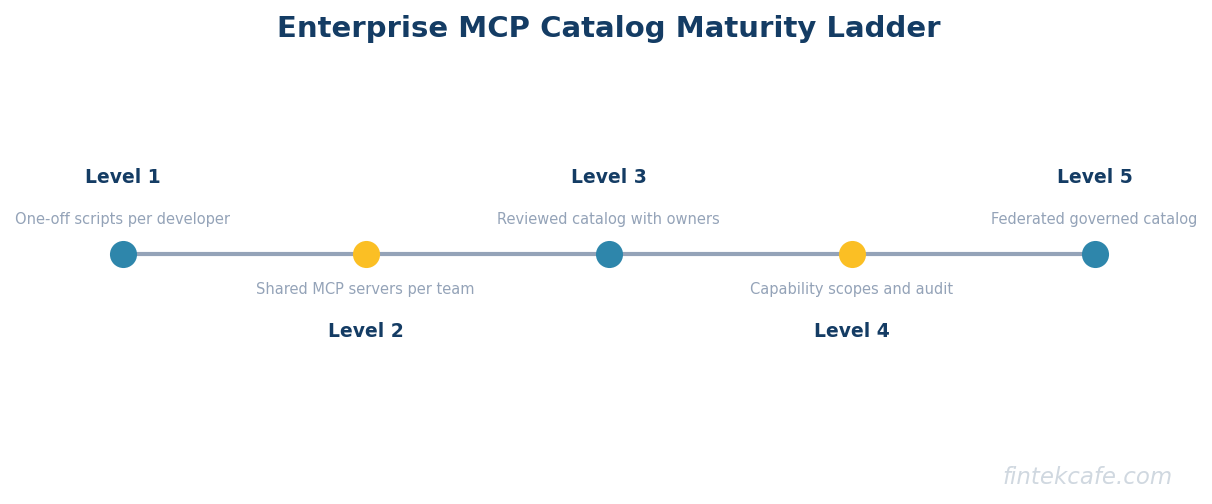
Level 1: Developer experimentation. Individual developers install MCP servers locally and use them through IDE plugins or chat applications. Value is real but bounded. No governance exists. The organization should encourage this stage and learn from it, not block it.
Level 2: Team adoption. A team standardizes on a small set of servers for shared workflows. Credentials are shared informally. Some servers run locally, some remotely. This stage produces the first horror stories: a wrong delete, a leaked credential, a surprise bill. Those stories are the right trigger to invest in governance.
Level 3: Platform layer. A platform team takes ownership of the catalog. It runs a small set of approved remote servers, integrates them with the identity provider, and instruments them for audit. Capability scoping moves from convention to enforcement. New servers go through a review.
Level 4: Governed enterprise catalog. The MCP catalog becomes a first-class product. Servers have owners, SLOs, versioning, and deprecation policies. Capability requests flow through the same approval process as any other privileged access. Audit logs feed the security operations center. Agents are registered identities with their own access reviews.
Level 5: Composable internal AI. New AI use cases are assembled, not engineered. Product teams pick capabilities from the catalog, write a small amount of orchestration code, and ship. The platform compounds because every new server benefits every existing client.
Most enterprises today are at Level 2 with pockets of Level 3. The gap between Level 3 and Level 4 is where the real architectural work lives. It is also where the strategic advantage compounds. A governed catalog is the closest thing AI has produced to a durable competitive moat for an enterprise.
How to Start: A Ninety-Day Plan
A pragmatic ninety-day plan for an enterprise that wants to move from ad hoc experimentation to a credible MCP foundation looks like this.
Days 1 to 30: Inventory and pick the first three servers. Catalog the agents and integrations that already exist informally. Identify the three internal systems that the most teams want to read or write through AI. Pick those three as the first managed MCP servers. Resist the urge to start with ten.
Days 31 to 60: Build the platform skeleton. Stand up a hosting environment for remote MCP servers with identity integration, short-lived credentials, and centralized audit logging. Build or adopt the first three servers. Define a capability review template that any new server must complete before joining the catalog.
Days 61 to 90: Onboard real workloads and instrument. Migrate at least two real agent workloads onto the managed catalog. Measure adoption, error rates, and cost per call. Publish a roadmap for the next ten servers based on actual demand, not predicted demand.
The deliberate restraint matters. The fastest way to fail at MCP is to declare a strategic initiative, hire a large team, and try to wrap every system at once. The fastest way to succeed is to ship a small, governed catalog that real teams use and let demand pull the rest.
What Changes for Different Roles
For CTOs, MCP is an integration architecture decision that will affect the next decade of AI build versus buy. Investing in a governed internal catalog is the cheapest way to keep model vendor optionality.
For CIOs, the protocol is a governance opportunity. The catalog is where access control, audit, and compliance for AI workloads naturally live. Treat it as a control plane, not a developer tool.
For VPs of engineering, MCP is leverage. A small platform team can serve many product teams by curating servers and capabilities. Headcount that would have gone into bespoke integrations can go into product work.
For CFOs, the question is unit economics. AI integration costs are real and rising. A governed catalog is the only way to attribute cost per agent, per capability, and per business outcome. Without it, AI spend remains a black box.
For CEOs, the strategic question is whether the organization's proprietary systems are reachable by AI without becoming exposed. The answer is determined by how the MCP layer is designed and owned, not by which model is bought.
FAQ
What is the Model Context Protocol in plain terms? MCP is an open standard that lets AI applications talk to tools, data, and workflows through one common interface. It is the connective tissue between large language models and the systems they need to act on, comparable to how USB-C standardized the cable between devices and peripherals.
Is MCP only for Claude or is it cross-vendor? The protocol started at Anthropic but is now an open specification supported by OpenAI, Google, most agent frameworks, every major IDE assistant, and a long list of platform vendors. Investing in MCP servers preserves optionality across model providers.
How does MCP differ from function calling? Function calling is a model-specific mechanism for letting a model invoke code. Every vendor implements it differently. MCP standardizes the contract between the client and the tool, so the same server works with any compliant client. Function calling is the underlying mechanism. MCP is the interoperability layer above it.
Do organizations need to replace existing APIs or API gateways? No. MCP servers sit in front of existing APIs and gateways. The gateway continues to handle rate limiting and traffic shaping. The MCP server adds curation, capability scoping, and a model-friendly interface on top.
What are the biggest risks to plan for before adopting MCP at scale? The four risks worth specific attention are overbroad server credentials, prompt injection through resources, capability sprawl as the catalog grows, and audit gaps in incident response. None of these are new, but a growing MCP estate concentrates them, so they deserve direct ownership from security and platform teams.
When does it make sense to build a custom MCP server rather than adopt one? Build internally when the underlying system is proprietary, the access control rules are unique, or compliance requires the integration to live under the organization's control. For commodity SaaS products with credible first-party or community servers, adopting is almost always the right call.
Related reading on FinTekCafe
- What Are AI Agents? An Executive Guide to Agentic Software
- What Is Agentic AI? The Executive Guide to Self-Directed Systems
- APIs Explained: The Plumbing of Modern Software
- The API Economy Explained: Why Every Company Is an API Company
- Prompt Engineering for Business: A Practical Guide
- Enterprise Software Evaluation in 30 Days
Related Articles
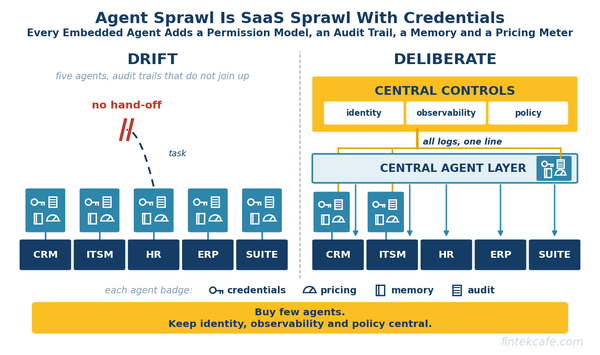
Every Software Vendor Now Sells an Agent, and Most Enterprises Should Buy Very Few of Them
Buying an agent from every system of record recreates SaaS sprawl one layer up. How CIOs should choose, and which controls must stay central.
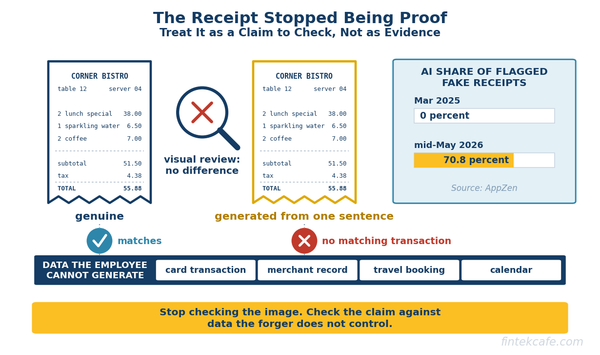
AI-Generated Fake Receipts: How Expense Fraud Changed and How Finance Teams Catch It
AI-generated fake receipts now beat visual review. How expense fraud changed, which detection still works, and the controls to use by company size.
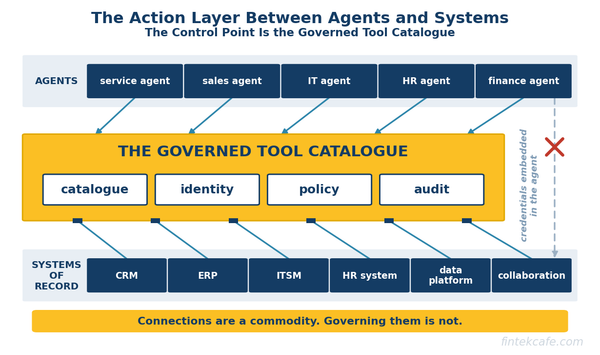
Integration Platforms Are the Quiet Winners of the Agent Era
Agents act through integrations. iPaaS and API vendors hold the connectors, credentials and audit trails, and MCP makes governing that layer worth more.