
AI in the Tax Function: What Corporate Tax Teams Can Automate, and Where Judgement Stays
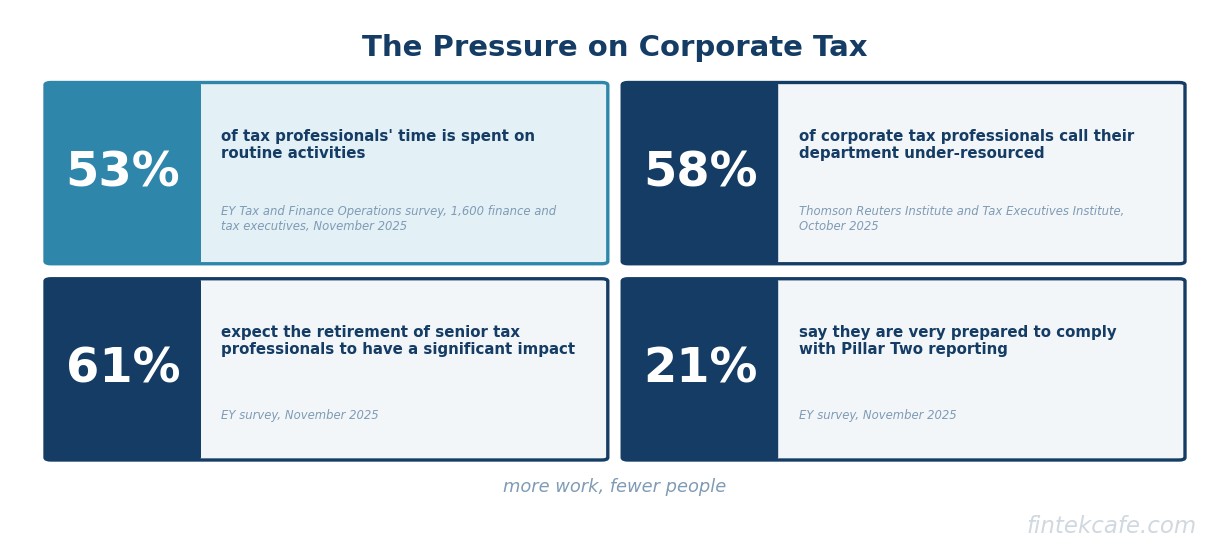
AI in the tax function means using software that reads, maps, classifies and drafts to take over the routine half of corporate tax work: pulling data out of the ERP, determining indirect tax on transactions, preparing provision workpapers, drafting documentation and triaging notices. That routine half is large. EY's 2025 Tax and Finance Operations survey of 1,600 finance and tax executives, published in November 2025, found tax professionals spend 53 percent of their time on routine activities and want to cut that to 21 percent. The position taken here: the return in tax AI sits in the data layer, not in the research chatbot. Automate data mapping and transaction-level determination under tight controls first, use AI as a drafter for research and documentation, and keep every filing position that needs a documented judgement with a senior person whose name goes on it.
This is a business decision guide for executives who own the tax function's budget and risk. It is not tax advice, and nothing here should be read as a view on any specific tax position.
Key Takeaways
- Corporate tax is short of people and long on new compliance work. 58 percent of corporate tax professionals called their departments under-resourced in the Thomson Reuters Institute and Tax Executives Institute report of October 2025, up from 51 percent a year earlier.
- The new load is real but uneven. The OECD global minimum tax produced its first information-return deadline on 30 June 2026, while a January 2026 OECD package largely exempts US-parented groups from the main charging rules. E-invoicing mandates went live in Belgium, Poland and France during 2026.
- AI is most reliable where tax work is mapping and classification against defined rules, and least reliable where it is interpretation of law.
- Hallucinated citations are already reaching tax courts. The US Tax Court flagged likely AI-generated fictitious cases in Clinco v. Commissioner in February 2026.
- The IRS Office of Professional Responsibility said in June 2026 that due diligence under Circular 230 "requires verifying the accuracy of facts, citations, and calculations produced by AI." The tool never carries the professional duty.
Why Tax Is Under Pressure Now
Every transaction a company makes, from procurement to payroll to intercompany charges, ends up as tax data, which makes tax one of the most data-heavy and deadline-bound functions in the enterprise.
The people problem
The pipeline is thinning. In the same EY survey, 61 percent of respondents expected the retirement of senior tax professionals to have a significant impact, and 66 percent said fewer new accountants entering the profession would be detrimental. Deloitte's 2025 Tax Transformation Trends report (1,000 senior tax and finance leaders, May 2025) found access to talent was the second most cited challenge, with gaps in specialist AI skills (45 percent), data analytics skills (42 percent) and specialist tax technical skills (36 percent). The work is growing faster than headcount, which is why tax leaders now treat automation as capacity planning rather than innovation.
The compliance load: the global minimum tax
The OECD's Pillar Two rules set a 15 percent minimum effective tax rate, measured jurisdiction by jurisdiction, for multinational groups with consolidated revenue of at least 750 million euros in two of the previous four years. For tax teams, the hard part is not the rate. It is the data: the GloBE Information Return asks for jurisdiction-by-jurisdiction figures, adjustments and elections that standard ERP and consolidation systems were never built to produce.
The rules are also in motion:
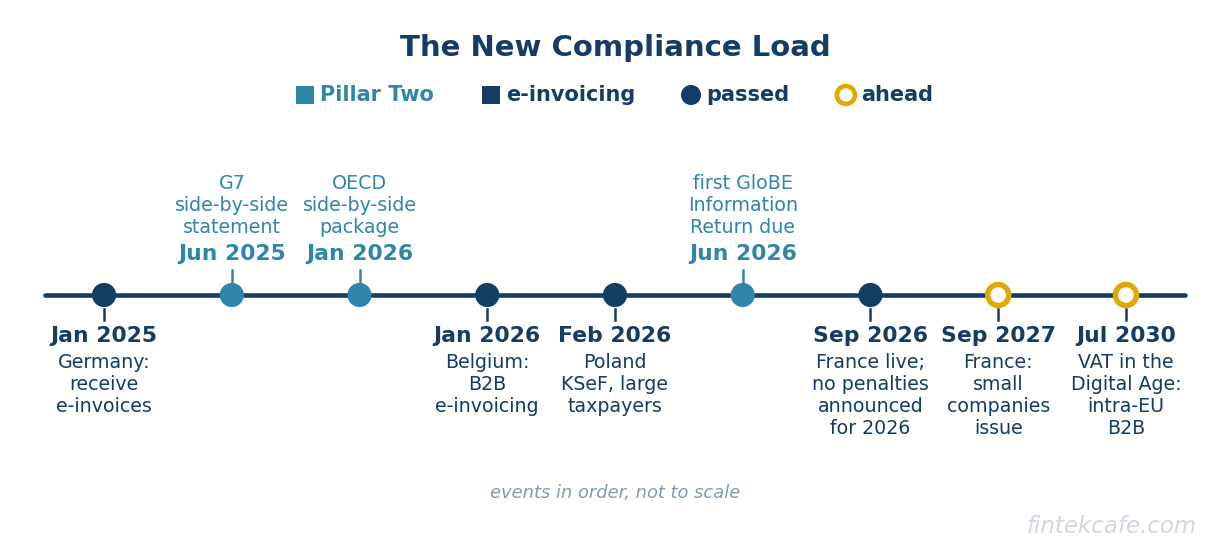
- The first filing deadline has passed. For groups with calendar fiscal years, the first GloBE Information Return, covering 2024, was due by 30 June 2026. Several jurisdictions eased the timing; Australia, for example, applied a 30-day automatic deferral for returns due that day.
- US-parented groups got a carve-out, not an exit. After a G7 statement on 28 June 2025 endorsing a "side-by-side" system, the OECD/G20 Inclusive Framework released a package on 5 January 2026. Its elective safe harbors, effective from 1 January 2026, largely remove top-up tax under the income inclusion rule and the undertaxed profits rule for eligible US-parented groups. Domestic minimum top-up taxes still apply where countries have enacted them, and law firm commentary is consistent that the data collection and filing burden largely remains.
- Readiness is low. Only 21 percent of EY's November 2025 respondents said they were very prepared to comply with Pillar Two reporting.
The compliance load: e-invoicing and real-time reporting
The second wave is indirect tax. Governments are moving from periodic VAT returns to transaction-level reporting, where the tax authority sees each invoice, sometimes before the buyer does.
- Belgium made structured B2B e-invoicing mandatory for VAT-registered businesses from 1 January 2026 under its Law of 6 February 2024, with invoices exchanged over the Peppol network, according to the Belgian finance ministry's e-invoicing portal. Administrative fines were held back until the end of March 2026.
- Poland brought large taxpayers (turnover above 200 million zloty) into its national KSeF platform from 1 February 2026, with most other businesses following on 1 April 2026 and micro-businesses in 2027, as EY's tax alerts on the signed law set out. KSeF is a clearance model: the authority validates each invoice.
- France went live on 1 September 2026. Every business must be able to receive e-invoices, large and mid-sized companies must issue them, and small companies follow from September 2027. The government announced no penalties for non-compliance during 2026, as reported by Thomson Reuters and Sovos, but the obligation itself was not deferred.
- Germany has required businesses to be able to receive structured e-invoices since 1 January 2025. Issuing becomes mandatory from 1 January 2027 for businesses with prior-year turnover above 800,000 euros and from 1 January 2028 for the rest, according to compliance guides from Sovos and ecosio.
- The EU's VAT in the Digital Age package, adopted by the Council on 11 March 2025, makes structured e-invoicing and digital reporting mandatory for intra-EU B2B supplies from 1 July 2030.
- Latin America got there first. Mexico's CFDI system, mandatory for most taxpayers since 2014 according to Avalara, requires each invoice to be stamped by the tax authority or an authorized provider before it is valid. Brazil is layering a new dual VAT (CBS and IBS) onto its e-invoices, with 2026 as a test year at 0.9 percent CBS and 0.1 percent IBS under Complementary Law 214 of 2025, and CBS charged in full from January 2027 at a reference rate still awaiting Senate approval, according to KPMG; penalty and split-payment dates are still contested.
Tax data is becoming real-time at the authority's end. A function that still cleans data by hand at quarter end is now slower than the government auditing it.
What AI Does in the Tax Function
Six activities account for most practical AI use in corporate tax. They differ in how much the work depends on rules versus interpretation, and that difference should drive control design.
Data gathering and mapping from the ERP
Every tax computation begins with mapping: which ledger accounts feed which tax line, which entity sits in which jurisdiction. Models can propose mappings for new accounts, flag unmapped balances and reconcile book to tax. The output is checkable against the ledger, which makes this a safe place to start.
Indirect tax determination
Determining VAT, GST or US sales tax on each transaction is high-volume classification: taxability, location, exemption, rate. Rules engines have done this for years; AI adds classification of messy product descriptions, certificate validation and rate monitoring. Each determination is a record, so errors are visible and auditable.
Provision workpapers
The income tax provision under ASC 740 or IAS 12 is a quarterly fire drill of data pulls, rollforwards and reconciliations. AI can assemble workpapers, tie out balances and draft the narrative for variance explanations. This is the tax counterpart of the finance function's own move, described in how AI enables the continuous close: the faster and cleaner the close, the earlier tax gets reliable numbers.
Transfer-pricing documentation drafts
Master and local files are long, repetitive documents built from interviews, intercompany agreements and benchmarking studies. AI drafts the descriptive sections well and keeps dozens of local files consistent. It is not a substitute for the functional analysis or the benchmark selection, which are where tax authorities challenge. Deloitte's May 2025 survey found tax leaders were most comfortable using AI for transfer-pricing documentation (47 percent), corporate income tax payments and returns (43 percent) and global tax provision (40 percent).
Tax research
Research assistants over statutes, rulings and commentary are the most visible use and the most dangerous: fast at locating and summarizing authority, and capable of confident, wrong answers, including citations to cases that do not exist.
Notice handling
Large groups receive a steady stream of tax authority letters in many languages. AI can classify them, extract amounts and deadlines, route them and draft first responses. This is a document understanding problem, covered in how document AI extraction works, and it matters because missed deadlines create penalties unrelated to the underlying tax.
The tax-process table
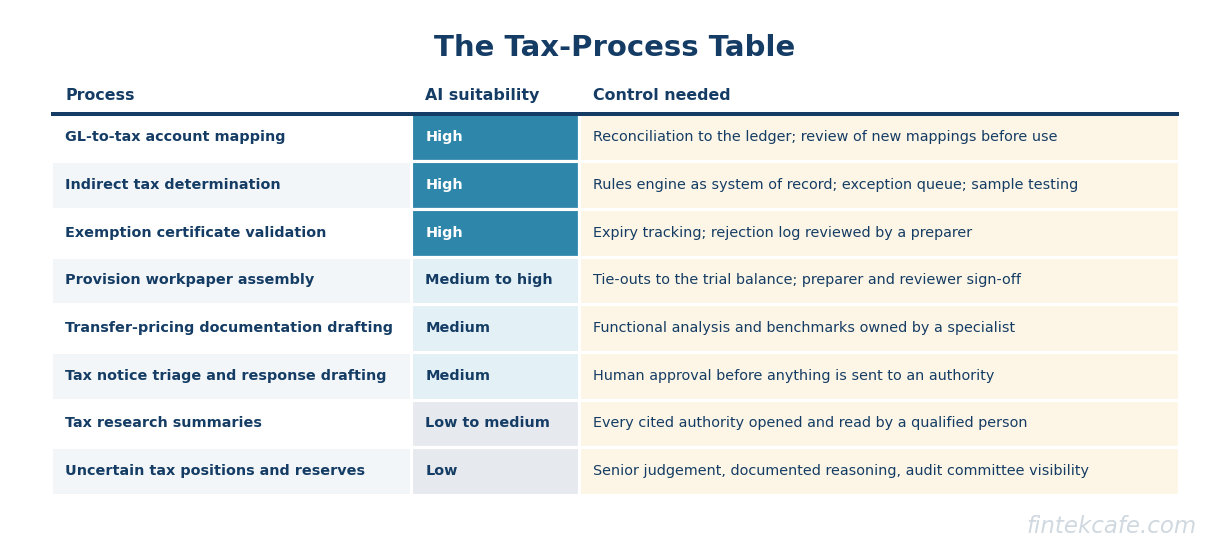
| Process | AI suitability | Control needed |
|---|---|---|
| GL-to-tax account mapping | High | Reconciliation to the ledger; review of new mappings before use |
| Indirect tax determination | High | Rules engine as system of record; exception queue; sample testing |
| Exemption certificate validation | High | Expiry tracking; rejection log reviewed by a preparer |
| Provision workpaper assembly | Medium to high | Tie-outs to the trial balance; preparer and reviewer sign-off |
| Transfer-pricing documentation drafting | Medium | Functional analysis and benchmarks owned by a specialist |
| Tax notice triage and response drafting | Medium | Human approval before anything is sent to an authority |
| Tax research summaries | Low to medium | Every cited authority opened and read by a qualified person |
| Uncertain tax positions and reserves | Low | Senior judgement, documented reasoning, audit committee visibility |
What Vendors and the Large Firms Now Offer
The vendor market moved from chat assistants to agents during 2025. Performance figures below are vendor claims, not independent results.
- Avalara launched Agentic Tax and Compliance in October 2025 and added a coordinating agent, Avi, on 3 November 2025. The company says every agent operates with built-in checkpoints for human review and approval.
- Thomson Reuters announced ONESOURCE+ on 5 November 2025 and launched ONESOURCE Sales and Use Tax AI for US companies on 15 January 2026, claiming up to 65 percent faster compliance. It also extended CoCounsel Tax with an agentic workflow for individual return preparation.
- Wolters Kluwer launched CCH Axcess Expert AI on 15 October 2025, aimed mainly at accounting firms across tax, audit and firm management.
- EY launched the EY.ai Agentic Platform, built with Nvidia, on 18 March 2025, with tax as the first domain: 150 tax agents supporting 80,000 EY tax professionals in data collection, document analysis, review and compliance.
Independent evidence on tax-specific accuracy is thin. The closest public benchmark is legal: Stanford researchers, in a 2025 Journal of Empirical Legal Studies paper, found leading AI legal research tools from LexisNexis and Thomson Reuters hallucinated on between 17 and 33 percent of test queries. Tax research has the same structure: dense authority, frequent amendments, fact-dependent answers.
Read vendor time savings as upper bounds achieved on clean data. EY's survey found 51 percent of tax and finance functions still in the early stages of data management maturity.
Where AI Fails in Tax
Hallucinated citations to tax law
In May 2025 the Minnesota Tax Court found that a county's brief in Delano Crossing v. County of Wright contained five AI-generated citations, none of which referred to an actual judicial decision, and referred the lawyer to the state's professional responsibility board. In Clinco v. Commissioner (T.C. Memo. 2026-16, February 2026), US Tax Court Judge Mark Holmes described three of the cases a taxpayer's counsel cited as likely hallucinations generated by an AI model, noted one was repeated after the IRS flagged it, and wrote that "submitting a brief with fictitious caselaw is a recipe for sanctions." No sanctions were imposed, but the warning is explicit. The broader control patterns are covered in how to control AI hallucinations.
Jurisdiction nuance
A question about withholding on a service payment has a different answer in each country, often depending on a treaty, a ruling or local practice that is thin in training data. Models are weighted toward the jurisdictions most written about. The failure mode is an answer correct for the United States and silently wrong for Indonesia or Colombia.
Positions that need documented judgement
Many filing positions are judgements about facts, substance and risk that must be documented: an uncertain tax position, a reserve, a transfer-pricing method. AI can draft a memo that looks like reasoning. It cannot own the judgement, and a reviewer who signs a fluent memo without testing it has not exercised judgement either.
Data quality
Most tax AI failures are data failures in disguise. A determination engine fed the wrong ship-to address applies the wrong rate perfectly. Deloitte's May 2025 report noted that tax authorities increasingly demand granular data, sometimes in real time, that is often not readily available or correct. AI amplifies whatever data quality the function already has.
What Regulators and Professional Standards Expect
In the United States, two sets of rules apply to tax practitioners using AI, and neither creates a new rule. Both restate that the professional stays responsible.
IRS Circular 230. On 24 June 2026 the IRS Office of Professional Responsibility issued Alert 2026-19, "Introductory Guidelines for Responsible AI Use in Federal Tax Practice." It ties AI use to existing duties: due diligence under Section 10.22 "requires verifying the accuracy of facts, citations, and calculations produced by AI"; competence under Section 10.35 means practitioners "must understand both the law and the technology"; and under Section 10.37, practitioners drafting written advice with generative AI "must independently authenticate all factual and legal information." The alert also says client data should go only into secure, enterprise-approved AI. Circular 230 governs attorneys, CPAs, enrolled agents and others who practice before the IRS.
AICPA Statements on Standards for Tax Services. The revised standards, effective 1 January 2024, added Section 1.4 on reliance on tools. A member may reasonably rely on tools but is "not thereby absolved of professional responsibility," and remains responsible for the resulting work product.
Elsewhere the principle is the same: the signatory owns the return. For the board, AI in tax is an internal control question as much as a technology one. The assurance approach is set out in how internal audit audits the AI the business runs.
Readiness: The Data Prerequisites
Before buying an agent, check whether the function can feed one. The table below is a pre-investment checklist.
| Data prerequisite | Why it matters | Check |
|---|---|---|
| Legal entity master data | Every tax computation is entity by entity; errors cascade into every jurisdiction | One authoritative entity list, reconciled to the consolidation system |
| Chart of accounts with tax mapping | Mapping is the base of provision, Pillar Two and returns | Percentage of GL balances with a reviewed tax mapping |
| Product and service tax codes | Indirect tax determination depends on classification | Share of active items with a validated tax code |
| Customer and vendor tax data | E-invoicing and exemptions need tax IDs and addresses | Validation rate of tax IDs against government registries |
| Intercompany transaction data | Transfer pricing and Pillar Two adjustments depend on it | Intercompany balances that net to zero at period end |
| Document repository | Research, notices and audits need retrievable evidence | Can any filed position be traced to its source documents within a day |
| Access and data handling rules | Circular 230 and data protection rules limit where client data goes | Approved AI tools list; no tax data in unapproved tools |
Many tax functions will find gaps here, and that is where the first year of AI spending should go. The same data foundations support the forecasting work described in how AI changes FP&A forecasting and planning, particularly the effective tax rate forecast that FP&A and tax so often disagree on.
The Decision: Automate, Review, or Keep With Senior Judgement
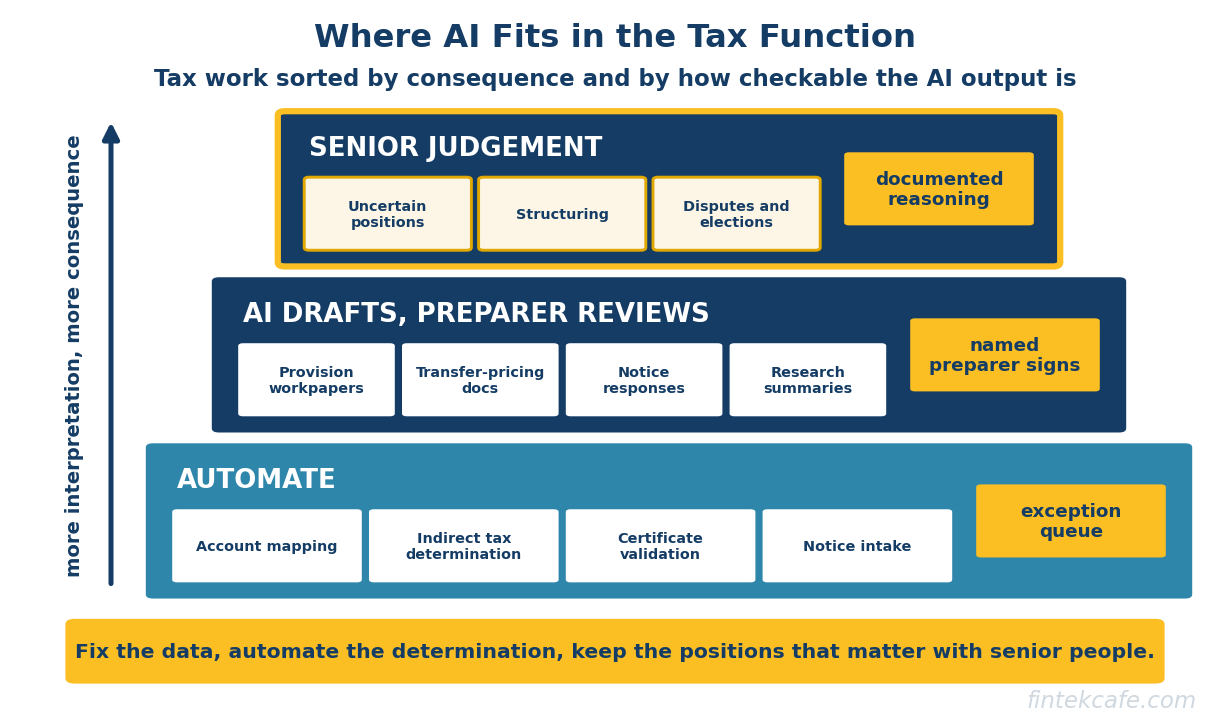
The three-tier model below sorts tax work by consequence and by how checkable the AI output is.
Automate, with exception handling. High-volume, rules-based work with a record for every decision: mapping proposals, indirect tax determination, certificate and e-invoice validation, notice intake, Pillar Two data pulls. The control is the exception queue and sample testing. This is where most of the routine time sits.
AI drafts, a preparer reviews. Provision workpapers, transfer-pricing documentation, notice responses, research summaries. The control is a named preparer who opens each source, ties each number and signs. A useful rule: no citation leaves the team unless a person has opened the authority.
Senior judgement stays human. Uncertain positions and reserves, transfer-pricing method choices, structuring, disputes, Pillar Two elections, and anything disclosed to the audit committee. AI prepares the analysis; a senior tax professional makes the call and documents why.
| Tier | Typical processes | Who owns the output | What failure costs |
|---|---|---|---|
| Automate | Mapping, indirect tax determination, certificate validation, notice intake | Process owner, via exception reports | Rate or classification errors, usually correctable |
| Preparer review | Provision workpapers, TP documentation, notice responses, research | Named preparer and reviewer | Misstatement, penalties, rework |
| Senior judgement | Uncertain positions, structuring, disputes, elections | Head of tax, with CFO visibility | Material exposure, reputational and professional risk |
The Position, and Its Tradeoff
The recommendation: spend first on the data layer and on automation of rules-based determination, and treat research assistants as productivity aids for qualified people rather than as answers. The reasoning is that the routine time is concentrated in data work, the errors there are visible and correctable, and the regulatory trend toward real-time reporting rewards clean transaction data more than faster memos.
The tradeoff is real. The data-first path is slower to show results: master data cleanup produces no demo for the CFO, and it often needs systems budget the tax function does not control. A research assistant rolls out in weeks, is immediately popular, and is where the professional liability sits. A function that buys the visible tool first gets early enthusiasm and the highest-risk use case; a function that buys the invisible one first gets a slower start and a foundation every later tool depends on. The data-first path is the better bet for any group facing Pillar Two or multiple e-invoicing mandates, which is most groups above the 750 million euro threshold.
Frequently Asked Questions
How is AI used in corporate tax departments?
The main uses are mapping ERP data to tax accounts, indirect tax determination, provision workpapers, transfer-pricing documentation drafts, research summaries and notice triage. Deloitte's May 2025 survey found tax leaders most comfortable using AI for transfer-pricing documentation, corporate income tax returns and the global provision.
Can AI prepare a corporate tax return?
AI can prepare much of the workpapers and populate forms from mapped data. It cannot sign the return or own its positions. The IRS Office of Professional Responsibility said in June 2026 that practitioners cannot rely solely on AI and must verify facts, citations and calculations.
What are the risks of using generative AI for tax research?
The main risk is fabricated or misapplied authority: Stanford researchers found leading legal research tools hallucinated on 17 to 33 percent of benchmark queries, and US tax courts have already flagged briefs citing cases that do not exist. The second is jurisdiction error.
Does Pillar Two still matter for US-headquartered companies?
Yes, though less than originally expected. The OECD package of January 2026 lets eligible US-parented groups elect safe harbors that largely remove top-up tax under the income inclusion and undertaxed profits rules from 2026. Domestic minimum top-up taxes still apply where enacted, and information filing obligations largely remain. Groups should take specific advice on their own facts; this guide is not tax advice.
The Bottom Line
Corporate tax is the clearest case of a function whose work is growing faster than its people. AI closes part of that gap in the high-volume, rules-based data and determination work, not in the judgement that authorities, courts and professional standards expect a named person to exercise. Fix the data, automate the determination, make every AI draft pass through a qualified reviewer, and keep the positions that matter with senior people. This is a framework for deciding where to invest, not tax advice on any position.
Related Articles
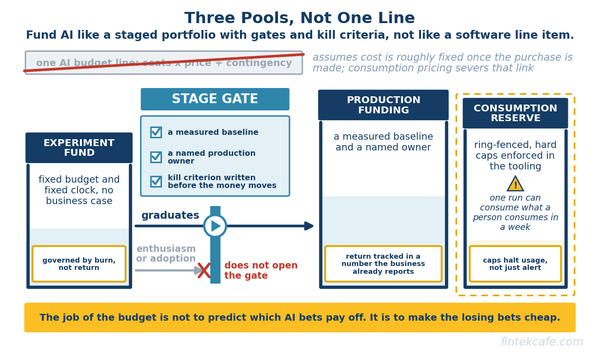
Budget Season for AI: How CFOs Should Fund Next Year's AI Without Funding Every Pilot
AI requests arrive from every function at once, priced in seats, consumption and services. Fund AI like a staged portfolio, not a software line item.
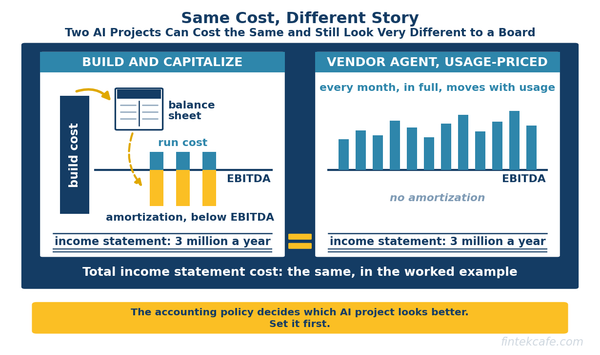
Capitalize or Expense: How AI Spending Lands on the Income Statement, and Why It Changes the Business Case
Accounting treatment quietly decides which AI projects look attractive. What can be capitalized, what cannot, and the policy a CFO should set first.
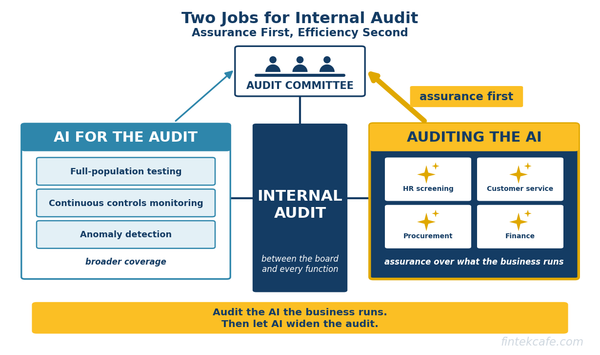
AI in Internal Audit: How Auditors Use It, and How to Audit the AI the Business Already Runs
AI in internal audit: full-population testing, continuous monitoring, where evidence breaks down, and an assurance checklist for the AI your business runs.