
Budget Season for AI: How CFOs Should Fund Next Year's AI Without Funding Every Pilot
Annual planning is under way at most companies, and this year the AI requests arrive from everywhere at once. Customer service wants a deflection agent. Engineering wants more coding-assistant seats. Sales wants a research and outreach tool. HR wants a screening assistant. Finance wants its own copilots. Each request is reasonable on its own, each is priced differently, and the sum does not fit the template the company has used to budget software for twenty years.
The instinct is to treat AI as a new software line: pick the tools, multiply seats by price, add a contingency, and move on. That instinct is wrong, and this year it is expensive. AI does not behave like software on three axes the old template assumes are stable. Its price is often consumption-based, so the bill scales with success rather than with a purchase decision. Its return is unproven at the point of funding, so a seat count is a bet, not a cost. And the requests are a portfolio of bets at wildly different stages, from a one-week experiment to a production system, lumped into a single budget ask.
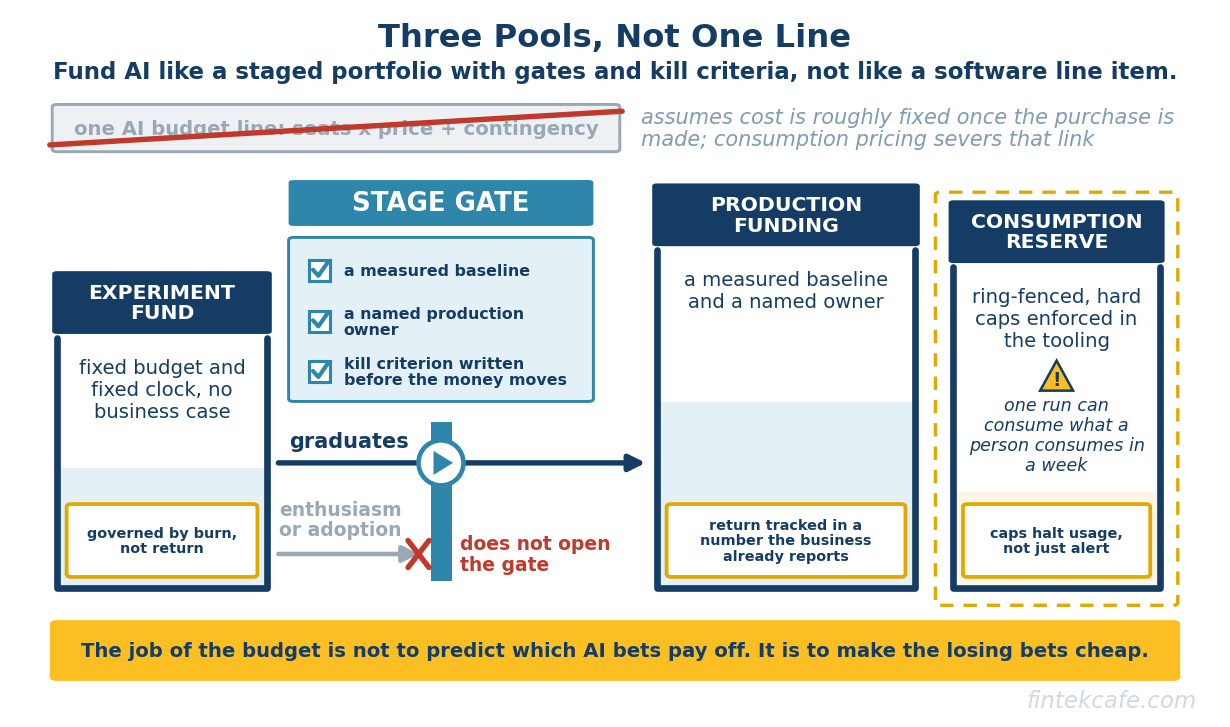
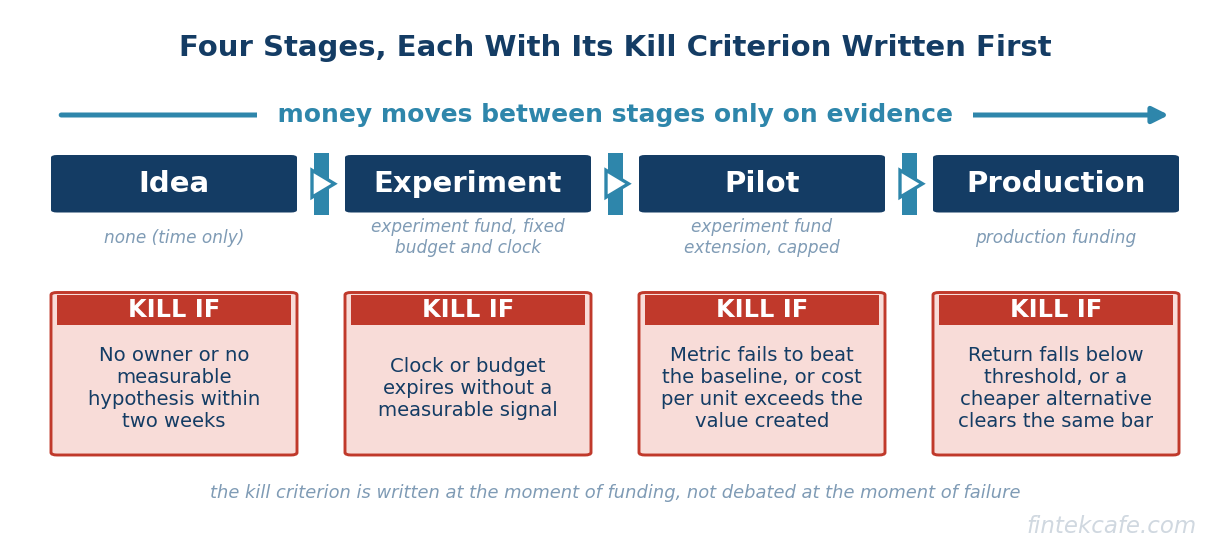
The thesis of this piece: fund AI like a staged portfolio with gates and kill criteria, not like a software line item. Concretely, that means three separate pools of money with different rules. A small central pool for experiments that anyone can draw on without a business case. A consumption reserve with hard caps for usage-priced tools, ring-fenced so a runaway bill does not raid the rest of the budget. And production funding released only against a measured baseline and a named owner, with kill criteria written before the money moves. The job of the budget is not to predict which AI bets pay off. It is to make the losing bets cheap and the winning ones fundable.
The Numbers Say the Spend Is Real and the Discipline Is Not
Two facts should anchor the planning conversation, and they point in opposite directions.
The spend is large and growing fast. Gartner's September 2026 forecast put worldwide AI spending at about 2.7 trillion dollars in 2026, a 49.5 percent increase over the prior year, and projected roughly 3.64 trillion for 2027, with the generative-AI model segment alone growing an estimated 117 percent in 2026 (Gartner, September 2026). Much of that headline figure is infrastructure and vendor capital spending rather than enterprise software budgets, so it is the wrong number to benchmark your own plan against. What it tells a CFO is simpler: the vendors are pricing for a surge, and the pressure to spend will arrive through every renewal and every new tool in the coming year.
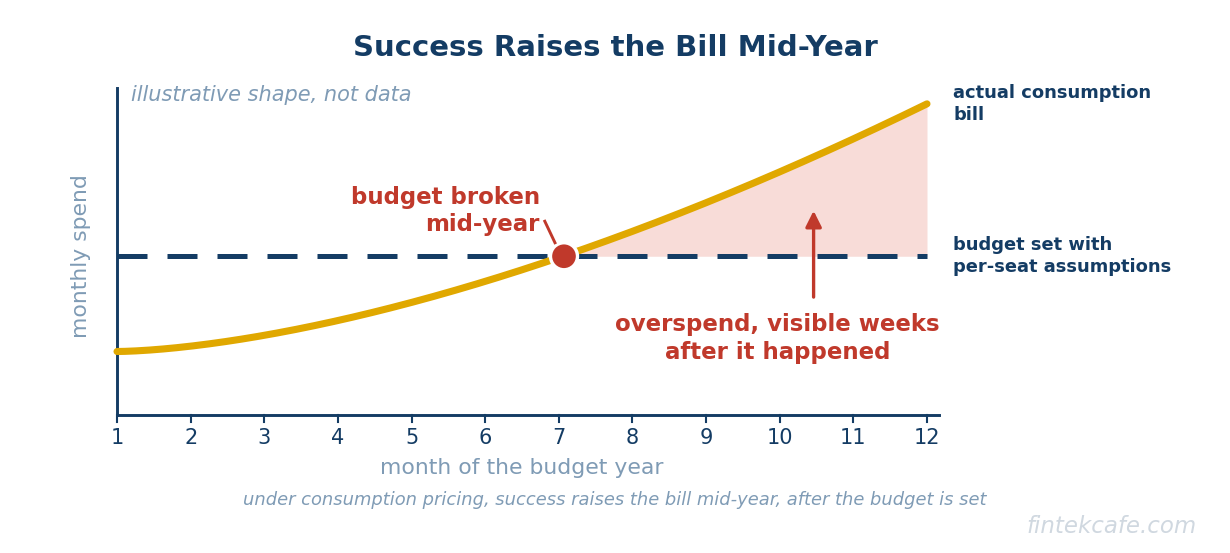
The discipline to manage that spend is not yet in place. The FinOps Foundation's State of FinOps 2026 report, released in February 2026 from roughly 1,200 practitioners, found that 98 percent of respondents now manage AI spend, up from 31 percent two years earlier, and named managing AI cost the single top forward-looking priority for the discipline (FinOps Foundation via Linux Foundation, February 2026). The near-universal figure is the tell: AI cost went from a fringe concern to everyone's problem in two years, which means almost no one has a mature practice for it yet. On the demand side, Pigment's third-quarter 2026 CFO Index reported that 83 percent of finance leaders said consumption-based AI costs came in above what they had expected (Pigment, October 7, 2026, 2,000 finance leaders). Budgets set with per-seat assumptions are being broken by per-use reality.
Put the two together and the planning problem is defined. A large, fast-growing, mostly consumption-priced category is landing on a finance function that, by its own account, cannot yet forecast or control it, and that mostly cannot yet show a return on what it has already spent (the measurement problem is the subject of why most finance teams cannot measure AI return). A budget template designed for predictable per-seat software will not hold this. The rest of this piece is the template that will.
This is a Premium Article
Sign up for a Premium membership to read this article and get full access to strategic intelligence on technology and business.
Already a member? Sign in
Related Articles
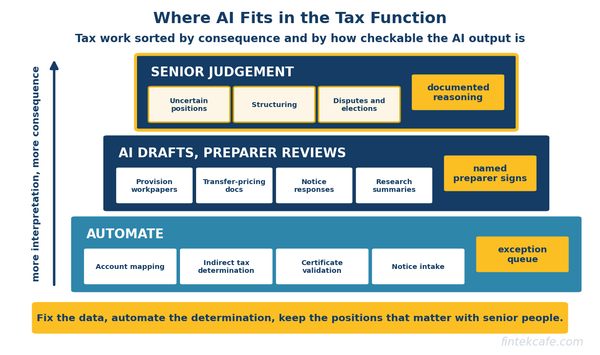
AI in the Tax Function: What Corporate Tax Teams Can Automate, and Where Judgement Stays
AI in corporate tax: what to automate, what needs preparer review, what stays with senior judgement, plus a data-readiness check for heads of tax and CFOs.
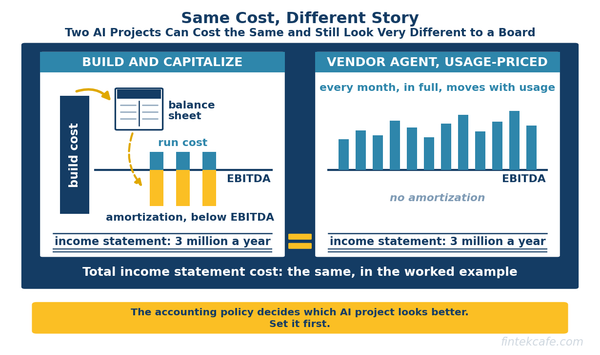
Capitalize or Expense: How AI Spending Lands on the Income Statement, and Why It Changes the Business Case
Accounting treatment quietly decides which AI projects look attractive. What can be capitalized, what cannot, and the policy a CFO should set first.
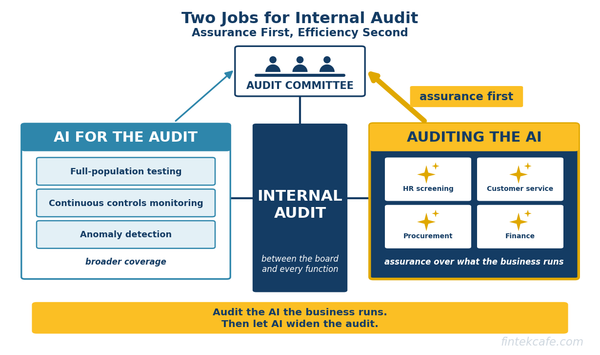
AI in Internal Audit: How Auditors Use It, and How to Audit the AI the Business Already Runs
AI in internal audit: full-population testing, continuous monitoring, where evidence breaks down, and an assurance checklist for the AI your business runs.