
AI in FP&A: What Forecasting and Planning AI Actually Changes for the Finance Team
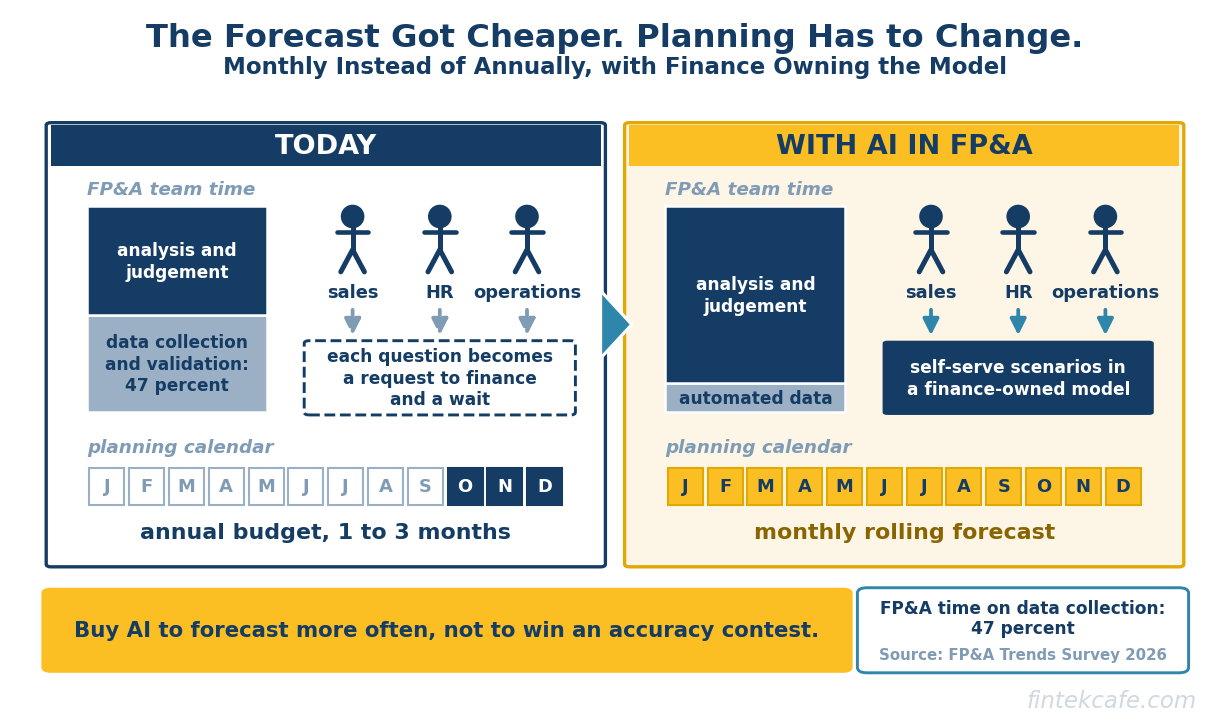
AI in FP&A means using machine learning and language models for the work of financial planning and analysis: building forecasts from more signals than a spreadsheet can hold, explaining variances, generating scenarios and drafting the commentary that goes to leadership. Adoption is wide and shallow. Gartner found in November 2025 that 59 percent of finance functions use AI, yet 91 percent of those leaders reported low or moderate impact so far. The FP&A Trends Survey, run with sponsor OneStream, found in July 2026 that only 12 percent of FP&A teams use machine learning in forecasting, while teams still spend 47 percent of their time collecting and validating data. The position taken here: the biggest change AI brings to FP&A is not a more accurate number. It is a cheaper forecast, which lets finance forecast more often, hand scenario tools to business-unit leaders, and spend its own time on judgement. Teams that buy AI to win a forecast-accuracy contest will be disappointed. Teams that buy it to change how planning works across the business will not.
Key Takeaways
- Most FP&A time still goes to gathering and checking data: 46 to 47 percent in the 2025 and 2026 FP&A Trends surveys. That is the first and safest place AI pays off.
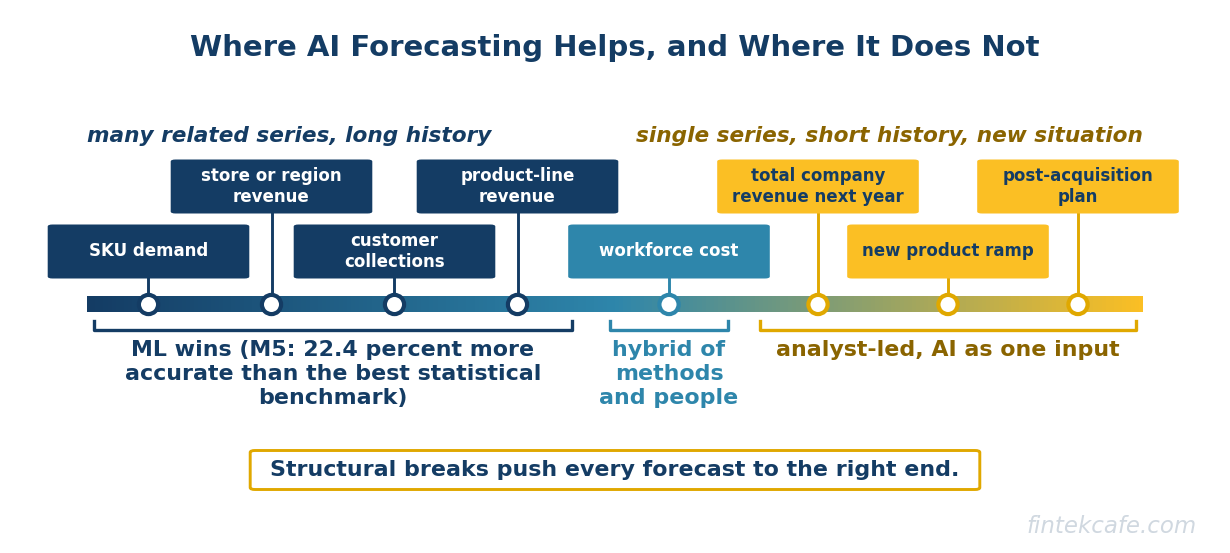
- Machine learning can beat statistical forecasting at scale. In the M5 competition on 42,840 Walmart series, the winner was 22.4 percent more accurate than the best statistical benchmark. But that advantage depends on volume and stable patterns, which most corporate forecasts lack.
- AI forecasts fail on structural breaks, small data sets and anything the model has never seen. The COVID-19 demand shock broke models trained on normal behaviour within weeks.
- A forecast the CFO cannot explain to the board is worse than a less accurate one that can be explained. Explainability, override logging and named model ownership are the controls that matter.
- The organizational change is bigger than the technical one: rolling forecasts and self-serve scenarios move planning out of finance and into the business lines, with finance owning the model and the assumptions.
Where FP&A Time Goes Today
The case for AI in FP&A starts with how planning teams spend their week. The evidence from the main independent surveys is consistent:
- Data, not analysis. The FP&A Trends Survey 2025, with 459 respondents, found 46 percent of FP&A time went to data collection and validation, the highest in five years. The 2026 edition, with 475 respondents in 52 countries, put it at 47 percent.
- Spreadsheets everywhere. The AFP's 2025 FP&A Benchmarking Survey found 96 percent of practitioners use spreadsheets for planning.
- Slow cycles. In the FP&A Trends 2025 data, 53 percent of organizations took one to three months to complete the annual budget, 28 percent took three to six months, and only 8 percent finished in under a month. 29 percent needed more than ten business days to produce a forecast.
- Short horizons. 61 percent could only forecast with confidence up to six months ahead. In the 2026 survey, confidence in planning six months or more ahead fell to 29 percent from 39 percent.
- Low AI use in practice. The AFP found 23 percent of FP&A practitioners use AI at least monthly, 40 percent are testing it, and 36 percent are neither testing nor planning to. Lack of expertise and unclear return were the top barriers, and 61 percent cited unreliable data.
Read together, these numbers describe a function that spends half its time preparing inputs, produces forecasts slowly, and trusts them for only a few months. The forecast is expensive, so it is made rarely. AI changes that economics before it changes accuracy.
What AI Does Well in FP&A Today
Data collection and preparation
The least glamorous use is the most valuable. AI can pull actuals from ERP, CRM, HR and operational systems, reconcile mismatched hierarchies, flag anomalies and fill the planning model without a week of spreadsheet work. Gartner's November 2025 survey found anomaly and error detection among the top finance AI uses, at 34 percent of functions. This is the same foundation that supports a faster close, covered in how continuous close changes the finance function.
Driver-based forecasts from more signals
Machine learning can use more drivers than an analyst can maintain by hand: pipeline data, web traffic, hiring plans, commodity prices, weather, payment behaviour. For high-volume forecasts such as revenue by product and region, demand by SKU or collections by customer segment, this is where measured accuracy gains appear.
Variance explanation and commentary drafts
Language models are good at turning a variance table into a first draft of the explanation: revenue was below plan in the region because two large deals slipped and pricing came in under assumption. The analyst checks and edits. This saves hours each cycle, and it is where the risk of a confident wrong statement is highest, so it needs the controls in AI hallucination controls.
Scenario generation
AI can build and run dozens of scenarios in the time it takes to build one by hand: what happens to margin if input costs rise, if a hiring plan slips a quarter, if a large customer churns. Workday's Adaptive Decision Intelligence, launched to early adopters in May 2026, and Oracle's Planning Agent in Fusion EPM, announced in October 2025, both centre on natural-language what-if analysis.
What the Evidence Says About Accuracy
Vendor claims of large accuracy gains are common. Independent evidence is more mixed, and more useful.
| Evidence | Finding | What it means for FP&A | Source and date |
|---|---|---|---|
| M5 forecasting competition | Winner 22.4 percent more accurate than the best statistical benchmark; most top methods used gradient-boosted trees | ML wins on many related, high-volume series | Makridakis et al., International Journal of Forecasting, 2022 |
| M5 caveat | Only 415 of 5,507 teams beat every benchmark | Most ML attempts did not beat simple methods | Same |
| M4 forecasting competition | Winner was a hybrid of exponential smoothing and a neural network; none of six pure ML methods beat the combination benchmark | On single, short series, pure ML underperforms | Makridakis et al., International Journal of Forecasting, 2018 |
| Judgmental adjustment study | Over 60,000 forecasts at four companies: small adjustments often hurt accuracy, large ones generally helped, upward adjustments were less reliable than downward | Overrides need discipline, not prohibition | Fildes, Goodwin, Lawrence, Nikolopoulos, 2009 |
| McKinsey estimate | AI could cut supply-chain forecasting errors by 20 to 50 percent | A consultancy estimate of potential for supply chain, not a measured FP&A result | McKinsey, "Smartening up with artificial intelligence", 2017 |
| Vendor claims | OneStream claims more than 25 percent average accuracy improvement for its forecasting product | Self-reported; test on your own data | OneStream, May 2025 |
Three conclusions follow. First, machine learning helps most where there are many related series with history: SKU demand, store revenue, customer-level collections. Second, it helps least on the forecasts executives care most about: total company revenue for next year, a new product's ramp, the effect of a pricing change. Those are single series, short histories or genuinely new situations. Third, the best results usually come from combining methods and people, which is what the M4 winner and the override research both point to.
Where It Fails
Structural breaks
A model learns the patterns in its training data. When the world changes, the patterns stop holding. MIT Technology Review reported in May 2020 that demand and inventory models across retail broke during the first weeks of the pandemic, because nothing in their history resembled the spike in buying. Tariff changes, a new competitor, a regulatory shift or an acquisition create the same problem on a smaller scale.
Small data
A mid-sized company forecasting quarterly revenue has perhaps forty data points of history. That is not enough for most machine-learning methods to beat a well-built driver model and an experienced analyst. The larger the number of related series, the stronger the case for ML; the fewer, the weaker.
Forecasts nobody can explain
A forecast that comes from a model the finance team cannot explain will not survive a board meeting, an earnings call or an auditor's question. If the CFO cannot say why the forecast moved, the forecast has no authority, however accurate it was last quarter. This is the failure that stalls most FP&A AI programs, and it is organizational, not technical.
Garbage drivers
AI magnifies the quality of its inputs. The 2026 FP&A Trends survey found only 19 percent of teams rate their data quality as advanced, and noted that AI is widening the gap between stronger and weaker teams rather than closing it. A model fed inconsistent product hierarchies or stale pipeline data produces confident nonsense faster.
The FP&A Task Table
| FP&A task | AI suitability today | Control needed |
|---|---|---|
| Data collection and reconciliation | High | Reconciliation to source totals; exception log |
| Anomaly detection in actuals | High | Analyst review of flagged items |
| High-volume forecasts (SKU, region, customer) | High | Back-testing against holdout periods; accuracy tracked monthly |
| Company-level annual revenue forecast | Medium, as one input | Comparison against driver model; documented overrides |
| Variance explanation drafts | High for drafts | Every claim traced to data before release |
| Board and investor commentary | Low | Human-written; AI only for first draft of supporting analysis |
| Scenario generation | High | Assumptions visible and owned; scenarios labelled as scenarios |
| Headcount and workforce planning | Medium | Privacy review; EU AI Act employment rules where they apply |
| New product or market forecasts | Low | Analyst-built with explicit assumptions |
| Long-range strategic plan | Low | Leadership judgement; AI for scenario support only |
How AI Changes Finance's Relationship With the Business
The more significant change is not inside the finance team. It is the boundary between finance and everyone else.
From annual budget to rolling forecast
When a forecast takes three weeks to produce, a company can afford one budget and a few reforecasts a year. When AI cuts the preparation time to days, a monthly rolling forecast becomes practical. The FP&A Trends 2025 survey found 46 percent of organizations had adopted rolling forecasts, while 38 percent still set targets as last year plus a percentage. AI makes the first group cheaper to run and removes the main excuse of the second.
Self-serve scenarios for business leaders
The sales leader wants to know what happens to the quarter if two large deals slip. The HR leader wants to know the cost of accelerating hiring. The operations leader wants the margin effect of a supplier price rise. Today, each question becomes a request to finance and a wait. With AI planning tools, each leader can run the scenario directly inside a model finance controls. Anaplan announced role-based agents for finance, sales, supply chain and workforce analysts in December 2025; Pigment and Planful launched comparable assistants in 2025.
This shifts where budget authority and judgement sit. The broader pattern of AI spending moving out to business units is covered in how AI budgets are shifting to the business units. For FP&A the implication is clear: finance stops being the producer of every number and becomes the owner of the model, the assumptions and the rules for using it.
Where CFOs are putting it
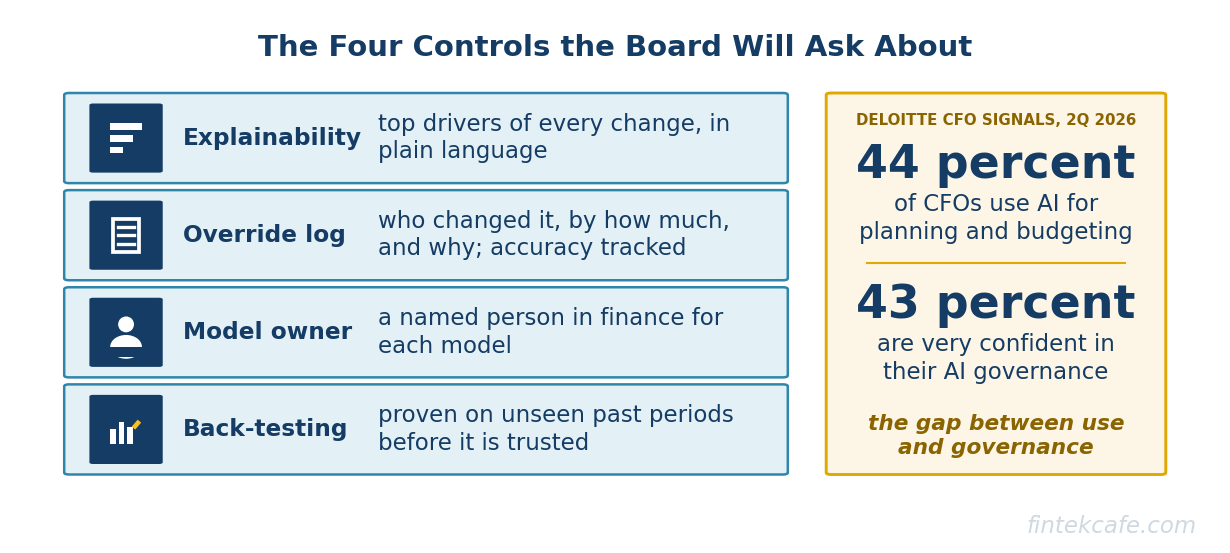
Deloitte's CFO Signals survey for the second quarter of 2026 found 44 percent of CFOs using AI for financial planning and budgeting, and 41 percent for financial data analysis, but only 43 percent very confident in their AI governance. That gap between use and governance is where the next section starts.
The Controls the Board Will Ask About
Explainability
Every forecast should come with the top drivers of the change since the last version, in plain language. If a tool cannot provide that, it should not produce numbers that reach leadership.
Override logging
Analysts and executives will override model forecasts, and the research says some overrides help. Log every override with who made it, by how much and why, then measure override accuracy over time. Over a few cycles this shows which judgement adds value and which adds optimism.
Model ownership
Every model needs a named owner in finance accountable for its performance, its data feeds and its retirement. Banks have long had formal model risk management. In the US, the Federal Reserve replaced its 2011 SR 11-7 guidance, and the later SR 21-8, with SR 26-2 in April 2026, a risk-based approach issued with the OCC and FDIC that applies primarily to banking organisations with more than 30 billion US dollars in assets. Corporate finance teams are not bound by it, but its core disciplines (inventory, validation, monitoring, ownership) are a sound template.
Evaluation before trust
Before a model's forecast replaces the analyst's, back-test it on past periods it did not see, compare it with the existing method, and keep running both for a few cycles. The broader discipline is covered in what AI evals are and why executives should care.
Regulatory scope
Under the EU AI Act, corporate financial forecasting is not on the Annex III list of high-risk uses, which covers areas such as credit scoring of individuals and employment decisions. Workforce planning that feeds decisions about individual employees may fall under the employment category. The Digital Omnibus regulation adopted in 2026 moved the Annex III high-risk deadline from August 2026 to December 2027.
The Maturity Path
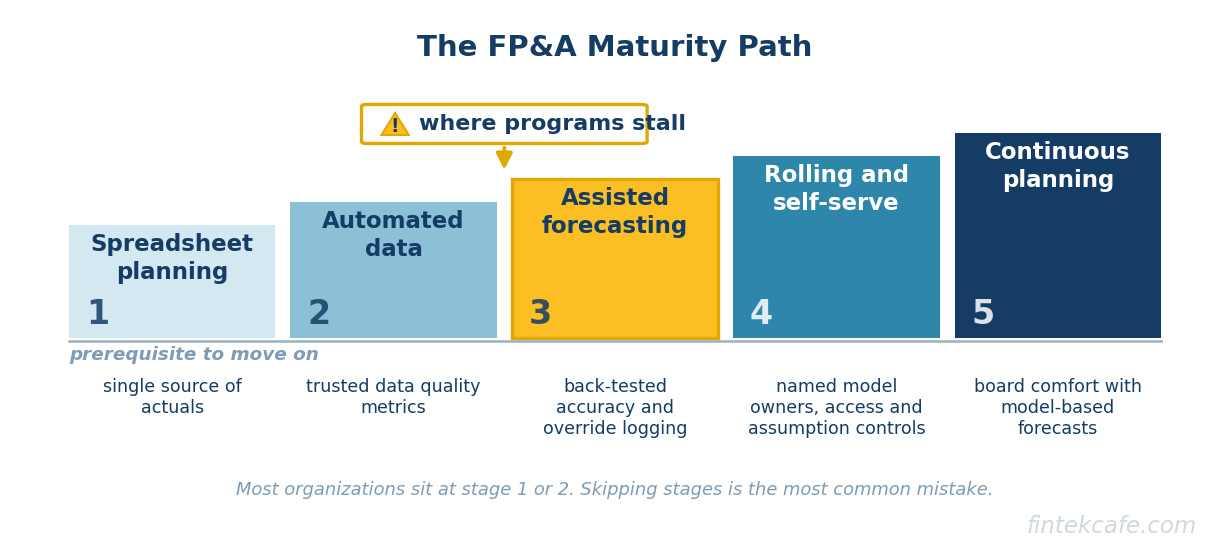
| Stage | What it looks like | AI role | Prerequisite to move on |
|---|---|---|---|
| 1. Spreadsheet planning | Annual budget, manual consolidation, few reforecasts | None or ad hoc chat use | Single source of actuals; consistent hierarchies |
| 2. Automated data | Actuals flow automatically into a planning platform | Data collection, anomaly detection | Data quality metrics tracked and trusted |
| 3. Assisted forecasting | ML forecasts for high-volume lines alongside analyst forecasts | Forecast generation, variance drafts | Back-tested accuracy; override logging in place |
| 4. Rolling and self-serve | Monthly rolling forecast; business leaders run scenarios in finance-owned models | Scenario generation, natural-language queries | Named model owners; access and assumption controls |
| 5. Continuous planning | Forecasts update as data arrives; finance focuses on decisions and exceptions | Agents monitor drivers and flag material changes | Board-level comfort with model-based forecasts and their governance |
Most organizations sit at stage one or two, and the evidence suggests the jump from two to three is where programs stall, because data quality and explainability were not solved first. Skipping stages is the most common mistake.
The Position, and Its Tradeoff
The recommended stance is to buy AI for FP&A to make forecasting cheap and frequent, not to make one forecast perfect. Start with data automation, use machine learning where you have volume, keep humans on the headline numbers, and redesign the planning calendar around faster cycles and self-serve scenarios.
The tradeoff is control. Putting scenario tools in the hands of business leaders means finance no longer sees every number before it is used, and some of those numbers will be built on bad assumptions. Rolling forecasts demand more frequent attention from leaders who were used to an annual ritual. And a team that automates its data work must find a new role for the analysts who did it, which is a people decision as much as a technology one. The alternative, using AI only inside finance to produce the same annual budget faster, is safer and captures a small fraction of the value.
Frequently Asked Questions
How is AI used in FP&A?
The most common uses are automating data collection and reconciliation, detecting anomalies in actuals, producing machine-learning forecasts for high-volume lines such as product or regional revenue, drafting variance commentary and generating scenarios. Board-level commentary and long-range strategy remain human-led.
Does AI make financial forecasts more accurate?
It can, mainly where there are many related series with good history. In the M5 competition the winning machine-learning method was 22.4 percent more accurate than the best statistical benchmark. On single, short series such as total company revenue, the evidence shows smaller or no gains, and hybrid approaches that combine methods and human judgement tend to do best.
Will AI replace FP&A analysts?
The evidence points to a change in the role rather than replacement. AI removes much of the data collection that takes nearly half of FP&A time and speeds up first drafts. Analysts shift toward checking model output, owning assumptions and advising business leaders, which requires more business understanding, not less.
What controls does an AI forecast need?
Explainability of the main drivers behind each forecast, logging of every human override with its reason, a named owner for each model, back-testing before the model is trusted, and ongoing accuracy tracking. These let the CFO defend a forecast to the board and the auditors.
The Bottom Line
FP&A has always been constrained by the cost of producing a forecast. Half the team's time goes to assembling data, so forecasts are made rarely, trusted briefly and defended with effort. AI attacks that cost directly. It will not produce a perfect forecast, and it will fail badly when the world changes faster than its history.
The finance teams that get the most from it will treat the cheaper forecast as an opportunity to change how the whole business plans: monthly instead of annually, scenarios run by the people closest to the decision, and finance owning the model and the assumptions rather than every cell. That is a larger change than any accuracy gain, and it is the one worth putting in front of the board.
Related Articles
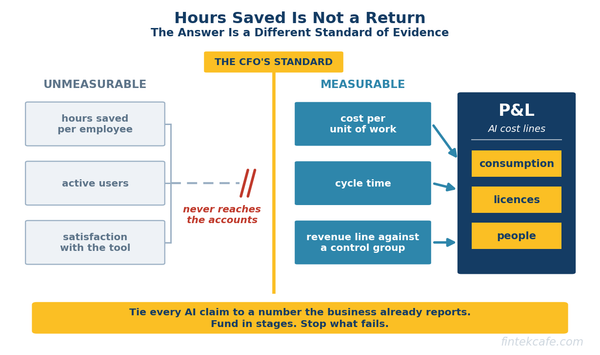
The CFO Now Owns the AI Business Case, and Most Finance Teams Cannot Measure the Return
Boards ask the CFO what AI returns, and most cannot say. Why hours saved fails, which metrics hold up, and a funding model that kills what does not pay.
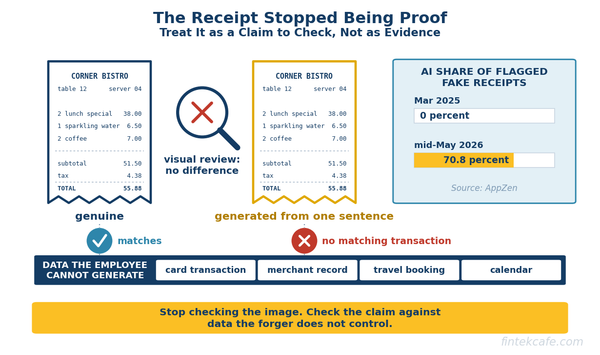
AI-Generated Fake Receipts: How Expense Fraud Changed and How Finance Teams Catch It
AI-generated fake receipts now beat visual review. How expense fraud changed, which detection still works, and the controls to use by company size.
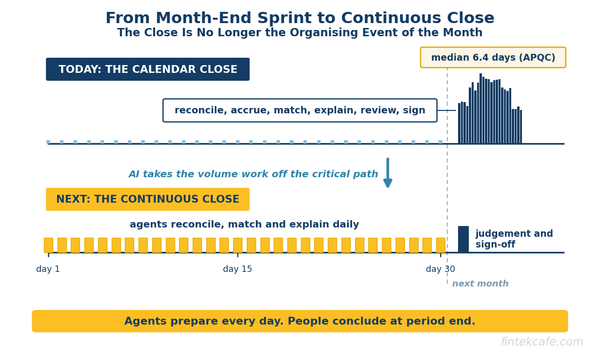
The Monthly Close Is Becoming Continuous, and the Finance Calendar Will Not Survive It
AI is taking the bottleneck work out of the month-end close. The close becomes continuous with a short sign-off, and finance, audit and the board change.