
Capitalize or Expense: How AI Spending Lands on the Income Statement, and Why It Changes the Business Case
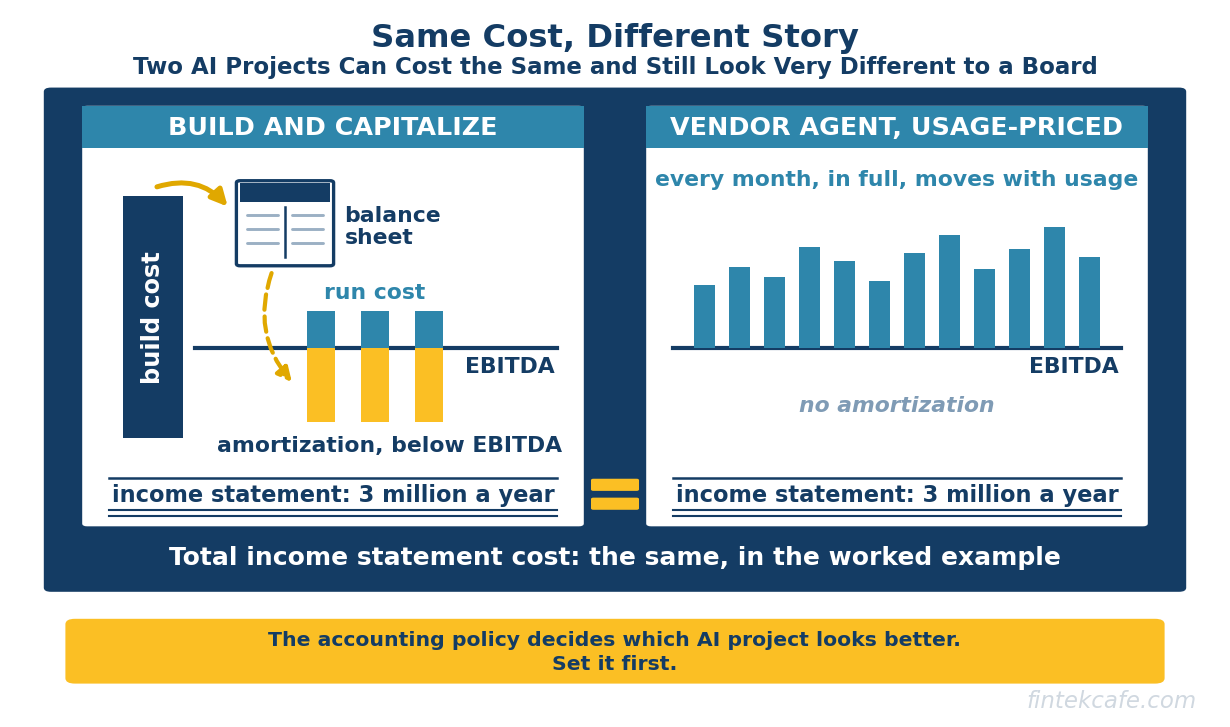
Two AI projects can cost the same, deliver the same result and still look very different to a board. One is an agent the company builds on its own platform. The other is a vendor agent priced per resolved ticket or per completed task. If the first is capitalized, its cost moves off the income statement and onto the balance sheet, then returns slowly as amortization below EBITDA. The second lands in operating expense every month, in full, and moves with usage.
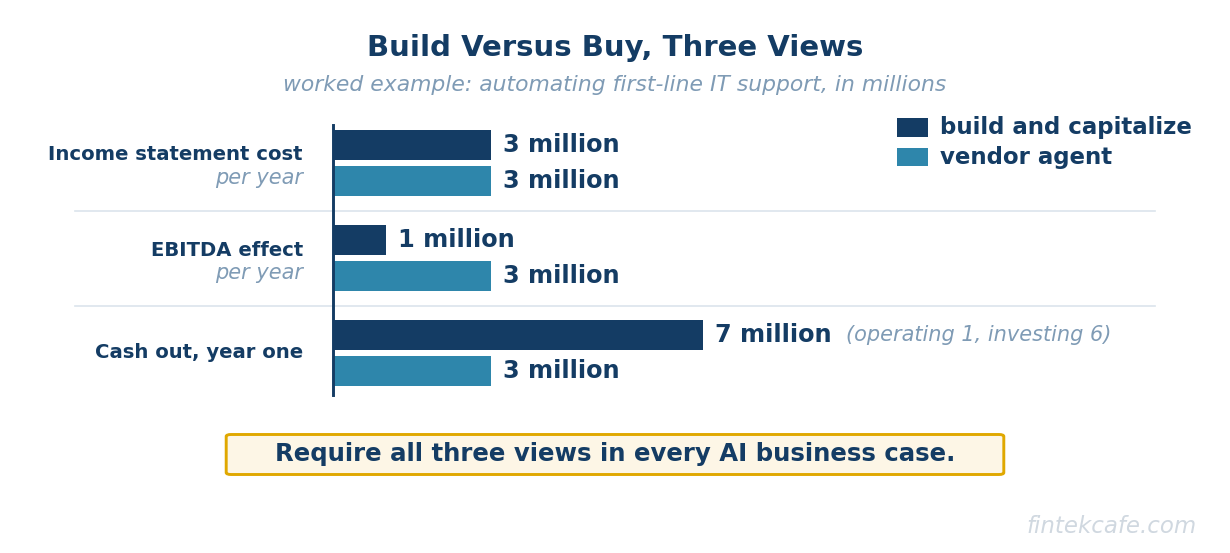
The thesis of this piece: the accounting treatment of AI spending quietly decides which AI projects look attractive, and most companies have not decided the treatment on purpose. Capitalized builds flatter near-term margins and depress later ones. Usage-priced vendor agents keep the balance sheet clean but make operating margins volatile. Neither is wrong. What is wrong is letting customer service, HR, engineering and procurement build their business cases on whatever treatment suits them, and discovering the policy after the money is committed.
The CFO should set the policy first, and the board should read every AI margin claim with that policy in mind. This is a business framing, not accounting advice. The auditor signs off on the policy, and the facts of each project decide the answer.
Most AI Spend Is Operating Expense, and That Is the Starting Point
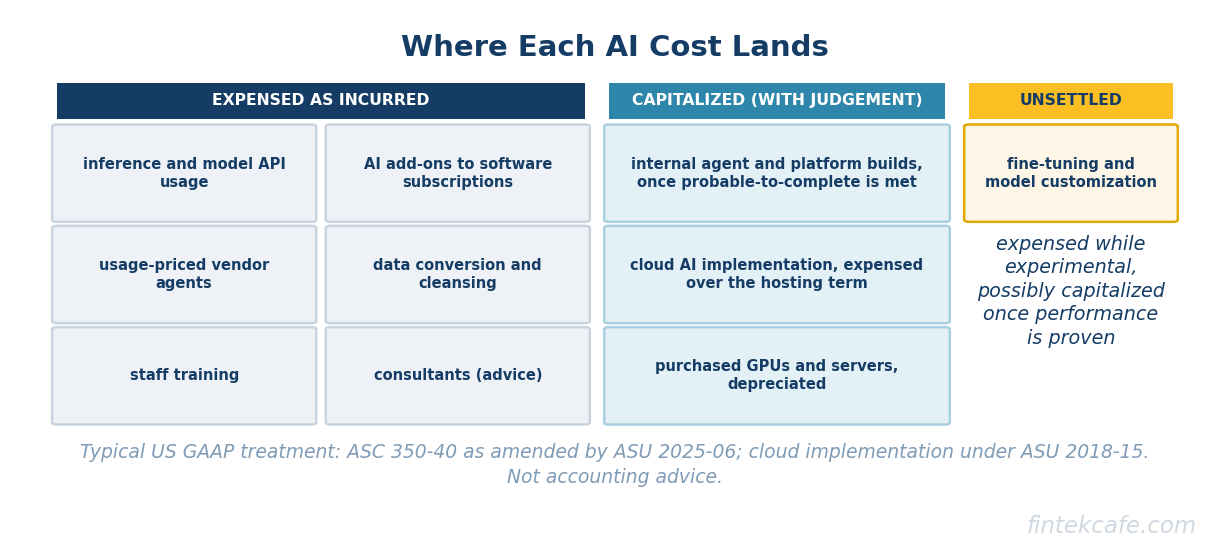
Start with what is not in doubt. Most enterprise AI spending today is operating expense: model and inference usage billed by the token, AI add-ons to existing software subscriptions, usage-priced agents, consultants, and the time staff spend learning new tools. None of it creates an asset the company controls, so it is expensed as incurred.
That is the mirror image of the companies selling the capacity. The largest cloud providers record AI as capital spending. Alphabet's chief financial officer, Anat Ashkenazi, told investors on October 29, 2026 that full-year 2026 capital expenditure guidance of 195 billion to 205 billion dollars was unchanged, and added that the investment "will continue to weigh on the P&L in the form of higher depreciation expenses and related data centers operation costs such as energy" (Alphabet third-quarter 2026 earnings call). Microsoft's chief financial officer, Amy Hood, said on October 28 that "Roughly 3/4 of our CapEx was for short-lived assets, primarily CPUs and GPUs," and expected calendar-year spending of about 170 billion dollars (Microsoft fiscal first-quarter 2027 earnings call).
The supplier capitalizes the data centre and recovers it through depreciation; the enterprise customer rents a slice and expenses the bill. Every AI business case sits somewhere on that line, depending on one question: is the company buying a service, or building something it controls?
For most companies the answer is mixed. Customer service may pay a vendor per resolution, engineering may build an internal coding platform, and HR may pay a consultancy to configure an AI module in its cloud human capital system. Those three spends follow three different sets of rules, and the policy a CFO writes decides how each one looks in the business case.
This is a Premium Article
Sign up for a Premium membership to read this article and get full access to strategic intelligence on technology and business.
Already a member? Sign in
Related Articles
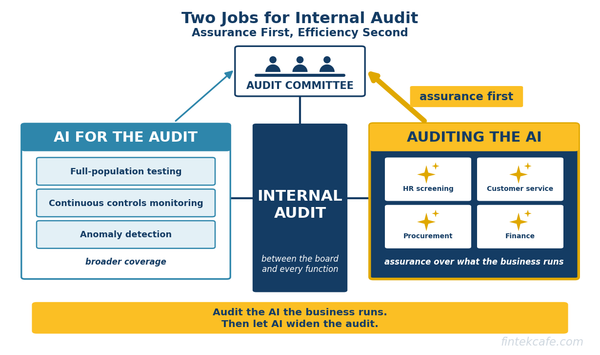
AI in Internal Audit: How Auditors Use It, and How to Audit the AI the Business Already Runs
AI in internal audit: full-population testing, continuous monitoring, where evidence breaks down, and an assurance checklist for the AI your business runs.
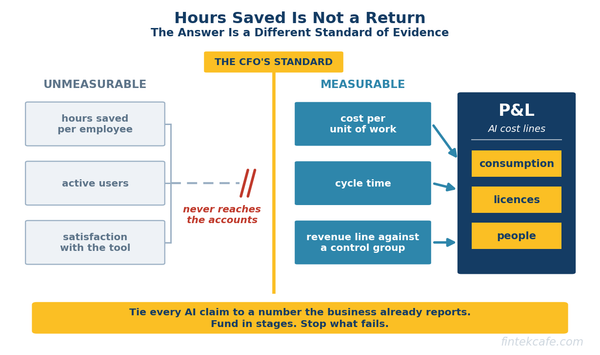
The CFO Now Owns the AI Business Case, and Most Finance Teams Cannot Measure the Return
Boards ask the CFO what AI returns, and most cannot say. Why hours saved fails, which metrics hold up, and a funding model that kills what does not pay.
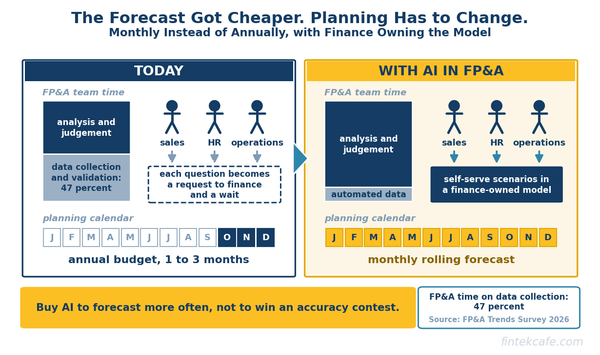
AI in FP&A: What Forecasting and Planning AI Actually Changes for the Finance Team
What AI in FP&A changes: where forecasting and planning AI works, where it fails, the controls the board needs, and a maturity path for the finance team.