
Procurement Is Where Agents Will Spend the Company's Money First
Most of the attention on agents that spend money has gone to consumers: the assistant that books the flight or reorders the groceries. That is the wrong place to look. The first agents trusted to commit real money at scale will be buying for the enterprise, in tail spend, renewals and routine sourcing, because procurement already has what an agent needs to act safely: written policies, approved catalogs, preferred suppliers, budgets and approval limits.
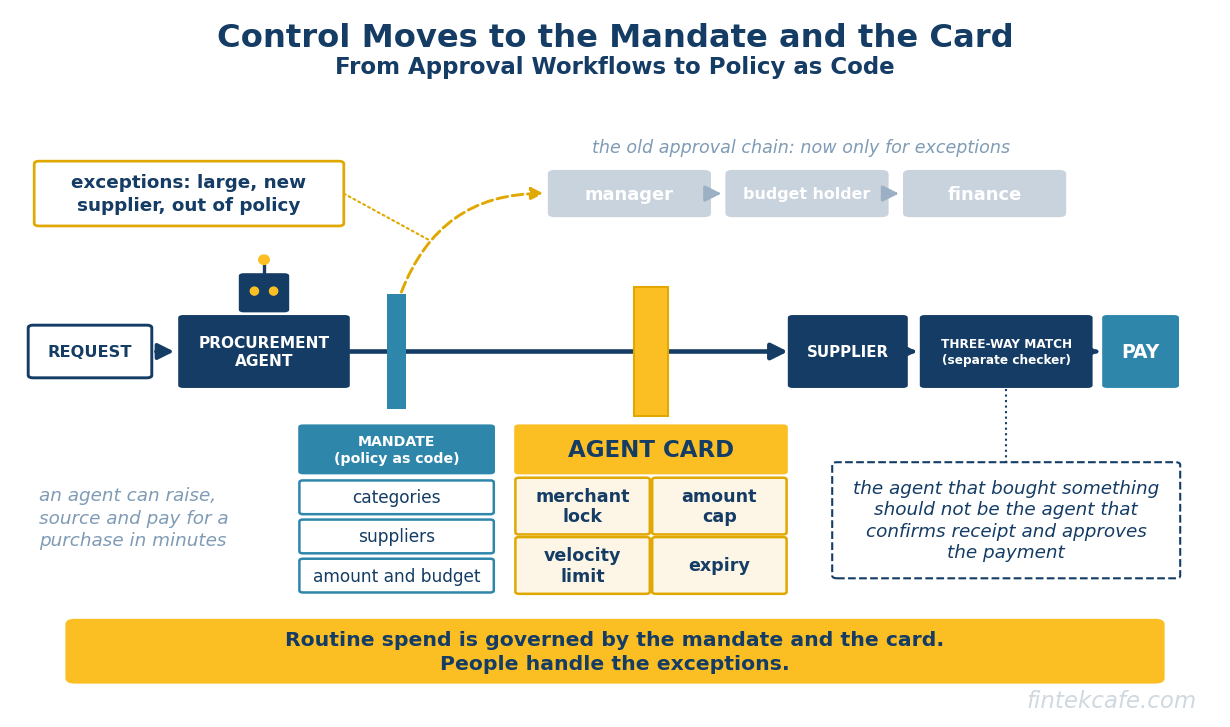
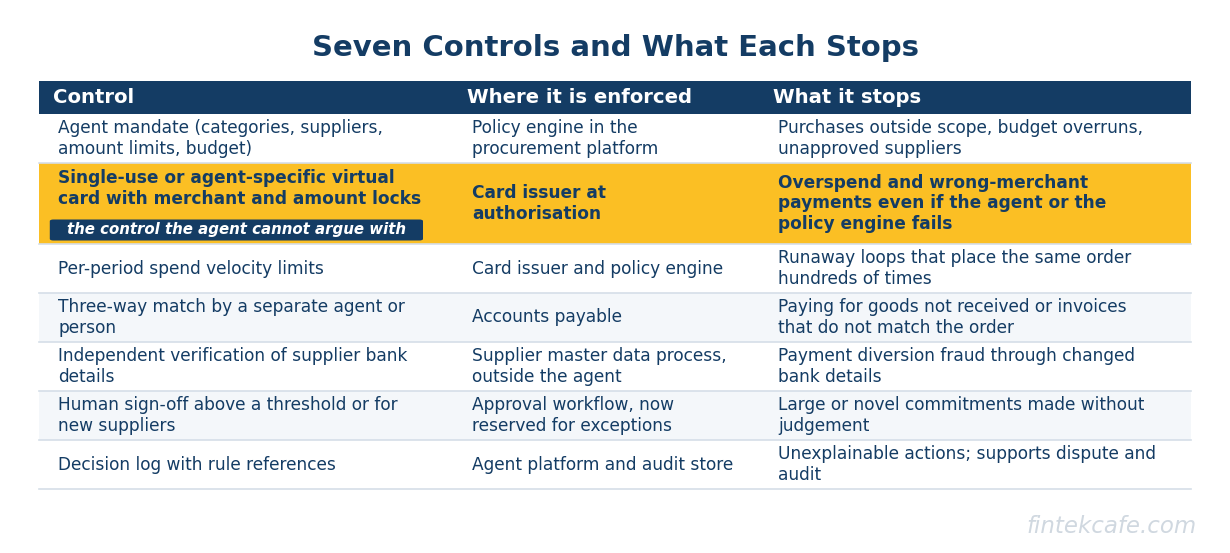
The thesis of this piece: agentic procurement moves control from approval workflows to policy expressed as code and to spending limits enforced at the payment instrument. Today, control means a person reads a request and clicks approve. When an agent can raise, source and pay for a purchase in minutes, that click becomes either a bottleneck that erases the benefit or a rubber stamp that provides no control. The durable control sits in two places instead: machine-readable rules about what the agent may buy, and hard limits on the card or payment rail that the agent cannot exceed whatever it decides.
The CFO who designs that layer first captures the savings, because the agent can work the long tail of spend that no human team has time for. The CFO who does not will face one of two outcomes: agents that are fenced in so tightly they save nothing, or agents that are trusted without controls and fail at machine speed.
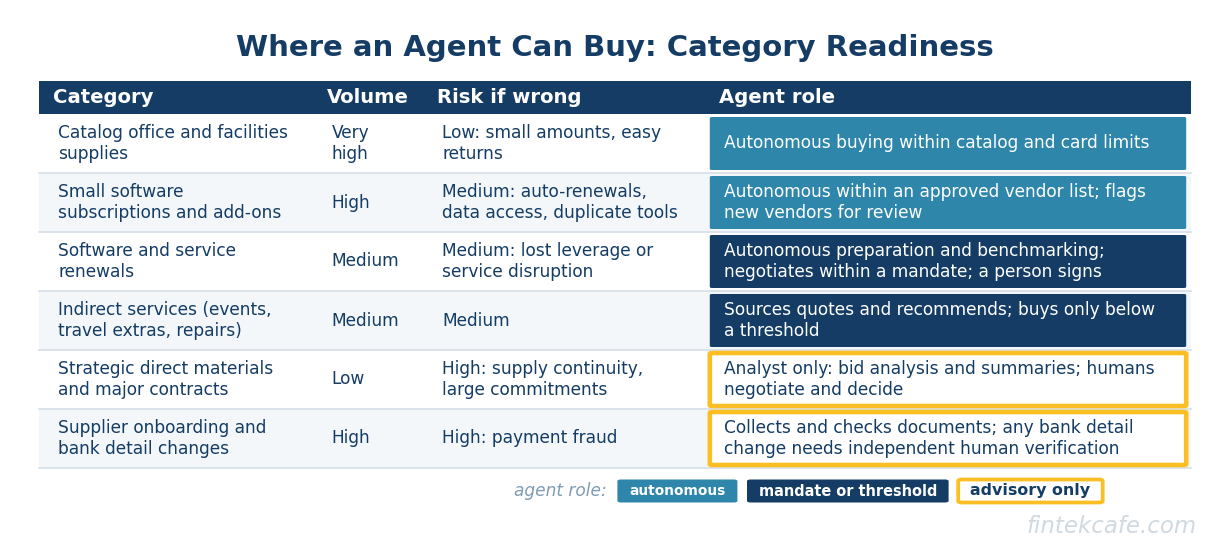
Why the First Agent With a Budget Will Work in Procurement
Three properties make procurement the natural first home for agents that spend.
The rules already exist. Procurement is one of the most codified functions in any company. Spend policies, delegation-of-authority matrices, preferred supplier lists, catalog pricing and contract terms are written down, because auditors require them. An agent does not need to infer what good behaviour looks like. It needs the existing rules in a form it can read and the system can enforce.
The value is in volume nobody handles. Large organisations negotiate their biggest contracts carefully and leave the long tail on standard terms. Harvard Business Review reported in November 2022 that Walmart, with more than 100,000 suppliers, could not negotiate with all of them, and that around 20% of its suppliers had signed cookie-cutter agreements that were often not negotiated at all. In a pilot with the autonomous negotiation vendor Pactum, the chatbot reached agreement with 64% of the tail-end suppliers invited, against a target of 20%, with an average turnaround of 11 days (Harvard Business Review, November 2022). Bloomberg later reported average savings of about 3% on the contracts negotiated and that three out of four suppliers said they preferred negotiating with the bot (Engadget, April 2023). That is the shape of the opportunity: small gains on a very large number of transactions that were previously not worth a person's time.
The software is shipping now. The procurement suites and spend-management platforms have moved from AI assistants that summarise to agents that act. Coupa said in August 2026 that more than 450 customers have put its Navi agents into production since the first release in May 2025, and that one of its payment agents ran fourteen payment batches containing 2,395 payments in its first five weeks in production (Coupa via Yahoo Finance, August 20, 2026). Ramp launched procurement agents on April 29, 2026 that triage employee requests, source vendors, review contract terms and run compliance checks (PYMNTS, April 2026).
Consumer agentic commerce, covered in the agentic commerce shift, has to solve trust from scratch with every shopper. Enterprise procurement starts with the rules, the budgets, the audit trail and a counterparty that is itself a business. That is why the first agent with a real budget will report to the CFO. The question that matters is not whether agents will buy for the company but who designs the controls they operate under, and that is where the rest of this piece goes.
This is a Premium Article
Sign up for a Premium membership to read this article and get full access to strategic intelligence on technology and business.
Already a member? Sign in
Related Articles
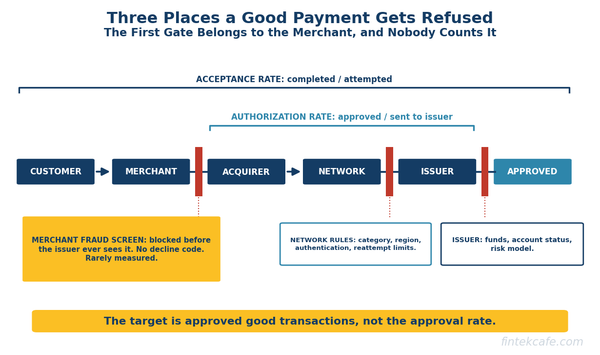
Why Card Payments Get Declined, and How Merchants Raise Their Approval Rate
Why card payments get declined, soft vs hard declines, and the levers that raise authorization rates without letting fraud and chargebacks rise with them.
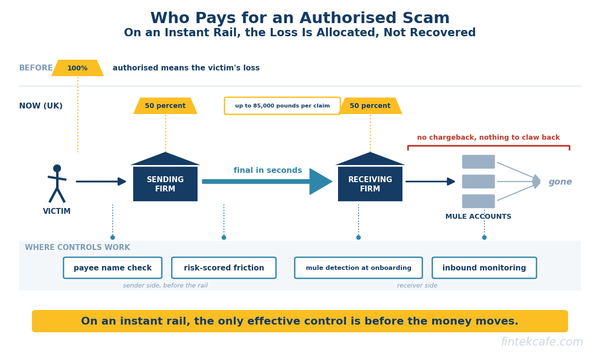
Scam Reimbursement Is Becoming a Cost of Running Instant Payments
Mandatory APP scam reimbursement turns fraud into a line in instant-payment unit economics, and the receiving firm now pays half. What it costs, and who.
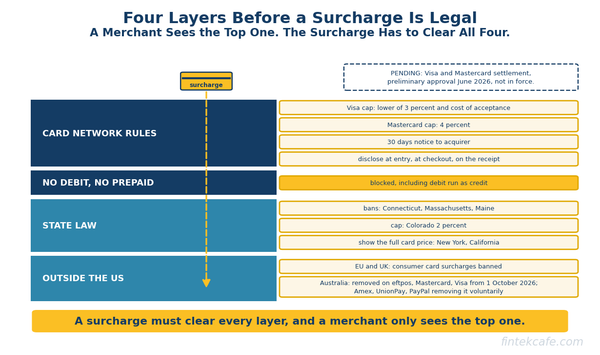
Credit Card Surcharging: When Passing On Card Costs Is Legal, and When It Costs More Than It Saves
Credit card surcharge rules differ by network, state and country. When a surcharge is legal, what it does to sales, and cheaper ways to cut card costs.