
The AI Budget Is Moving From IT to the Business Lines, and Governance Has Not Followed
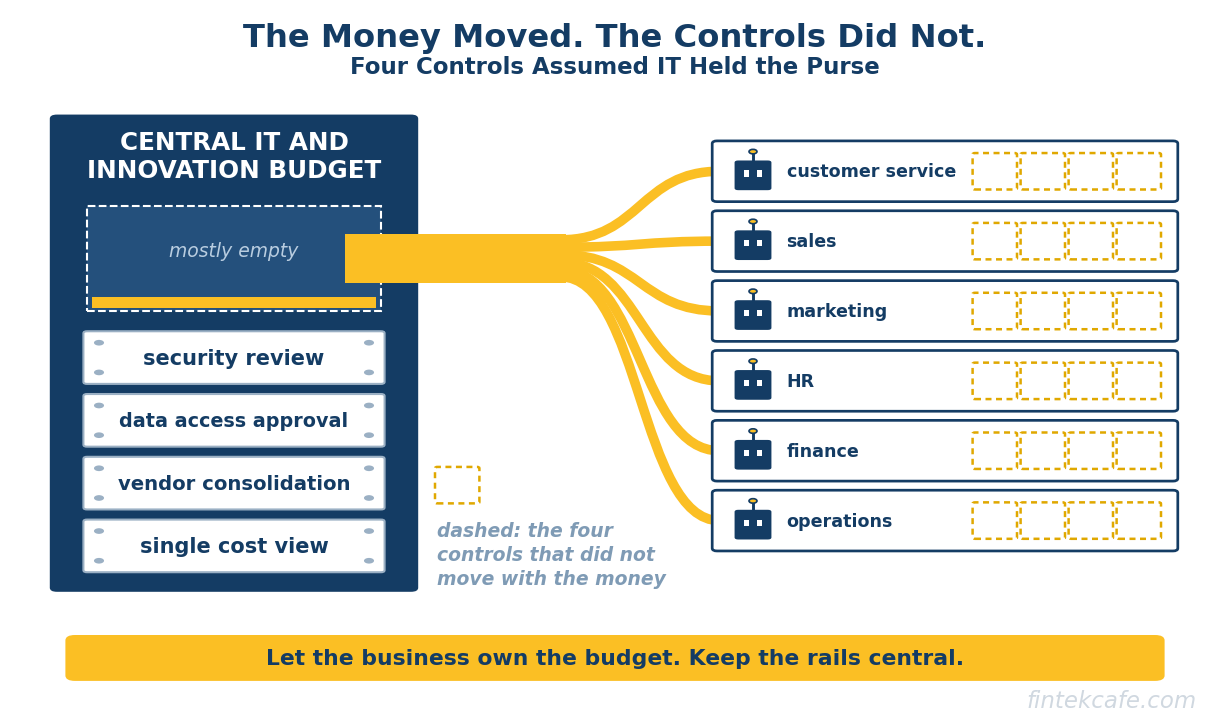
The first wave of enterprise AI was paid for centrally. A CIO, a chief data officer or an innovation fund bought the licences, ran the pilots and owned the results, such as they were. That arrangement is ending. Customer service, sales, marketing, HR, finance and operations now buy AI out of their own budgets, increasingly as agents priced per outcome, and very often from the software vendors they already pay.
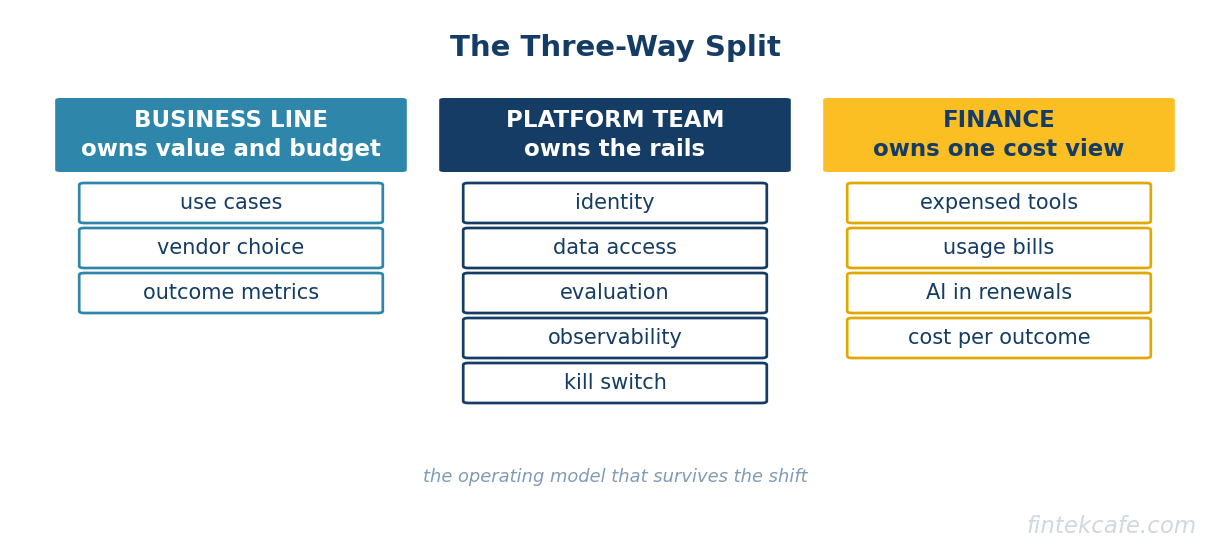
The thesis: the shift of AI spend to the business lines is mostly healthy, because it ties money to outcomes the buyer can see, but it quietly breaks four controls that assumed IT held the purse: security review, data access approval, vendor consolidation and a single view of cost. The answer is not to pull the money back to the centre. It is to split ownership deliberately: the business owns the value and the budget, a central platform team owns identity, data access, evaluation and observability, and finance owns one consolidated view of what AI actually costs. Most organisations have the first part already. Few have built the other two.
Where the Money Sits Now
The evidence that AI spend has left the innovation budget is consistent across sources that measure it differently.
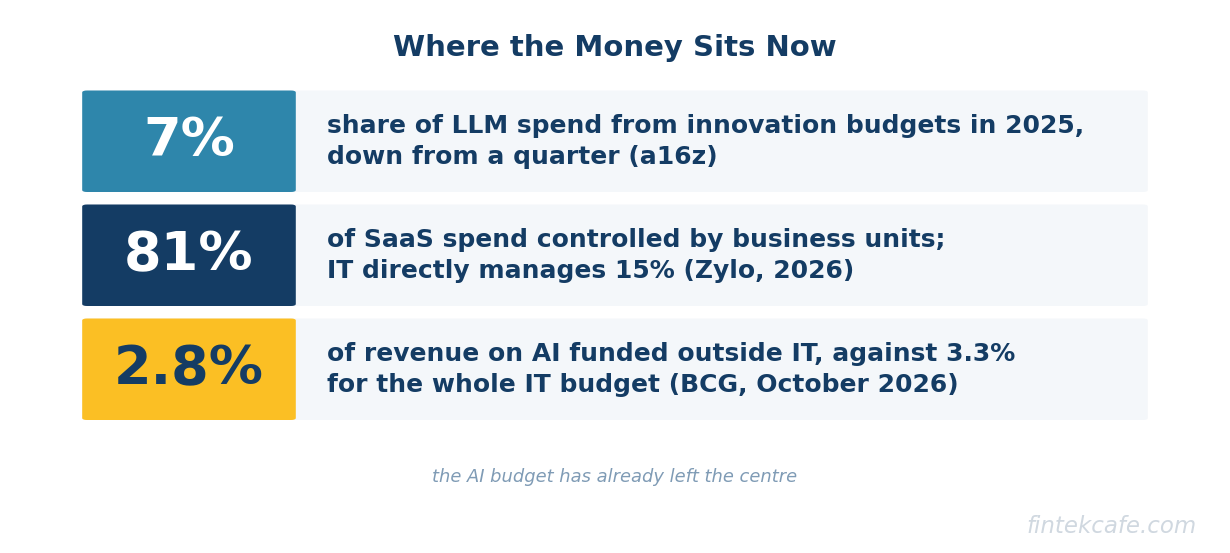
Innovation budgets have shrunk to a rounding error. In its survey of 100 enterprise CIOs published in June 2025, Andreessen Horowitz found that innovation budgets had funded a quarter of large language model spending a year earlier and just 7 percent in 2025. The rest now comes from "centralized IT and business unit budgets", which the firm read as a sign that AI is "no longer experimental but essential". Menlo Ventures' December 2025 report put total enterprise AI spend at 37 billion dollars for the year, with 19 billion of it on applications.
A growing share of that spend never passes through IT at all. Menlo's 2025 report found that 27 percent of AI application spend arrives through product-led growth, meaning individuals and teams adopting a tool and expanding it bottom-up, nearly four times the 7 percent rate in traditional software. Zylo's 2026 SaaS Management Index, based on 75 billion dollars of software spend, found that business units now control 81 percent of SaaS spend while IT directly manages 15 percent, and that ChatGPT has become the most expensed application in its data. Expensed spend is, almost by definition, spend that skipped procurement review.
The business lines are now funding AI at a scale comparable to IT itself. Boston Consulting Group's Applied AI survey, published on October 2, 2026, found that companies spend on average 3.3 percent of revenue on enterprise IT plus a further 2.8 percent of revenue on AI initiatives funded outside the technology budget. Gartner's survey of 1,303 respondents, run from January to April 2026 and published in September, found that functional leaders devoted an average of 12 percent of their budgets to AI in 2025, that 85 percent planned to increase that spending in 2026, and that roughly 11 percent of functional leaders were entirely unaware of what their function spent on AI.
None of this is a forecast. It is a description of where the money already is. The governance question follows from it: if the CIO no longer signs most of the AI purchase orders, which of the controls that used to hang off those signatures still exist?
That question is the subject of the rest of this analysis. The short answer is that four of them have quietly lapsed, and that the fix is a division of ownership rather than a return to central control.
This is a Premium Article
Sign up for a Premium membership to read this article and get full access to strategic intelligence on technology and business.
Already a member? Sign in
Related Articles
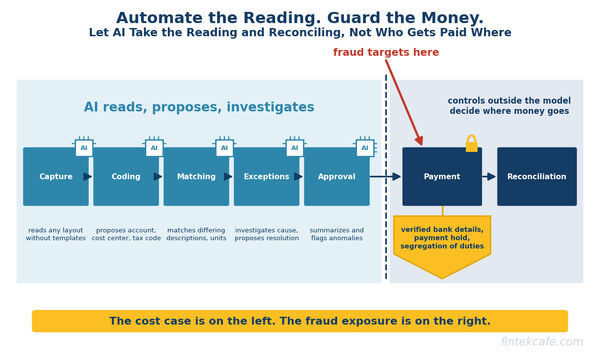
Accounts Payable Automation: What AI Can Actually Take Over in Invoice-to-Pay
What AI can take over in accounts payable, step by step from capture to payment, where the fraud risk grows, and which controls must stay outside the model.
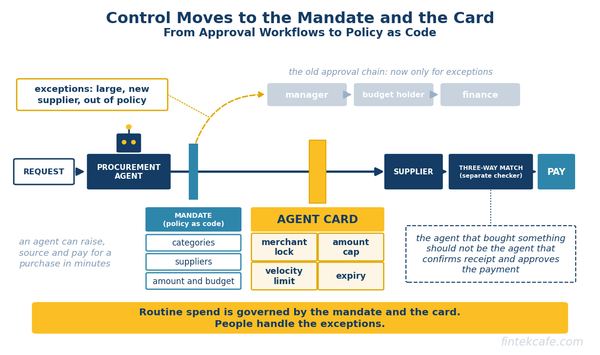
Procurement Is Where Agents Will Spend the Company's Money First
The first agents trusted with company money will buy for the enterprise. Control moves from approval chains to policy as code and card-level limits.
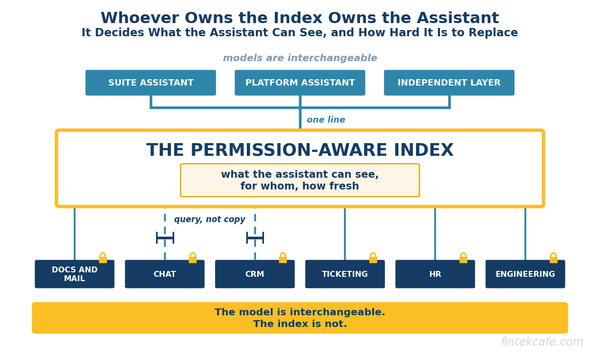
Enterprise Search Is Back, and This Time It Decides Which AI Assistant Wins
Enterprise search failed for twenty years. Now the permission-aware index behind every AI assistant is the control point, and its owner wins.