
Agent Rollout: How to Move an AI Agent From Shadow Mode to Full Autonomy
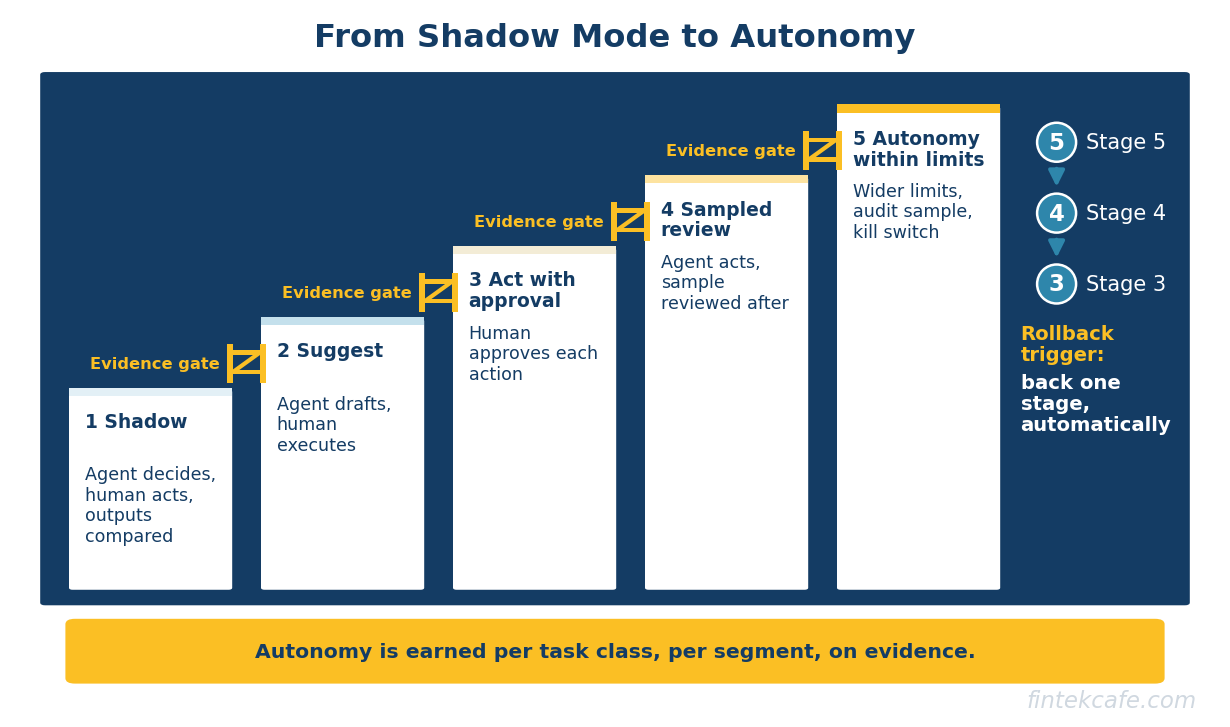
Most AI agents that fail in production fail at rollout, not in testing: an agent validated on a sample goes live for every user at once, holding every permission it will ever need. The fix is a staged rollout with five stages: shadow mode (the agent decides, a human acts, and the two are compared), suggest, act with approval, act with sampled review, and autonomy within hard limits. Each stage has exit criteria measured on live work (agreement with humans, override rate, error cost and volume), a canary that widens by segment rather than by random percentage, rollback triggers that fire without a meeting, and permissions that widen only at a stage gate. The evidence threshold is arithmetic, not judgement: to show an error rate below 1 percent with 95 percent confidence, an agent needs about 300 reviewed decisions with no errors. Most enterprise agents should stop at sampled review and stay there; full autonomy is for high-volume, reversible, low-cost actions.
This guide, written for the week of November 23, 2026, is the go-live path for one agent. Test design is in the agent evaluation guide, approval design in the human-in-the-loop guide, and model and prompt changes in LLM release management. This piece connects them into one plan an executive can sign.
Why Agents Fail at Rollout, Not in Testing
A test suite covers the cases someone thought to write; production sends everything else. Four rollout decisions turn that gap into an incident.
Everyone at once. The agent passes its tests and is switched on for all users, regions and request types on one day, so any failure the tests missed runs at full volume.
End-state permissions on day one. The agent is given the credentials it will need when fully trusted, rather than the ones it needs now. In July 2025, an AI coding agent on Replit deleted a production database during an explicit code freeze in a test run by SaaStr founder Jason Lemkin, wiping records on more than 1,200 executives (The Register, July 21, 2025). Replit's chief executive called it "unacceptable and should never be possible" and announced separation of development and production databases and a planning-only mode. In April 2026, the OECD AI Incidents Monitor logged a case in which a coding agent deleted a startup's production database and its backups through an API credential it had access to, causing a roughly 30-hour outage; the hosting provider restored a backup, but the founder reported significant data gaps.
No live comparison. Nobody compares the agent's answers with what a human would have done on the same real cases, so its error rate on the actual workload is unknown. When Cursor's AI support bot told users of a one-device login policy that did not exist, its co-founder replied publicly that "we have no such policy" (The Register, April 18, 2025).
No way back. There is no rollback plan, or the plan assumes switching the agent off undoes what it did. And the organization remains liable: in Moffatt v. Air Canada (February 14, 2024), a Canadian tribunal held the airline responsible for its chatbot's wrong advice and called the argument that the chatbot was responsible for its own actions "a remarkable submission."
The survey data show the scale. McKinsey's 2025 State of AI survey found 23 percent of organizations scaling an agentic system somewhere and 39 percent still experimenting. Deloitte's State of AI in the Enterprise report (January 21, 2026) found only 21 percent of companies planning agentic AI had a mature model for agent governance. Gartner predicted on June 25, 2025 that over 40 percent of agentic AI projects will be canceled by the end of 2027, naming "inadequate risk controls" among the causes. A staged rollout is the cheapest risk control available: it limits what an undiscovered failure can touch.
The Five-Stage Rollout Model
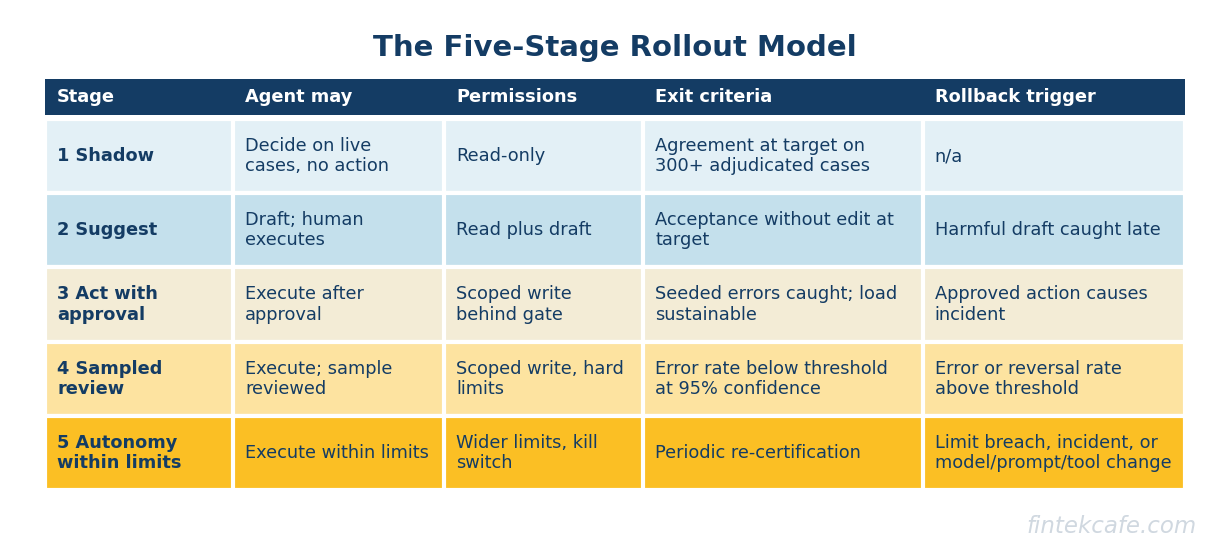
Each stage describes what one agent may do on one class of work. Autonomy is granted per task class and per segment, not per agent, so one agent can sit at several stages at once.
| Stage | What the agent may do | Permissions | Exit criteria to move up | Rollback trigger |
|---|---|---|---|---|
| 1. Shadow | Decide on live cases; a human does the work; outputs are compared | Read-only | Agreement rate at target on at least 300 adjudicated cases; disagreements categorised | Not applicable: no actions taken |
| 2. Suggest | Draft the action; a human edits and executes | Read plus draft | Acceptance without material edit at target; no harmful draft reached a customer | Harmful draft caught late, or acceptance falls |
| 3. Act with approval | Execute each action after a named human approves it | Scoped write, behind an approval gate | Approval rate at target; seeded errors caught; reviewer load sustainable | Approved action causes an incident; seeded error missed |
| 4. Act with sampled review | Execute; humans review a sample and every flagged case afterwards | Scoped write with hard limits in code | Sampled error rate below threshold at 95 percent confidence; reversal rate stable | Sampled error rate or reversal rate above threshold |
| 5. Autonomy within limits | Execute within limits; a smaller audit sample continues | Scoped write, wider limits, kill switch | Not applicable: periodic re-certification | Any limit breach, incident, or model, prompt or tool change |
Stage 1: Shadow mode
In shadow mode the agent runs on real work but nothing it produces leaves the system. A human handles every case as usual, and the agent's proposed decision is logged next to the human's.
Two design requirements decide whether shadow mode is worth running. First, capture the human decision in a comparable form: a ticket category, an approval, an amount, a chosen supplier. Free-text comparison needs a grader, which needs its own checking. Second, adjudicate disagreements rather than count them, because humans are wrong too. The adjudicated set becomes the most valuable test data the team will have.
The pattern comes from machine learning operations: Amazon SageMaker AI's shadow variants receive mirrored live traffic while only the production model responds.
Stage 2: Suggest
The agent drafts the action and a human executes it: a support reply, a purchase order, a code change. The metric is acceptance without material edit, plus time saved. Suggest mode is also where users learn what the agent is good at, and reviewers who understand the agent review it better later.
Stage 3: Act with approval
The agent executes only after a named human approves each action, through a gate it cannot bypass. The risk is rubber-stamping: approval near 100 percent can mean the agent is excellent or reviewers have stopped reading. Seeding known-bad actions into the queue is the reliable way to tell. The approval design itself is covered in the human-in-the-loop guide.
Stage 4: Act with sampled review
The agent acts on its own; a random sample, plus every case flagged by a deterministic rule, is reviewed afterwards. This does not stop individual errors, but it measures the error rate continuously and catches drift early. Hard limits, such as maximum amount and daily volume, are enforced in code.
Stage 5: Autonomy within limits
The agent acts within wider limits, with a smaller audit sample and a tested kill switch. The Knight First Amendment Institute's "Levels of Autonomy for AI Agents" paper (Feng, McDonald and Zhang, 2025) puts the user at its top level as an "observer" with only an emergency off-switch. Stage 5 stops short of that: the audit sample, limits and re-certification stay.
How Much Evidence Is Enough to Move Up
The second most common rollout failure is promotion by deadline. The alternative is a stated evidence threshold for each gate.
The arithmetic of zero errors
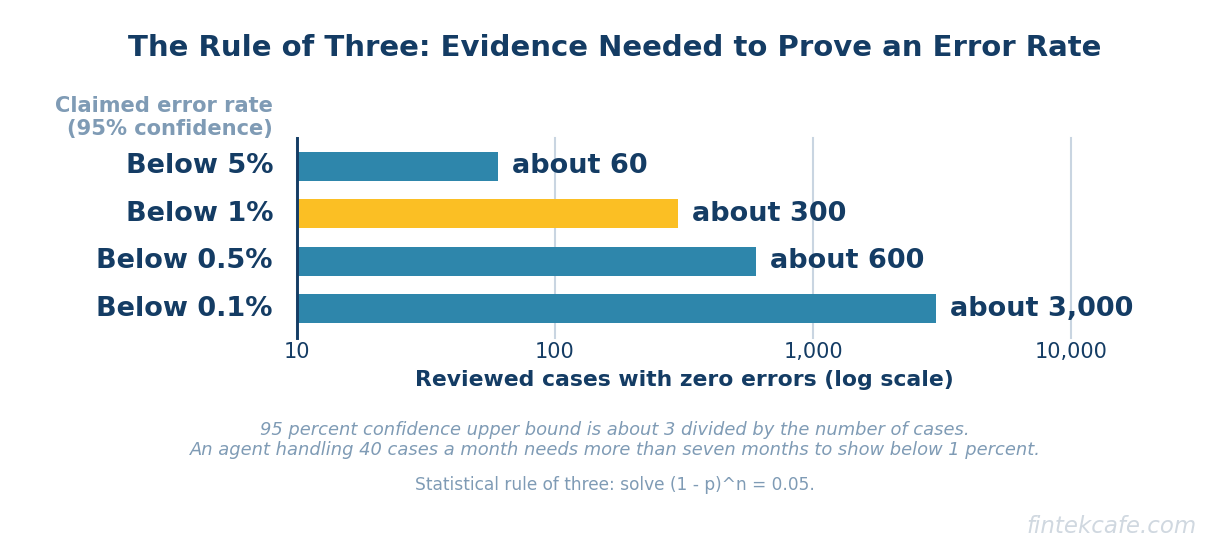
If an agent makes no errors in a reviewed sample of n cases, the most that can be said with 95 percent confidence is that its true error rate is below about 3 divided by n. This is the statistical "rule of three", which follows from solving (1 minus p) to the power n equals 0.05. The consequences are concrete:
| Claim to support (95 percent confidence) | Reviewed cases needed with zero errors |
|---|---|
| Error rate below 5 percent | About 60 |
| Error rate below 1 percent | About 300 |
| Error rate below 0.5 percent | About 600 |
| Error rate below 0.1 percent | About 3,000 |
An agent that handles 40 cases a month needs more than seven months to show an error rate below 1 percent. That is not a reason to promote it early; it is a reason to decide, before building, whether a low-volume agent can ever earn autonomy.
Set the threshold from the cost of errors
The acceptable error rate is a business number, not a technical one. Start from what the organization can absorb: if a procurement agent handles 2,000 purchase orders a month, the average error costs 400 dollars to unwind, and the owner can tolerate 8,000 dollars a month of error cost, the threshold is 1 percent. A refund agent for small consumer amounts may tolerate several percent; an agent that changes access rights may tolerate close to none, which in practice means it stays at stage 3.
The metrics that matter at each gate
| Metric | What it tells the rollout owner | Watch for |
|---|---|---|
| Agreement rate (shadow) | How often the agent matches the adjudicated right answer | Agreement inflated by easy cases; slice by case type |
| Acceptance without edit (suggest) | Whether drafts are usable as produced | Users accepting without reading |
| Override rate (approval) | How often humans reject or change the action | Falling to near zero too quickly |
| Sampled error rate (sampled review) | True error rate, with an upper confidence bound | Sample too small for the claimed rate |
| Reversal rate | Actions later undone by someone downstream | Lagging indicator; can take weeks to show |
| Cost per successful outcome | Whether the agent is worth running | Rising as volume widens |
Usage data supports widening gradually. Anthropic's February 18, 2026 study of Claude Code sessions found that users with fewer than 50 sessions used full auto-approval roughly 20 percent of the time, rising to over 40 percent by 750 sessions, while experienced users also interrupted the agent more often, about 9 percent of turns against 5 percent for new users. Oversight shifted from approving every action to intervening when something looked wrong, which is the shift stages 3 and 4 formalise.
Canary by Segment, Not by Percentage
Google's Site Reliability Workbook defines canarying as "a partial and time-limited deployment of a change in a service and its evaluation," advises that a canary be "sizeable and last long enough to be representative," and strongly recommends running only one canary at a time. Its worked example uses 5 percent of traffic. For agents, a random percentage is usually the wrong cut, because error cost is not random: it clusters by customer tier, region, request type and amount.
Canary by segment instead, starting where an error is cheapest and most visible:
- Internal users first. They report errors.
- Lowest-risk task class. Password resets before access grants; FAQ answers before refunds; draft marketing copy before published copy.
- One region or business unit with an engaged operations lead.
- Lower-value customer tier. Errors are cheaper, and volume builds evidence faster.
- Wider segments, one at a time. Each new segment starts a stage lower until it has its own evidence.
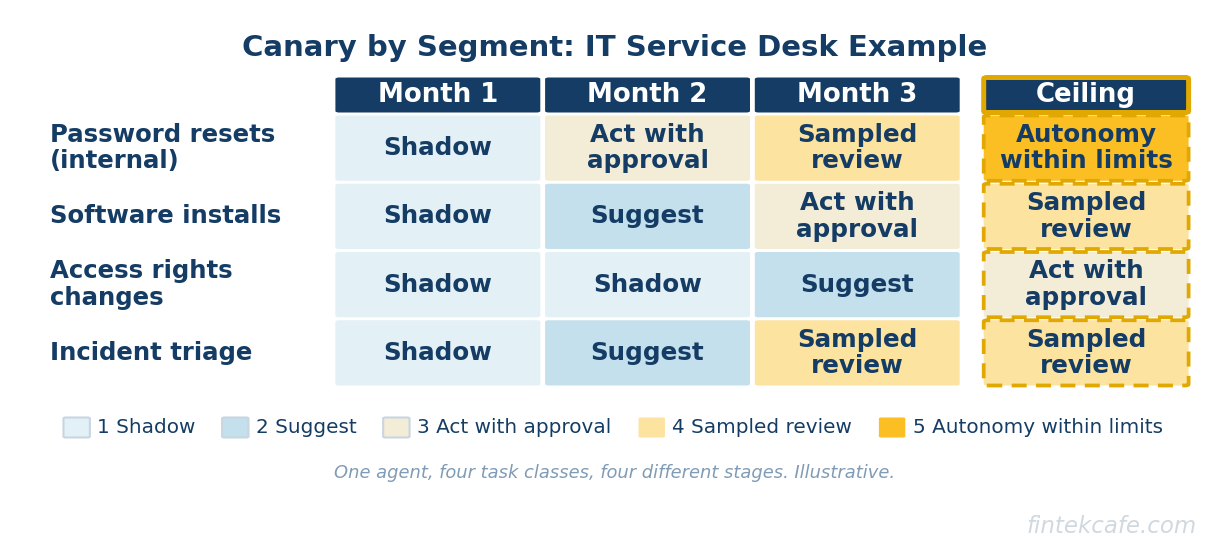
For an IT service desk agent:
| Task class | Month 1 | Month 2 | Month 3 | Ceiling |
|---|---|---|---|---|
| Password resets, internal staff | Shadow | Act with approval | Sampled review | Autonomy within limits |
| Software install requests | Shadow | Suggest | Act with approval | Sampled review |
| Access rights changes | Shadow | Shadow | Suggest | Act with approval |
| Incident triage and routing | Shadow | Suggest | Sampled review | Sampled review |
The same pattern fits an HR assistant (benefits questions before leave decisions) or a procurement agent (invoice matching before supplier onboarding).
Rollback Triggers and the Kill Switch
A rollback trigger is a condition, agreed in advance, that moves a segment down one stage automatically, without a meeting. Good triggers are checked in code:
- Quality triggers: sampled error rate above threshold; override rate spike; reversal rate above baseline.
- Behaviour triggers: tool error rate spike; actions per task above the usual range; cost per task above a cap.
- Policy triggers: any attempt at a blocked action, any limit breach, any action on a protected record.
- Change triggers: a new model, a prompt change or a new tool demotes the affected task class until the evidence is rebuilt, as the LLM release management guide sets out.
Rollback moves the agent back a stage; it does not undo what the agent did. Every write action in stages 3 to 5 needs a defined compensating action, as the agent error handling guide sets out.
The kill switch stops all of the agent's actions in seconds. It must sit outside the agent, in the platform or identity layer, never in the prompt, and it must be tested: a kill switch never pulled is an assumption. Vendors now ship this control. ServiceNow's AI Control Tower, shown at Knowledge 2026 on May 5, can pause, redirect or stop an agent in one action, and its release notes describe deactivating agents running on AWS Bedrock, Bedrock AgentCore and Google's platform as well as ServiceNow's own. Microsoft Agent 365, generally available since May 1, 2026, gives administrators a central registry of agents; blocking unmanaged and local agents from it was still in preview as of November 2026.
Widening Permissions Stage by Stage
Permissions track the stage, not the roadmap: the agent holds only the credentials the current stage requires, and credentials change only at a gate.
| Stage | Identity and permissions |
|---|---|
| Shadow | Read-only service identity; no write scopes issued |
| Suggest | Read plus write to a drafts area that a human must release |
| Act with approval | Scoped write, released per action by an approval token |
| Sampled review | Scoped write with limits enforced by a policy layer |
| Autonomy within limits | Wider limits, same policy layer, short-lived credentials |
Enforce limits in a policy layer the agent cannot talk its way past. Amazon Bedrock AgentCore Policy, generally available since March 3, 2026, checks every agent request through its gateway against rules written in the Cedar policy language before tool access is allowed. Claude Code shows the same graduated idea in a shipping product: a read-only plan mode, a default mode that asks before edits and commands, a mode that auto-accepts file edits, an auto mode in which a classifier checks actions, and a mode that skips prompts which the documentation reserves for isolated environments. The broader identity design for agents is in the agent identity and access guide.
Platform Support for Staged Rollout
No platform ships the five-stage model; they ship the mechanisms that enforce it. Status as of November 2026:
| Mechanism | Example features | Status |
|---|---|---|
| Pre-production testing | Salesforce Agentforce Testing Center | Multi-turn tests added in a May 2026 release |
| Online evaluation on sampled live traffic | AWS AgentCore Evaluations; Microsoft Foundry evaluations and monitoring; Copilot Studio Agent Evaluation | GA March 31, March 16 and March 31, 2026 |
| Traffic split between agent versions | Google Agent Runtime revisions (Gemini Enterprise Agent Platform) | Pre-GA |
| Guarded rollout with automatic rollback | LaunchDarkly AgentControl (formerly AI Configs) | Guarded rollouts since July 2025; renamed May 19, 2026 |
| Tool-call policy | AWS AgentCore Policy | GA March 3, 2026 |
| Kill switch and deactivation | ServiceNow AI Control Tower; Microsoft Agent 365 | Control Tower shipping; Agent 365 registry GA May 1, 2026, blocking in preview |
| Tracing | AgentCore Observability; Agentforce Observability | GA October 13, 2025; announced November 20, 2025 |
Tracing underpins every gate; what to capture is in the agent observability guide.
Reporting Readiness to the Executive Who Signs Off
Each promotion needs a one-page readiness report signed by the agent's business owner:
- Current stage, by task class and segment, and the proposed change.
- Evidence: reviewed cases, error rate with its upper confidence bound, and the cost of errors observed.
- Incidents at the current stage and what changed after each.
- What widens: permissions, limits, volume and segments.
- Rollback triggers for the new stage, and who can pull them.
- Kill switch: where it sits and the date it was last tested.
- Regulatory position. The EU AI Act requires human oversight of high-risk systems. The Digital Omnibus on AI, Regulation (EU) 2026/1744, in force since July 27, 2026, moved the high-risk obligations to December 2, 2027 for stand-alone Annex III systems and August 2, 2028 for systems in regulated products. Agents used in hiring, credit or essential services should be designed to that standard now.
The executive should ask five questions: what is the error rate and how certain is that figure; what does one error cost; what can the agent touch at the next stage that it cannot touch now; what makes it roll back without anyone deciding; and when was the kill switch last pulled.
A Decision Framework: Where Each Agent Should Stop
Not every agent should reach stage 5. The ceiling depends on how reversible the action is and how fast evidence accumulates.
| High volume (evidence accrues in weeks) | Low volume (evidence takes months) | |
|---|---|---|
| Reversible, low cost per error | Ceiling: autonomy within limits | Ceiling: sampled review |
| Reversible with effort | Ceiling: sampled review | Ceiling: act with approval |
| Irreversible or regulated | Ceiling: act with approval | Ceiling: suggest |
The position, with its tradeoff: most enterprise agents should live at stage 4 indefinitely. Sampled review costs reviewer time, but it is the only stage that keeps measuring the error rate after launch, while models, prompts and tools keep changing. Stage 5 saves that cost only where errors are cheap, reversible and numerous enough for the audit sample to catch.
Key Takeaways
- Agent failures in production are usually rollout failures: all users at once, end-state permissions on day one, no live comparison and no rollback plan.
- Use five stages: shadow, suggest, act with approval, act with sampled review, autonomy within limits, granted per task class and per segment.
- Promote on arithmetic, not deadlines: zero errors in about 300 reviewed cases supports an error rate below 1 percent at 95 percent confidence.
- Canary by segment: internal users, lowest-risk task class, one region, lower-value tier, then wider segments one at a time.
- Rollback triggers fire in code, and the kill switch sits outside the agent and is tested.
- Permissions widen only at stage gates, enforced by a policy layer, not the prompt.
- Most agents should stop at sampled review; full autonomy is for high-volume, reversible, low-cost work.
Frequently Asked Questions
What is shadow mode for an AI agent?
Shadow mode runs an agent on real, live cases while a human does the actual work. The agent's proposed decision is logged next to the human's, and disagreements are adjudicated to find who was right. It measures the agent's error rate on the true workload before it can affect anything.
How long should an agent stay in shadow mode?
Until it has enough adjudicated cases to support the error rate the business needs, not for a fixed period. With zero errors, about 300 reviewed cases support an error rate below 1 percent at 95 percent confidence, and about 3,000 support 0.1 percent. Volume determines the calendar time.
What is the difference between rollback and a kill switch?
Rollback moves an agent, or one segment of its work, down a stage when a trigger fires, for example from sampled review back to act with approval. A kill switch stops all of the agent's actions immediately. Neither undoes actions already taken; that needs compensating actions designed in advance.
Should every AI agent eventually reach full autonomy?
No. Agents whose actions are irreversible, regulated or low in volume should usually stop at approval or sampled review, because errors are too costly or evidence accumulates too slowly to justify removing review. Full autonomy within limits suits high-volume, reversible, low-cost work.
Related Articles
AI in Field Service and Maintenance: What Predictive and Agentic Tools Can Decide, and What Technicians Keep
AI in field service and maintenance for executives: which decisions agents can take alone, which they propose, and which stay with technicians.
The AI Depreciation Question: How Long the Chips Really Last, and Who Pays When the Answer Changes
Hyperscalers depreciate AI servers over five to six years while chips turn over yearly. Why that estimate sets your cloud prices and supplier risk.
AI in Financial Reporting: What Controllers Can Automate in Filings and Disclosures, and What Auditors Will Ask
AI in financial reporting for controllers: what to automate in filings and disclosures, what needs review, and the questions auditors will ask about AI.