
Accounts Payable Automation: What AI Can Actually Take Over in Invoice-to-Pay
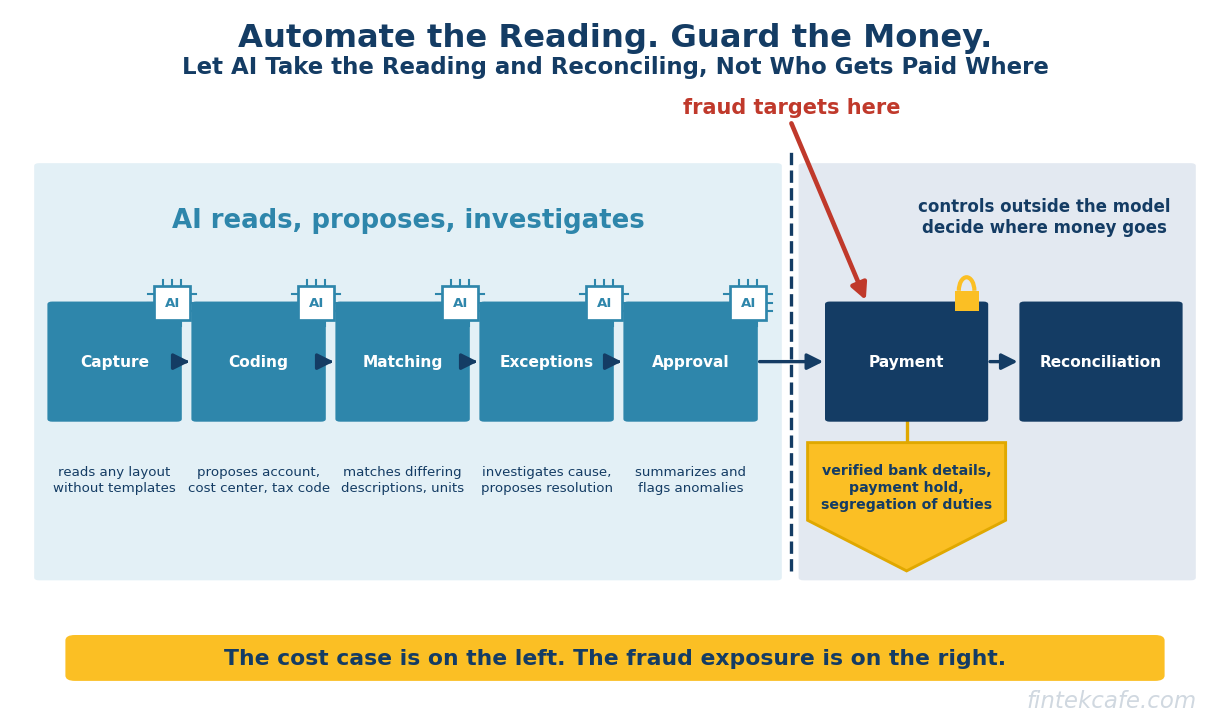
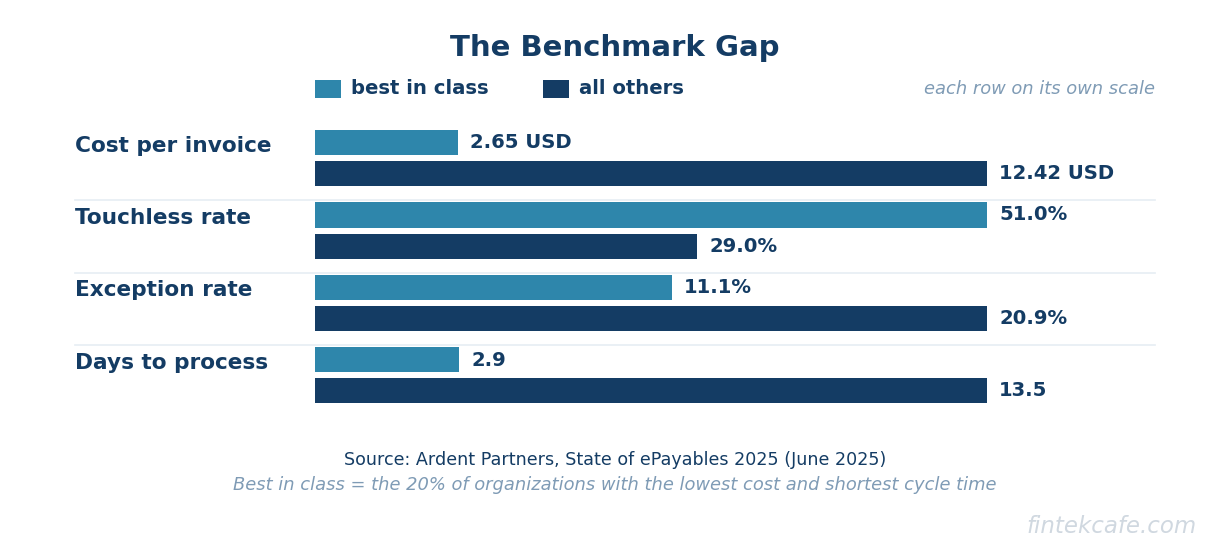
Accounts payable automation is the use of software to move a supplier invoice from receipt to payment with as few human touches as possible. AI changes how far that can go, but not where the risk sits. The prize is large: Ardent Partners' State of ePayables 2025 report (June 2025, 204 respondents) puts the fully loaded cost of processing one invoice at 12.42 dollars for most organizations and 2.65 dollars for the best-performing fifth, with straight-through (touchless) rates of 29.0 percent against 51.0 percent. AI can close much of that gap, because the hard part of accounts payable is reading messy documents and resolving exceptions, which is where language models are strong. The position here is that executives should let AI take over most of the reading and reconciling in invoice-to-pay, and none of the decisions about who gets paid where. The cost case lives in the first half of the cycle. The fraud exposure lives in the second half, and it grows as automation removes the people who used to notice that something looked wrong.
Key Takeaways
- Accounts payable is one of the clearest AI use cases in any company, in any industry: the inputs are documents, the rules are written down and every error has a countable cost.
- Classic automation already handled clean, purchase-order-backed invoices. AI adds reading the unstructured remainder, proposing coding, and investigating exceptions.
- The exception queue is the real cost center. In Ardent Partners' 2025 survey, slow approvals (49 percent) and a high share of exceptions (48 percent) were the top two challenges, yet only 4 percent of teams fully automate exception management.
- Automation raises the fraud stakes. Vendor impersonation and bank-detail change fraud target exactly the steps that get faster, and AI makes forgeries cheaper.
- The decisive controls stay outside the model: independent verification of bank-detail changes, segregation of duties, and holds on payments to newly changed accounts.
- Measure touchless rate, exception rate, cost per invoice, cycle time and fraud caught together. A rising touchless rate with no fraud metric beside it is a warning sign.
Why Accounts Payable Is the Clearest AI Use Case in the Enterprise
Every organization pays suppliers. A hospital, a software company, a manufacturer and a city government all run the same cycle: an invoice arrives, someone checks it against what was ordered and received, someone approves it, and money leaves. Three properties make it unusually well suited to AI.
The inputs are documents. Invoices arrive as PDFs, scans, email bodies and structured electronic files. Turning them into reliable data is a reading problem, and modern document AI reads far better than the template-based optical character recognition before it, as covered in when LLM extraction beats OCR templates.
The rules are written down. Payment terms, approval limits, matching tolerances and coding policies already exist. A model does not need to invent judgment; it needs to apply rules the organization has already agreed.
The errors are expensive and measurable. A duplicate payment, a missed discount or a payment to a fraudster each has a number attached, so the before and after can be counted.
Adoption is earlier than vendor marketing suggests, and moving fast: in Ardent Partners' 2025 survey, 44 percent of accounts payable teams were using AI in any capacity, and more than 75 percent expected to be within 12 months. The question for executives is no longer whether. It is which steps to hand over, which to keep, and how to tell whether it is working.
The Invoice-to-Pay Cycle, Step by Step
Classic automation (rules engines, templates, workflow) already covered parts of each of the seven steps. The table shows what AI adds and what risk remains.
| Step | What classic automation already did | What AI adds | Residual risk |
|---|---|---|---|
| Capture | Template OCR for known layouts | Reads any layout without templates | Plausible misreads; forgeries read faithfully |
| Coding | Default codes per vendor | Proposes account, cost center and tax code from line text and history | Wrong coding that distorts reporting |
| Matching | Exact match within fixed tolerances | Matches lines with different descriptions, units or partial deliveries | Over-eager match clears a real discrepancy |
| Exception handling | Routes to a queue | Investigates cause, drafts supplier query, proposes resolution | Confident wrong resolution at volume |
| Approval | Routes by amount and cost center | Summarizes and flags anomalies | Rubber-stamping a fluent summary |
| Payment | Scheduled runs by terms | Optimizes timing for discounts and cash | Payment to an altered, fraudulent account |
| Reconciliation | Matches bank lines by reference | Resolves partial and bundled payments; explains breaks | Small breaks written off unreviewed |
Capture
Capture is where AI has already won. Template OCR breaks every time a supplier changes its layout; language-model extraction reads by meaning rather than position. Ardent Partners' data shows how much of the field still runs the older way: only 60 percent of accounts payable departments had automated data capture and extraction in use at all.
Structured electronic invoicing is shrinking the capture problem at the source in some regions. Germany has required businesses to be able to receive structured e-invoices for domestic business-to-business transactions since January 2025, and the EU's VAT in the Digital Age package, adopted on 11 March 2025, makes e-invoicing mandatory for intra-EU business-to-business transactions from July 2030. Where invoices arrive as data, AI's value shifts downstream.
Coding and matching
Coding is where AI saves the most skilled time. Proposing an account and cost center from a free-text line such as "quarterly maintenance, Building C HVAC" used to need a clerk who knew the chart of accounts. A model with the organization's coding history can propose it with a confidence score.
Matching is where AI needs the most restraint. Classic three-way matching compares invoice, purchase order (PO) and goods receipt within a fixed tolerance. AI can match lines whose descriptions differ ("10 boxes of 12" against "120 units"), which genuinely reduces false exceptions. It can also talk itself into matching lines that should not match. The safe pattern: AI proposes the match, and finance-set tolerance rules decide whether it clears.
Approval, payment and reconciliation
At approval, AI is most useful as a summarizer and anomaly flagger: "this invoice is 40 percent above the last six from this supplier" helps an approver more than the PDF does. The risk is that a fluent summary makes the approver less careful, not more.
Payment is where AI should have the least autonomy. It can recommend timing, such as paying early to capture a discount. It should never decide where the money goes.
Reconciliation closes the loop, matching what left the bank to what the ledger says was paid, as covered in why payments arrive as one number and a thousand questions.
The Exception Queue Is the Real Cost Center
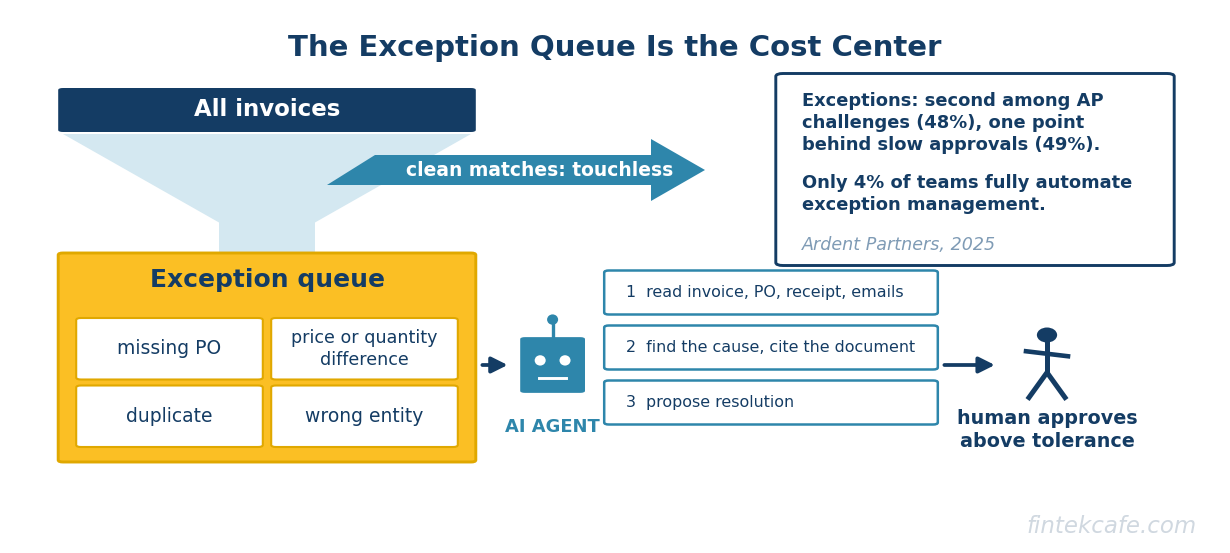
Most accounts payable cost comes not from clean invoices but from the ones that do not match: missing purchase order numbers, quantity differences, unagreed price changes, goods not yet received, duplicates, and invoices addressed to the wrong legal entity.
Ardent Partners' State of ePayables 2025, a June 2025 survey of 204 accounts payable professionals, is clear on this:
- Exceptions ranked second among challenges, cited by 48 percent, one point behind approvals that take too long (49 percent). Slow approvals and exceptions are often the same problem: an invoice stuck with an approver who has to work out why it does not match.
- The average exception rate was 18.4 percent, with the best performers at 11.1 percent against 20.9 percent for everyone else.
- Only 4 percent of teams had exception management fully automated, the lowest of any accounts payable activity the survey measured.
- Staff spent 21.9 percent of their time managing supplier inquiries. The survey does not say what those inquiries concern; it is an inference, not a finding, that many are payment-status questions.
This is where AI changes the economics most. Classic automation could route an exception to a queue but not investigate it. An AI agent can read the invoice, purchase order, receipt and supplier emails, notice that the price difference matches last month's contract amendment, and propose clearing it with a note citing the amendment. A person still approves, but the investigation, which was most of the work, is done.
That is also where AI's characteristic failure lives: a confident, well-written, wrong explanation. The remedies are set out in the controls that actually reduce AI hallucination. For accounts payable, every proposed resolution should cite the document that justifies it, and the citation should be checked mechanically before the resolution clears.
Automation Raises the Fraud Stakes
Every step that gets faster and less touched by people is a step where fewer people notice that something looks wrong. Accounts payable fraud is not new, but automation and AI change both sides of it.
The scale is well documented. The FBI's 2025 Internet Crime Report recorded 24,768 business email compromise complaints with reported losses of about 3.05 billion dollars, second only to investment fraud. The 2026 AFP Payments Fraud and Control Survey (April 2026, 465 respondents, sponsored by Truist) found 76 percent of organizations experienced attempted or actual payments fraud in 2025 and 74 percent were affected by business email compromise. The ACFE's 2024 Report to the Nations found billing schemes, in which an insider causes the organization to pay a false invoice, in 22 percent of the occupational fraud cases it studied, with a median loss of 100,000 dollars.
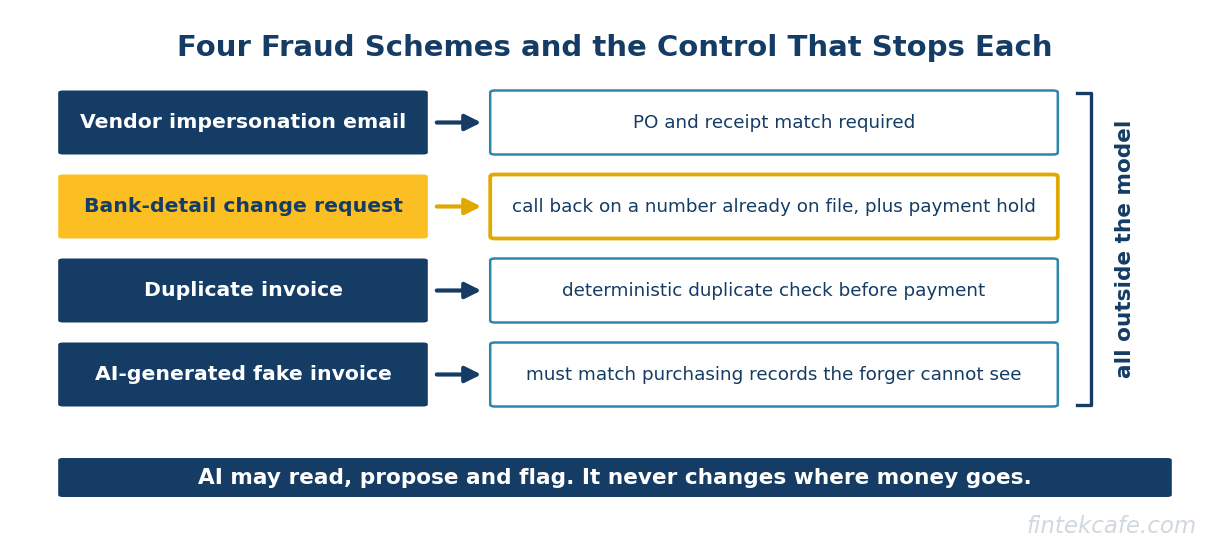
Four schemes matter most.
Vendor impersonation
A fraudster poses as a real supplier, usually from a compromised or lookalike email domain, and asks for payment of a realistic invoice. AI makes the emails better: correct tone, correct references, no spelling errors. The FBI's report records more than 30 million dollars of 2025 business email compromise losses involving AI, a figure likely undercounted because victims rarely know how a convincing email was written.
Bank-detail change fraud
The most damaging variant. The fraudster sends no fake invoice, only a request to update a real supplier's bank account. Every legitimate invoice from that supplier is then paid to the fraudster until the real supplier asks where its money is. Automation is most exposed here, because a well-run automated process will pay the next ten invoices on time, to the wrong account, without anyone looking.
Duplicate invoices
The same invoice submitted twice, by mistake or deliberately, with a changed number, date or format. AI helps here by catching near-duplicates that exact-match rules miss, one of the few fraud types where adding AI reduces risk without new exposure.
AI-generated fake invoices
Generation tools can now produce a convincing invoice on a real supplier's letterhead in seconds. Better visual inspection is not the defense: a perfect forgery read by perfect extraction produces perfect data about a payment that should never happen. The defense is that the invoice must match a purchase order, a receipt and a known vendor record, none of which the forger controls.
The Controls That Must Stay Outside the Model
The principle is non-negotiable: AI may read, propose and flag. It must not be the control that decides whether a vendor's payment details are genuine. A model can be fooled by the same email that fools a clerk, and manipulated by text embedded in a document it reads. Controls that depend on the model's judgment fail exactly when the attacker is good.
| Control | What it stops | Why it must sit outside the model |
|---|---|---|
| Independent verification of bank-detail changes | Bank-detail change fraud | Uses a contact already on file, never one in the request |
| Payment hold on newly changed accounts | Losses from a change that slipped through | A delay lets the real supplier notice; it cannot be argued with |
| Segregation of duties | Insider billing schemes, single-point compromise | Whoever changes vendor data cannot release payments |
| Vendor master data locked from the AI | Injected or hallucinated changes to where money goes | AI gets no write access to bank details |
| PO and receipt match required above a threshold | Fake and inflated invoices | A forger can fake a document, not purchasing records |
| Bank account ownership validation services | Payments to accounts the payee does not own | Checks bank data, not the invoice |
| Dual approval on high-value or first payments | Large single losses | Two people, two channels, before money leaves |
Two of these deserve emphasis. The FBI's long-standing guidance on business email compromise is to verify any change in account number or payment procedure using contact details obtained independently, not the ones in the message. And in the United States, Nacha's risk management rules, which took effect in two phases in March and June 2026, require non-consumer originators, which from the June 2026 phase includes ordinary businesses paying suppliers, to have risk-based processes to identify payments that are unauthorized or authorized under false pretenses. A business paying suppliers by ACH now has a formal reason, not just a prudent one, to document how it verifies bank-detail changes.
Payment method matters too. Paying by single-use virtual card, where the supplier accepts it, removes the bank-account-change attack for those payments, because there is no account number to redirect, as covered in how single-use virtual card numbers fix corporate spend.
How to Measure It Honestly
Vendors will quote touchless rate. On its own it rewards the wrong thing: the easiest way to raise it is to loosen tolerances and approve more without looking. Track five measures together, against named benchmarks.
| Metric | What it tells you | Benchmark (Ardent Partners, State of ePayables 2025) |
|---|---|---|
| Touchless rate | Invoices processed straight through with no human touch | 35.4% average; 51.0% best in class; 29.0% all others |
| Exception rate | Invoices failing matching or validation | 18.4% average; 11.1% best in class; 20.9% all others |
| Cost per invoice | Fully loaded staff, technology and overhead cost | 9.84 dollars average; 2.65 dollars best in class; 12.42 dollars all others |
| Cycle time | Days to process one invoice | 8.2 average; 2.9 best in class; 13.5 all others |
| Fraud caught | Attempts stopped, and losses after | No reliable public benchmark; track the trend |
Ardent Partners defines best in class as the 20 percent of organizations with the lowest processing costs and shortest cycle times, so part of the gap is definitional. Benchmarks also vary by source and method; treat them as an order of magnitude, not a target to the decimal.
Two further measures matter once AI is in the loop. AI proposal acceptance rate, by step: if people accept 99 percent of proposed codings unchanged, either the model is excellent or nobody is reading, and only a sample audit says which. Days payable outstanding: faster processing should give treasury more control over when to pay, not make everything pay sooner.
The most important honesty rule: report fraud caught beside touchless rate on the same dashboard. A program that raises touchless processing with no fraud measure has optimized for speed and stopped checking whether the speed is safe.
Build Versus Buy
For almost every organization the answer is to buy the core and build at the edges.
Buy the accounts payable platform. Mid-size and large organizations have a mature market of accounts payable suites and ERP modules, nearly all now including AI capture, coding suggestions and exception assistance. Building capture, matching, workflow and payment execution from scratch reproduces years of edge cases, such as tax handling and multi-entity rules, that vendors have already absorbed.
Build where the exceptions are unusual. High-volume organizations with industry-specific complexity, such as construction with progress billing, healthcare with contract pricing, or energy with joint-venture cost allocation, often find vendor exception handling generic. That is where a custom AI agent on top of the platform's data earns its cost, the same pattern described in agentic receivables.
Never build the payment controls into the AI layer. Bank-detail verification, segregation of duties and payment release must live in the ERP or payment platform, with the AI given read access, not write access.
When evaluating vendors, ask for touchless and exception rates on customers with similar volume and purchase order coverage, not their best reference. Ask whether vendor master data is ever writable by the AI, and ask for the false-match rate, not only the match rate.
A Decision Framework by Volume and Complexity
The right level of AI autonomy depends on invoice volume and complexity, meaning how many invoices lack purchase orders, run to many lines or carry industry-specific terms.
| Profile | Typical situation | Where AI should start | What stays human |
|---|---|---|---|
| Low volume, low complexity | A few thousand invoices a year, recurring suppliers | AI capture, coding and duplicate detection in accounting software | All approvals; all vendor changes; payment release |
| Low volume, high complexity | Project-based work, few purchase orders | AI capture plus approver summaries | Coding review on one-off spend; vendor changes; payment release |
| High volume, low complexity | Tens of thousands of PO-backed invoices | AI capture, coding and matching within set tolerances; touchless clean matches | Exceptions above threshold; vendor changes; first payments to new accounts |
| High volume, high complexity | Multi-entity, regulated or project industries | AI exception investigation with cited resolutions | Resolutions above tolerance; vendor changes; payment release |
The position, and its tradeoff
The recommendation is to let AI take over capture, coding, matching proposals and exception investigation as fast as accuracy allows, and to give it no authority over vendor master data or payment release. The tradeoff is real: keeping a human on bank-detail changes and first payments caps the touchless rate below what vendors will promise. That ceiling is the price of not paying a fraudster ten invoices in a row. An organization that removes the last human check to reach a higher touchless number has not finished automating; it has removed the control its attackers are counting on.
Frequently Asked Questions
What is a good touchless invoice processing rate?
Ardent Partners' State of ePayables 2025 puts the average straight-through rate at 35.4 percent, best in class at 51.0 percent and all others at 29.0 percent. A good rate depends on purchase order coverage and supplier mix, and it should always be tracked alongside exception rate and fraud caught.
How much does it cost to process an invoice?
Ardent Partners' State of ePayables 2025 reported an average fully loaded cost of 9.84 dollars per invoice, with best in class at 2.65 dollars and all others at 12.42 dollars. Other research firms count different cost elements, so treat these as a range rather than a precise target.
Does accounts payable automation increase fraud risk?
It can. Automation removes people who used to notice unusual requests, and AI makes fake invoices and impersonation emails cheaper. The risk is manageable if bank-detail changes are verified through independently obtained contacts, changed accounts are subject to payment holds, and no single person or system can both change vendor data and release payments.
Should a mid-size company build or buy AI accounts payable software?
Buy. Mature platforms and ERP modules already include AI capture, coding and exception support. Custom AI work is worth considering only for unusual, high-volume, industry-specific exceptions, and payment controls should stay in the ERP or payment platform either way.
The Bottom Line
Accounts payable is the rare AI use case where the value is concrete, the data already exists and the result can be measured to the cent. The gains come mostly from the parts of the job people least enjoy: reading inconsistent documents, coding them, and chasing down why an invoice does not match.
The mistake is to treat the whole cycle as one thing to automate. The first half, from capture to exception resolution, is a reading and reasoning problem that AI handles well. The second half, deciding who is paid and where, is a trust problem, and attackers are investing in AI as fast as finance teams are. The organizations that get this right automate the reading aggressively, keep the money decisions behind controls no model can be talked out of, and measure fraud caught as seriously as touchless rate.
Related Articles
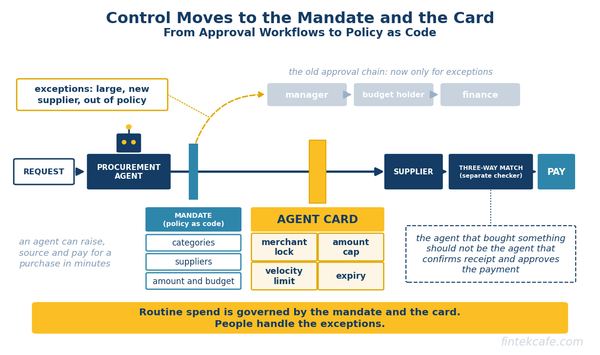
Procurement Is Where Agents Will Spend the Company's Money First
The first agents trusted with company money will buy for the enterprise. Control moves from approval chains to policy as code and card-level limits.
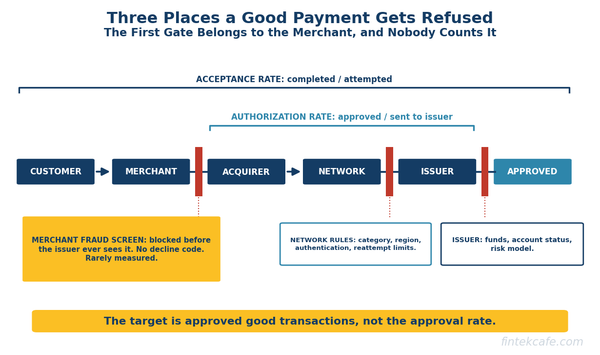
Why Card Payments Get Declined, and How Merchants Raise Their Approval Rate
Why card payments get declined, soft vs hard declines, and the levers that raise authorization rates without letting fraud and chargebacks rise with them.
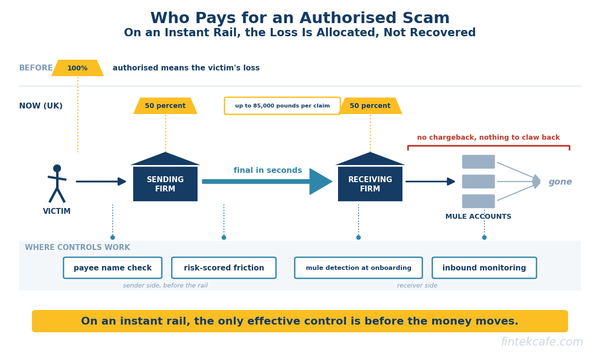
Scam Reimbursement Is Becoming a Cost of Running Instant Payments
Mandatory APP scam reimbursement turns fraud into a line in instant-payment unit economics, and the receiving firm now pays half. What it costs, and who.