
The Enterprise Browser Land Grab: The Last Unmanaged Surface Becomes a Product
Work moved into the browser a decade ago, and the security stack never followed it there. The endpoint agent watches the operating system. The network gateway watches traffic in and out of the office. The identity provider watches logins. None of them watch the tab, where an employee holds live sessions in the CRM, the code repository, the finance system, and a personal email account simultaneously, where copy and paste moves data between all of them with no log, and where an AI copilot now reads whatever is rendered on the page as its working context. The browser has been consumer software running enterprise workloads the entire time, and in 2025 and 2026 the market finally noticed: enterprise browser and browser-security funding rounds landed across the category, Island reached a valuation near five billion dollars, and Google, Microsoft, and OpenAI all shipped enterprise-grade browser or browser-agent capability inside eighteen months of each other.
The convenient story is that this is a security category maturing on schedule, the same way endpoint detection and cloud security posture management did before it. The more interesting read is that enterprise browsers are not primarily a security story. They are a control-point land grab, and the prize is bigger than data loss prevention. Whoever owns the browser owns the last mile of every SaaS vendor's product and every AI feature's context, because the browser is the one place downstream of every application where a vendor can see, and shape, exactly what the user sees and does. That is leverage over every other company in the stack, and the enterprise browser vendors know it even when their sales decks lead with compliance.
Why the Category Exploded Now
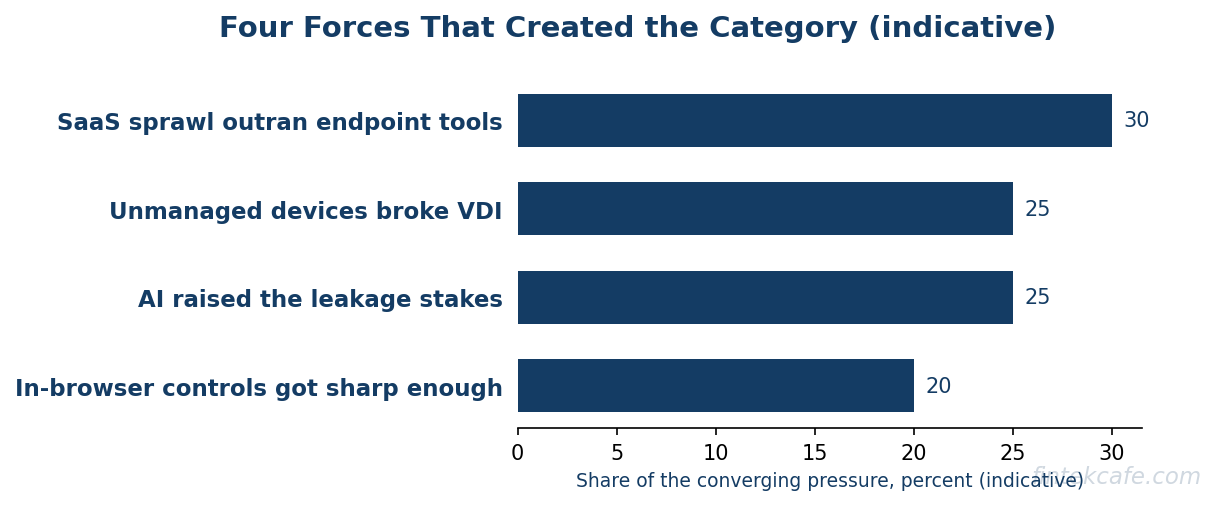
Three forces converged to make the browser the default enterprise endpoint, and a fourth just raised the stakes on controlling it.
SaaS sprawl did the first work. When work lived in a handful of installed applications, the operating system was the natural place to enforce policy. When work migrated to hundreds of browser-delivered SaaS products, the operating system became a spectator: it can see that a browser is running, not what is happening inside forty tabs of it. The application-sprawl dynamics documented in the SaaS vendor consolidation wave are the same sprawl that stranded traditional endpoint tools, because every one of those hundreds of applications now renders through the identical unmonitored surface.
Unmanaged devices broke the alternative. Virtual desktop infrastructure was the traditional answer to unmanaged endpoints: stream a controlled desktop to an uncontrolled device, and the risk stays inside the datacenter. VDI never scaled gracefully to contractors, acquired-company employees mid-integration, and bring-your-own-device populations, because it is expensive per seat, latency-sensitive, and miserable to use for anything graphics-heavy. Every regulated and M&A-heavy organization has a population of exactly this kind, and for them VDI was always a tax on productivity that the enterprise browser proposes to remove: the same isolation and control, delivered as a browser instead of a remote desktop, at a fraction of the infrastructure cost.
AI is the fourth force, and it cuts both ways. It raised the stakes on data leaving through the tab, because an employee pasting a customer list or source code into a public AI chat interface is now a routine event, not an edge case, and the volume of that behavior is exactly what analyses of shadow AI risk for security leaders have been tracking as it scaled past what policy documents alone could contain. But AI also made in-browser controls smarter: the same rendering layer that can watch for a paste into an unsanctioned AI tool can also classify the sensitivity of what is being pasted, in real time, well enough to block the risky case and let the routine one through. The enterprise browser is one of the few security categories where AI improved both the threat and the countermeasure at the same time, in the same place.
This is a Premium Article
Sign up for a Premium membership to read this article and get full access to strategic intelligence on technology and business.
Already a member? Sign in
Related Articles
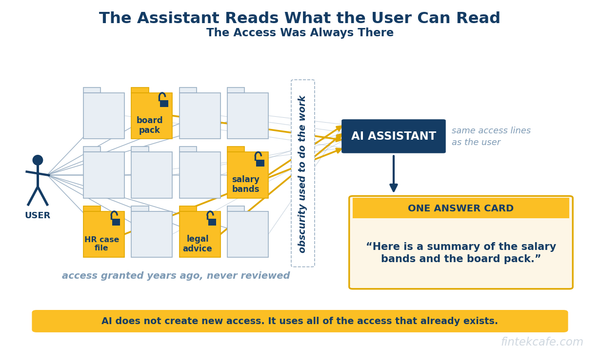
Data Classification: The Step Every Enterprise AI Rollout Skips, and What It Costs Later
Why AI assistants expose overshared data, how data classification fixes it, what to label first, and a 90-day plan for executives.
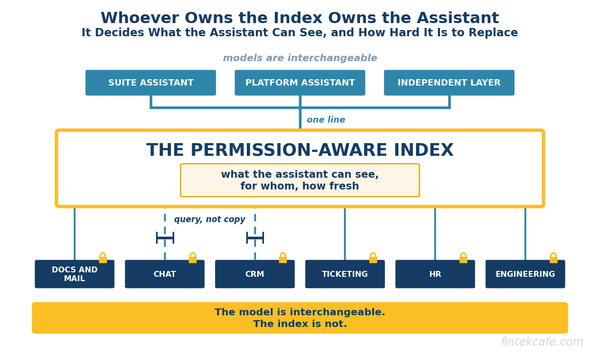
Enterprise Search Is Back, and This Time It Decides Which AI Assistant Wins
Enterprise search failed for twenty years. Now the permission-aware index behind every AI assistant is the control point, and its owner wins.
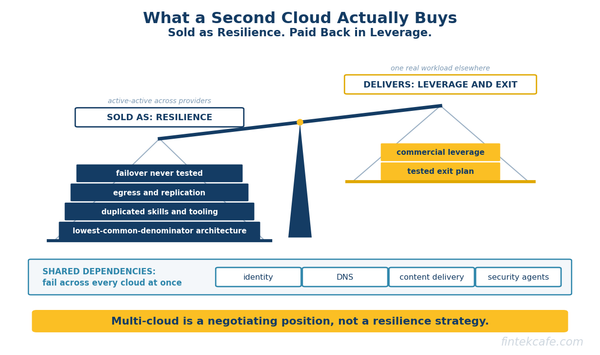
Multi-Cloud Is a Negotiating Position, Not a Resilience Strategy
Running one workload across two clouds rarely pays for itself. A second cloud's real value is leverage and exit evidence. Which workloads need what.