
What Is an AI Gateway: The Control Point Between Your Apps and Every Model
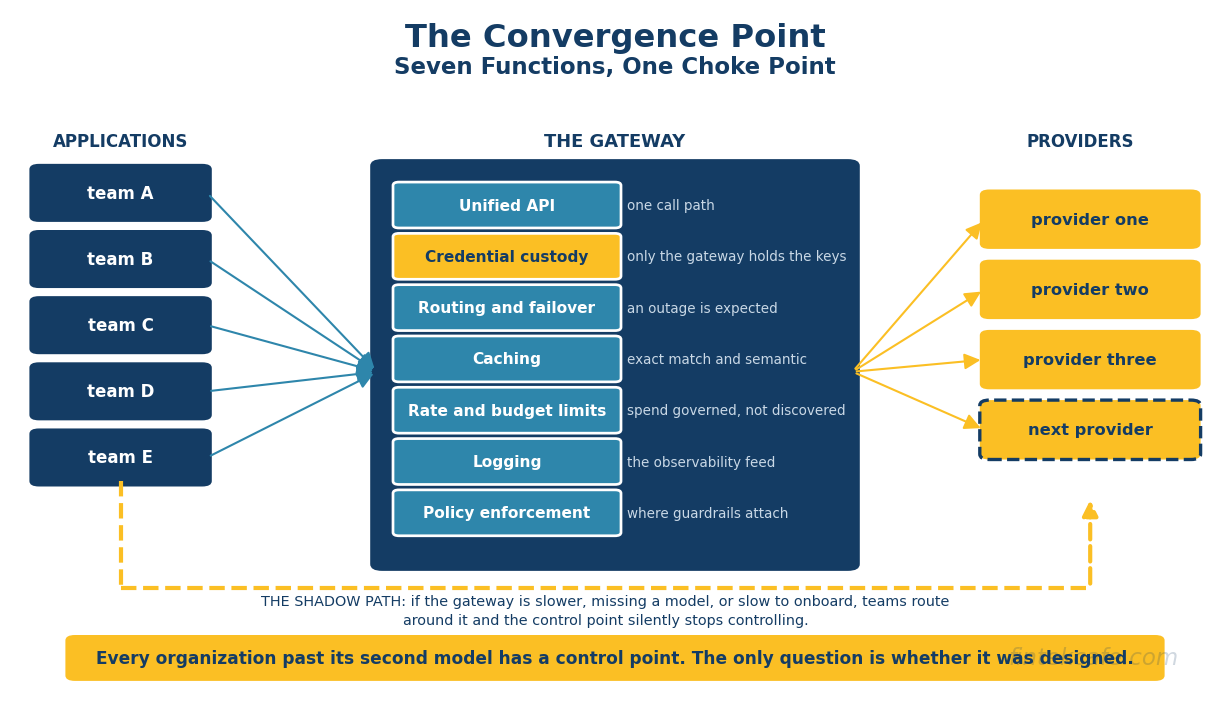
An AI gateway is a proxy that sits between an organization's applications and every model provider it uses, presenting one interface and enforcing policy, cost controls, and logging at a single point. Most enterprises build one before they name it. The sequence is predictable: one team integrates one provider directly, a second team integrates a different provider, a third needs failover when the first provider has an outage, finance asks which team is responsible for the invoice, security asks who holds the API keys, and compliance asks what was sent to a third party last quarter. Each question is answerable only at a place where all the traffic converges, and if no such place exists, someone builds a wrapper library, and that wrapper becomes a gateway with none of the properties a gateway should have. The strategic question is not whether to have this control point. Once a second model and a second team exist, an organization has one whether it planned it or not. The question is whether it is a designed component or an accident, and this guide covers what it does, how it differs from the API gateway already in place, the build and buy options, the failure modes that make gateways hated, and the order to roll one out.
Key Takeaways
- An AI gateway is not one feature but a convergence point for seven: a unified API across providers, credential custody, routing and failover, caching, rate and budget enforcement, request logging, and policy enforcement. Its value comes from all of them living at the same choke point rather than from any one in isolation.
- Credential custody is the property that most changes an organization's security posture. When app teams hold raw provider keys, those keys spread into config stores, environment variables, and notebooks, and revocation becomes a search problem. When only the gateway holds them, revocation is one action.
- An AI gateway is not an API gateway with a new label. The differences are substantive: token-based rather than request-based metering, streaming responses that break request-response assumptions, semantic caching rather than exact-match, cost per call varying by orders of magnitude, and failover across providers with incompatible interfaces rather than across identical backends.
- The failure mode that kills gateway programs is not downtime, it is the shadow path. If the gateway is slower, harder to onboard to, or missing a model a team needs, that team calls the provider directly, and the control point silently stops being one. Adoption is a product problem, not a mandate problem.
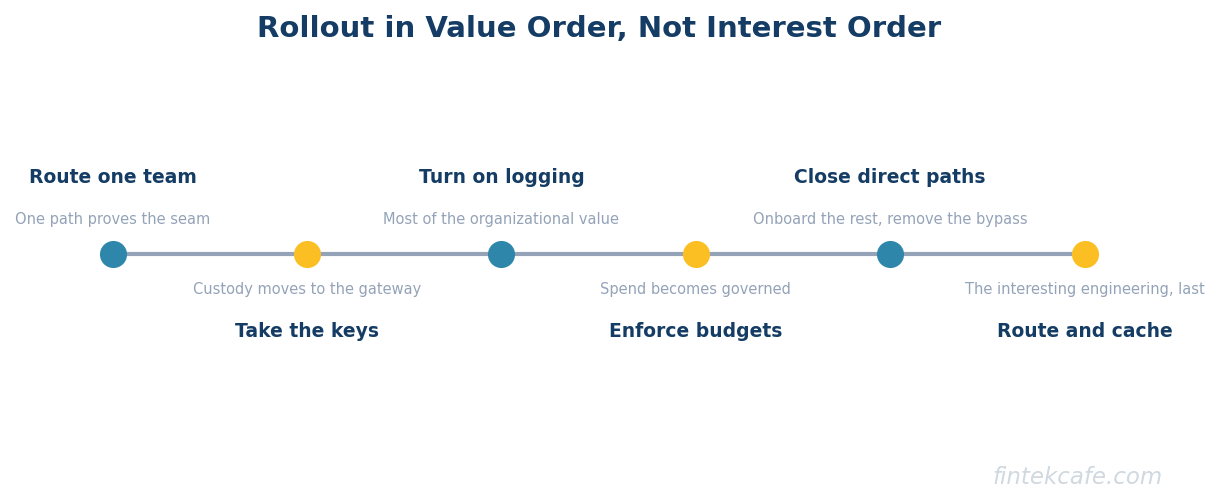
- Roll out by value order, not by completeness: credential custody and logging first, since they deliver security and cost visibility immediately with almost no risk, then budget enforcement, then routing and caching. Building the sophisticated routing layer first is the common inversion and it delays the benefits that actually justify the project.
What an AI Gateway Actually Does
Seven functions converge. Each could theoretically live elsewhere, and the argument for the gateway is that scattering them means implementing each one repeatedly and inconsistently.
Unified API across providers. One request format that the gateway translates to each provider's native interface. This is the visible feature and the least important one strategically, though it is what makes every other function possible, because a single call path is a prerequisite for a single control point.
Credential custody. The gateway holds provider keys; applications hold a credential to the gateway. This inverts the security posture. Raw provider keys stop circulating through application configuration, a compromised application credential grants access only to what the gateway permits it, and rotating a provider key is one operation rather than a hunt across every service that embedded it.
Routing and failover. Directing traffic to a chosen model, retrying against an alternate provider when one returns errors or times out, and shifting load during degradation. Provider outages are a real operating condition rather than a hypothetical, and failover implemented once at the gateway is failover every application inherits. The related question of routing by cost and task difficulty is covered in LLM model routing in production.
Caching. Exact-match caching for repeated identical requests, and semantic caching that serves a stored response when a new request is sufficiently similar to a previous one. Semantic caching is genuinely useful and genuinely risky, since the similarity threshold determines whether a user gets a fast correct answer or a fast wrong one.
Rate and budget enforcement. Per-team, per-application, and per-environment limits on requests and spend, enforced at the proxy. This is the function that converts model spend from a monthly surprise into a governed resource, and it is the one finance leadership cares about most.
Logging. Every request and response, with attribution to team, application, and user, retained for debugging, cost allocation, and compliance. The gateway is the natural place for this because it is the only component that sees all traffic, and it is the feed that everything downstream depends on, as covered in LLM observability and monitoring.
Policy enforcement. The attach point for input and output controls: blocking sensitive data in prompts, filtering responses, and enforcing which models a given team may reach. The controls themselves are covered in AI guardrails for production systems; the gateway is where they attach so that every application inherits them rather than implementing them separately.
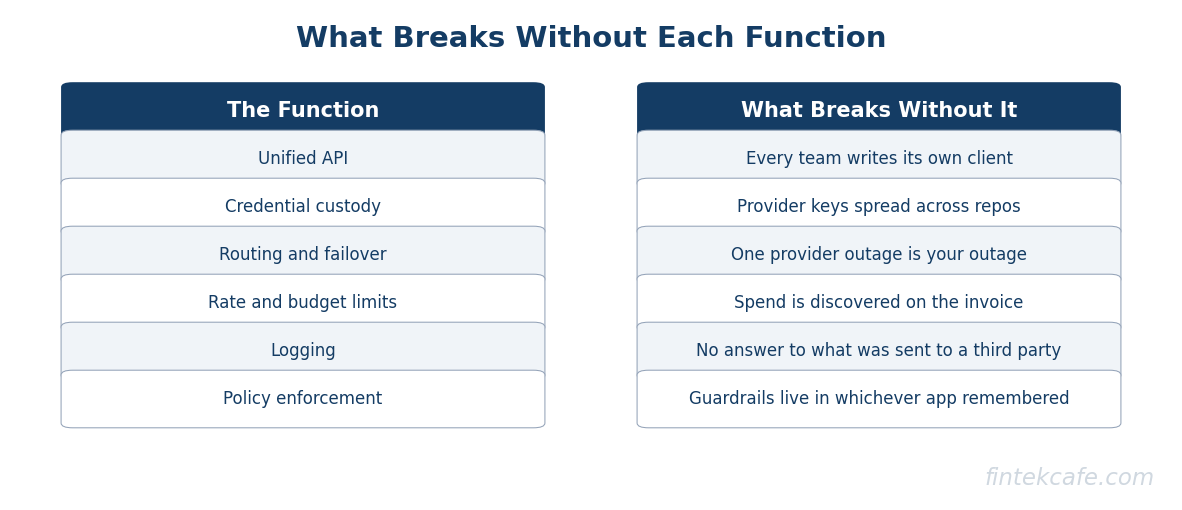
| Function | Why it lives in the gateway | What breaks without it |
|---|---|---|
| Unified API | One call path is the prerequisite for every other control | Each team writes provider-specific integration code and re-writes it on every change |
| Credential custody | Only the proxy needs raw provider keys | Keys spread through configs and repositories; rotation becomes a search problem |
| Routing and failover | Implemented once, inherited by every application | Each team builds its own retry logic, or none does and a provider outage becomes an application outage |
| Caching | Shared cache serves all applications, not one | Identical requests paid for repeatedly across teams that cannot see each other |
| Rate and budget limits | Enforcement requires seeing all traffic for a principal | Spend is discovered on the invoice; one runaway loop consumes a quarter's budget |
| Logging | Only the proxy sees every request across every provider | No cost attribution, no debugging trail, no compliance answer about what was sent where |
| Policy enforcement | One attach point applies controls uniformly | Guardrails implemented inconsistently, and unevenly bypassed |
Why It Becomes the Natural Control Point
The structural argument is arithmetic. With one team and one provider, direct integration is correct and a gateway is overhead. With five teams and three providers, direct integration means fifteen integration points, each with its own credentials, retry behavior, logging, and spend, and no place where any question about the whole can be answered.
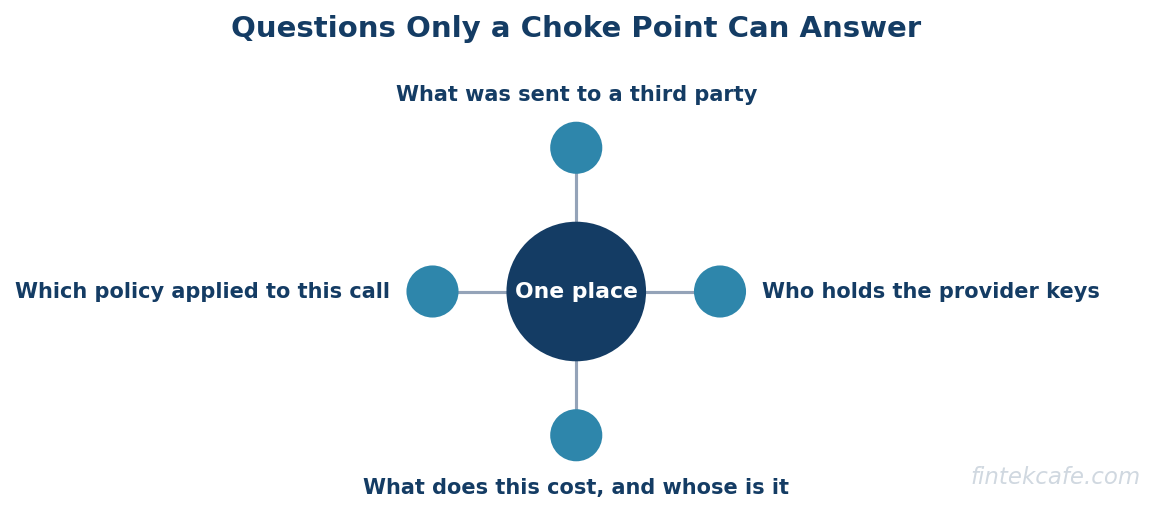
Three questions arrive on a schedule in every organization that scales AI usage, and all three require a convergence point.
Finance asks what this costs and who is responsible. Provider invoices arrive aggregated by account, not by team or feature. Without gateway-level attribution, allocation is guesswork, and the standard workaround, giving each team its own provider account, multiplies the security surface to solve an accounting problem.
Security asks who holds the keys. The honest answer in a direct-integration environment is usually that nobody knows precisely, because keys were issued during a proof of concept and propagated from there.
Compliance asks what was sent to a third party. Answerable only if something logged it. Retrofitting that logging across many independent integrations after the question is asked is dramatically harder than having had one proxy all along.
This is why the gateway ends up as a load-bearing component in most enterprise AI architectures rather than an optional convenience, a position illustrated in the enterprise AI stack reference architecture. It is the layer where the organizational questions become answerable.
AI Gateway Versus API Gateway
A reasonable objection is that enterprises already run API gateways, and that adding a second gateway is duplicated infrastructure. The functions do rhyme: both proxy traffic, hold credentials, enforce rate limits, and log. Five differences make the AI case genuinely distinct.
Metering is token-based, not request-based. A traditional rate limit counts requests, which works when requests are roughly equivalent. Model requests vary enormously in cost within the same endpoint, so meaningful limits count tokens and spend. A per-request limit permits a single request that consumes an entire budget.
Cost varies by orders of magnitude per call. Two calls to the same endpoint can differ hundredfold in cost depending on model choice and context length. Traditional gateways were not built to make routing decisions with cost as a primary input, because for ordinary APIs cost per call was effectively constant.
Responses stream. Token-by-token streaming breaks the request-response assumptions in much traditional proxy tooling: buffering behavior, timeout semantics, and any policy that needs to inspect a complete response before returning it. Output filtering on a streamed response is a genuinely harder problem than on a complete one.
Caching is semantic, not exact-match. Traditional caching keys on the exact request. Useful model caching keys on meaning, which requires embedding the request and comparing similarity, an entirely different mechanism with a correctness risk traditional caching does not have.
Failover crosses incompatible interfaces. Traditional failover routes to another instance of the same service. Model failover routes to a different provider with a different API shape, different parameters, and different output characteristics, so the gateway must translate rather than merely redirect.
The practical conclusion is that these are complementary layers rather than competitors. The AI gateway typically sits behind the API gateway, which continues handling north-south traffic, authentication, and general ingress. Some organizations satisfy the AI requirements with plugins on their existing proxy, which is a reasonable path when the existing proxy already carries the operational maturity.
Build, Buy, or Adopt
| Option | What it is | Fits when | Real cost |
|---|---|---|---|
| Open-source proxy | Self-hosted projects such as LiteLLM, or AI-specific plugins on Kong or Envoy | Broad provider coverage needed, cost sensitivity, willingness to operate it | Operating a latency-critical component in the hot path of every AI feature |
| Cloud-provider native | Model access services such as AWS Bedrock, Azure, or Google Cloud, which unify models within their own ecosystem | Already committed to one cloud, models needed are available there | Coverage limited to that provider's catalog; a second gateway appears when a model outside it is required |
| Commercial gateway | Managed vendors bundling the proxy with observability, caching, and governance | Speed matters more than control; a small platform team | Vendor dependency at the center of the architecture, plus per-request pricing at scale |
| Existing proxy plus plugins | AI capabilities added to the API gateway already in production | Strong existing gateway practice and operational maturity | AI-specific features generally trail dedicated tools; semantic caching and token metering are commonly weaker |
| Build in-house | A custom proxy service | Genuinely unusual requirements no product satisfies | Ongoing maintenance of infrastructure that is not the product, tracking every provider API change forever |
The last row is the one to be suspicious of. Building a gateway looks easy at the outset, because the first version is a thin translation layer that takes days. The maintenance is not the first version. It is tracking provider API changes indefinitely, implementing streaming correctly, handling partial failures, and building the caching and metering that provide most of the value, all for a component that is not the product and that fails loudly when it breaks.
The recommendation that fits most organizations is to adopt rather than build, and to defer the build-versus-buy question by starting with an open-source proxy in a thin configuration. It establishes the call path and the control point immediately, and migrating from one gateway to another later is far cheaper than migrating from no gateway to one, because the applications are already pointed at a single endpoint.
The Failure Modes
The shadow path. The most consequential failure. If the gateway lacks a model a team needs, adds noticeable latency, or takes two weeks to onboard, that team will call the provider directly, and the control point silently stops controlling. Every downstream benefit evaporates for that traffic, and nobody notices because the gateway's own metrics look fine. The defenses are provider-side controls that only accept traffic originating from the gateway, egress rules blocking direct provider domains, and, more importantly, making the gateway the path of least resistance. Adoption is a product problem. A gateway teams route around has failed regardless of its feature list.
Single point of failure. Concentrating all model traffic through one component means its outage is a total AI outage. This is a real cost of the architecture and the answer is ordinary infrastructure discipline: redundancy, health checks, and a documented degradation mode. A gateway that fails closed on its own policy engine takes down every AI feature over a non-critical dependency.
The latency tax. Every proxy adds a hop. On model calls measured in seconds, a well-implemented gateway's overhead is small relative to inference time, but it is not zero and it compounds with retries and policy evaluation. The number worth tracking is gateway overhead as a percentage of total request time, monitored continuously, because it is the number that drives teams toward the shadow path.
Becoming a bottleneck organizationally. When adding a model or adjusting a limit requires a ticket to a central team, the gateway becomes a queue. Self-service configuration within policy-defined bounds is what prevents the control point from turning into a gatekeeper, and this is a governance design decision rather than a technical one.
Logging that captures the wrong things. Logging metadata without prompts and responses produces a trail that supports cost allocation and nothing else. Logging everything indiscriminately creates a retention and privacy liability, since prompts routinely contain exactly the sensitive data the organization is trying to govern. The tenable position is full capture with retention limits and redaction, decided deliberately rather than defaulted into.
A Rollout Sequence
Route one team's traffic through it. Start with a thin proxy, one provider, one willing team. The goal is establishing the call path, not building capability.
Take custody of credentials. Move provider keys into the gateway and revoke the copies applications held. This delivers the largest security improvement in the program and requires none of the sophisticated features.
Turn on logging and cost attribution. Immediately answers the finance and compliance questions, and produces the usage data every later decision depends on.
Add budget and rate enforcement. With attribution in place, limits become meaningful. Start with alerting thresholds before hard caps, so the first enforcement action is not an outage.
Onboard remaining teams and close the direct paths. Only now is it reasonable to restrict direct provider access, because the gateway is demonstrably better than the alternative rather than merely mandatory.
Then add routing and caching. The sophisticated capabilities come last, once real traffic patterns are visible in the logs. Building them first means optimizing against guesses.
The ordering is deliberate. Credential custody and logging are cheap, low-risk, and deliver most of the organizational value. Routing and semantic caching are the interesting engineering and the smaller near-term payoff. Programs that invert this spend a quarter building a routing engine while provider keys are still scattered across a dozen repositories.
Frequently Asked Questions
What is an AI gateway?
A proxy between applications and model providers that presents one interface and centralizes control. It typically holds provider credentials, routes requests across models with failover, caches responses, enforces rate and budget limits, logs every request for cost attribution and compliance, and serves as the attach point for guardrail policies. The value comes from these functions sharing one choke point rather than being implemented separately by each team.
How is an AI gateway different from an API gateway?
Five substantive differences: metering counts tokens and spend rather than requests, cost per call varies by orders of magnitude at the same endpoint, responses stream token by token in ways that break traditional proxy buffering and policy assumptions, useful caching is semantic rather than exact-match, and failover crosses providers with incompatible interfaces rather than identical backends. They are complementary layers, and the AI gateway usually sits behind the API gateway.
Should an organization build or buy an AI gateway?
Adopt, in almost all cases. The first version of a custom gateway is deceptively quick, and the enduring cost is tracking provider API changes indefinitely, implementing streaming correctly, and building the caching and metering that supply most of the value, for a component that is not the product. Starting with an open-source proxy establishes the control point immediately and keeps the later build-versus-buy decision cheap.
What is the biggest risk of an AI gateway?
The shadow path. If the gateway is slower, missing a needed model, or slow to onboard, teams call providers directly and the control point quietly stops controlling, while its own metrics still look healthy. Technical enforcement helps, but the durable defense is making the gateway the easiest option. Concentration risk is the second, and it is managed with ordinary redundancy discipline.
When does an organization need one?
At the second model provider or the second team, whichever comes first. Below that, direct integration is correct and a gateway is overhead. Past it, the integration count grows multiplicatively and the finance, security, and compliance questions become unanswerable without a convergence point. Waiting until the questions are urgent means retrofitting attribution and credential custody across many integrations rather than establishing them once.
The Bottom Line
The framing that clarifies the decision is that an AI gateway is not a product category to evaluate but a control point that either exists deliberately or emerges accidentally. Every organization running multiple models across multiple teams has convergence somewhere: a shared wrapper library, a copied configuration block, a team that became the unofficial owner of provider keys. Those are gateways without redundancy, logging, or policy enforcement.
The practical guidance is therefore about sequence rather than selection. Establish the call path early, when redirecting three applications is trivial. Take custody of credentials and turn on logging first, because those deliver the security and cost visibility that justify the work while the sophisticated features are still unbuilt. Treat adoption as a product problem, since a gateway teams route around controls nothing.
The organizations that struggle are rarely the ones that chose the wrong gateway. They are the ones that waited until finance asked where the money went, security asked who held the keys, and compliance asked what had been sent to a third party, and discovered that answering required instrumenting fifteen integrations that should have been one.
Related Articles
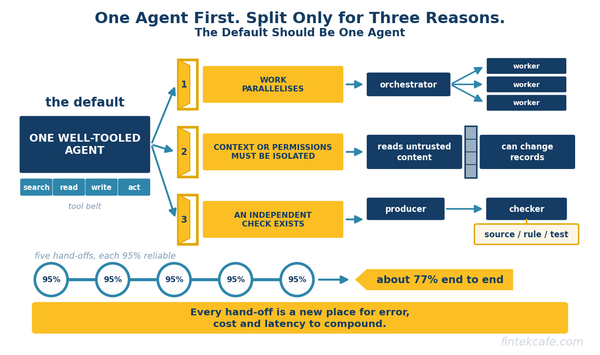
Multi-Agent Systems: When Splitting Work Across Agents Helps, and When It Multiplies Failure
Most tasks run better on one well-tooled agent. Multi-agent systems pay off only for parallel work, isolated context or independent checks.
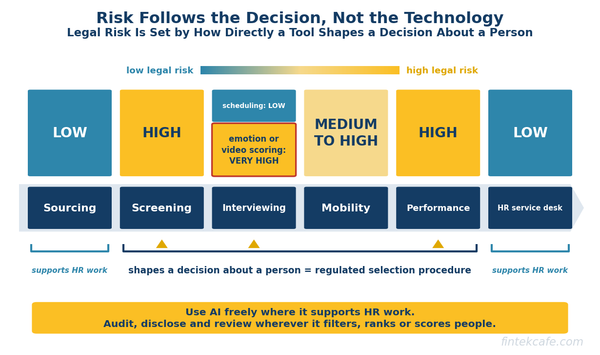
AI in Hiring and HR: Where It Helps, and Where the Legal Risk Sits
Where AI helps in hiring and HR, where legal risk concentrates, what NYC, the EU, Colorado, Illinois and California require, and which controls hold up.
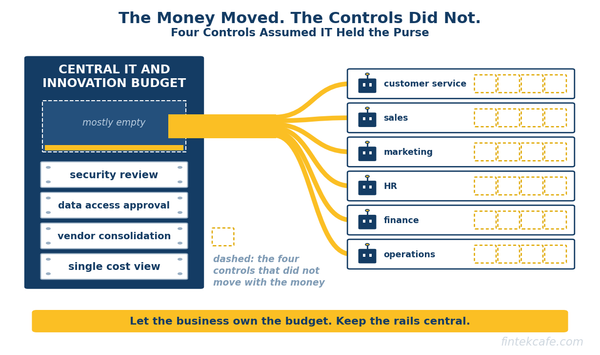
The AI Budget Is Moving From IT to the Business Lines, and Governance Has Not Followed
AI spend is moving from central IT to business lines. That ties cost to outcomes but breaks controls built for an IT-held purse. The model that works.