
AI in Legal and Contract Review: What In-House Teams Can Automate, and Where the Risk Stays
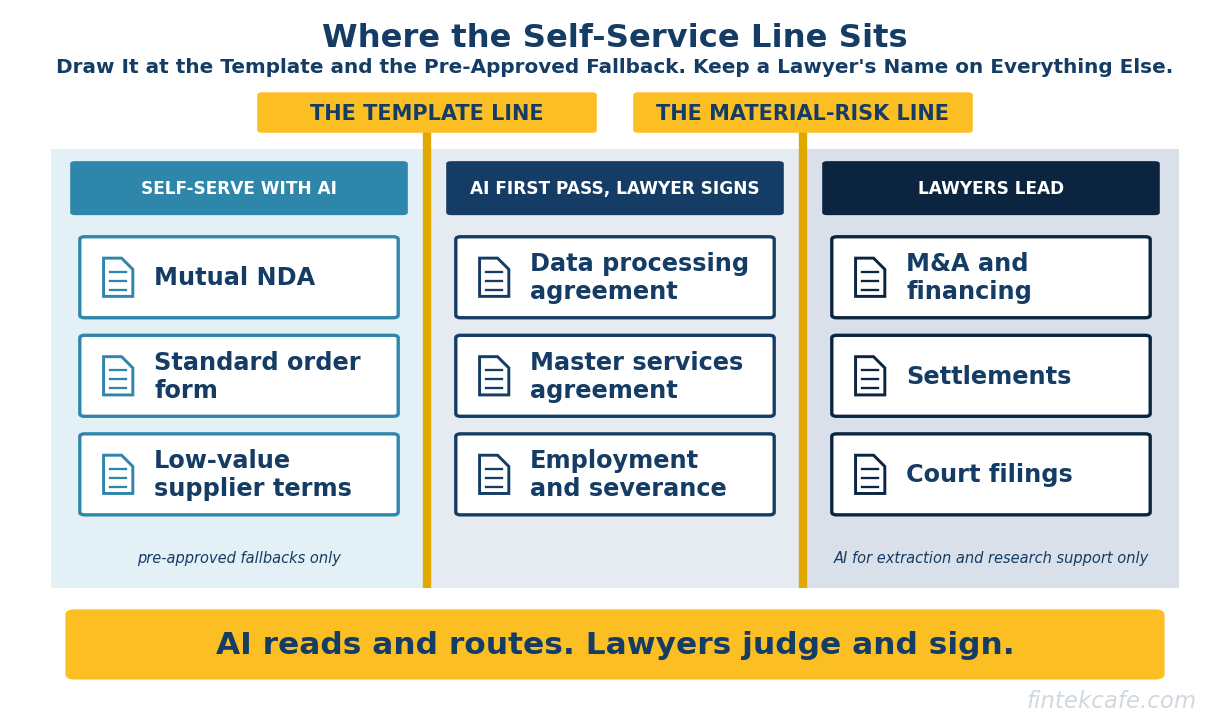
AI contract review is the use of language models to read, classify, compare and mark up agreements against a company's own standards, so that lawyers spend their time on the clauses that matter instead of the ones that never change. It is now mainstream in corporate legal departments: the ACC and Everlaw survey of 657 in-house legal professionals, published in October 2025, found generative AI use had more than doubled in a year, from 23 percent to 52 percent. The evidence on quality is split by task. AI tools beat lawyers on extraction and document questions in the Vals Legal AI Report of February 2025, but lost to them on redlining, and the leading legal research tools still hallucinated on 17 to 33 percent of queries in a Stanford study. The position taken here: let the business self-serve low-value standard agreements with AI under a legal playbook, keep a lawyer on everything that moves material risk, and never let a model's output reach a court, a regulator or a counterparty without human verification.
This is a business decision guide for executives, not legal advice. Your own counsel should set the playbook and the thresholds.
Key Takeaways
- Legal touches every deal, hire and vendor. AI removes most of the reading on standard agreements, not the judgement on non-standard ones.
- Independent benchmarks show AI ahead of lawyers on data extraction, document Q&A and summarization, and behind them on redlining and on research in public filings. Vendor studies claiming near-perfect accuracy should be read as marketing.
- Hallucinated citations are a sanctionable failure, not a hypothetical one. A public tracker of court decisions involving AI-fabricated material listed 2,246 cases as of October 31, 2026.
- Privilege is unsettled. In February 2026 a federal judge in New York held that a defendant's chats with a consumer AI tool were neither privileged nor work product; a court in Michigan reached a different result on work product the same day.
- The decision is a triage: self-serve with AI, AI first pass plus lawyer sign-off, or fully manual, set by contract type and value at risk.
Why Legal Is Where the Volume Problem Sits
Every function generates contracts: sales order forms, procurement supplier terms, HR offer letters and severance releases, IT software licences. Most are close to a template, and most in-house teams still read them line by line, because nobody can tell in advance which one hides the unusual indemnity.
The cost of not reading carefully is measurable. World Commerce and Contracting, the contract managers' association, reported in an August 2025 whitepaper that the average business loses almost 9 percent of contract value through poor contract management, with an average value erosion of 8.6 percent. Best performers sit near 3 percent; the worst lose 15 percent or more.
High volume, mostly standard content and money hidden in the exceptions: that is the pattern where AI earns its place. It is the same pattern seen in AI-driven HR screening, with one important difference: in legal, the output is often a binding commitment.
What AI Does Across the In-House Legal Workflow
Contract intake and triage
Intake triage is the step where an incoming contract is classified by type, counterparty, value and deviation from template, and routed to the right reviewer. For most teams it is the lowest-risk, highest-return starting point: a misrouted contract gets caught by the reviewer it lands with.
First-pass review against a playbook
A playbook is the legal team's written position on each clause: preferred language, acceptable fallbacks and walk-away points. AI compares a counterparty draft against it and produces an issues list. Here the playbook matters more than the model: without a written one, the tool has nothing consistent to compare against.
Clause extraction and obligation tracking
Extraction pulls renewal dates, notice periods, liability caps and service levels from signed contracts into a register, and obligation tracking turns them into alerts. The technology is the same document AI used across finance and operations, covered in how document AI extraction works. This is where the WorldCC value-erosion figure is most directly attacked: missed renewals and unclaimed service credits are extraction failures, not negotiation failures.
Redlining standard agreements
AI can propose tracked changes to bring a counterparty's NDA or standard order form back to the company's positions. On simple, high-volume agreements this works well enough to let the business self-serve. On complex agreements the evidence below says lawyers still do it better.
Legal research
Research assistants answer questions of law and cite authorities. It is the task with the most documented failures, because models produce plausible citations to cases that do not exist.
E-discovery and investigations
Technology-assisted review is long established in litigation. Generative models extend it to summaries and chronologies, under mature controls: sampling and validation against human-coded sets.
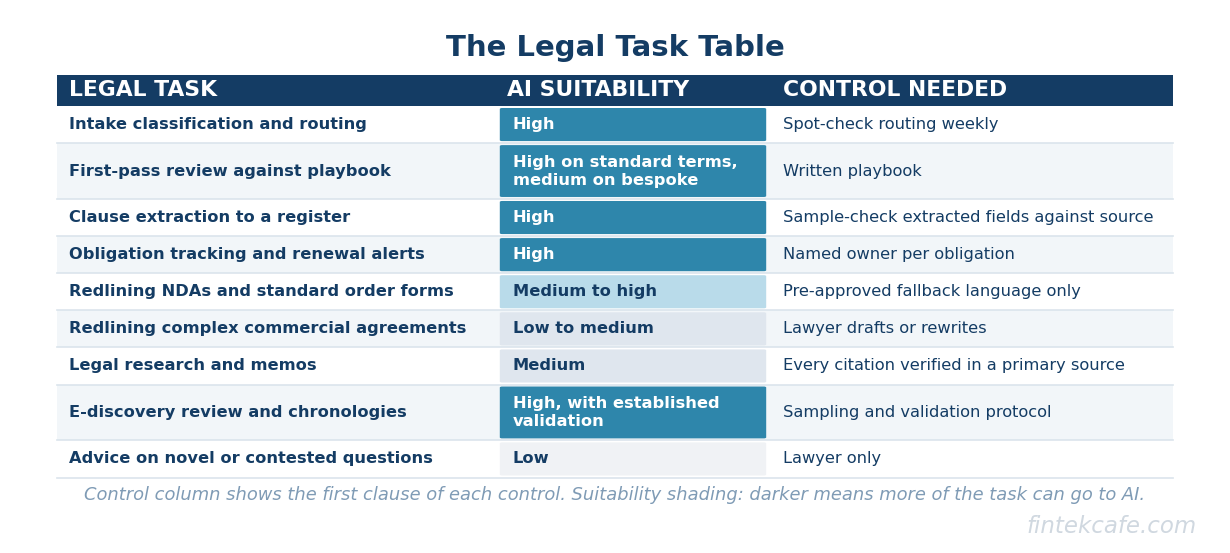
The legal task table
| Legal task | AI suitability | Control needed |
|---|---|---|
| Intake classification and routing | High | Spot-check routing weekly; reviewer can reclassify |
| First-pass review against playbook | High on standard terms, medium on bespoke | Written playbook; lawyer reviews every flagged deviation |
| Clause extraction to a register | High | Sample-check extracted fields against source; track error rate |
| Obligation tracking and renewal alerts | High | Named owner per obligation; alert escalation if unacknowledged |
| Redlining NDAs and standard order forms | Medium to high | Pre-approved fallback language only; no new positions generated |
| Redlining complex commercial agreements | Low to medium | Lawyer drafts or rewrites; AI suggestions treated as a checklist |
| Legal research and memos | Medium | Every citation verified in a primary source before use |
| E-discovery review and chronologies | High, with established validation | Sampling and validation protocol defensible in court |
| Advice on novel or contested questions | Low | Lawyer only; AI limited to background reading |
What the Evidence Says About Accuracy and Time Saved
The evidence base is better than in most functions, because legal academics have run controlled studies. It still needs sorting into independent work and vendor claims.
| Study | What it tested | Result | Source and type |
|---|---|---|---|
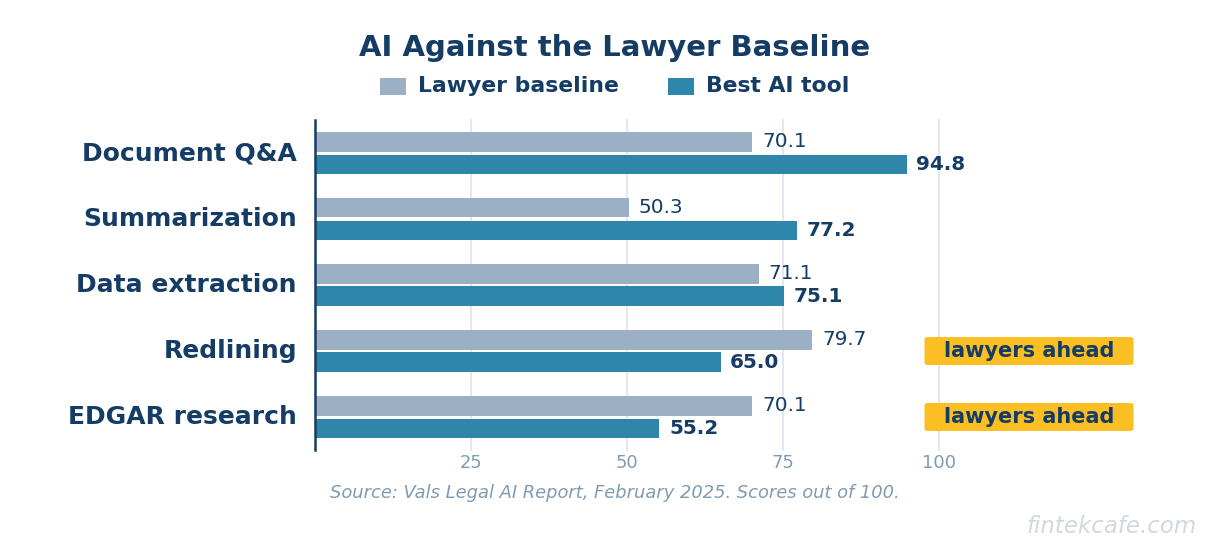
| Vals Legal AI Report | Seven legal tasks, AI tools against a lawyer baseline | Best tool beat lawyers on document Q&A (94.8 against 70.1), summarization (77.2 against 50.3) and data extraction (75.1 against 71.1); lawyers won on redlining (79.7 against 65.0) and EDGAR research (70.1 against 55.2) | Vals AI, February 2025; independent benchmark, vendors opted in |
| Magesh et al., "Hallucination-Free?" | Leading AI legal research tools on 202 preregistered queries | Lexis+ AI, Westlaw AI-Assisted Research and Ask Practical Law AI each hallucinated on 17 to 33 percent of queries; accuracy 65, 41 and 19 percent respectively | Stanford researchers, Journal of Empirical Legal Studies, 2025; independent |
| Dahl et al., "Large Legal Fictions" | General-purpose models on questions about federal cases | Hallucination rates from 58 percent (GPT-4) to 88 percent (Llama 2) | Journal of Legal Analysis, 2024; independent |
| Choi, Monahan and Schwarcz | Randomized trial of law students with and without GPT-4 | Quality improved only slightly and inconsistently, with the largest gains for the lowest-skilled participants; speed increased substantially and consistently | Minnesota Law Review, November 2024; independent |
| Schwarcz et al., "AI-Powered Lawyering" | Randomized trial of a reasoning model and a legal research tool | Productivity gains of 34 to 140 percent (reasoning model) and 38 to 115 percent (legal tool) on five of six tasks; the reasoning model added some hallucinations | Published 2026, preprint March 2025; independent |
| LawGeex NDA study | AI against 20 US lawyers reviewing five NDAs | AI 94 percent accuracy in 26 seconds; lawyers 85 percent in an average of 92 minutes | LawGeex, February 2018; vendor-commissioned |
| "Better Call GPT" | Language models against junior lawyers and outsourcers on contract review | Models matched or beat humans; claimed 99.97 percent cost reduction | Onit, January 2024; vendor, not peer-reviewed |
Three conclusions follow. AI is reliably faster: Vals found the tools between six and 80 times faster than lawyers, depending on the task. Quality is task-dependent, and the tasks where AI loses, redlining and research, are the ones that create binding language or cite authority. And the near-perfect numbers come from vendors; the LawGeex answer key was built partly from all participants' answers, including the AI's.
Adoption surveys mostly come from vendors too. Thomson Reuters, which sells CoCounsel, reported in February 2026 that 47 percent of corporate legal respondents worked at organizations using generative AI, in a survey of 1,514 professionals. FTI Consulting and Relativity put general counsel team use at 87 percent in March 2026. Read the direction, not the decimal.
The more telling number is about measurement. In a November 2025 ACC and Everlaw follow-up survey of 284 legal leaders, only 12 percent said they track technology return on investment. The fix is to pick a unit of work, such as cost and cycle time per contract, and measure it before and after.
Where It Fails
Hallucinated citations, and the courts' response
The failure that made legal AI famous is still happening. The cases below are a sample, each verified against the decision or reliable reporting:
| Case | Court and date | What happened | Consequence |
|---|---|---|---|
| Mata v. Avianca | Southern District of New York, June 22, 2023 | Brief cited six fabricated cases generated by ChatGPT | 5,000 dollar sanction on two lawyers and their firm, with a finding of subjective bad faith |
| Wadsworth v. Walmart | District of Wyoming, February 24, 2025 | Eight of nine cited cases did not exist; generated by a law firm's in-house AI tool | 3,000 dollars on the drafting lawyer, whose admission to the case was revoked, and 1,000 dollars each on two others; the firm was not sanctioned |
| Coomer v. Lindell | District of Colorado, July 7, 2025 | Nearly 30 defective citations in a filing | 3,000 dollars each for two lawyers |
| Johnson v. Dunn | Northern District of Alabama, July 23, 2025 | Fabricated citations from lawyers at a large firm | No fine; public reprimand, removal from the case and referral to the state bar |
| Noland v. Land of the Free | California Court of Appeal, September 12, 2025 | 21 of 23 case quotations fabricated | 10,000 dollar sanction and bar notification, in California's first published opinion on the issue |
| Ayinde v Haringey | High Court of England and Wales, June 6, 2025 | Fictitious citations in two cases | Court warned that tools such as ChatGPT "are not capable of conducting reliable legal research" and put the duty on heads of chambers and managing partners |
Researcher Damien Charlotin's tracker listed 2,246 such decisions worldwide as of October 31, 2026. Large firms and specialist tools are not immune, and courts treat it as a supervision failure, so the exposure travels up to whoever was responsible for the work. For the control patterns that reduce this failure, see how to control AI hallucination in production.
Non-standard deals
Playbook review works because standard agreements are repetitive. A joint venture, an acquisition or a settlement is not. There is no playbook position to compare against, and the risk lies in what is missing from the draft as much as in what is there. AI does not reliably notice an absent clause that a lawyer would expect.
Jurisdiction nuance
The same clause can be enforceable in one jurisdiction and void in another: non-competes, liability caps and consumer terms all vary. A tool used on cross-border agreements needs jurisdiction-specific playbooks, and a lawyer qualified in the governing law for anything outside them.
Privilege and Confidentiality: The Unsettled Risk
When a contract or a legal question goes to a model, two questions follow: does the provider keep or use the data, and does sending it waive legal privilege?
The confidentiality risk is familiar. In May 2023 Samsung banned staff in one of its largest divisions from using generative AI on company devices after engineers uploaded internal source code to ChatGPT, Bloomberg reported. Enterprise terms now usually exclude training on customer data, but they differ and need checking clause by clause. The broader question of how to evaluate an AI vendor applies in full.
The privilege question is newer and live. In United States v. Heppner, Judge Jed Rakoff of the Southern District of New York ruled from the bench on February 10, 2026, and issued a written opinion on February 17, holding that a criminal defendant's conversations with a consumer AI chatbot were neither privileged nor work product. The reasons were that the tool is not a lawyer, that the provider's privacy policy allowed sharing with third parties, so there was no reasonable expectation of confidentiality, and that the material was not prepared at counsel's direction. The opinion left room for enterprise tools with different terms to be treated differently. On the same day as the Heppner bench ruling, February 10, 2026, a magistrate judge in the Eastern District of Michigan, in Warner v. Gilbarco, held that a self-represented plaintiff's ChatGPT-assisted materials were protected work product, reasoning that AI tools are tools, not persons. Two district courts, no appellate ruling.
The practical consequence is a policy line: privileged material goes only into enterprise tools with contractual confidentiality, under counsel's direction, never into consumer tools.
What the Professional Rules Say
Lawyers are bound by professional-responsibility rules, and the main bodies have issued guidance:
- American Bar Association Formal Opinion 512, issued July 29, 2024, applies the existing duties of competence, confidentiality, communication, candor, supervision and reasonable fees to generative AI. It says client informed consent is required before information about a representation is entered into a self-learning tool, and that boilerplate in an engagement letter is not enough. It is advisory, not binding.
- State bars. The State Bar of California approved practical guidance in November 2023, the Florida Bar adopted Ethics Opinion 24-1 in January 2024, and the New York State Bar adopted its task force report in April 2024.
- Courts. Judge Brantley Starr of the Northern District of Texas issued one of the first standing orders in May 2023, requiring lawyers to certify that AI-drafted content was checked by a human.
- Regulators. The Solicitors Regulation Authority in England and Wales authorized Garfield.Law on May 6, 2025, as the first AI-driven law firm, limited to small debt claims and requiring client approval at each step.
For in-house teams, supervision is the duty that bites: a general counsel who lets the business self-serve contracts with AI is accountable for how that process is designed. The wider question of who answers when an autonomous system makes a costly mistake is covered in the agent liability and accountability gap.
In-house contract review is not a high-risk use under the EU AI Act: Annex III, point 8, covers AI used by or for judicial authorities. The Digital Omnibus on AI, published on July 24, 2026, also moved most high-risk obligations to December 2, 2027, and those for AI embedded in regulated products to August 2, 2028.
The Decision: Which Contracts the Business Can Self-Serve
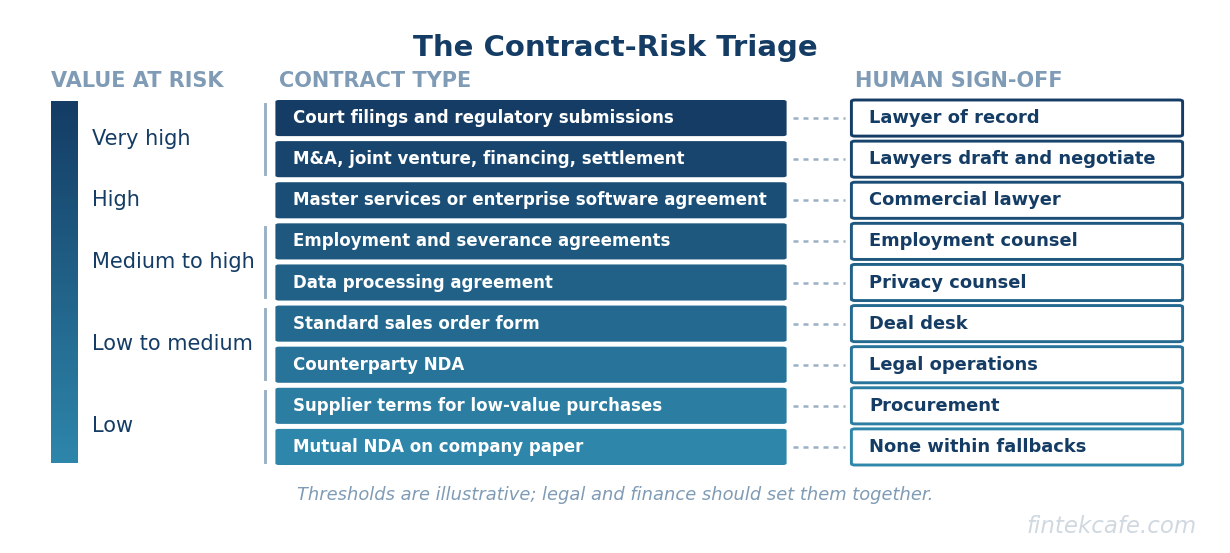
The triage below sets the AI role and human sign-off by contract type and value at risk. Thresholds are illustrative; legal and finance should set them together.
| Contract type | Value at risk | AI role | Human sign-off |
|---|---|---|---|
| Mutual NDA on company paper | Low | Self-serve: business generates and AI checks counterparty edits against fallbacks | None if all edits are within pre-approved fallbacks; legal if any are outside |
| Counterparty NDA | Low to medium | AI first pass, issues list | Legal operations or paralegal approves |
| Standard sales order form under an agreed master agreement | Low to medium | Self-serve within deal desk rules | Deal desk; legal only above a value threshold or on non-standard terms |
| Supplier terms for low-value purchases | Low | AI first pass against procurement playbook | Procurement; legal on data, IP or liability deviations |
| Data processing agreement | Medium to high | AI first pass and clause extraction | Privacy counsel |
| Master services or enterprise software agreement | High | AI first pass and issues list; extraction after signature | Commercial lawyer |
| Employment and severance agreements | Medium to high | AI drafting from approved templates | Employment counsel; HR cannot self-serve releases |
| M&A, joint venture, financing and settlement documents | Very high | Due diligence extraction and summaries only | Lawyers draft and negotiate; outside counsel where needed |
| Court filings and regulatory submissions | Very high | Research support, every citation verified | Lawyer of record, personally |
Self-service is safe only where the contract is on a template, deviations are pre-approved and an error is small and recoverable. Every other row gets a named lawyer.
What the Vendor Market Offers
The market has consolidated around research platforms, contract-lifecycle tools and Word add-ins. Harvey announced a 550 million US dollar raise at a 15.5 billion dollar valuation in September 2026. Thomson Reuters bought Casetext, maker of CoCounsel, for 650 million dollars in August 2023. LexisNexis made its Protégé assistant generally available in the US in January 2025. Luminance raised a 75 million dollar Series C in February 2025, and Spellbook a 50 million dollar Series B in October 2025. Funding measures investor conviction, not accuracy: ask for results on your own contracts, scored by your own lawyers.
How to Roll It Out
- Write the playbook first. No playbook, no self-service.
- Start with extraction on signed contracts. It recovers renewal and obligation value at the least risk and builds the register every later step needs.
- Pilot first-pass review on NDAs, measuring cycle time and how often lawyers override the AI's issues list.
- Open self-service only when the override rate is low and stable, with a one-click escalation to legal.
- Set the privilege policy in writing: which tools, which data, under whose direction.
The Position, and Its Tradeoff
The recommended stance is AI for reading and routing, lawyers for judgement and signature. AI does intake, extraction and first-pass review on everything; the business self-serves only templated, low-value agreements; a named lawyer stays on every contract that moves material risk and every document that cites authority.
The tradeoff is speed. A stricter line keeps more contracts in the legal queue, and the business will push back. Some teams will draw the line higher and accept more small errors for faster deals. That is legitimate if it is deliberate, with the error rate measured and the threshold written down. What is not defensible is drift: a self-service scope that grows until a model is negotiating material terms no lawyer has read.
Frequently Asked Questions
Can AI review contracts as accurately as a lawyer?
On some tasks, yes. The Vals Legal AI Report of February 2025 found the best tools ahead of a lawyer baseline on data extraction, document questions and summarization, but behind lawyers on redlining. Accuracy depends on the task, the tool and the quality of the company's playbook.
Is it safe to upload contracts to an AI tool?
It depends on the tool's contractual terms. Enterprise agreements usually exclude training on customer data and provide confidentiality commitments; consumer tools often do not. A February 2026 New York federal ruling held that chats with a consumer AI tool were not privileged, so privileged material belongs only in enterprise tools used under counsel's direction.
Which contracts can the business review without legal?
Only templated, low-value agreements where every permitted change is pre-approved by legal, such as mutual NDAs on company paper or standard order forms within deal desk rules. Anything with non-standard terms, data processing, employment releases or material liability needs a lawyer's sign-off.
What happens if AI invents a legal citation?
Courts sanction the lawyers who file it. In the US cases summarized above, fines ranged from 1,000 to 10,000 dollars, alongside reprimands, removal from cases and referrals to bar regulators. More than 2,200 such decisions had been logged worldwide by October 2026.
The Bottom Line
Legal was always going to be early: its raw material is repetitive language. The evidence shows where AI is safe: reading, classifying, extracting and comparing. It also shows where it is not: binding language on novel deals, and authority cited without verification.
Draw the self-service line at the template and the pre-approved fallback, measure what crosses it, and keep a lawyer's name on everything else. That gets most of the speed without betting a material contract on a model's best guess.
Related Articles
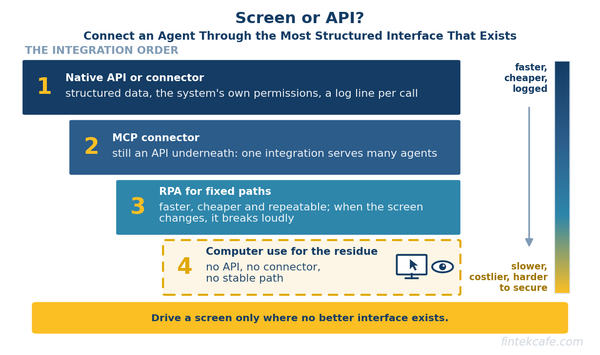
Computer-Use Agents: When to Let an AI Agent Drive a Screen, and When to Give It an API
Computer-use agents reach systems with no API, but they are the slowest, least reliable way in. When to use them, the benchmarks, and the controls.
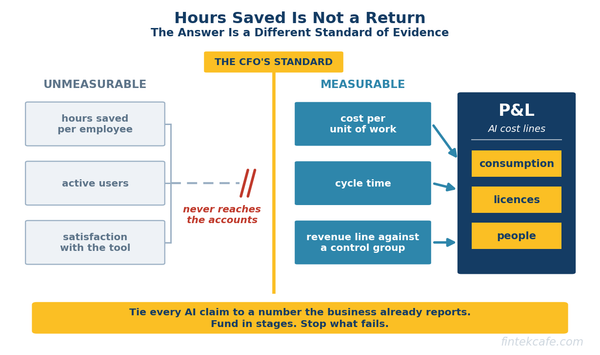
The CFO Now Owns the AI Business Case, and Most Finance Teams Cannot Measure the Return
Boards ask the CFO what AI returns, and most cannot say. Why hours saved fails, which metrics hold up, and a funding model that kills what does not pay.
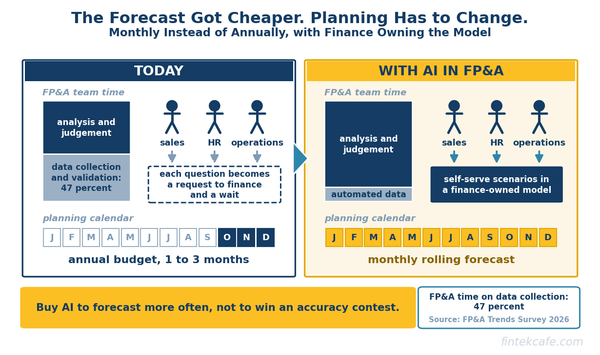
AI in FP&A: What Forecasting and Planning AI Actually Changes for the Finance Team
What AI in FP&A changes: where forecasting and planning AI works, where it fails, the controls the board needs, and a maturity path for the finance team.