
The Missing Rung: What Happens to the Talent Pipeline When AI Does the Entry-Level Work
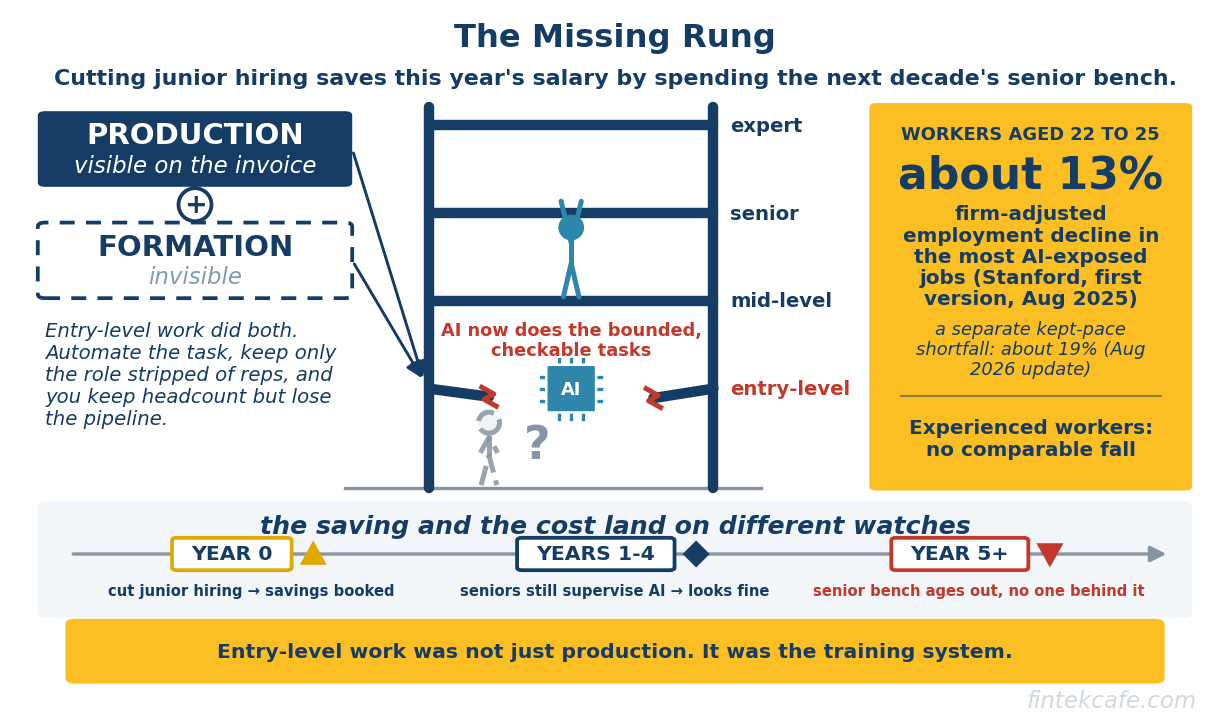
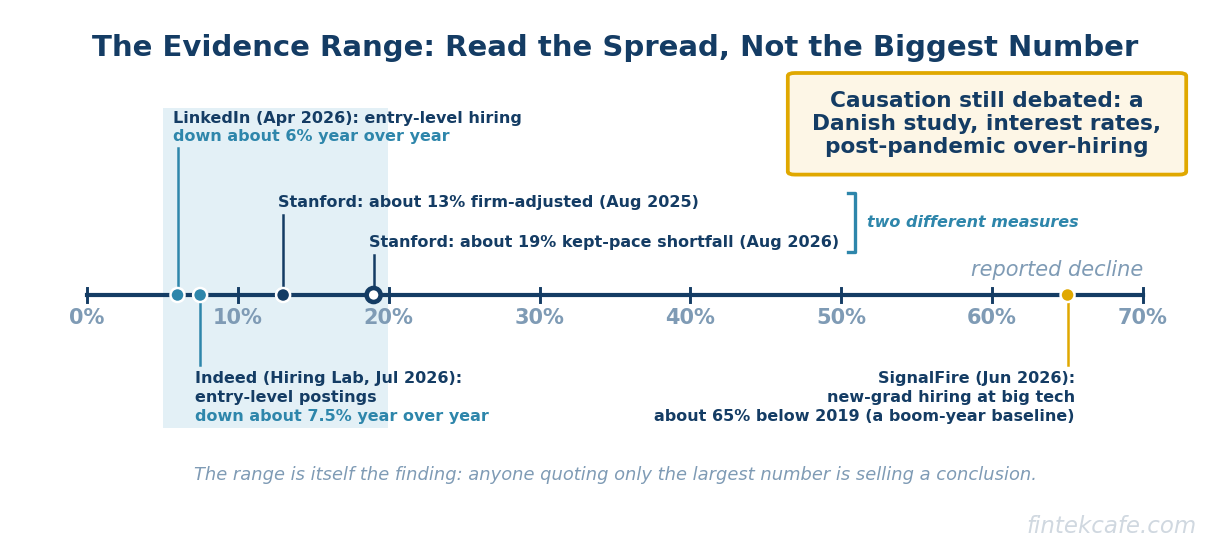
The first measurable labour-market effect of generative AI is not mass unemployment. It is a quiet withdrawal of the bottom rung. The clearest evidence comes from Stanford's Digital Economy Lab: in "Canaries in the Coal Mine?", first posted in August 2025, Erik Brynjolfsson, Bharat Chandar and Ruyu Chen used payroll records from the provider ADP and found a roughly 13 percent relative decline in employment for workers aged 22 to 25 in the occupations most exposed to AI, with no comparable fall for older, more experienced workers in the same jobs (Brynjolfsson, Chandar and Chen, Stanford Digital Economy Lab, August 2025). That 13 percent is the firm-adjusted estimate from the paper's first version; later data moved it to about 16 percent. A separate measure, the shortfall against where these workers would be had they kept pace with less-exposed occupations, ran at about 15 percent in that first version and about 19 percent in the lab's August 12, 2026 update (data through June 2026). That revision also reported the firm-adjusted estimate weakening and, under the original sample filters, no longer statistically significant, which is why the lab frames its own result as no widespread displacement alongside a widening young-worker gap. The direction holds across measures; the exact magnitude is contested, and this piece treats it that way.
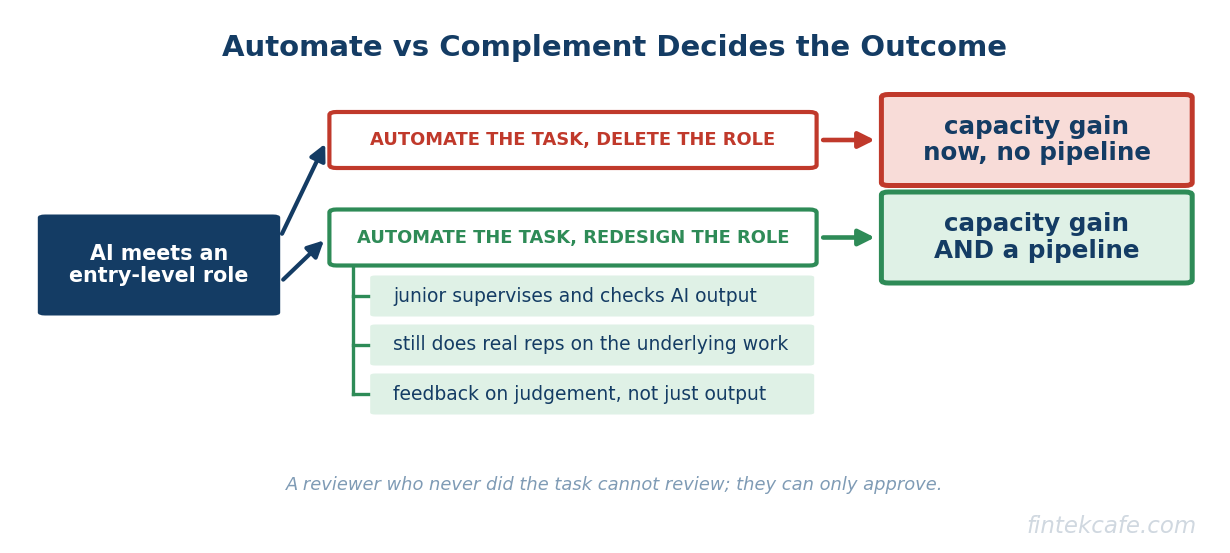
The thesis of this piece: a company that cuts junior hiring because AI can do junior tasks is saving this year's salary cost by spending the next decade's senior bench, because entry-level work was never only production. It was the training system. The junior analyst who assembled the deck, the associate who reviewed the documents, the new developer who fixed the small bugs, was learning the judgement that makes a senior. Automate the task and keep the role, and you have a capacity gain. Automate the task and delete the role, and you have cut the pipeline that produces the people who supervise the AI. The better move is not to protect make-work. It is to redesign the junior role around supervising and checking AI output, and to fund apprenticeship as a deliberate investment with its own budget line.
This is a decision for the chief executive, the chief human-resources officer and every function head at once, because the pipeline is a shared asset that no single quarter's hiring plan is incentivized to protect. The function that cuts junior intake books the saving immediately and pays the cost years later, on someone else's watch. That asymmetry is exactly why it needs a decision made deliberately now, rather than by default through a thousand separate hiring freezes.
The Evidence, and Where It Is Contested
The honest version of this argument acknowledges that the evidence is young, partly correlational, and disputed. An executive making a decade-long bet should see the disagreement, not a single tidy number.
What the strongest studies agree on is the shape: the effect is concentrated among early-career workers in exposed occupations, not spread across the workforce. The Stanford lab frames its own finding as "no widespread displacement" alongside a widening young-worker gap, and notes that the declines cluster in occupations where AI tends to automate tasks rather than complement the worker. That distinction, automation versus complement, is the whole ballgame, and it is a design choice as much as a property of the technology.
The hiring data points the same way, though the magnitude depends heavily on the baseline. SignalFire's State of Talent Report 2026 (June 22, 2026) found new-graduate hiring down roughly 65 percent at the largest technology firms, a named set of twelve, and about 76 percent at early-stage startups, both measured against 2019. But 2019 was a boom year for new-grad recruiting, so the drop from recent years is smaller than the headline. Broader market measures are milder still: Indeed's Hiring Lab (July 23, 2026) reported entry-level postings down about 7.5 percent year over year as of May 2026, and LinkedIn's 2026 Grad's Guide (April 15, 2026) put entry-level hiring down about 6 percent year over year. The range, from single digits to sixty-plus percent, is itself the finding: the effect is real and concentrated, and anyone quoting only the largest number is selling a conclusion.
The genuine dispute is causation. A Danish study by Anders Humlum and Emilie Vestergaard, "Still Waters, Rapid Currents" (revised March 2026), found that the early-career employment declines in exposed occupations there are not driven by firms adopting generative AI chatbots, with adoption accounting for at most a small fraction. A Yale Budget Lab analysis of US Current Population Survey data (October 2025) found no systematic difference in employment trends across more- and less-exposed occupations, though that is descriptive work without controls. Entry-level hiring is also sensitive to interest rates, post-pandemic over-hiring and its correction, and offshoring, all of which fell in the same window. Brynjolfsson, Chandar and Chen's response, in a joint post titled "Canaries, Interest Rates, and Timing" (February 2026), is that interest rates do not explain why the decline is concentrated specifically in the AI-exposed occupations, which is a fair point, but it is a point in an open argument, not a closed case.
The decision-useful reading: the direction is consistent enough across independent sources to act on, and the mechanism, AI absorbing exactly the bounded, checkable tasks that juniors used to do, is plausible enough that waiting for certainty is itself a bet. A leader does not need to resolve the causation debate to notice that the training system is under strain.
This is a Premium Article
Sign up for a Premium membership to read this article and get full access to strategic intelligence on technology and business.
Already a member? Sign in
Related Articles
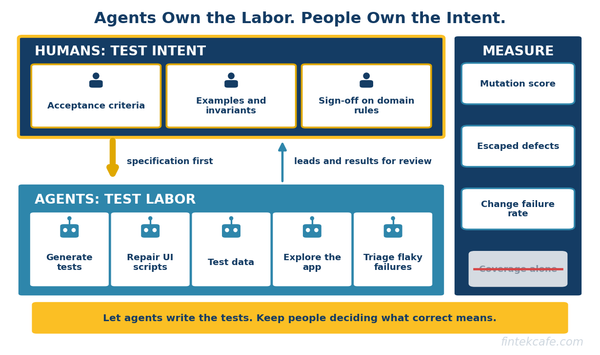
AI for Software Testing: What QA Agents Can Take Over, and Where Human Testers Still Matter
AI software testing for executives: what QA agents can generate and maintain, why AI-written tests miss bugs, and which tests to automate or keep human.
Everyone Is a Developer Now: Why AI App Builders Are the Next Shadow IT, and How to Say Yes Safely
AI app builders let any employee ship working software. That is shadow IT with a bigger blast radius. A paved-road policy that says yes without the breach.
AI in Supply Chain: What Planning and Logistics Agents Can Decide, and What Planners Must Keep
AI in supply chain for executives: what planning and logistics agents can decide alone, what needs approval, and which decisions planners must keep.