
Tokenized Deposits vs Stablecoins: Why Banks Are Building Their Own Rails
The stablecoin story owns the headlines. A regulated dollar token, redeemable at par, settling in seconds across a public chain, reads like the obvious successor to slow correspondent rails and expensive interchange. The narrative has a clean villain (the legacy bank) and a clean hero (the programmable token issued outside the banking perimeter). It is a good story, and the market has priced it accordingly.
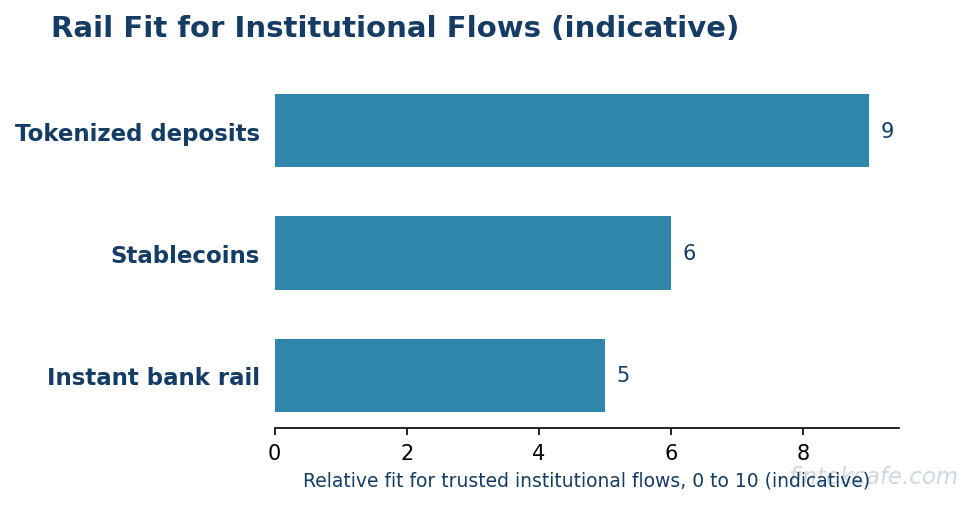
It is also the wrong place to look. While the attention sits on third-party stablecoins, the more consequential build is happening quietly inside the largest banks, and it is not a stablecoin at all. It is the tokenized deposit: a regulated, deposit-backed token that represents a claim on a specific bank, settles on shared ledgers, and never leaves the banking perimeter. The contrarian read is that tokenized deposits, not third-party stablecoins, become the dominant programmable-money rail for institutional flows, precisely because they sidestep the two problems that make stablecoins structurally awkward for banks: deposit flight and reserve economics.
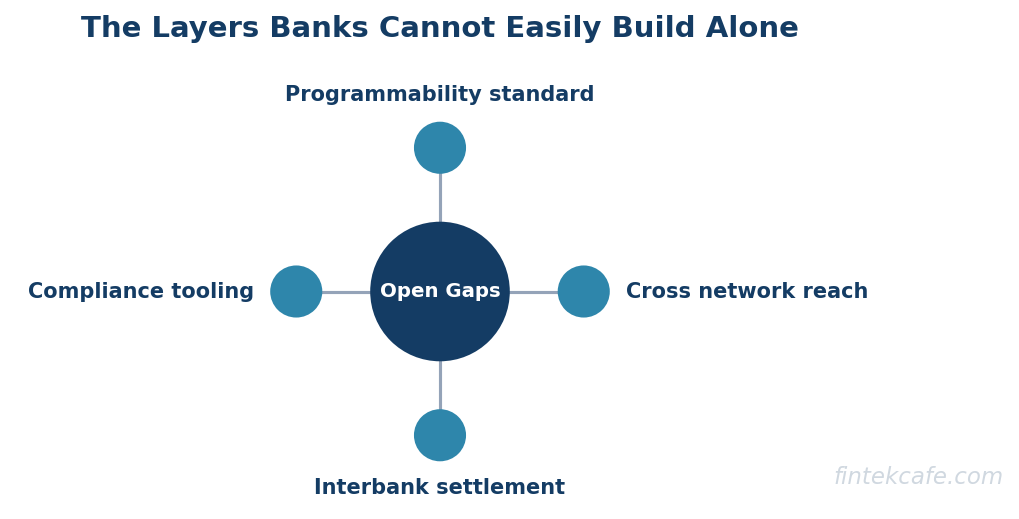
This matters because the firms positioning themselves to sit between banks and stablecoin liquidity have made an assumption that the tokenized-deposit path quietly invalidates. If banks can issue programmable money that stays on their own balance sheet, the intermediary layer that fintechs hoped to occupy gets a great deal thinner. What follows is the structural difference that drives the outcome, the settlement and interoperability questions still unresolved, and the strategic implication for anyone whose business model assumed the bank would cede the rail.
A Claim on a Bank Versus a Claim on a Reserve Pool
The entire argument turns on what the token actually represents, and the two designs are not variations on a theme. They are different legal instruments.
A stablecoin is a claim on a reserve pool. The issuer takes the holder's money, parks it in high-quality liquid assets held away from its operating funds, and issues a token redeemable for one dollar. The token is a bearer-style instrument: it can move to anyone, on any compatible chain, without the issuer needing a relationship with the recipient. The backing is the reserve, not the issuer's general balance sheet, and the holder's recourse runs to that segregated pool.
A tokenized deposit is a claim on a bank. It is the existing deposit liability, the balance that already sits in a checking or operating account, represented in tokenized form on a ledger the bank controls or participates in. The token does not create a new pool of assets. It re-expresses a liability the bank already carries. The holder's claim is on the bank, exactly as a normal deposit is, with the same deposit-insurance treatment up to applicable limits and the same supervisory protections. Crucially, the token typically moves only between parties the bank or its network has onboarded, because it is a deposit, and deposits are accounts, and accounts have known holders.
That distinction looks like legal hair-splitting until the economics are traced through it. Consider what happens to the money supply and to the bank's balance sheet under each design. When a customer converts a deposit into a third-party stablecoin, money leaves the bank. The deposit funds the issuer's reserve purchase, the bank loses a cheap funding source, and the customer now holds a claim on a reserve manager rather than on the bank. The bank has been disintermediated from its own customer's transactional cash. When a customer uses a tokenized deposit, none of that happens. The money stays on the bank's balance sheet, the funding base is intact, and the bank keeps both the relationship and the cheap deposit. The token is just a faster, programmable way to move a balance the bank already holds.
This is why the tokenized-deposit design is the natural one for a bank to build and the stablecoin design is the natural one for a bank to fear. The structural analysis of the GENIUS Act laid out why regulated dollar tokens become bank infrastructure rather than crypto, and why the largest banks are positioned to capture the settlement margin; the deeper treatment of stablecoins as bank infrastructure under the GENIUS Act makes the case that scale players win the issuance game. Tokenized deposits are the form that win takes. A bank that issues a stablecoin is, in effect, competing with its own deposit base. A bank that tokenizes its deposits is upgrading the rail under the deposit base without losing it.
This is a Premium Article
Sign up for a Premium membership to read this article and get full access to strategic intelligence on technology and business.
Already a member? Sign in
Related Articles

AI-Generated Fake Receipts: How Expense Fraud Changed and How Finance Teams Catch It
AI-generated fake receipts now beat visual review. How expense fraud changed, which detection still works, and the controls to use by company size.

The Monthly Close Is Becoming Continuous, and the Finance Calendar Will Not Survive It
AI is taking the bottleneck work out of the month-end close. The close becomes continuous with a short sign-off, and finance, audit and the board change.
Accounts Payable Automation: What AI Can Actually Take Over in Invoice-to-Pay
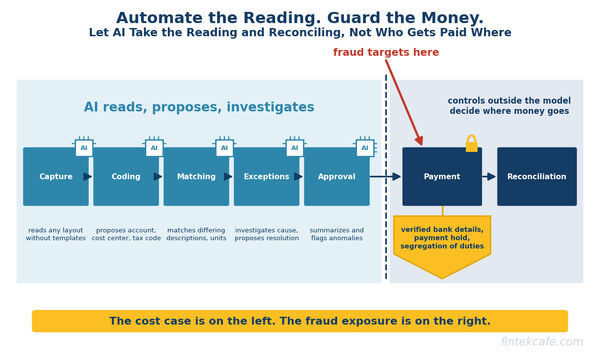
What AI can take over in accounts payable, step by step from capture to payment, where the fraud risk grows, and which controls must stay outside the model.