
Every Software Vendor Now Sells an Agent, and Most Enterprises Should Buy Very Few of Them
Open any enterprise software vendor's homepage and the offer is the same. The CRM vendor sells an agent for sales and service. The IT service management vendor sells one for the service desk. The HR suite sells one for recruiting and employee questions. The ERP vendor sells one for finance. The collaboration suite sells one for everything. Each comes with an agent builder, and each is priced its own way: per conversation, per action, per credit or per seat.
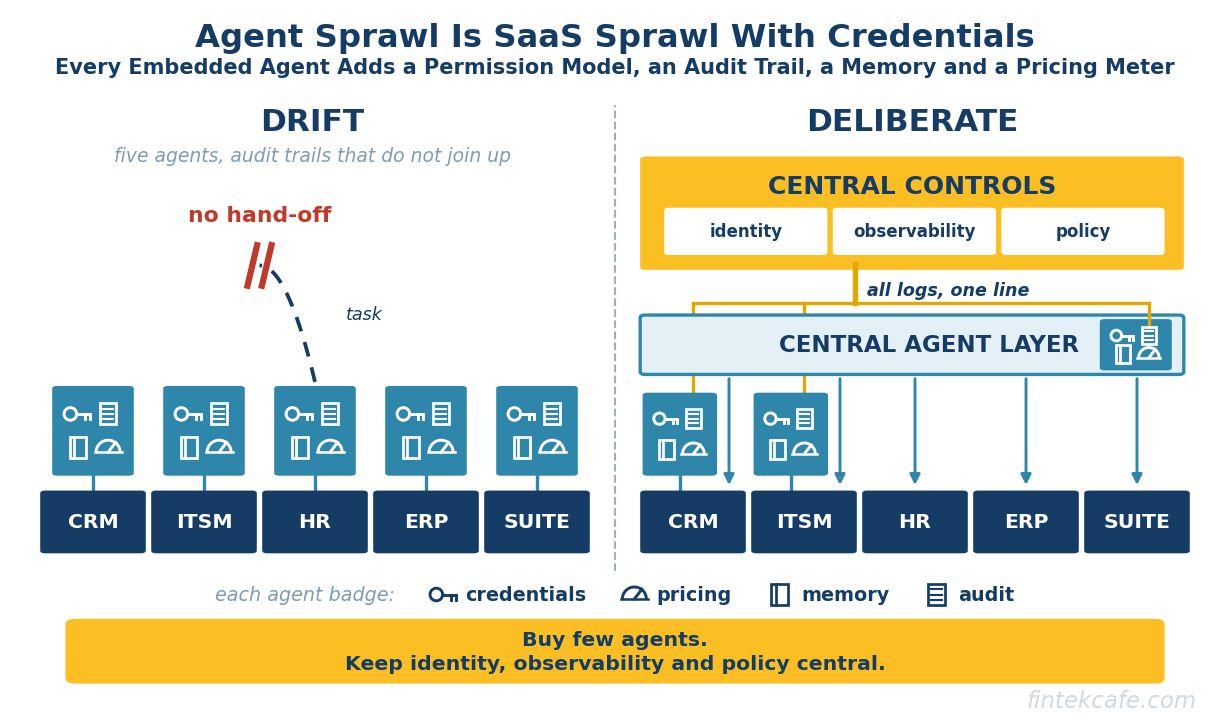
The thesis of this piece: buying an agent from every system of record recreates the SaaS sprawl problem one layer up, with worse consequences. A sprawl of applications wastes money and fragments data. A sprawl of agents does that and more, because each agent holds credentials, takes actions and keeps its own memory. Ten vendors' agents means ten sets of permissions to govern, ten audit trails that do not join up, ten pricing meters to forecast, and ten agents that cannot hand work to one another when a process crosses systems.
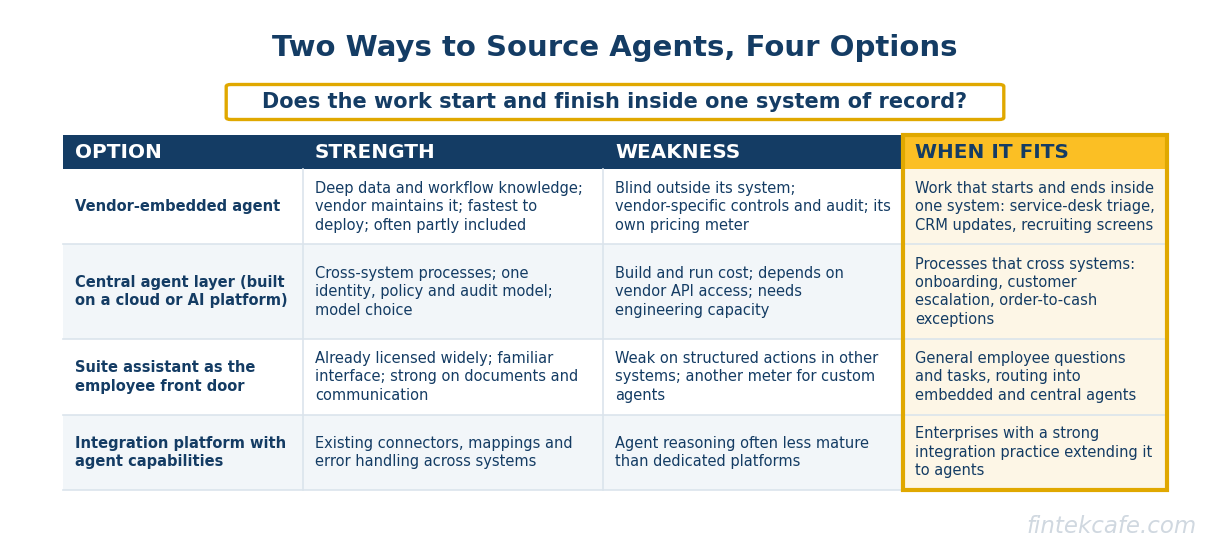
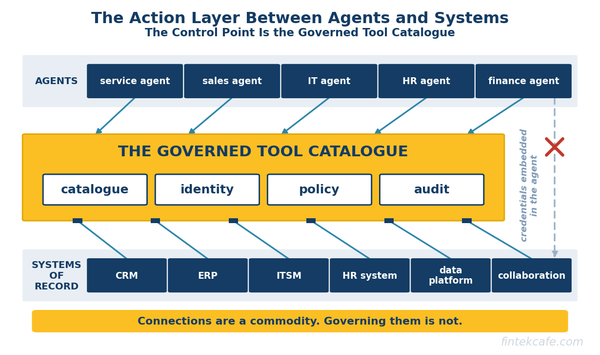
The CIO's job is to choose deliberately between two models. Vendor-embedded agents are deep in one system and blind outside it. A central agent layer works across systems but must be built, integrated and governed. Most enterprises will use both. What they cannot afford is to drift into ten embedded agents by accepting every renewal's add-on, and to discover the cost when the first cross-system process breaks or the first agent does something no one can trace. Whatever the mix, three things must stay central: identity, observability and policy.
The Offer Every Vendor Is Making
The pricing alone shows how different the offers are, and how hard they are to compare.
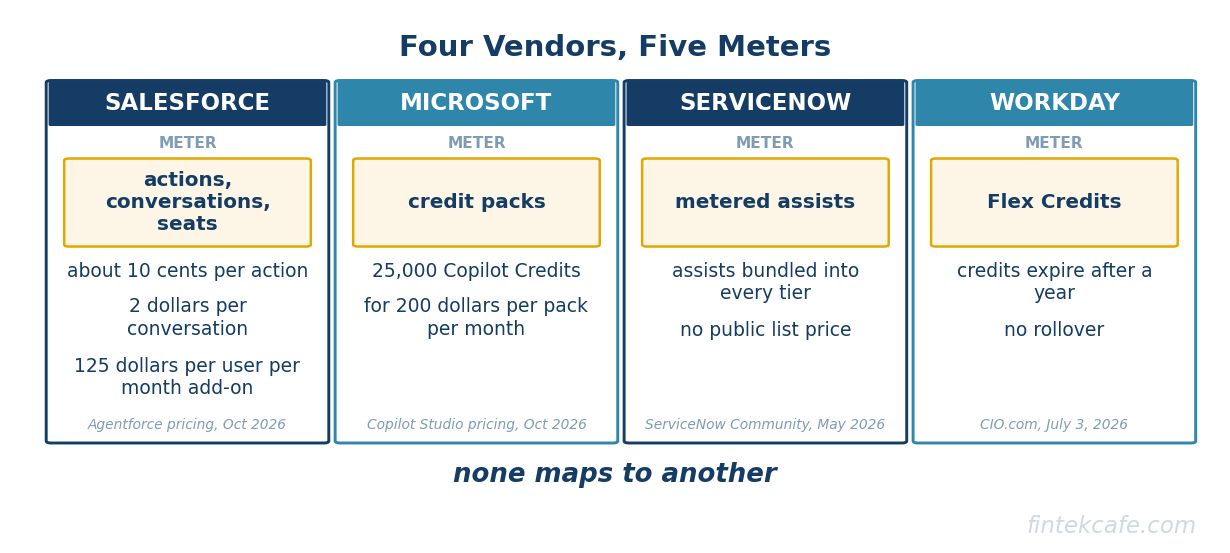
Salesforce prices Agentforce several ways at once. Flex Credits cost 500 dollars per 100,000 credits, with a standard agent action consuming 20 credits, which works out to about 10 cents an action. Customer-facing conversations can instead be priced at 2 dollars each. Per-user add-ons for unmetered employee use start at 125 dollars per user per month (Salesforce Agentforce pricing, October 2026).
Microsoft sells Microsoft 365 Copilot at 30 dollars per user per month, which includes basic agent building inside Microsoft 365, and sells Copilot Studio, its agent builder, in tenant-wide capacity packs of 25,000 Copilot Credits for 200 dollars per pack per month, with pay-as-you-go and pre-purchase alternatives (Microsoft Copilot Studio pricing, October 2026).
ServiceNow repackaged its IT service management offer in April 2026 into three tiers, Foundation, Advanced and Prime, with AI bundled into every tier as an allocation of metered "assists" and the ability to build new custom AI agents reserved for Prime (ServiceNow Community, May 2026). ServiceNow does not publish list prices.
Workday meters its agents through Flex Credits: an allotment included in the base subscription, extra credits purchasable, and credits that expire after a year with no rollover. Its rate card prices screening a résumé in the Recruiting Agent at 6 credits and contract review in the Contract Negotiation Agent at 500 (CIO.com, July 3, 2026).
Four vendors, five meters: actions, conversations, credits of different sizes, assists, and seats. None maps to another. A CIO trying to answer the simple question "what do agents cost the company per month?" has to translate between all of them, and the answer changes with usage that nobody has yet measured.
The pricing confusion is a symptom. The underlying issue is that each vendor's agent is designed to make that vendor's system the place where work happens, and the vendor is pricing it to capture the value of the work it displaces. That is a reasonable commercial strategy for each vendor. Summed across a dozen vendors, it is an expensive and ungovernable architecture for the customer. The rest of this piece sets out why, how far the interoperability standards really help, and a framework for deciding which agents to buy.
This is a Premium Article
Sign up for a Premium membership to read this article and get full access to strategic intelligence on technology and business.
Already a member? Sign in
Related Articles
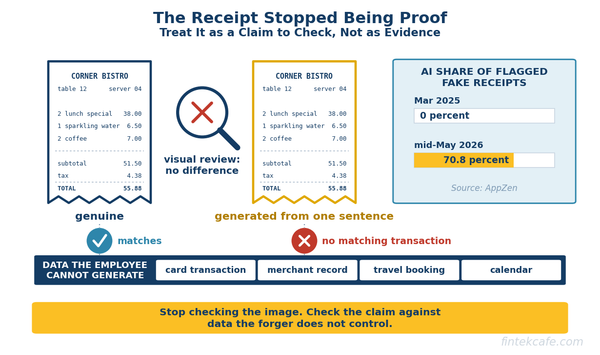
AI-Generated Fake Receipts: How Expense Fraud Changed and How Finance Teams Catch It
AI-generated fake receipts now beat visual review. How expense fraud changed, which detection still works, and the controls to use by company size.
Integration Platforms Are the Quiet Winners of the Agent Era
Agents act through integrations. iPaaS and API vendors hold the connectors, credentials and audit trails, and MCP makes governing that layer worth more.
What Happens to Your Data Inside AI Systems: Retention, Deletion and the Copies Nobody Tracks
Every AI feature copies company data into prompts, logs, embeddings and memory. Where each copy lives, what vendors retain, and how to make deletion real.