
Your Next Customer Is an Agent: How Buyer-Side AI Changes Sales, Service and Procurement
Ninety-four percent of business buyers say they use AI during their buying process, according to Forrester's survey of nearly 18,000 buyers worldwide (Forrester, The State of Business Buying, 2026, published January 21, 2026). Most enterprise AI strategy still assumes the opposite direction of travel: the company deploys agents to sell, market and serve, and a human customer sits at the other end. That assumption is already out of date.
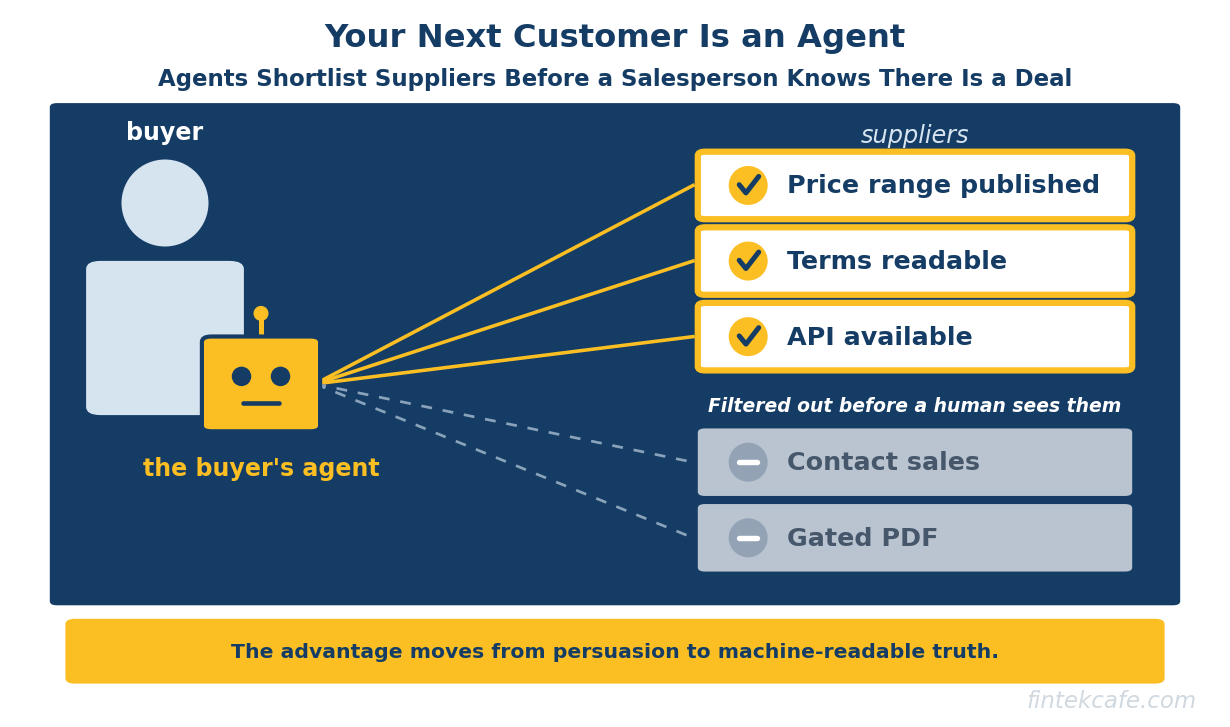
The buyer is deploying agents too. Agents shortlist suppliers before a salesperson knows there is a deal. They compare specifications and terms across ten websites in seconds. They draft the complaint, chase the refund and file the dispute. In procurement, they open the negotiation.
The thesis of this piece: when the buyer is an agent, the advantage moves from persuasion to machine-readable truth. Structured product data, real-time price and availability, clear terms, and an interface an agent can actually use become the things that win business. Companies that optimise only for human-facing funnels, with the landing page, the gated PDF and the "contact sales" form, will increasingly be filtered out before a human ever sees them.
This is not a payments story, although payment firms are building some of the plumbing. It is a change in how every customer-facing function works: sales, marketing, customer service, contracting and the supplier side of procurement. It belongs on the agenda of the chief revenue officer, the chief marketing officer and the chief operating officer at the same time.
The Buyer's Agent Is Already in the Room
The evidence that buyer-side AI is real comes in three layers: what buyers do today, what customers do in service, and what analysts forecast. They should not be confused.
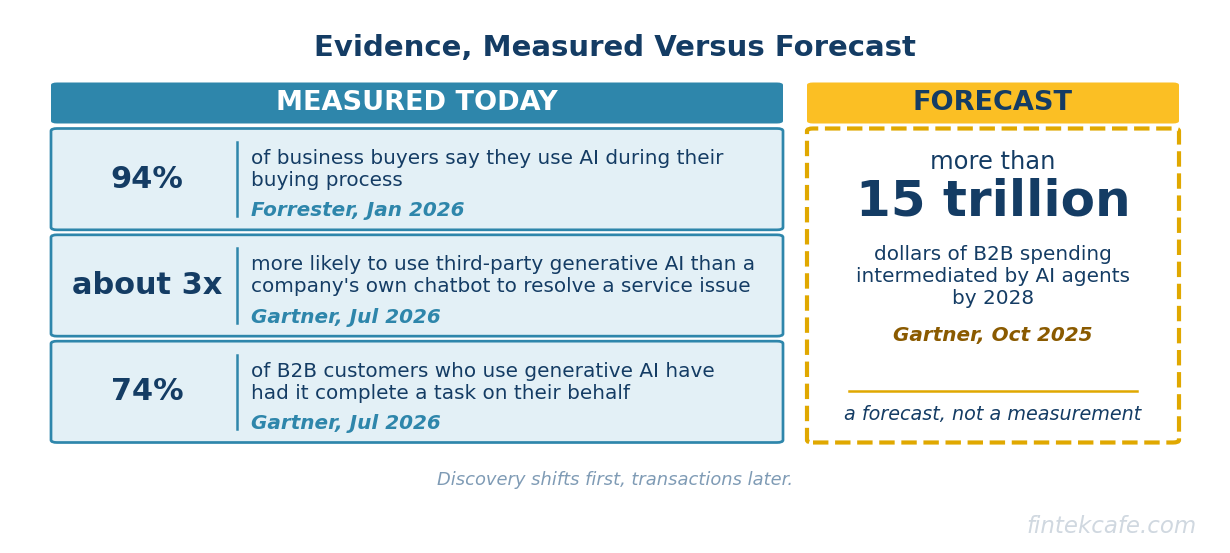
What buyers do today. Forrester's 94 percent figure covers AI use anywhere in the buying process, mostly research and comparison. The same research shows the limits. Buying groups average 13 internal stakeholders and nine external influencers, and procurement is a decision-maker in 53 percent of buying cycles. Forrester also found that AI search tools can deliver incomplete or unreliable information, so buyers check what the tools tell them with peers, analysts and suppliers. The buyer's agent is a filter and a research assistant, not yet the decision-maker.
What customers do in service. Gartner surveyed 3,566 business and consumer customers in February and March 2026. Customers were about three times more likely to use third-party generative AI tools than a company's own chatbot when resolving a service issue. Among customers who use generative AI, 58 percent had used it to complete a task on their behalf, rising to 74 percent among B2B customers. Third-party AI use in service nearly doubled in a year, while use of company chatbots has been statistically flat since 2022 (Gartner press release, July 8, 2026). Eric Keller, a senior director analyst at Gartner, put the consequence plainly: "GenAI is shifting some service interactions outside of company-owned channels."
What analysts forecast. At its IT Symposium/Xpo in October 2025, Gartner predicted that AI agents will intermediate more than 15 trillion dollars of B2B spending by 2028, and that 90 percent of B2B buying will be agent-mediated by then (Digital Commerce 360, November 28, 2025). That is a forecast, not a measurement, and the timeline is aggressive given how large buying groups remain.
The careful reading is this. Agents already shape which suppliers make the shortlist and how customers approach service. Agents that complete a whole purchase are early, and limited mostly to routine and repeat buying. But the filtering effect arrives first, and it arrives before anyone in the selling company notices. A supplier that is invisible or unreadable to the buyer's agent loses deals it never knew existed.
This is a Premium Article
Sign up for a Premium membership to read this article and get full access to strategic intelligence on technology and business.
Already a member? Sign in
Related Articles
AI for Legacy Code Migration: What Agents Can Modernize, and Where Rewrites Still Fail
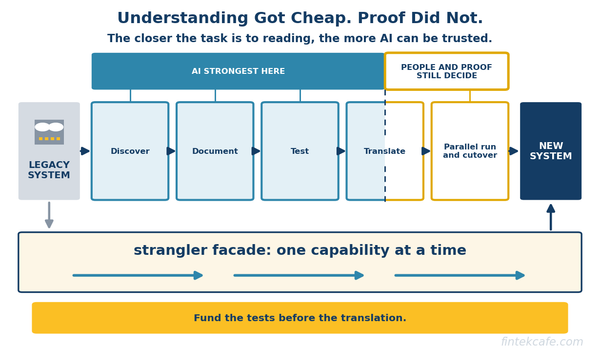
AI legacy code migration for executives: what agents do well, where COBOL rewrites still fail, and when to wrap, translate, rewrite or retire a system.
The Year-Two Copilot Audit: Why Enterprises Are Cutting AI Seat Licences, and Who Should Keep Them
AI assistant seats are up for renewal. Keep them for power users and proven workflows, pool the rest, and renegotiate with your own usage data.
AI in Marketing: What Generative AI Changes in Content, Campaigns and Brand Risk
AI in marketing for executives: what generative AI changes in content, campaigns and search, where brand risk sits, and what to automate or keep human.