
The AI Capex Bubble: Why Hyperscaler Spending Will Outrun Cloud Revenue Through 2027
The clean version of the AI infrastructure story is that the hyperscalers are spending heavily because the demand is real, the customers are real, and the revenue is arriving on schedule. The clean version is materially incomplete.
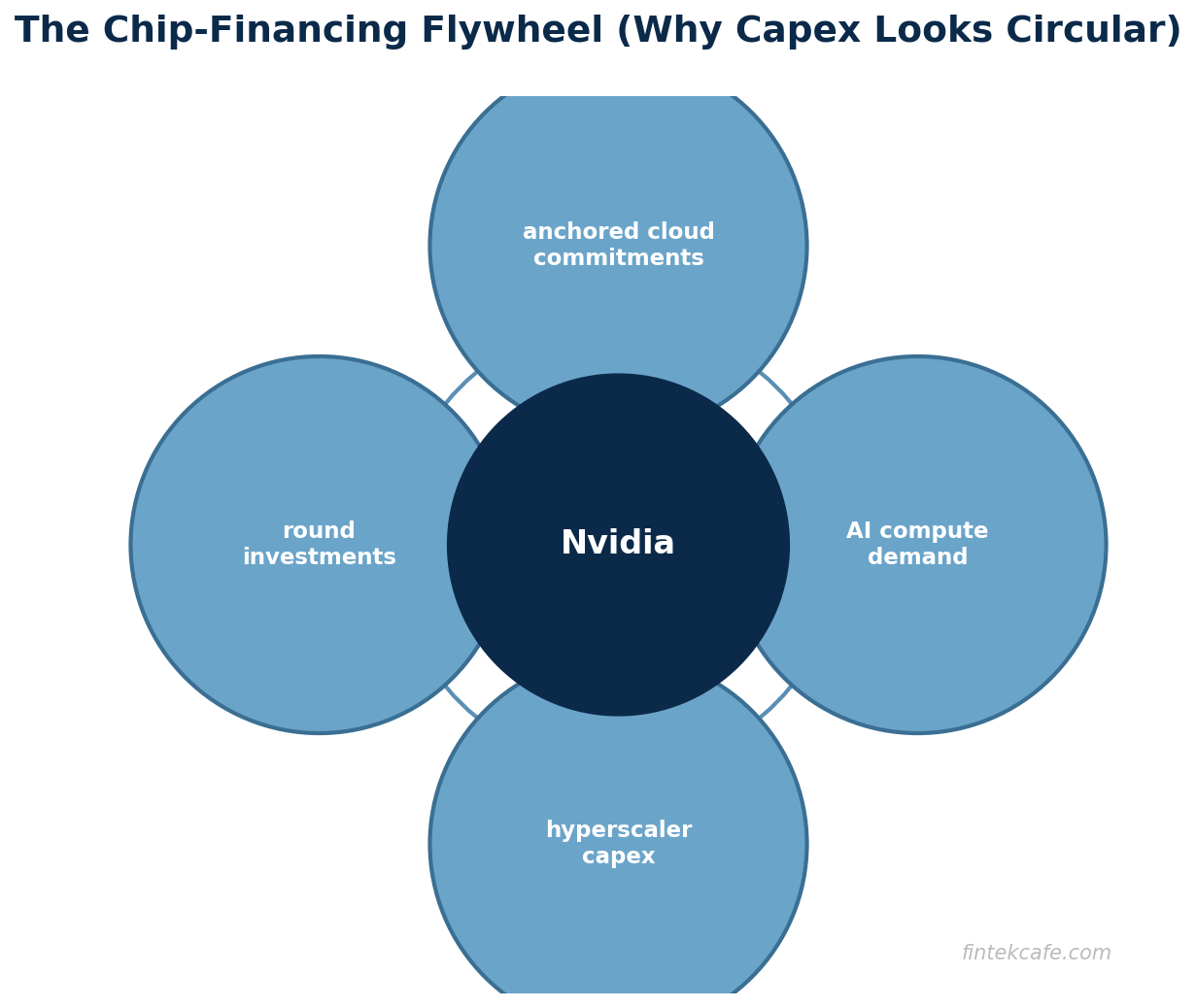
The 2025 ten-K filings of the five companies most exposed (Amazon, Microsoft, Alphabet, Meta, and Oracle) describe a capex trajectory through 2026 and 2027 that the public cloud revenue lines, even on aggressive assumptions, will not service for at least eighteen months and quite possibly longer. The gap is being closed in the meantime by a circular financing structure between Nvidia, the hyperscalers, and a small number of model labs, in which compute commitments and equity investments and reported revenue all reference the same underlying dollars more than once.
This is not a claim that AI is a bubble in the broad consumer sense, or that enterprise demand is fake. It is a narrower and more specific claim: the published growth rates that justify current infrastructure-provider valuations are partially manufactured by intra-industry transactions, the capex required to keep building is rising faster than the revenue that funds it, and the resolution path is materially different from the consensus analyst model. Enterprise buyers signing multi-year compute and model commitments in 2026 are signing them into a system whose financial geometry is more fragile than the marketing materials suggest.
What the 2025 Ten-Ks Actually Disclose
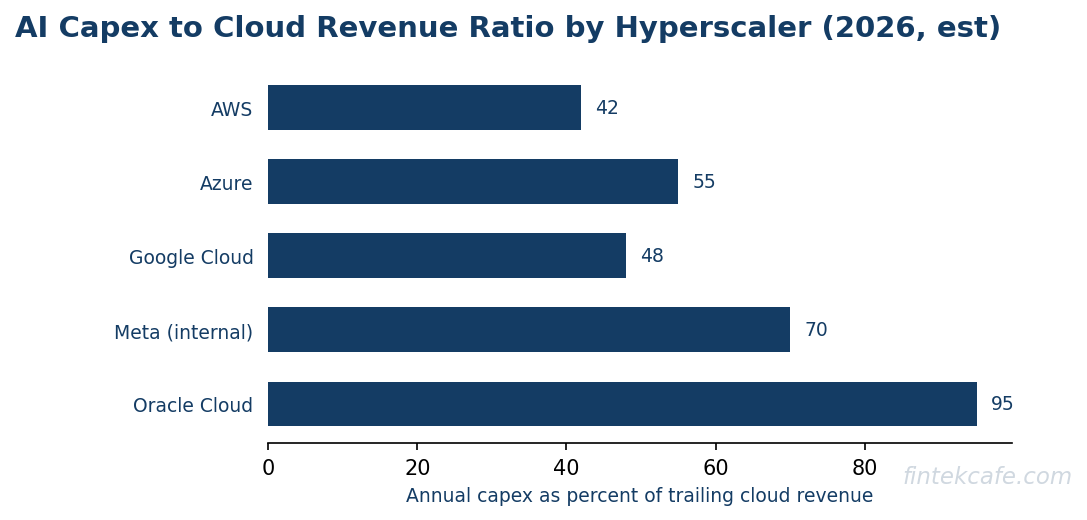
The disclosed 2025 capex numbers from the five infrastructure providers, taken from the ten-K filings and aggregated, run to a cohort total in the range of three hundred and twenty to three hundred and sixty billion USD, the majority of which is attributable to AI-specific data center build-out, GPU procurement, networking infrastructure, and power capacity. The 2026 capex guidance disclosed or signaled by the same providers points to a step up rather than a moderation. Multiple companies have explicitly told investors that capex intensity (capex divided by revenue) will remain elevated through at least 2027.
The corresponding cloud revenue lines tell a different story. AWS, Azure, and Google Cloud report annual run-rates that are growing at roughly the high teens to low thirties in percentage terms, depending on the segment and the quarter, with the AI-specific contribution disclosed in qualitative rather than quantitative terms. Oracle's OCI grew faster off a smaller base. Meta does not have a public cloud revenue line; its capex is internally absorbed and rationalized against advertising and AI product investment. The aggregate effect is that the capex denominator is growing faster than the revenue numerator across the cohort, and the divergence is widening, not narrowing.
The disclosure that matters most is the one most easily missed: depreciation. Capex spent in 2024 and 2025 is now flowing through income statements as accelerated depreciation on AI infrastructure with useful lives that the companies have, in several cases, recently extended from four years to six years. That accounting choice is what kept reported operating margins as resilient as they were in 2025. Without the useful-life extension, AWS, Azure, and Google Cloud operating margins in 2025 would have compressed by several hundred basis points each, and the AI-driven margin headwind would have been visible to public-equity investors in the quarterly cadence rather than buried in footnotes.
This matters because the useful-life extension is a one-time lever. It cannot be pulled twice. The 2026 and 2027 income statements will absorb the depreciation of 2024 to 2026 capex on the new schedule, but the absolute dollar amount is climbing fast enough that even the extended schedule will become visible in margin compression unless either revenue accelerates dramatically or capex slows.
This is a Premium Article
Sign up for a Premium membership to read this article and get full access to strategic intelligence on technology and business.
Already a member? Sign in
Related Articles
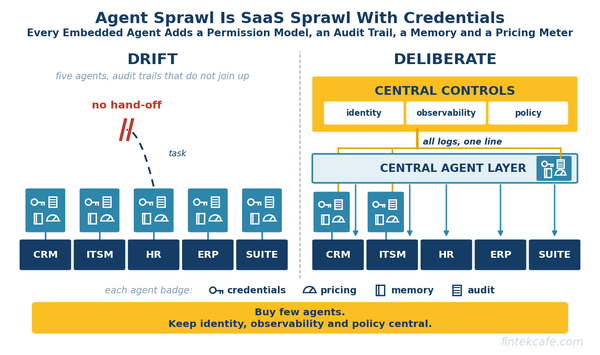
Every Software Vendor Now Sells an Agent, and Most Enterprises Should Buy Very Few of Them
Buying an agent from every system of record recreates SaaS sprawl one layer up. How CIOs should choose, and which controls must stay central.
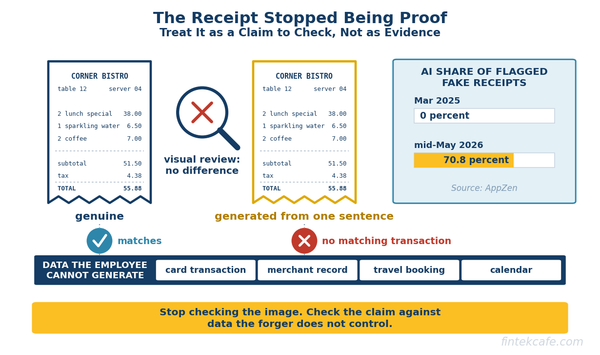
AI-Generated Fake Receipts: How Expense Fraud Changed and How Finance Teams Catch It
AI-generated fake receipts now beat visual review. How expense fraud changed, which detection still works, and the controls to use by company size.
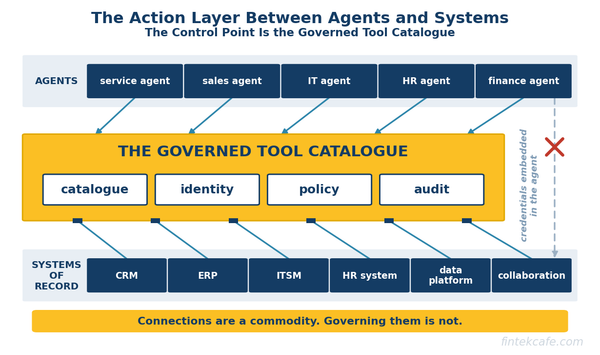
Integration Platforms Are the Quiet Winners of the Agent Era
Agents act through integrations. iPaaS and API vendors hold the connectors, credentials and audit trails, and MCP makes governing that layer worth more.