
What Is ISO 20022? The Payments Standard Quietly Reshaping Global Banking
Key Takeaways
- ISO 20022 is replacing legacy SWIFT MT messages and many domestic payment formats with a structured XML-based standard, enabling richer data on every transaction.
- The November 2025 SWIFT cutover has made coexistence the immediate operational reality, with full MT decommissioning following on a published timeline.
- Structured remittance data unlocks real-time fraud detection, automated reconciliation, sanctions screening, and cash forecasting that were not possible with legacy formats.
- Enterprises that treat ISO 20022 as a technical compliance project consistently underestimate the data, treasury, and ERP integration work involved.
- A practical readiness checklist focused on data mapping, vendor commitments, and reconciliation workflows separates organizations that benefit from the standard from those that just survive it.
The Quiet Standard Reshaping Payments
The most significant change in global payments infrastructure of the last decade is happening with very little public discussion outside the operations and treasury communities. ISO 20022, an open international standard for financial messaging, is replacing the messaging formats that have powered cross-border payments, securities settlement, and central bank payment systems for forty years. The transition has been underway since 2018, accelerated through 2023 and 2024, and reached a critical inflection point in November 2025 with the SWIFT cutover.
For executives outside the payments operations function, ISO 20022 looks technical. It is technical, but the consequences are strategic. The standard changes what data accompanies every payment, which in turn changes what payment systems can do. Real-time fraud detection, automated reconciliation, structured sanctions screening, and integrated cash forecasting all become possible at scale. The organizations that prepare for the standard capture these benefits. The organizations that treat the migration as a checkbox exercise survive but do not improve.
This article explains what ISO 20022 is, why every major network is migrating, what the November 2025 cutover means in practice, and what enterprise treasurers and fintechs need to do now.
What ISO 20022 Actually Is
ISO 20022 is an international standard published by the International Organization for Standardization that defines a common methodology for creating financial messages. The standard provides a shared business model, a data dictionary, and an XML-based syntax that financial messages must follow.
The key innovation is structured data. Legacy SWIFT MT messages used fixed-format text fields with limited length and minimal structure. The remittance information field on an MT103 cross-border payment, for example, allowed a few lines of free text. ISO 20022 messages, often referred to as MX messages, allow structured data fields for purpose codes, regulatory references, structured remittance information, and rich party identification.
The result is that an ISO 20022 payment message carries roughly five to ten times more usable structured data than the legacy MT message it replaces. That data is machine-readable in a standardized way, which is the entire point.
Why XML, Not JSON
Practitioners new to the standard often ask why financial messaging chose XML rather than the lighter JSON format common in modern APIs. The answer is regulatory and historical. ISO 20022 predates the JSON era, requires strict schema validation that XML schemas handle natively, and is processed primarily by infrastructure that was built for XML. Industry conversations about JSON-based variants are ongoing, but XML is and will remain the production format for the foreseeable future.
Why Every Major Network Is Migrating
The migration is not driven by a single regulator. It is driven by network-by-network decisions that all converged on the same standard, which itself is the strongest endorsement of where global payments are heading.
SWIFT
The SWIFT network, which carries the majority of global cross-border bank-to-bank payments, began its ISO 20022 migration for cross-border payments and reporting in March 2023. The original cutover was extended multiple times to give the industry more preparation time. The November 2025 milestone moved the network into the final phase of its transition, with MT message support continuing in coexistence mode through the published end-of-coexistence date.
European Central Bank
The Eurosystem migrated TARGET2 to TARGET, its renewed real-time gross settlement system, on the ISO 20022 standard in March 2023. The TIPS instant payment system uses ISO 20022 natively. EBA Clearing, which operates major euro payment infrastructures, has aligned its services on the same standard.
Federal Reserve and the United States
The Federal Reserve migrated the Fedwire Funds Service to ISO 20022 on March 10, 2025. The CHIPS network operated by The Clearing House also migrated to ISO 20022. The FedNow instant payments service launched on ISO 20022 from inception.
United Kingdom and Other Major Networks
The Bank of England's CHAPS system migrated to ISO 20022 in stages, with the enhanced data variant becoming mandatory in May 2023 for inbound messages. Bacs and Faster Payments are following on their own timelines. Major networks in Australia, Singapore, Japan, Switzerland, and Canada are all on ISO 20022 or in active migration.
The pattern is unambiguous. Within the next several years, virtually every significant payment network in the developed world will operate on ISO 20022 as its primary messaging standard.
What Structured Data Unlocks
The core value of ISO 20022 lies in what becomes possible when payments carry rich, structured, standardized data. Four categories of capability matter most for enterprises.
Real-Time Fraud Detection
Legacy MT messages provided sparse data for anomaly detection. The originator, beneficiary, amount, and a free-text reference. Modern fraud models perform far better when given structured fields: the purpose of the payment, the underlying invoice reference, the regulatory category, the relationship between sender and receiver, and the originating channel.
ISO 20022 provides all of these as structured fields. Banks and fintechs that ingest the structured data into their fraud platforms report meaningful reductions in false-positive rates and faster detection of new attack patterns. The data was always conceptually available; the standard makes it operationally usable at scale.
Sanctions and Compliance Screening
Sanctions screening on free-text legacy messages produces high false-positive rates because string matching is imprecise. Structured ISO 20022 fields for legal entity identifiers, country codes, and party roles allow screening systems to make far more accurate determinations.
The compliance benefit compounds. Lower false-positive rates mean fewer manual reviews, faster payment processing, lower compliance operating costs, and better customer experience for legitimate payments that previously got caught in screening queues.
Automated Reconciliation
For corporate treasurers, the structured remittance information block is the most valuable single feature of ISO 20022. A payment can carry the invoice number, the purchase order reference, the discount applied, the regulatory reporting code, and a structured creditor reference. Receivables reconciliation that previously required human matching against bank statements becomes a deterministic process.
Treasurers who have integrated structured remittance data into their ERP systems report reconciliation rates above 95 percent for properly formed ISO 20022 payments, compared to 60 to 75 percent on legacy formats. The labor savings in shared service centers are substantial.
Cash Forecasting
When payment messages carry structured purpose, expected settlement, and regulatory data, cash forecasting models become more accurate. Treasury teams can categorize inbound and outbound flows automatically, model intraday liquidity with greater precision, and reduce the buffers held against forecast uncertainty.
Use Cases by Industry
The strategic implications of ISO 20022 differ by where an organization sits in the payments stack. The four archetypes below capture the bulk of the migration economics.
Banks
For banks, ISO 20022 is both a regulatory requirement and a competitive asset. The regulatory side is straightforward: any bank that participates on SWIFT, Fedwire, CHIPS, TARGET, CHAPS, or FedNow must operate on the standard to remain in the network. The competitive side is where most strategic difference now lives. Banks that pass through structured remittance data unchanged to corporate clients differentiate against banks that summarize or strip the data on the way to customer reporting. Banks that ingest the structured fields into their fraud and compliance engines reduce false-positive rates and the operational cost of running those engines. Banks that publish corporate sandboxes for testing ISO 20022 messages earn share in the treasury RFP. Banks that defer the work treat their corporate clients to a degraded version of what the standard makes possible.
Fintechs
Fintech impact splits by business model. Payment processors, embedded-finance providers, and money-movement infrastructure platforms have to handle ISO 20022 end to end because their bank-side counterparts now require it. Fintechs that ride the rails as a software layer on top of banks have a narrower scope but still benefit from the richer reporting available to consume. The opportunities are largest for fintechs that purpose-build for the structured-data world: corporate treasury platforms that parse remittance information into ERP-consumable fields, sanctions-screening vendors that take advantage of structured legal-entity identifiers, and reconciliation engines that automate the matching work the standard makes deterministic.
Corporates and Treasurers
For corporates, the value of ISO 20022 is concentrated in receivables matching, payables straight-through processing, and intraday cash visibility. Treasury teams that wire the structured remittance block into their ERP receivables module can move reconciliation rates from the legacy 60 to 75 percent range up above 95 percent on properly formed messages, with material reductions in shared-service-center labor. Multinational treasuries with five or more banking partners pick up another benefit: the standard reduces the per-bank customization that used to consume integration budget, freeing capacity for higher-value treasury work. The corporates that lag are typically those that scoped the migration as an IT project rather than a treasury process redesign.
Central Banks and Regulators
Central banks have led the migration as much through example as through mandate. The Eurosystem, the Bank of England, the Federal Reserve, the Bank of Canada, the Reserve Bank of Australia, the Monetary Authority of Singapore, and the Swiss National Bank have all moved their core wholesale and instant payment systems onto ISO 20022. The motivation is partly operational and partly supervisory. Structured payment data makes the central bank's own monitoring of liquidity, market conduct, and financial stability sharper. It also creates the data foundation for the next layer of payment-system innovation: real-time gross settlement on tokenized money, central bank digital currencies, and cross-border instant payment links such as Project Nexus that connect domestic real-time rails. Each of those builds on a standardized message layer; without ISO 20022, the bridge work is bespoke.
Migration Timeline by Network
| Network | Key Migration Date | Status |
|---|---|---|
| TARGET2 (Eurosystem) | March 2023 | Live on ISO 20022 |
| SWIFT cross-border | March 2023, coexistence | Coexistence in final phase post Nov 2025 |
| Bank of England CHAPS | June 2023, enhanced May 2023 | Live with enhanced data |
| EBA Clearing EURO1 | March 2023 | Live on ISO 20022 |
| Federal Reserve Fedwire | March 10, 2025 | Live on ISO 20022 |
| The Clearing House CHIPS | April 2024 | Live on ISO 20022 |
| FedNow | July 2023 launch | Native ISO 20022 |
| SWIFT MT decommission | November 2025 cutover, full end of coexistence on published timeline | In final transition |
What the November 2025 SWIFT Cutover Actually Means
The November 2025 milestone has been widely discussed and frequently misunderstood. It is not a hard switch in which legacy MT messages stopped working. It is the date at which SWIFT entered the final phase of its multi-year coexistence period and began applying stricter requirements on the use of MT formats.
In practical terms, the cutover means three things for participating banks and their corporate clients. First, banks that have not yet migrated to MX for cross-border payments are now operating in a constrained mode that limits their access to the full ISO 20022 data set. Second, banks that have migrated are receiving payments enriched with MX data even when their counterparts send legacy formats, with SWIFT's translation services bridging the gap. Third, the operational pressure on the remaining laggards has increased sharply, both from SWIFT itself and from correspondent banks unwilling to absorb the costs of supporting two formats indefinitely.
The end-of-coexistence date, after which MT for cross-border payments will not be accepted on the network, is published on SWIFT's official program timeline and remains the definitive deadline for full migration.
MT Versus MX Message Anatomy
Comparing a legacy MT103 to its MX equivalent, the pacs.008 message, illustrates the change concretely.
| Element | MT103 (legacy) | pacs.008 (ISO 20022) |
|---|---|---|
| Format | Fixed-format text | Structured XML |
| Maximum length | About 2 kilobytes | Larger, with extensible fields |
| Originator data | Name and address as free text | Structured fields, optional LEI |
| Beneficiary data | Name and address as free text | Structured fields, optional LEI |
| Remittance information | Up to 4 lines of free text | Structured remittance block, multiple invoice references |
| Purpose code | Optional, limited values | Structured ISO purpose code |
| Regulatory reporting | Limited free text | Structured regulatory reporting block |
| Charges | Single field | Structured charges section |
A receiving system that knows how to parse the structured fields can automate work that previously required human judgment. A receiving system that does not is essentially treating the MX message as a richer MT, capturing only a fraction of the available value.
The Hidden Complexity of Migration
Most enterprise migration projects underestimate the work because they scope it as a technical messaging change rather than as the data and process change it actually is. Four areas consistently consume more time and budget than initial estimates suggest.
Data Quality and Mapping
ISO 20022 fields require structured, validated data. Originator addresses must be parsed into structured components. Legal entity identifiers, where required, must be sourced and maintained. Purpose codes must be selected accurately for each payment type. Many enterprises discover during migration that their existing master data is not clean enough to populate the required fields without significant remediation.
ERP and TMS Integration
Enterprise resource planning systems and treasury management systems must be configured to consume the structured data. ERP vendors have released ISO 20022 modules, but enterprise customers consistently find that the modules require non-trivial integration work, particularly for receivables matching against the structured remittance block.
Bank Connectivity
Each bank handles ISO 20022 slightly differently. Field availability, optionality, and reporting timing vary. Multinational treasuries that operate with five or more banking partners frequently discover that achieving consistent behavior across the partners requires sustained relationship management, not just technical configuration.
Reconciliation Process Redesign
The promise of automated reconciliation requires redesigning the reconciliation process to take advantage of structured fields. Legacy reconciliation processes built around string matching against free-text references will not capture the benefits even when the underlying data is now richer. Process redesign is organizational change, not technical change.
Vendor Readiness Checklist
The checklist below covers the questions every treasurer, payments leader, and fintech operator should be able to answer for each banking and technology partner.
Bank Partners
- Has the bank migrated all relevant payment products to ISO 20022, including cross-border, domestic high-value, and instant payments?
- For payments your business processes, what structured fields are populated, and which remain optional or empty?
- Does the bank pass structured remittance data through to customer reporting unmodified, or is it summarized?
- What is the bank's roadmap for any payment products still on legacy formats, including the dates and any conditions?
- For inbound payments, does the bank deliver the full pacs.008 fields in customer reporting, or only a subset?
- What support does the bank offer for testing and validation in the corporate sandbox, and what is the response time on issues?
Treasury Management System and ERP
- Does the system natively consume ISO 20022 reporting messages, including camt.052, camt.053, and camt.054?
- Does the system parse structured remittance information into ERP-consumable fields, or treat it as a free-text block?
- What is the upgrade path required to support the most current ISO 20022 message versions, and what is the vendor commitment to ongoing version support?
- How are sanctions screening and fraud detection rules configured to use new structured fields?
- What is the testing strategy for migration, and what regression testing does the vendor provide?
Internal Readiness
- Has master data been audited for completeness against ISO 20022 mandatory fields?
- Have purpose codes been mapped for each business payment type?
- Has the reconciliation process been redesigned to use structured remittance fields?
- Have operations and treasury teams been trained on the data model, not just the technical change?
- Is there a designated owner for ISO 20022 program management with executive sponsorship?
What to Do in the Next 90 Days
For organizations that have not yet started or are mid-migration, three actions are urgent.
First, complete the readiness assessment using the checklist above. The output should be a written status report by partner and by capability, with a clear list of gaps. The document is the basis for all subsequent prioritization.
Second, prioritize the data quality work. Without clean, structured master data, the technical migration produces ISO 20022 messages that look compliant but carry the same impoverished content as the MT messages they replace. The benefits do not appear, and the budget produces no return.
Third, designate a single executive owner. ISO 20022 migration spans operations, treasury, IT, finance, and compliance. Programs that lack a single accountable executive consistently miss deadlines, fragment investment, and produce shelf-ware. The right owner is typically the head of payments operations or the corporate treasurer, depending on the organization.
Frequently Asked Questions
What is the difference between ISO 20022 and SWIFT MT?
ISO 20022 and SWIFT MT are two generations of financial messaging standards. SWIFT MT, introduced in the 1970s, uses fixed-format text fields with limited length and limited structure; the canonical example is the MT103 cross-border payment message. ISO 20022 is an international standard published by the International Organization for Standardization, codified as XML, and carrying roughly five to ten times more usable structured data than its MT equivalent. The ISO 20022 message that replaces MT103 is pacs.008. SWIFT itself is migrating from MT to MX (the SWIFT term for ISO 20022 messages) on its cross-border network; the November 2025 cutover moved that migration into its final phase.
Do I need to migrate if I am using a US bank?
If your business sends or receives any payment that traverses Fedwire, CHIPS, FedNow, or any SWIFT cross-border message, the underlying message is already on ISO 20022 or is being migrated to it on a published timetable. Fedwire migrated on March 10, 2025; CHIPS migrated in April 2024; FedNow launched on ISO 20022 in July 2023. Even if your internal ERP and treasury systems are not migrating directly, your US bank's customer reporting is increasingly delivered on ISO 20022 messages. Capturing the structured fields requires your TMS, ERP, or accounting system to be configured to parse them; otherwise, your bank is producing data that your business is not consuming.
How much does ISO 20022 migration typically cost?
Published industry estimates and the consulting firms that advise on payment-system migration place the total program cost for a large global bank in the high tens of millions of dollars to low hundreds of millions of dollars, spread over three to five years. Mid-sized regional banks and fintechs typically report programs in the low millions to tens of millions. For corporates, the work is concentrated in TMS and ERP configuration, master-data remediation, and reconciliation-process redesign rather than messaging infrastructure itself; multinational treasury programs commonly run in the low millions over two to three years. The cost driver is rarely the message format itself; it is the data quality, integration, and process redesign work the migration surfaces.
Does ISO 20022 affect FedNow, RTP, and SEPA Instant?
Yes, and the effect on instant payment systems is structurally different from the effect on legacy rails. FedNow launched natively on ISO 20022 in July 2023, RTP from The Clearing House has been on ISO 20022 since its 2017 launch, and SEPA Instant from the Eurosystem operates on ISO 20022 from inception. For these rails the standard is not a migration target; it is the only message format ever supported. The practical implication is that any organization connecting to a domestic instant-payment rail in 2026 is signing up for ISO 20022 by definition. The benefits of structured remittance information, structured purpose codes, and richer party identification are immediately available on every transaction without a coexistence period to wait through.
Is ISO 20022 mandatory for your organization?
If your organization sends or receives payments through any major bank or network operating on ISO 20022, you are already affected, even if your internal systems are not directly migrating. The structured data your bank now produces in customer reporting is on ISO 20022 messages, and the value of that data depends on your ability to consume it.
What happens to MT messages after the SWIFT end of coexistence?
For cross-border payment messages on the SWIFT network, MT formats will be retired on the published end-of-coexistence date. After that date, only ISO 20022 MX messages will be accepted for the affected message types. Banks and corporate clients that have not migrated will be unable to send or receive these messages.
Will adopting ISO 20022 reduce payment costs?
Direct transaction costs are unlikely to fall as a result of ISO 20022 alone. Indirect savings, particularly in reconciliation, sanctions screening, and fraud operations, are substantial when the structured data is fully used. The savings appear in operations budgets, not in payment fees.
Does ISO 20022 affect retail payments and consumer transactions?
ISO 20022 is being adopted in many retail and instant payment systems, including FedNow, TIPS, and several domestic real-time payment networks. For consumer transactions in card networks like Visa and Mastercard, the relevant standards differ, although ISO 20022 alignment is increasing in adjacent areas.
How does ISO 20022 interact with open banking and APIs?
Open banking APIs and ISO 20022 messages serve overlapping but distinct purposes. APIs enable real-time interaction with bank systems for account data and payment initiation. ISO 20022 is the underlying messaging standard for the payments themselves. Mature implementations use both, with APIs for initiation and reporting and ISO 20022 for the underlying clearing and settlement.
What are the most common migration mistakes?
Treating the project as a technical message format change rather than a data and process change. Underinvesting in master data quality. Failing to redesign reconciliation processes. Spreading ownership across too many functions without an executive owner. Assuming the vendor's out-of-the-box support is sufficient without testing against real banking partners.
Internal Reading
Related Articles
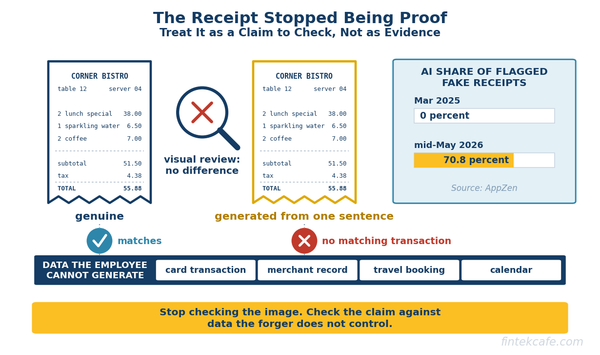
AI-Generated Fake Receipts: How Expense Fraud Changed and How Finance Teams Catch It
AI-generated fake receipts now beat visual review. How expense fraud changed, which detection still works, and the controls to use by company size.
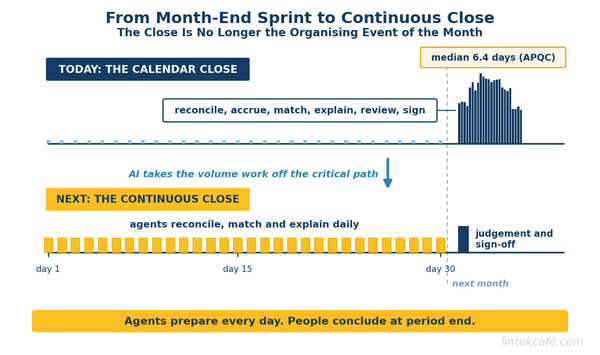
The Monthly Close Is Becoming Continuous, and the Finance Calendar Will Not Survive It
AI is taking the bottleneck work out of the month-end close. The close becomes continuous with a short sign-off, and finance, audit and the board change.
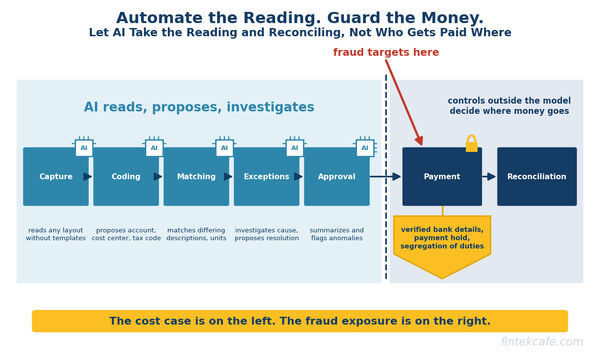
Accounts Payable Automation: What AI Can Actually Take Over in Invoice-to-Pay
What AI can take over in accounts payable, step by step from capture to payment, where the fraud risk grows, and which controls must stay outside the model.