
What Is FinOps? A Practical Guide for Finance and Technology Leaders
Key Takeaways
- FinOps is a cultural practice, not a tool purchase. It creates shared accountability for cloud spend between finance, engineering, and business teams.
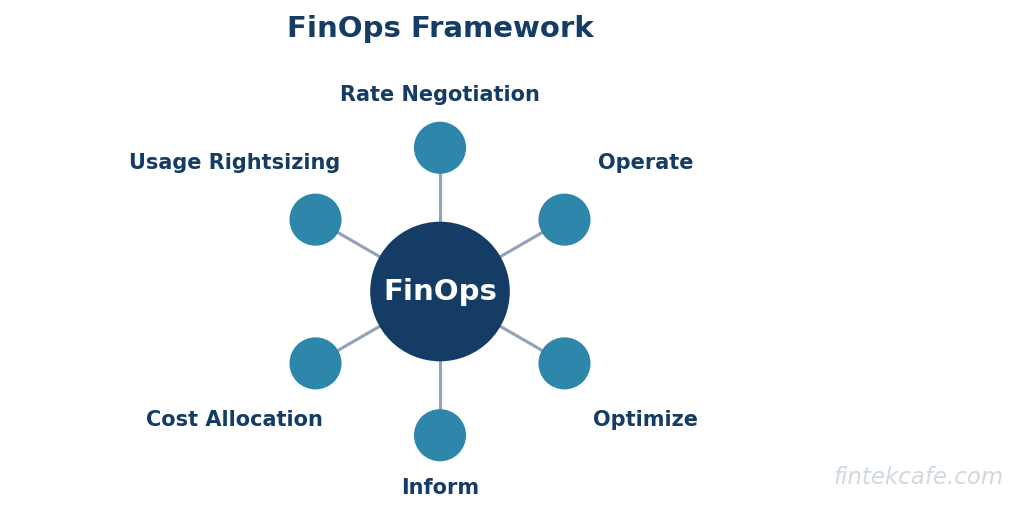
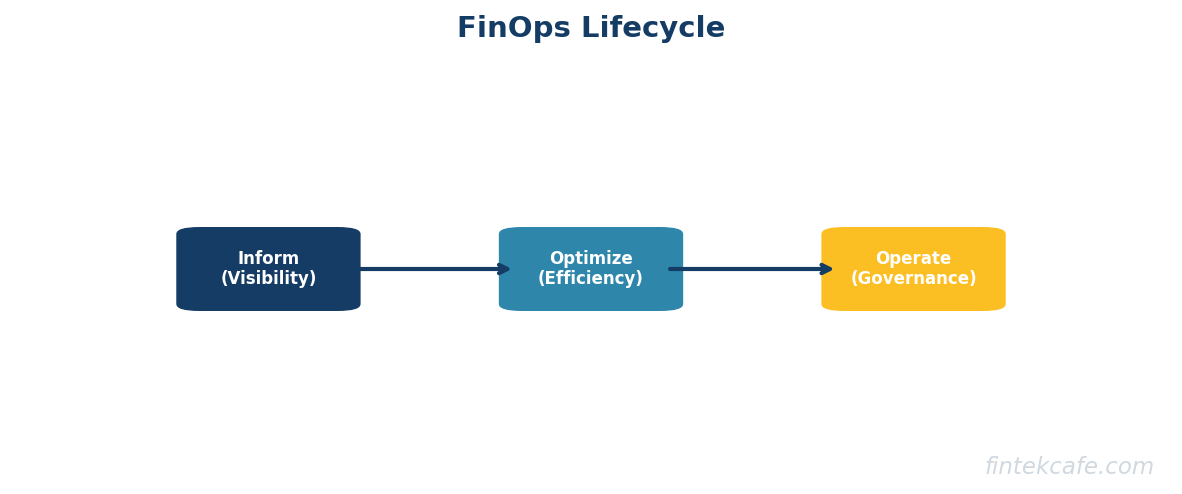
- The framework operates in three phases: Inform, Optimize, and Operate. Most organizations stall in the first phase because they skip the cultural work.
- Unit economics (cost per transaction, cost per customer, cost per environment) matter more than total cloud spend.
- Showback builds awareness. Chargeback drives behavior change. The right choice depends on organizational maturity.
- Organizations spending more than 5 million per year on cloud infrastructure should evaluate a dedicated FinOps practitioner before investing in tooling.
What FinOps Actually Means
FinOps, short for Cloud Financial Operations, is the practice of bringing financial accountability to cloud spending. It sounds simple, but the shift it demands is significant. In the traditional data center model, infrastructure was a capital expense approved once and depreciated over years. Cloud flipped that model entirely. Infrastructure became an operational expense that any engineer with the right credentials could increase with a single API call.
That shift created a fundamental disconnect. Finance teams accustomed to predictable quarterly costs suddenly faced variable bills that spiked without warning. Engineering teams accustomed to requesting hardware through procurement suddenly had unlimited access to compute resources with no built-in spending guardrails. FinOps exists to close that gap.
The FinOps Foundation, part of the Linux Foundation, defines it as "an evolving cloud financial management discipline and cultural practice that enables organizations to get maximum business value by helping engineering, finance, and business teams to collaborate on data-driven spending decisions."
The key word in that definition is "cultural." Organizations that treat FinOps as a tooling problem consistently underperform those that treat it as a collaboration problem.
The Three Phases of FinOps
The FinOps framework organizes cloud financial management into three iterative phases. These are not sequential stages that an organization completes and moves past. They form a continuous cycle that teams revisit as cloud usage evolves.
Phase 1: Inform
The first phase focuses on visibility. Before anyone can optimize cloud spending, every stakeholder needs to see what the organization spends, where the money goes, and who drives the costs.
Core activities in this phase:
-
Tagging and allocation: Every cloud resource gets tagged with metadata identifying the team, project, environment, and cost center responsible. Without consistent tagging, cost allocation is guesswork. Industry benchmarks suggest that organizations with less than 80 percent tagging coverage cannot reliably attribute costs to business units.
-
Cost reporting and dashboards: Build or deploy dashboards that show spend by team, service, environment, and time period. The audience matters: engineers need granular, real-time data; finance leaders need monthly trends and forecasts; executives need business-unit-level summaries.
-
Anomaly detection: Set up alerts for unexpected cost spikes. A forgotten test environment running GPU instances over a weekend can generate thousands in unplanned costs. Automated detection catches these before the monthly bill arrives.
-
Unit economics: Calculate the cost per meaningful business unit. Cost per transaction, cost per active user, cost per API call, or cost per environment. Total cloud spend is a vanity metric. Unit economics reveal efficiency.
Common failure in this phase: Organizations build dashboards but nobody looks at them. The Inform phase succeeds only when cost data becomes part of regular team rituals, such as sprint reviews, monthly business reviews, and architecture decisions.
Phase 2: Optimize
With visibility established, the second phase focuses on reducing waste and improving efficiency. The optimization levers fall into three categories.
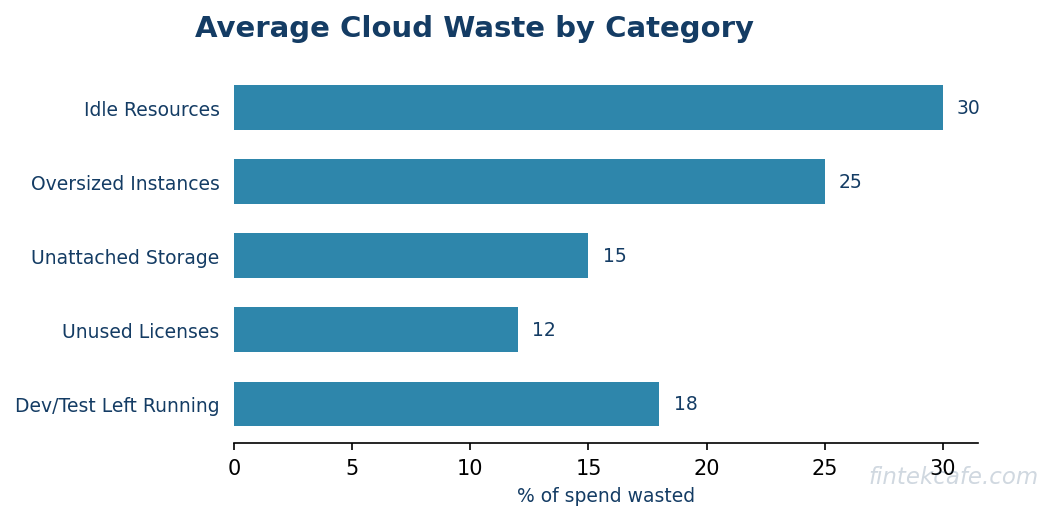
Right-sizing: Matching resource allocation to actual usage. Industry research consistently finds that 30 to 40 percent of cloud instances are oversized for their workloads. A database server provisioned for peak holiday traffic runs at 15 percent utilization the other 11 months of the year. Right-sizing addresses this by adjusting instance types, scaling policies, and resource allocations based on observed usage patterns.
Rate optimization: Reducing the per-unit cost of cloud resources through commitment-based pricing.
-
Reserved Instances (RIs): Commit to one or three years of usage for a specific instance type in exchange for discounts of 30 to 60 percent compared to on-demand pricing. The tradeoff is flexibility. A three-year commitment to a specific instance family locks the organization into that choice even if requirements change.
-
Savings Plans: A more flexible alternative offered by major cloud providers. Commit to a consistent amount of hourly spend (measured in cost per hour) rather than a specific instance type. Savings Plans offer slightly lower discounts than RIs but significantly more flexibility.
-
Spot and Preemptible Instances: Use spare cloud capacity at discounts of 60 to 90 percent for workloads that tolerate interruption. Batch processing, testing, and stateless microservices are strong candidates. Production databases are not.
Architecture optimization: Redesigning systems to use cloud resources more efficiently. Serverless architectures eliminate idle compute costs. Tiered storage moves infrequently accessed data to cheaper storage classes. Caching layers reduce redundant API calls and database queries.
The reserved instance math: Consider an organization running 100 instances of a specific type 24/7. On-demand pricing might cost the equivalent of 100 units per month. A one-year reserved instance commitment reduces that to 60 units per month, saving 40 percent. A three-year commitment reduces it further to 40 units per month. The break-even point for a one-year RI is typically seven to eight months. If the organization is confident the workload will run for at least that long, the commitment pays for itself.
Phase 3: Operate
The third phase embeds FinOps into the organization's operating rhythm. Optimization is not a one-time project. It requires ongoing governance, automation, and cultural reinforcement.
Governance structures: Establish a FinOps team or practice with clear ownership. Define policies for tagging compliance, budget thresholds, approval workflows for large resource provisioning, and regular cost reviews.
Automation: Automate the enforcement of FinOps policies wherever possible. Automatically shut down non-production environments outside business hours. Auto-scale resources based on demand. Flag untagged resources for remediation. Schedule reserved instance purchases based on usage forecasts.
Continuous improvement: Treat cloud cost efficiency as an ongoing practice, not a quarterly cleanup. The most effective organizations review unit economics weekly, optimize commitments monthly, and reassess architecture quarterly.
Showback vs Chargeback
One of the most consequential decisions in FinOps implementation is how cloud costs flow back to business units. Two models dominate.
Showback
Cloud costs are allocated and displayed to business units, but no actual money changes hands internally. Teams see what they spend, but their budgets are not directly impacted.
Advantages: Lower friction to implement. Teams build awareness without the political complexity of internal billing. Useful in organizations where cloud spending is still relatively small or where the culture resists internal cost transfers.
Disadvantages: Without financial consequences, showback often fails to drive behavior change. Teams acknowledge the data and continue overspending because there is no penalty.
Chargeback
Cloud costs are allocated to business units and deducted from their budgets. Teams pay for what they use.
Advantages: Strong incentive to optimize. When cloud waste comes out of a team's budget, that team finds the motivation to right-size instances and clean up unused resources. Chargeback creates genuine ownership.
Disadvantages: Requires accurate, defensible cost allocation. If the chargeback model is perceived as unfair (charging a team for shared infrastructure they did not choose), it creates political conflict rather than accountability. Also requires mature tagging and allocation practices; implementing chargeback with poor cost attribution creates more problems than it solves.
The Recommended Path
Start with showback. Build tagging discipline, establish trust in the data, and let teams develop cost awareness. Transition to chargeback once allocation accuracy exceeds 85 percent and the organization has at least six months of consistent cost data. This phased approach avoids the political backlash that comes from charging teams based on unreliable numbers.
The Role of the FinOps Practitioner
As cloud spending grows, organizations reach a point where cost management cannot remain a side responsibility. The FinOps practitioner is a dedicated role that bridges finance, engineering, and business operations.
Core Responsibilities
- Cost analysis and reporting: Produce regular cost reports for stakeholders at every level. Translate raw cloud billing data into business-relevant insights.
- Optimization recommendations: Identify savings opportunities across right-sizing, commitment purchases, and architecture changes. Quantify the potential impact of each recommendation.
- Governance and policy: Define and enforce tagging standards, budget policies, and approval workflows. Monitor compliance and escalate violations.
- Forecasting: Build cloud cost forecasts based on historical trends, planned product launches, and capacity models. Finance teams depend on these forecasts for budgeting.
- Vendor management: Negotiate enterprise agreements with cloud providers. Evaluate and recommend third-party FinOps tools.
Where This Role Reports
The FinOps practitioner often reports to the VP of Engineering, the CFO's office, or a dedicated Cloud Center of Excellence. The most effective placement depends on the organization's primary pain point. If overspending is driven by engineering decisions, place the role closer to engineering. If the problem is forecasting accuracy, place it closer to finance.
When to Hire vs When to Buy a Tool
The FinOps tooling market has grown rapidly, with platforms like Cloudability, Apptio Cloudability (now IBM), Vantage, and native cloud provider tools all competing for attention. The decision between hiring a practitioner and purchasing a tool is not either/or, but the sequencing matters.
Hire First When:
- Annual cloud spend exceeds 5 million. At this scale, even small percentage optimizations yield significant savings.
- The organization lacks basic tagging and allocation practices. No tool fixes a governance gap.
- Cloud cost decisions are spread across more than five teams with no coordination.
- The organization needs someone to build the FinOps culture, not just run reports.
Buy a Tool First When:
- Annual cloud spend is between 500,000 and 5 million. A tool provides visibility without the cost of a dedicated hire.
- Tagging and allocation practices are already mature and the primary need is better dashboards and automation.
- The organization uses multiple cloud providers and needs a unified view across AWS, Azure, and GCP.
Tool Comparison Overview
| Tool | Strengths | Best For |
|---|---|---|
| Cloudability (IBM) | Deep allocation, enterprise reporting | Large enterprises, multi-cloud |
| Vantage | Developer-friendly, fast setup | Engineering-led organizations |
| AWS Cost Explorer | Native integration, no extra cost | AWS-only environments |
| Azure Cost Management | Native integration, budget alerts | Azure-only environments |
| GCP Billing Reports | BigQuery export, custom analysis | GCP-only, data-savvy teams |
| Kubecost | Kubernetes-specific cost allocation | Container-heavy workloads |
FinOps Maturity Assessment
Organizations can evaluate their FinOps maturity across six dimensions. Rate each on a scale of 1 (ad hoc) to 5 (optimized).
Dimension 1: Cost Visibility
- Level 1: No consistent cost reporting. Teams rely on monthly cloud invoices.
- Level 3: Dashboards show spend by team and service. Updated weekly.
- Level 5: Real-time cost visibility with automated anomaly detection. Unit economics tracked per product.
Dimension 2: Tagging and Allocation
- Level 1: Less than 30 percent of resources tagged. Cost allocation is manual.
- Level 3: 70 to 85 percent tagging coverage. Automated tagging for new resources.
- Level 5: Over 95 percent coverage. Automated enforcement blocks untagged resource creation.
Dimension 3: Rate Optimization
- Level 1: All resources on on-demand pricing.
- Level 3: Reserved instances or savings plans cover 50 to 70 percent of steady-state workloads.
- Level 5: Dynamic commitment management. Spot instances used for all eligible workloads. Coverage exceeds 80 percent.
Dimension 4: Architecture Efficiency
- Level 1: No consideration of cost in architecture decisions.
- Level 3: Cost is a factor in architecture reviews. Right-sizing happens quarterly.
- Level 5: Cost-aware architecture is the default. Auto-scaling, serverless, and tiered storage are standard patterns.
Dimension 5: Organizational Alignment
- Level 1: Finance and engineering do not collaborate on cloud costs.
- Level 3: Regular cross-functional cost reviews. Showback in place.
- Level 5: Full chargeback. Engineering teams own their cost targets. FinOps is embedded in the development lifecycle.
Dimension 6: Forecasting Accuracy
- Level 1: No cloud cost forecasts. Monthly bills are a surprise.
- Level 3: Quarterly forecasts within 15 percent accuracy.
- Level 5: Monthly forecasts within 5 percent accuracy. Forecasts updated automatically based on usage trends.
Scoring guide: A total score below 12 indicates the organization is in the crawl stage. Between 12 and 22 indicates the walk stage. Above 22 indicates the run stage. Most organizations start the FinOps journey at 8 to 10.
Frequently Asked Questions
How much can FinOps actually save an organization?
Industry benchmarks from the FinOps Foundation suggest that mature FinOps practices reduce cloud waste by 20 to 30 percent. For an organization spending 10 million per year on cloud infrastructure, that represents 2 to 3 million in annual savings. The first six months typically yield the largest gains as obvious waste (unused resources, oversized instances, missing commitments) gets addressed.
Is FinOps only relevant for large enterprises?
No, but the approach scales with the problem. Organizations spending less than 100,000 per year on cloud can manage costs with native cloud tools and basic tagging discipline. The formal FinOps framework becomes valuable once cloud spend exceeds 500,000 per year or involves more than three teams making independent purchasing decisions.
How long does it take to implement FinOps?
The Inform phase typically takes two to three months. Reaching a mature Optimize phase takes six to twelve months. Full organizational adoption (the Operate phase) usually requires 12 to 18 months. Organizations that try to skip the Inform phase and jump directly to optimization consistently report poor results because they are optimizing based on incomplete data.
What is the relationship between FinOps and DevOps?
FinOps extends the DevOps principle of shared ownership to include financial accountability. In a mature DevOps culture, engineers own the reliability of their services. In a mature FinOps culture, engineers also own the cost efficiency of their services. The two practices are complementary: DevOps provides the automation infrastructure (CI/CD, infrastructure as code) that FinOps leverages for cost governance.
Can FinOps work in a multi-cloud environment?
Yes, but multi-cloud adds complexity to every FinOps activity. Tagging conventions differ across providers. Commitment-based pricing structures are provider-specific. Cost allocation models must normalize data from multiple billing systems. Organizations running significant workloads across two or more cloud providers should strongly consider a third-party FinOps tool that provides a unified view.
Who should lead FinOps in an organization?
The ideal FinOps leader combines financial literacy, technical understanding, and strong communication skills. This person does not need to write code, but must understand cloud architecture well enough to evaluate optimization recommendations. Equally important is the ability to translate technical decisions into financial impact for CFO-level conversations. Common backgrounds include cloud architecture, financial planning and analysis, and technical program management.
Internal Links
- Cloud Computing Explained: What Every Executive Needs to Know
- Infrastructure as Code: A Guide for Technology Leaders
- An Executive Guide to Cloud Costs
- DevOps Explained: A Guide for Non-Technical Leaders
- How to Build an AI Strategy That Survives First Contact with Reality
Related Articles
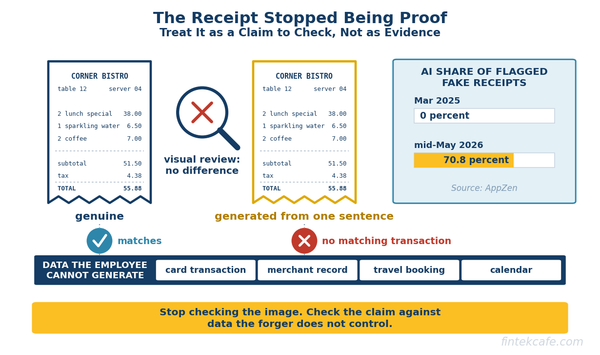
AI-Generated Fake Receipts: How Expense Fraud Changed and How Finance Teams Catch It
AI-generated fake receipts now beat visual review. How expense fraud changed, which detection still works, and the controls to use by company size.
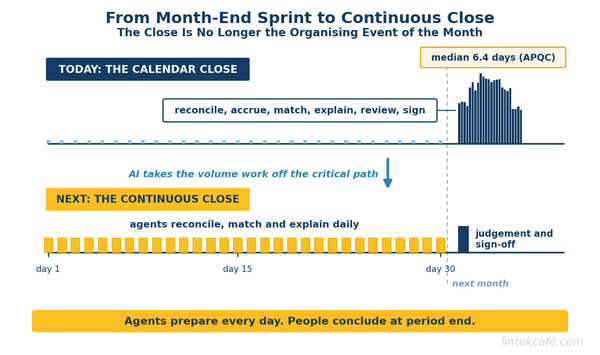
The Monthly Close Is Becoming Continuous, and the Finance Calendar Will Not Survive It
AI is taking the bottleneck work out of the month-end close. The close becomes continuous with a short sign-off, and finance, audit and the board change.
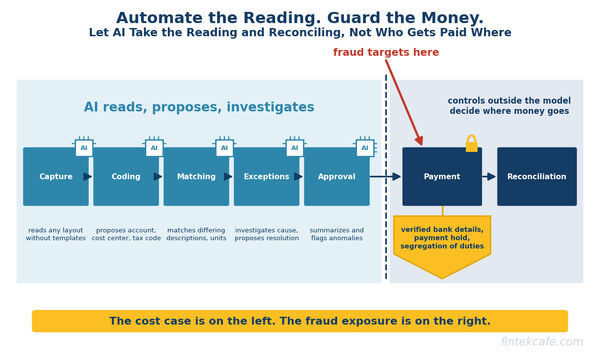
Accounts Payable Automation: What AI Can Actually Take Over in Invoice-to-Pay
What AI can take over in accounts payable, step by step from capture to payment, where the fraud risk grows, and which controls must stay outside the model.