
Trade Finance Explained: Letters of Credit, Factoring, and Supply Chain Finance
The $5 Trillion Infrastructure Nobody Talks About
Every iPhone assembled in Zhengzhou, every container of Brazilian soybeans unloaded in Rotterdam, every batch of Vietnamese electronics shipped to a German retailer - all of it depends on a financial system that most technology people have never heard of.
Trade finance is the $5 to $6 trillion market that makes global commerce physically possible. It solves a problem so obvious it's easy to miss: when a buyer in Munich and a seller in Ho Chi Minh City have never met, neither speaks the other's language, and $2 million worth of circuit boards is sitting in a container somewhere in the South China Sea - who moves first?
The buyer won't pay before the goods arrive. The seller won't ship before they get paid. Without a trusted intermediary to break the deadlock, global trade stops.
Trade finance is that intermediary. It has existed in recognizable form since Venetian merchants financed the Silk Road. And despite decades of promises from fintech startups, it still runs on paper, fax machines, and the credit relationships between a small number of large banks.
The Fundamental Trust Problem in International Trade
To understand why trade finance exists, you need to feel the asymmetry at the heart of every cross-border transaction.
A domestic sale is relatively low-risk. If the buyer doesn't pay, the seller can sue. Courts are accessible, contracts are enforceable, and the goods are nearby. A cross-border sale reverses every one of those assumptions. Jurisdiction is unclear, enforcement is expensive, the goods are on a ship for six weeks, and the parties may have no prior relationship at all.
This creates a classic standoff. The exporter in Vietnam faces counterparty risk - what if the German importer receives the electronics and simply refuses to pay? The importer in Germany faces performance risk - what if the Vietnamese factory ships substandard goods, or ships nothing at all?
Neither party is being unreasonable. They're each correctly identifying a real risk.
Banks solve this through two basic mechanisms. First, they substitute their own creditworthiness for the creditworthiness of unknown counterparties. A Vietnamese exporter may not trust a German retailer, but they trust Deutsche Bank. Second, they tie payment to documented proof of performance - shipping documents, bills of lading, inspection certificates - rather than to trust between strangers.
The instruments that implement this logic are letters of credit, factoring, and supply chain finance. Each solves a slightly different version of the problem.
Letters of Credit: How They Work, Step by Step
A letter of credit (LC) is a bank's written commitment to pay an exporter, provided the exporter presents documents proving they shipped the correct goods on time. It is, at its core, a conditional payment guarantee.
Here is how a real transaction works:
Step 1 - The commercial agreement. A German electronics retailer (the importer) and a Vietnamese manufacturer (the exporter) agree on a $2 million order. Payment terms: letter of credit.
Step 2 - Application. The German importer applies to its bank - say, Deutsche Bank - for a letter of credit. Deutsche Bank reviews the importer's creditworthiness and, if approved, issues the LC. The LC specifies exactly what documents the exporter must present to receive payment: a bill of lading, a commercial invoice, a packing list, an insurance certificate, and an inspection report.
Step 3 - LC transmission. Deutsche Bank sends the LC to the exporter's bank in Vietnam - say, Vietcombank. Vietcombank "advises" the LC to the exporter, confirming it is authentic. If Vietcombank also "confirms" the LC, it adds its own payment guarantee on top of Deutsche Bank's - the exporter now has two banks on the hook.
Step 4 - Shipment. The Vietnamese manufacturer produces and ships the goods. The shipping company issues a bill of lading - the key document that proves the goods are on their way and controls who can claim them at the destination port.
Step 5 - Document presentation. The exporter takes the full set of documents - bill of lading, invoice, inspection certificate - to Vietcombank. The bank examines the documents against the LC terms, character by character. This is not a cursory review. If the invoice says "electronics components" and the LC says "electronic components," there is a discrepancy. Banks operate on the principle of strict compliance: documents must match the LC exactly.
Step 6 - Payment. If the documents comply, Vietcombank pays the exporter (often immediately, sometimes at a future maturity date). Vietcombank then presents the documents to Deutsche Bank for reimbursement. Deutsche Bank debits the importer's account and releases the documents, which the importer needs to take possession of the goods at the port.
The result: the Vietnamese exporter gets paid as soon as documents are correct, without trusting the German buyer. The German importer gets the goods they specified, without trusting the Vietnamese manufacturer. Both banks earn fees and do not extend credit to unknown foreign counterparties - they extend credit to their own customers, whose creditworthiness they already know.
LCs are expensive (1–3% of transaction value in fees), slow (days of document processing), and labor-intensive. But they remain the dominant instrument for high-value first-time transactions in emerging markets. The ICC estimates roughly $2.8 trillion of annual LC volume.
Factoring: Sell Your Invoice for Cash Now
Once a shipment is complete and the buyer has accepted the goods, the seller holds a receivable - a contractual right to be paid in 30, 60, or 90 days. For a large corporation, this is a balance sheet item. For a small Vietnamese manufacturer, this is a cash crisis.
Factoring is the solution. The exporter sells the receivable to a third party - a factor - at a discount, in exchange for immediate cash.
If the German retailer owes $2 million in 60 days, a factor might pay $1.92 million today. The factor's 4% discount covers its cost of funds, its risk of non-payment by the buyer, and its profit. The exporter loses $80,000 but gains working capital immediately.
There are two types of factoring:
Recourse factoring: if the buyer doesn't pay, the exporter has to buy back the receivable. The factor is financing the exporter, not absorbing credit risk. Cheaper.
Non-recourse factoring: the factor takes on the credit risk of non-payment. The exporter is fully protected against buyer default. More expensive.
Invoice factoring is ancient - it predates letters of credit. But it has been technology-enabled by platforms like Tradeshift, C2FO, and a dozen others, which allow suppliers to upload invoices and receive bids from multiple factors in minutes. The fundamental economics have not changed; the process has been digitized.
Supply Chain Finance: The Buyer Enables Early Payment
Supply chain finance (SCF), also called reverse factoring, inverts the factoring model. Instead of the supplier seeking early payment, the buyer sets up a program that enables suppliers to receive early payment - at the buyer's credit rate, not the supplier's.
Here is why this matters. A large retailer like Walmart has an excellent credit rating. Its small suppliers do not. If a supplier could borrow at Walmart's rate, it would pay 2–3% for early payment instead of 8–12%. The spread between those rates is the foundation of the SCF market.
In a typical SCF program:
- The buyer (Walmart, Apple, a major automaker) sets up a program with a bank or SCF platform.
- When the buyer approves an invoice, it is uploaded to the SCF platform.
- The supplier can choose to receive payment immediately - at the buyer's credit rate - rather than waiting for the standard payment term.
- The bank pays the supplier and collects from the buyer at the original due date.
Everyone benefits in theory. Suppliers get cheaper working capital. Buyers can extend their payment terms (effectively borrowing from their suppliers at low rates). Banks earn a margin on the financing. SCF platforms like Taulia, C2FO, and PrimeRevenue earn technology fees.
The SCF market is estimated at $2+ trillion in annual volume, concentrated in large buyer programs from Fortune 500 companies.
Trade Finance Instruments Compared
| Instrument | Who initiates | What it solves | Cost (approx.) | Stage of trade |
|---|---|---|---|---|
| Letter of Credit | Importer (buyer) | Trust between strangers; payment guarantee tied to documents | 1–3% of transaction | Pre-shipment / at shipment |
| Factoring | Exporter (supplier) | Working capital: converts receivable to immediate cash | 2–5% discount on invoice | Post-shipment / post-invoice |
| Supply Chain Finance | Importer (buyer) | Supplier liquidity at buyer's lower credit rate | 1–3% annualized | Post-invoice approval |
| Export Credit Insurance | Exporter | Protects against buyer default; enables open account trade | 0.5–2% of insured value | Pre-shipment through payment |
Why Fintech Disruption Has Been Harder Than It Looks
Every few years, a new startup announces it will "digitize trade finance" by putting letters of credit on a blockchain, replacing paper documents with APIs, or using machine learning to approve SME trade loans in seconds. The pitch is compelling. The $5 trillion market is genuinely underserved - the ICC estimates an $1.7 trillion trade finance gap, meaning demand that banks won't serve. Trade finance runs on paper, fax, and SWIFT messages that haven't changed since the 1990s — though the SWIFT messaging layer itself is now in the final phase of migrating to ISO 20022, the structured payment-messaging standard carrying five to ten times the structured data of the legacy MT format.
Yet the disruption wave has consistently stalled. Here is why.
Network effects are brutal. A letter of credit requires two banks, in two countries, both of which need to trust the platform being used. The correspondent banking network that supports trade finance is a relationship web built over decades. Replicating it from scratch is not a software problem; it is a trust and compliance problem.
The documents are the product. LC processing is about verifying legal documents in multiple languages against precise contractual terms under varying national laws. Automating this requires not just OCR and NLP but also legal expertise in dozens of jurisdictions. Marco Polo Network, Contour, and other blockchain-based trade finance platforms discovered this after raising hundreds of millions in investment. Contour shut down in 2022 after failing to achieve scale. Marco Polo filed for insolvency in 2023.
Banks are the competition, not the customers. The largest trade finance banks - HSBC, Citi, Deutsche Bank, BNP Paribas - process enormous volumes and have invested heavily in digitizing their own platforms. When a startup approaches these banks as partners, it is asking them to route revenue through an external platform. When it approaches them as competition, it faces their existing customer relationships.
Regulatory complexity is a moat, not a bug. KYC/AML requirements for cross-border trade are among the strictest in financial services. Knowing your customer's customer - the ultimate buyer or seller in a trade finance chain - requires correspondent banking licenses and compliance infrastructure that take years to build.
The Greensill Collapse: When Supply Chain Finance Became a Credit Product
Greensill Capital was the most dramatic proof point for the limits of SCF fintech disruption. Founded by Lex Greensill in 2011, the firm reached a valuation of $7 billion and was backed by SoftBank's Vision Fund. Its collapse in March 2021 remains a cautionary tale about what happens when supply chain finance stops being about liquidity and starts being about credit risk.
Greensill's business model was, at its core, reverse factoring. It provided early payment to suppliers in large buyer programs. To fund this at scale, it securitized the receivables - packaging them into notes sold to investors via funds managed by Credit Suisse. At peak, those funds held roughly $10 billion in Greensill-originated assets.
The problem was what Greensill was actually financing. Instead of approved invoices representing goods already delivered, Greensill began financing prospective receivables - invoices for goods that might be ordered in the future, based on forward-looking projections. This is not supply chain finance; it is unsecured lending to speculative receivables dressed up as trade finance.
The single largest exposure was to Sanjeev Gupta's GFG Alliance, a steel and commodities group that owed Greensill an estimated $5 billion. When credit insurer Tokio Marine refused to renew its policy on Greensill's receivables in early 2021, the funding structure collapsed. Credit Suisse suspended the funds. Greensill filed for administration within weeks.
The lesson is not that supply chain finance is dangerous. It is that the instrument depends entirely on the integrity of the underlying receivable. When a fintech replaces verified trade documents with speculative future invoices in order to grow faster, it is not innovating on trade finance - it is manufacturing credit risk while calling it something else.
Key Takeaways
- Trade finance is a $5–6 trillion market that solves the fundamental trust gap between buyers and sellers who don't know each other, operating across different legal jurisdictions.
- A letter of credit substitutes bank creditworthiness for counterparty trust, with payment triggered by verified documents rather than personal trust - making it the dominant instrument for high-value first-time cross-border transactions.
- Factoring converts a completed invoice into immediate cash by selling the receivable at a discount; supply chain finance (reverse factoring) does the same but is initiated by the buyer, allowing suppliers to borrow at the buyer's lower credit rate.
- Trade finance fintech has repeatedly underestimated the network effects, document complexity, and regulatory requirements that protect incumbent banks - Contour and Marco Polo are notable casualties.
- Greensill Capital's collapse in 2021 illustrates the systemic risk that emerges when supply chain finance is used to fund speculative receivables rather than verified trade transactions.
- The $1.7 trillion trade finance gap is real, but closing it requires not just technology but trust relationships, correspondent banking licenses, and legal expertise across dozens of jurisdictions.
Related Reading
Related Articles
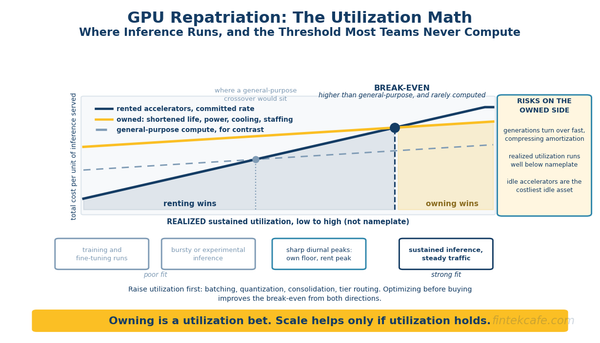
GPU Repatriation: The Utilization Math Deciding Where Inference Runs
Owned accelerators beat rented ones above a utilization threshold most teams never compute. The break-even math, and why idle GPUs are the expensive asset.
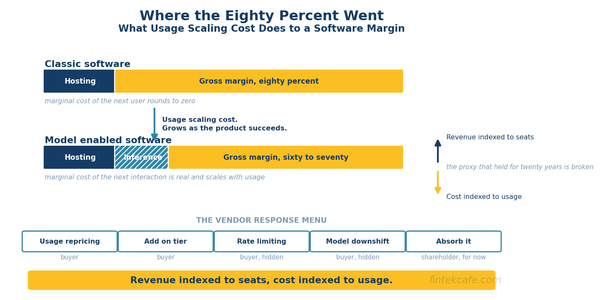
The SaaS Gross Margin Squeeze: AI COGS Are Breaking the Eighty Percent Model
Inference is a real, usage-scaling cost of goods sold. It is pulling software gross margins toward infrastructure territory, and buyers pay for it either way.
How Central Bank Digital Currencies Will Change Finance
What are CBDCs and how will they change banking? A complete guide to central bank digital currencies, from China's digital yuan to the EU's digital euro.