
Fintech M&A: Why Banks Are Buying Startups and What They're Paying
In January 2020, Visa announced it would acquire Plaid for $5.3 billion. The Department of Justice sued to block the deal, arguing it would eliminate a competitive threat to Visa's debit network. Visa walked away in January 2021. Plaid went on to raise additional funding at a $13.4 billion valuation.
The Visa-Plaid saga encapsulates everything about fintech M&A in a single transaction: strategic buyers willing to pay enormous premiums, regulatory intervention reshaping deal outcomes, and valuation math that reflects not what a company earns today but what it might prevent the acquirer from earning tomorrow.
Fintech M&A has accelerated dramatically since 2020. Banks, card networks, and large fintechs have spent hundreds of billions of dollars acquiring startups, technology platforms, and data infrastructure companies. The motivation is straightforward: build-or-buy decisions in financial services increasingly favor buying, because the pace of technology change has outstripped the ability of traditional institutions to build internally.
But the deals are not all the same. Some acquirers are buying technology. Others are buying talent. Many are buying market position or regulatory arbitrage. Understanding what the acquirer is actually buying - and what they are paying for it - separates informed analysis from headline-chasing.
The Acquisition Thesis: What Are Buyers Actually Paying For?
Every fintech acquisition, regardless of size, is motivated by one or more of four strategic drivers. The mix determines the price.
Technology Acquisition
The acquirer wants specific technology - a platform, an algorithm, an infrastructure layer - that would take years to build internally. This is the most common driver and typically commands the lowest premium relative to revenue, because the technology can be evaluated objectively.
JPMorgan's acquisition strategy exemplifies this approach. The bank has been the most active acquirer in financial services, completing over a dozen technology acquisitions since 2020. Key deals include:
- Renovite Technologies (2022): A cloud-native payment processing platform. JPMorgan needed modern payment infrastructure to replace legacy systems and compete with Stripe and Adyen for e-commerce merchant processing. The deal was reportedly under $100 million.
- Aumni (2023): Investment analytics platform that mapped the venture capital ecosystem. Acquired for an estimated $230 million to strengthen JPMorgan's private markets data capabilities.
- 47 Degrees (2022): A data engineering and functional programming consultancy. JPMorgan bought the team and their expertise in Scala and data infrastructure.
Technology acquisitions typically price at 5-15x revenue, depending on the growth rate and strategic fit.
Talent Acquisition
Sometimes the acquirer wants the people more than the product. This is common when the target operates in a specialized domain where experienced engineers, data scientists, or compliance experts are scarce.
Goldman Sachs's acquisition of GreenSky for $2.24 billion in 2022 was partially a talent play - GreenSky's team had deep expertise in point-of-sale consumer lending. Goldman paid approximately 3x GreenSky's 2021 revenue of $689 million, a modest multiple that reflected both the talent value and the fact that GreenSky's business had declining margins. Goldman subsequently sold the GreenSky lending platform to a consortium in 2024 for a fraction of the acquisition price, keeping certain technology components and personnel - confirming that the talent and technology were more valuable than the ongoing business.
Market Position
The most expensive acquisitions are those where the acquirer is buying market share, customer relationships, or competitive positioning that cannot be replicated organically. These deals command the highest premiums because they eliminate a competitor and simultaneously strengthen the acquirer.
Visa's acquisition of Tink for approximately $2.1 billion in 2022 is a textbook example. Tink is an open banking platform that connects financial institutions and fintechs across Europe. Tink's revenue at the time of acquisition was estimated at $30-40 million - implying a revenue multiple of 50-70x. That extreme multiple was not a bet on Tink's current revenue. It was a bet on Tink's position as the dominant open banking connectivity layer in Europe, where PSD2 regulation was mandating bank data-sharing. Visa was buying the infrastructure that would sit between European banks and the fintechs building on top of them.
Similarly, Mastercard's acquisition of Finicity for $825 million in 2020 (later increased to approximately $1 billion including performance incentives) was a market position play. Finicity provided financial data aggregation - the ability to connect to consumer bank accounts and retrieve transaction data. The revenue at acquisition was estimated at $100-150 million, implying a multiple of 6-10x. Mastercard wanted this capability to compete with Plaid (which Visa had tried and failed to acquire) and to build open banking services in North America.
Regulatory Arbitrage
Some acquisitions are motivated by the regulatory asset the target holds - a bank charter, a money transmitter license portfolio, or a regulatory approval that takes years to obtain independently.
SoFi's acquisition of Golden Pacific Bancorp in 2022 for approximately $22 million was pure regulatory arbitrage. Golden Pacific was a tiny community bank with assets under $200 million. What SoFi wanted was its national bank charter, which SoFi converted into a full-service digital bank charter - avoiding years of de novo charter application and review. The value of the charter to SoFi was orders of magnitude greater than the $22 million purchase price.
LendingClub's acquisition of Radius Bank in 2021 for $185 million followed the same logic. Radius had approximately $1.4 billion in assets, but the strategic value was the banking charter that allowed LendingClub to fund its own loans with deposits rather than relying on third-party funding - dramatically improving its cost of capital.
This is a Premium Article
Sign up for a Premium membership to read this article and get full access to strategic intelligence on technology and business.
Already a member? Sign in
Related Articles
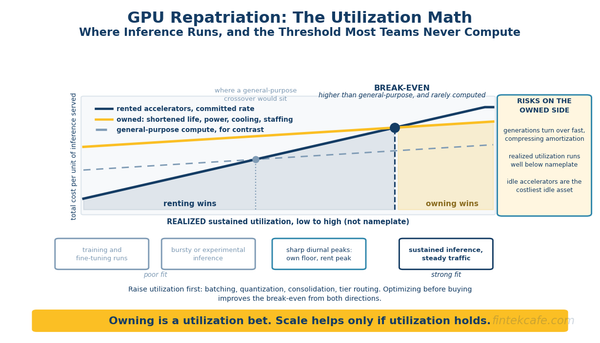
GPU Repatriation: The Utilization Math Deciding Where Inference Runs
Owned accelerators beat rented ones above a utilization threshold most teams never compute. The break-even math, and why idle GPUs are the expensive asset.
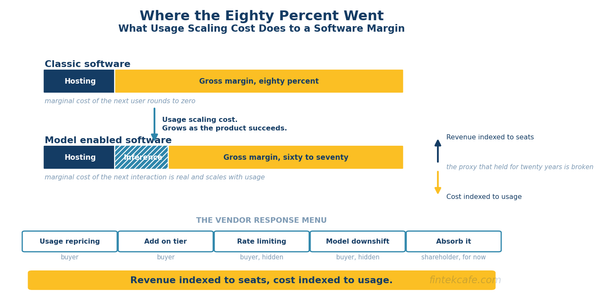
The SaaS Gross Margin Squeeze: AI COGS Are Breaking the Eighty Percent Model
Inference is a real, usage-scaling cost of goods sold. It is pulling software gross margins toward infrastructure territory, and buyers pay for it either way.
Trade Finance Explained: Letters of Credit, Factoring, and Supply Chain Finance
The $5 Trillion Infrastructure Nobody Talks About Every iPhone assembled in Zhengzhou, every container of Brazilian soybeans unloaded in Rotterdam, every batch of Vietnamese electronics shipped