
The Talent Barbell: Why Mid-Level Tech Hiring Is Collapsing and What Replaces It
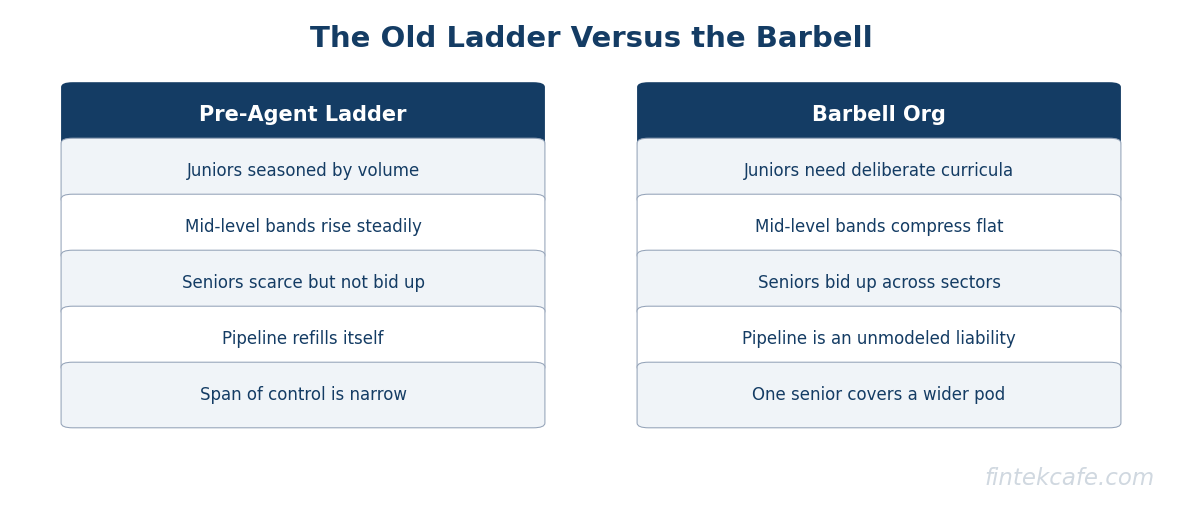
Fintech unicorns are now bidding openly against frontier AI labs for the same staff and principal engineers, matching compensation packages that would have been unthinkable outside of the labs themselves two years ago. At the same moment, the same companies are freezing or shrinking the middle rungs of their engineering ladders, holding mid-level bands flat while junior hiring continues at volume for cheap, agent-supervised capacity. Plot compensation and headcount by level across enough of the industry and a single shape appears everywhere: a barbell, heavy at both ends, hollow in the middle.
The comfortable read of this pattern is that it is an AI-hype distortion, a temporary overcorrection that will normalize once the market settles and executives stop panic-bidding for anyone who can plausibly claim agent expertise. The contrarian and more accurate read is that this is a structural repricing of experience, not a pricing anomaly, and it will not revert. Organizations letting the barbell form by accident, rather than designing around it deliberately, are quietly accumulating a five-year seniority cliff that has not been modeled into any workforce plan on the table today. This piece is about why the middle is actually collapsing, what the compensation data already shows, the pipeline liability nobody has put on a balance sheet, and what the organizations handling this well are doing instead.
Why the Middle Is Collapsing
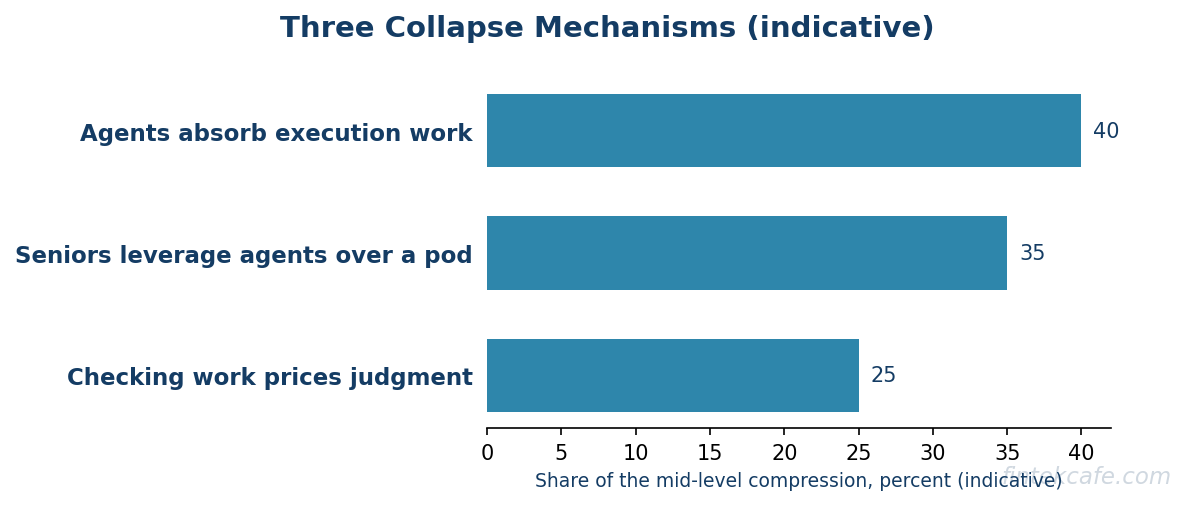
Three forces are compressing mid-level roles simultaneously, and each one alone would be survivable. Together they are not.
The first is direct absorption. Mid-level engineers earned their level by doing a large volume of well-specified, moderately complex work: implementing features from a design, writing the tests, fixing the bugs that a senior's design review missed. This is close to exactly the work agentic coding tools now do fastest and most reliably, because it is bounded, specified, and reviewable, the same profile that made receivables the beachhead for agentic payments in a different domain. The mid-level engineer's traditional value proposition, reliable execution at volume, is precisely what an agent under supervision now delivers at a fraction of the cost.
The second is senior leverage. A senior or staff engineer equipped with agentic tooling can review, direct, and validate the output of several agents simultaneously, effectively covering what used to require a small pod of mid-level engineers underneath them. This is not a hypothetical productivity multiplier; it shows up directly in how organizations are restructuring reporting lines, with fewer, more senior individual contributors carrying wider technical scope than the traditional ladder assumed any one person could hold.
The third is the checking-work economy repricing judgment specifically. As covered in the analysis of what agents actually do to the org chart, agents do not eliminate work, they convert doing-work into checking-work, and checking-work is priced by the judgment it requires, not the volume it processes. Judgment is disproportionately a senior asset, built over years of having been wrong in expensive, memorable ways. A market that suddenly needs much more checking-work and much less doing-work is a market that suddenly needs much more of what seniors have and much less of what the traditional mid-level role supplied.
All three forces point the same direction: toward the person who can supervise and away from the person who used to execute. The middle of the ladder was built on execution, and execution is exactly the layer being automated first.
This is a Premium Article
Sign up for a Premium membership to read this article and get full access to strategic intelligence on technology and business.
Already a member? Sign in
Related Articles
Data Classification: The Step Every Enterprise AI Rollout Skips, and What It Costs Later
Why AI assistants expose overshared data, how data classification fixes it, what to label first, and a 90-day plan for executives.
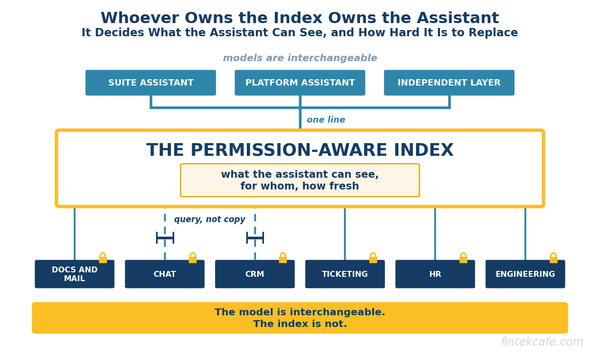
Enterprise Search Is Back, and This Time It Decides Which AI Assistant Wins
Enterprise search failed for twenty years. Now the permission-aware index behind every AI assistant is the control point, and its owner wins.
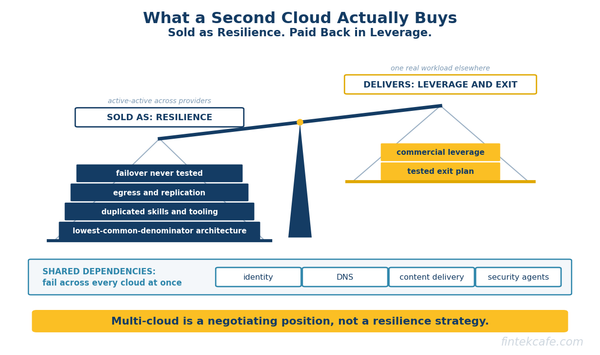
Multi-Cloud Is a Negotiating Position, Not a Resilience Strategy
Running one workload across two clouds rarely pays for itself. A second cloud's real value is leverage and exit evidence. Which workloads need what.