
The Open-Weights Endgame: What Free Frontier Models Do to Pricing Power
In one week in July, DeepSeek shipped its V4 stable release and Moonshot followed with Kimi K3 open weights, putting two near-frontier models into the hands of any enterprise willing to download them, with no license fee attached. In the same window, Google guided capital spending toward roughly two hundred billion dollars in annualized terms, one data point in a hyperscaler capex cycle that shows no sign of slowing despite, or perhaps because of, the free models arriving beside it. Commentators read the juxtaposition as a contradiction: if frontier-quality models are now free to license, why is the capital spending on frontier infrastructure still accelerating?
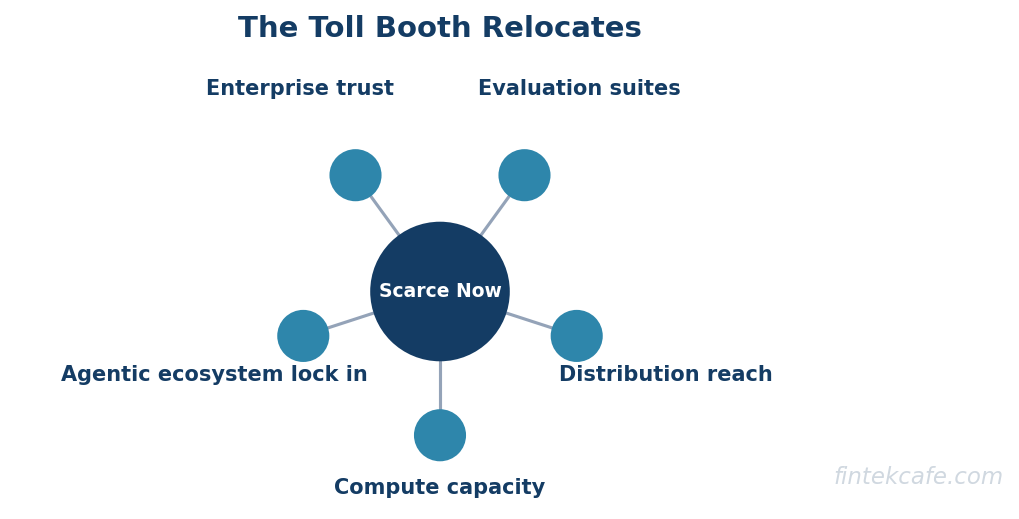
It is not a contradiction, and the resolution is the contrarian thesis this piece argues in full: open weights do not commoditize AI. They relocate the toll booth. A model that costs nothing to license was never where most of the money in applied AI actually changed hands, and a buyer who treats the license-free download as the end of the story misreads what the free model does to the market around it. The margin that used to sit, or was assumed to sit, in the model weights themselves migrates to whoever owns compute, distribution, and evaluation, three assets that remain scarce even as the fourth, the weights, becomes free. The frontier labs' pricing power survives the free release, but it survives on a narrower and more contestable foundation: a capability gap that must be re-earned every quarter against a model that costs its buyer nothing to acquire.
The Real Economics of Running Open Weights
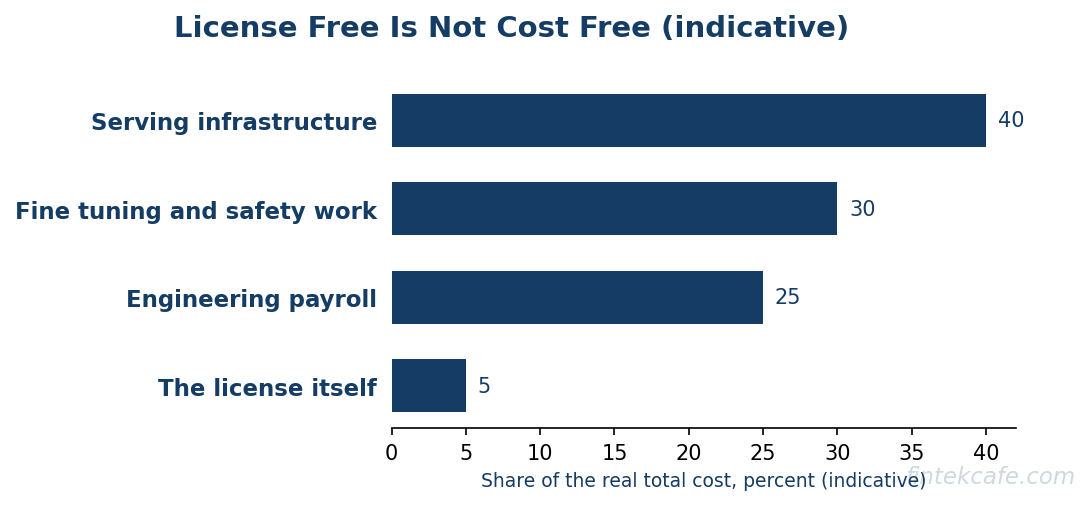
The phrase "license-free" does the most misleading work in this entire conversation, because it implies cost-free, and running a near-frontier open-weights model at production quality and scale is not cost-free. It is, in most organizations, barely cheaper than paying for the API, once the full bill is honestly totaled.
Serving infrastructure is the first line, and it is substantial: frontier-scale open models require multiple high-end accelerators just to hold the weights in memory, before any consideration of throughput, latency, or redundancy, which means either a meaningful capital commitment or a colocation and cloud-GPU rental bill that tracks the same accelerator scarcity driving the hyperscalers' own capex. Fine-tuning and adaptation is the second line: a model downloaded in its base form is rarely the model an enterprise deploys, and the domain adaptation, safety tuning, and instruction alignment work that closes that gap requires both compute and the specialized talent to do it well. Safety and guardrail work is the third line, and it is not optional: an open-weights model arrives without the frontier lab's safety tuning, red-teaming, and content-policy layer, all of which the deploying organization must now build or buy itself, a cost the API price implicitly bundled and the open-weights buyer must now price separately. The fourth line, and the one buyers most consistently underestimate, is engineering payroll: the ongoing cost of a team that can operate, monitor, patch, and re-tune a self-hosted model, which is a standing headcount commitment, not a line item that disappears once the initial deployment ships.
Total these four lines against a frontier API's per-token price at realistic enterprise volume and a specific, underappreciated pattern emerges: open weights paradoxically favor large, sophisticated buyers over small ones. A buyer with the scale to amortize the fixed infrastructure and payroll costs across enormous request volume, and the in-house talent to do the fine-tuning and safety work competently, can genuinely beat the API price. A buyer without that scale or talent is paying most of the same costs the API price already bundled, minus the license fee, which was rarely the largest line item to begin with, while taking on operational risk the API relationship used to absorb. The free model is a scale-dependent discount, not a universal one, and vendors selling managed open-weights hosting exist precisely to sell that discount back to buyers who cannot capture it themselves, at a markup that quietly reintroduces much of the economics a pure API relationship already had.
This is a Premium Article
Sign up for a Premium membership to read this article and get full access to strategic intelligence on technology and business.
Already a member? Sign in
Related Articles
The AI Budget Is Moving From IT to the Business Lines, and Governance Has Not Followed
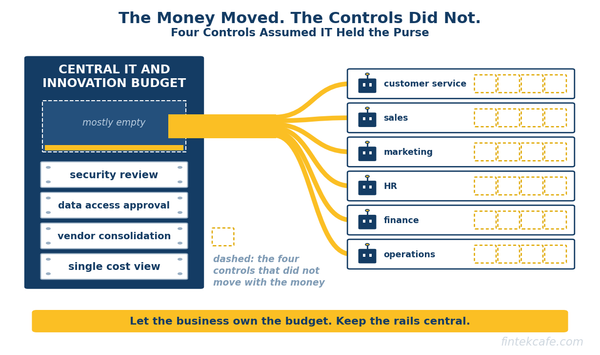
AI spend is moving from central IT to business lines. That ties cost to outcomes but breaks controls built for an IT-held purse. The model that works.
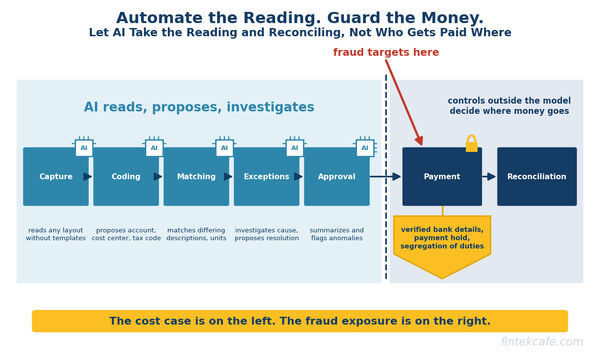
Accounts Payable Automation: What AI Can Actually Take Over in Invoice-to-Pay
What AI can take over in accounts payable, step by step from capture to payment, where the fraud risk grows, and which controls must stay outside the model.
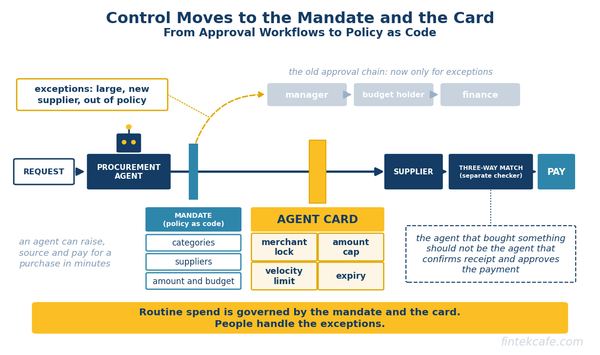
Procurement Is Where Agents Will Spend the Company's Money First
The first agents trusted with company money will buy for the enterprise. Control moves from approval chains to policy as code and card-level limits.