
The Coming Repricing of Series B: Why 2024-2025 Fintech Valuations Are About to Get Recut
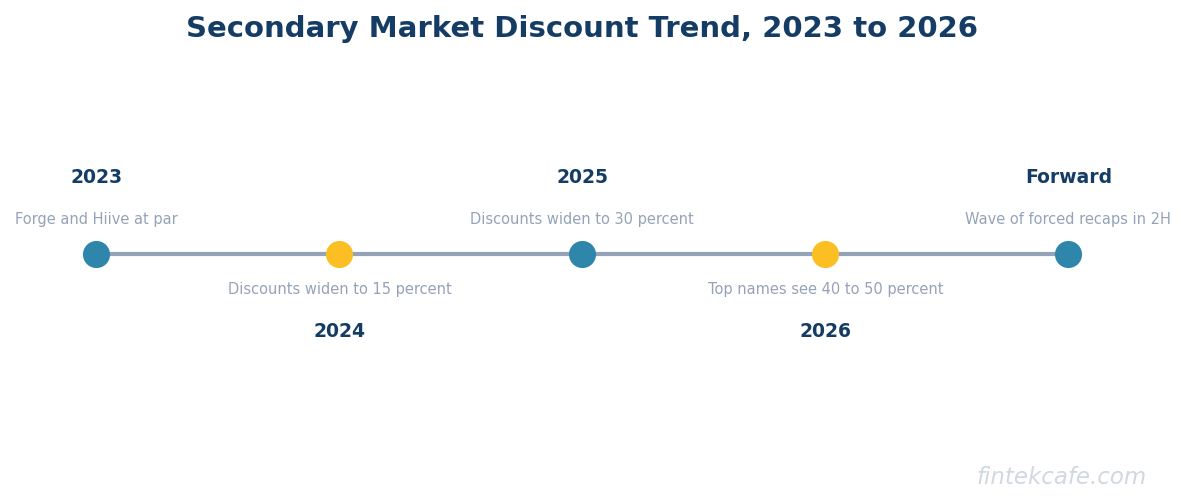
The Series B rounds that closed in fintech between early 2024 and the end of 2025 are about to be revalued, and not in the founders' favor. Secondary trades on Forge and Hiive through April 2026 show clearing prices 30 to 50 percent below the last priced rounds for a meaningful share of that cohort. The IPO window that the original 2024-2025 valuations implied has narrowed instead of widening. The fundraising cycle is approaching the point where those last paper marks have to be tested against either a new round, a recap, or an acquirer, and the math under each path leads to the same answer.
This piece is the founder's and operator's read on what is about to happen, why it is already visible in secondary prices, which fintech sub-sectors are most exposed, and what the disciplined response looks like for a company that does not want to learn the lesson the way the 2022 cohort learned it.
The Unit Economics That Justified the 2024-2025 Marks
The Series B fintech cohort raised at multiples that were already aggressive and that depended on conditions that did not continue. The typical profile across the cohort, drawn from PitchBook's 2025 fintech round-detail data, CB Insights' deal-level disclosures, and the disclosed metrics in public S-1s filed during the window:
- Customer-acquisition-cost payback of 28 to 36 months, median above 30
- Gross margin in the 55 to 65 percent band for interchange-driven or rate-sensitive lending plays, 65 to 75 percent for software-and-payments hybrids
- Net dollar retention between 105 and 120 percent for B2B, lower for consumer
- Forward revenue multiple of 12 to 18 times at the priced round, with AI-adjacent outliers above 20 times
- Burn multiple between 1.4 and 2.0, with a long tail above 3.0
These metrics were defensible when public market comparables traded at premium revenue multiples and when the cost of capital was discounted by an implicit assumption that rates would normalize down before a Series C priced. Neither assumption has held into 2026. The Federal Reserve's policy rate has spent eighteen months in the 4.25 to 4.75 percent corridor with no clean break below it. The two-year Treasury, the cleaner proxy for a venture-backed company's effective discount rate, has been above 4.0 percent for the entire 2024-2026 window. The discount-rate compression the cohort priced in did not arrive, and the public comparables that those Series B multiples were calibrated against have repriced accordingly.
What Secondary Markets Are Already Telling Us
Secondary platforms (Forge, Hiive, EquityZen, Augment) clear trades between accredited holders of late-stage private shares and incoming investors. The clearing prices on those platforms are the closest thing the venture industry has to a publicly observable indicative price for a privately held company. Through the first four months of 2026, the indicative-versus-last-round discount on fintech Series B holdings tracked by Hiive's published index sits between 30 and 50 percent for the most active names, with a long tail of holdings indicated 60 percent or more below last paper.
The discounts are not uniform. They cluster by sub-sector and by burn discipline. Three patterns stand out:
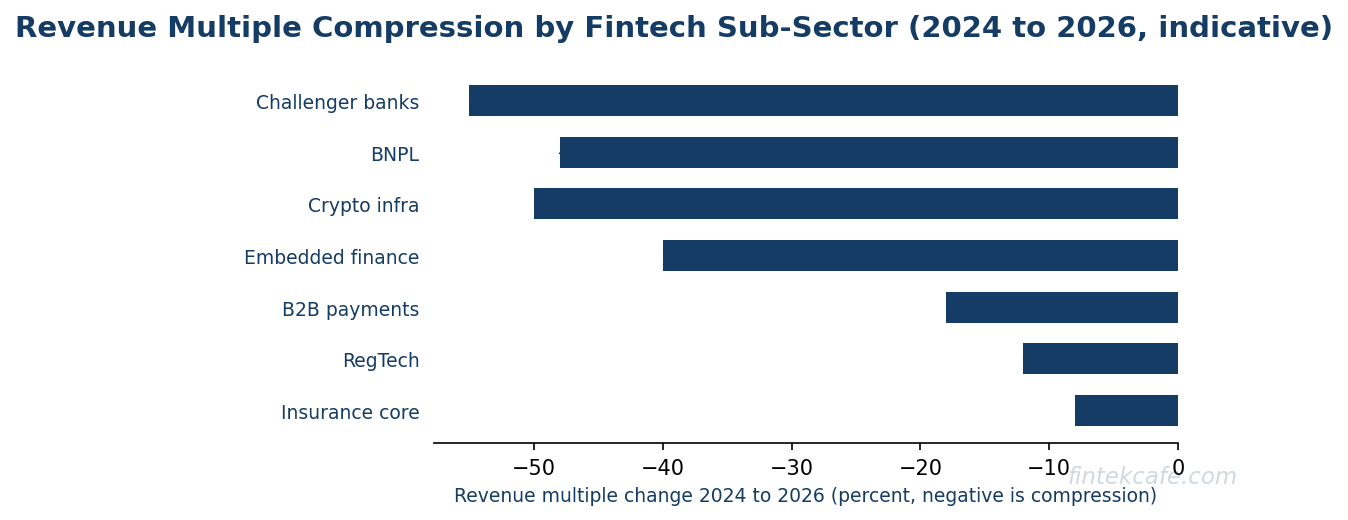
The widest discounts are on consumer-credit fintechs, BNPL platforms, and crypto-native infrastructure companies that priced at 14 to 18 times forward revenue in late 2024 or early 2025. Indicated prices in April 2026 cluster between 7 and 10 times. That is a 40 to 50 percent compression on multiple alone, before any adjustment for revenue underperformance against the projection.
A middle band of consumer neobanks, embedded-finance enablers, and challenger-card issuers shows 25 to 35 percent compression. The growth assumptions baked into the original Series B did not collapse but did not accelerate either, and the multiple compressed in line with public-market peers.
The narrowest discounts (10 to 20 percent) are on B2B payments infrastructure, RegTech and compliance-automation, insurance-core modernization, and treasury-management plays for the small-and-medium-business segment. These companies' revenue lines proved more resilient to the higher-rate environment, and the multiples those companies trade at on secondary are closer to the original paper marks.
These are not predictions. They are indicative prices a real buyer would pay today for an existing holder's secondary shares. When the next priced round happens, the lead is using these secondary prints as the starting reference point for the new pre-money valuation. The clearing price is the discovery mechanism. The Series B mark, by the time the Series C is negotiated, is a number on a slide deck that nobody is using as the actual anchor.
This is a Premium Article
Sign up for a Premium membership to read this article and get full access to strategic intelligence on technology and business.
Already a member? Sign in
Related Articles
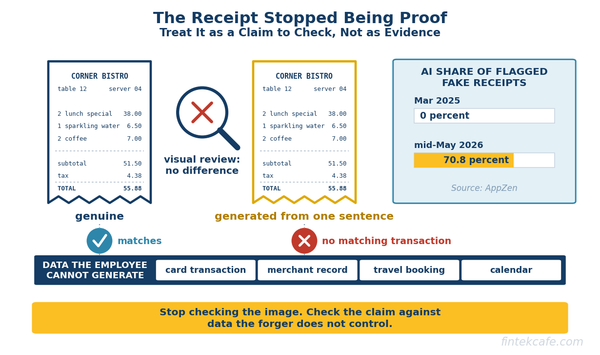
AI-Generated Fake Receipts: How Expense Fraud Changed and How Finance Teams Catch It
AI-generated fake receipts now beat visual review. How expense fraud changed, which detection still works, and the controls to use by company size.
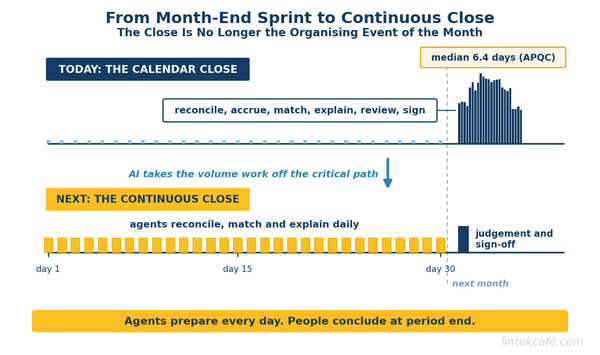
The Monthly Close Is Becoming Continuous, and the Finance Calendar Will Not Survive It
AI is taking the bottleneck work out of the month-end close. The close becomes continuous with a short sign-off, and finance, audit and the board change.
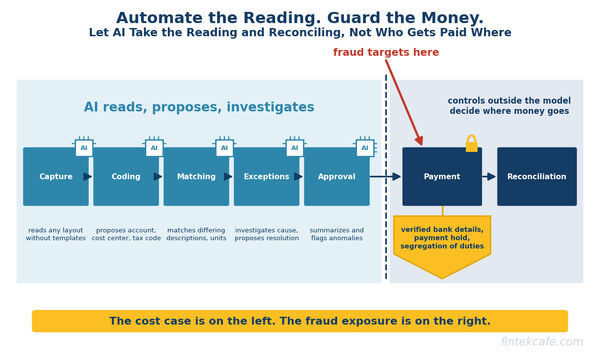
Accounts Payable Automation: What AI Can Actually Take Over in Invoice-to-Pay
What AI can take over in accounts payable, step by step from capture to payment, where the fraud risk grows, and which controls must stay outside the model.