
How AI Is Reshaping Payment Infrastructure: What Changes and What Doesn't
Every payments executive you talk to right now has "AI" somewhere in their roadmap. Most of what they're pointing at is either already happening and has been for two decades, or is a proof-of-concept that hasn't survived contact with production latency requirements.
Getting this right matters because the companies that accurately identify where AI creates durable advantage - versus where it creates technical debt and regulatory risk - will separate from competitors who applied it everywhere and got nothing.
Here is an honest map of what's changing, where, and why. And an equally honest answer about what AI will never change about payments.
Fraud Detection: Where AI Has Been Working for 20 Years
The most common claim in payments AI - "we use machine learning for fraud detection" - is also the least interesting, because it stopped being differentiating around 2005.
Visa has run neural network models on transaction scoring since the early 2000s. Mastercard's Decision Intelligence system processes 75 billion transactions per year through ML scoring. If you tap your card anywhere in the world and it approves in under two seconds, some version of a trained model made that decision.
What has changed is three things:
Feature richness. Early fraud models scored transactions on maybe 20–30 variables: merchant category, transaction amount, location, time of day. Modern systems score on hundreds of features simultaneously - device fingerprint, typing cadence, how long you hesitated on the checkout screen, whether the shipping address was recently added, the behavioral pattern of the session compared to your historical sessions. This behavioral biometrics layer is genuinely new and genuinely effective.
Real-time model retraining. Fraud patterns evolve in hours, not months. Fraudsters probe systems, find gaps, exploit them at scale, and move on. Fraud teams that retrain models weekly are now being beaten by teams retraining daily or using online learning (continuous model updates as new labeled data arrives). Sardine, Sift, and Featurespace have built businesses specifically on this: not better algorithms, but faster adaptation cycles.
The ensemble approach. The best fraud systems now combine rule-based filters, gradient boosted trees, neural networks, and behavioral biometrics in sequence. No single model is dominant. Rules catch known-bad patterns instantly. Trees handle tabular fraud signals efficiently. Neural networks catch subtle patterns in sequences of behavior. The architecture matters as much as any individual model.
What remains hype: the vendor claim that "AI" means your fraud problem is solved. Stripe Radar, which powers fraud scoring for millions of businesses, still produces false positives that frustrate legitimate customers. No model eliminates fraud - it manages the cost-benefit trade-off between catching fraud and declining real purchases. The wrong threshold costs you more in lost revenue than it saves in fraud losses. That trade-off is business judgment, not machine learning.
This is a Premium Article
Sign up for a Premium membership to read this article and get full access to strategic intelligence on technology and business.
Already a member? Sign in
Related Articles
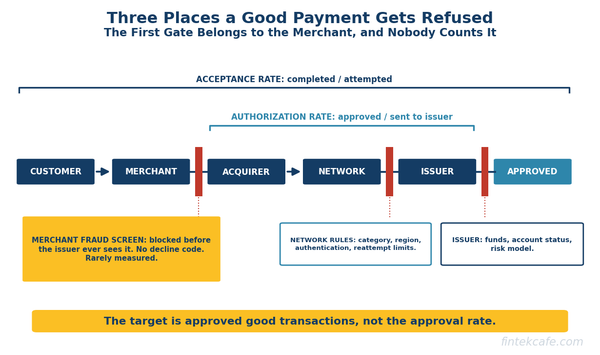
Why Card Payments Get Declined, and How Merchants Raise Their Approval Rate
Why card payments get declined, soft vs hard declines, and the levers that raise authorization rates without letting fraud and chargebacks rise with them.
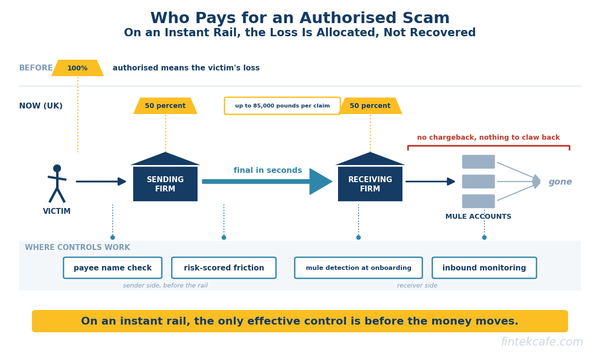
Scam Reimbursement Is Becoming a Cost of Running Instant Payments
Mandatory APP scam reimbursement turns fraud into a line in instant-payment unit economics, and the receiving firm now pays half. What it costs, and who.
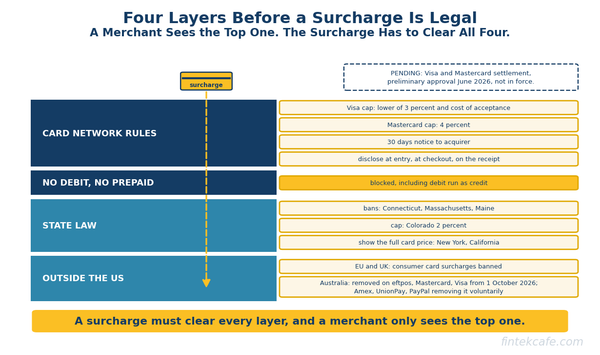
Credit Card Surcharging: When Passing On Card Costs Is Legal, and When It Costs More Than It Saves
Credit card surcharge rules differ by network, state and country. When a surcharge is legal, what it does to sales, and cheaper ways to cut card costs.