
Who Should Own AI in the Company: The Case For and Against a Chief AI Officer
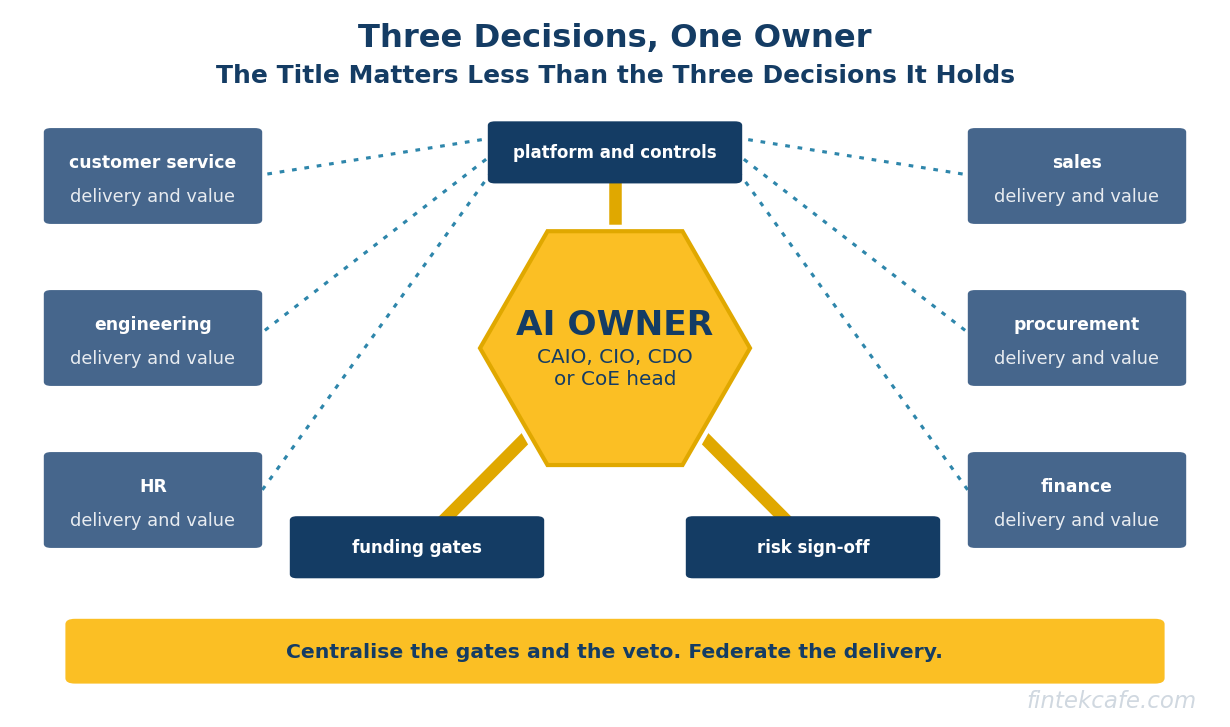
Every board now asks the same question about artificial intelligence: who owns it? The most common answer is a new title. Some companies appoint a chief AI officer. Others widen the remit of the chief information officer, the chief technology officer or the chief data officer. Others set up a centre of excellence and a steering committee. Each answer produces an org chart. Few of them settle the question the board was actually asking, which is who decides, who pays and who is accountable when something goes wrong.
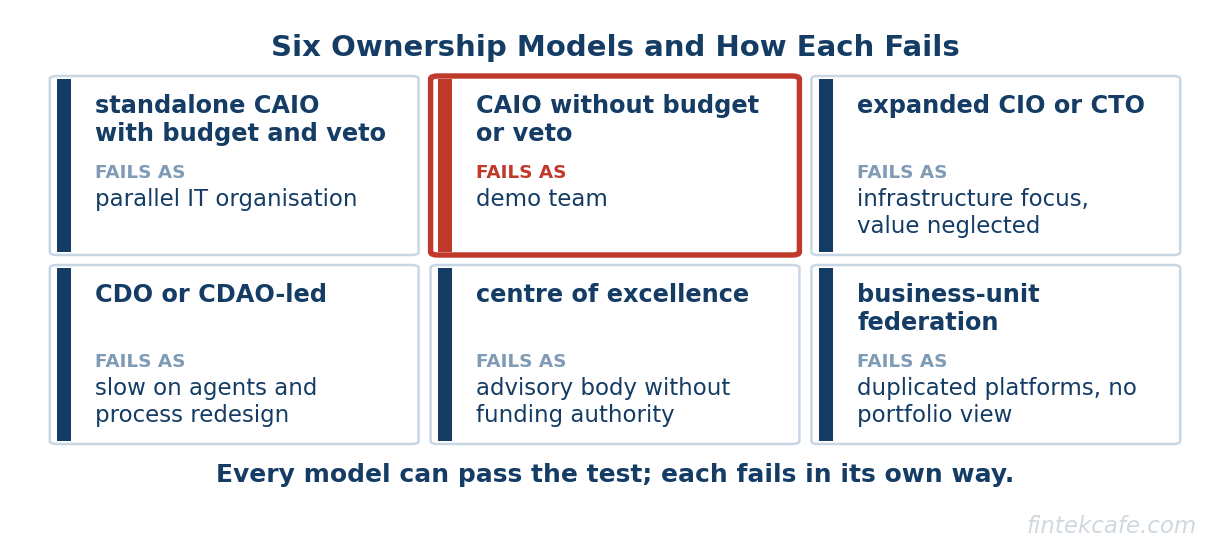
The thesis of this piece: the title matters less than whether three things sit with one owner: the AI platform and its controls, the AI portfolio and its funding gates, and the risk sign-off. Delivery and value belong in the functions that use AI. A chief AI officer helps when the role holds those three. It fails when it becomes a showcase team with no budget and no veto, producing demonstrations while customer service, engineering, HR, sales and procurement buy their own tools. An expanded CIO or CDO remit can work just as well, or just as badly, by the same test.
How Common the Role Has Become, and Why the Numbers Disagree
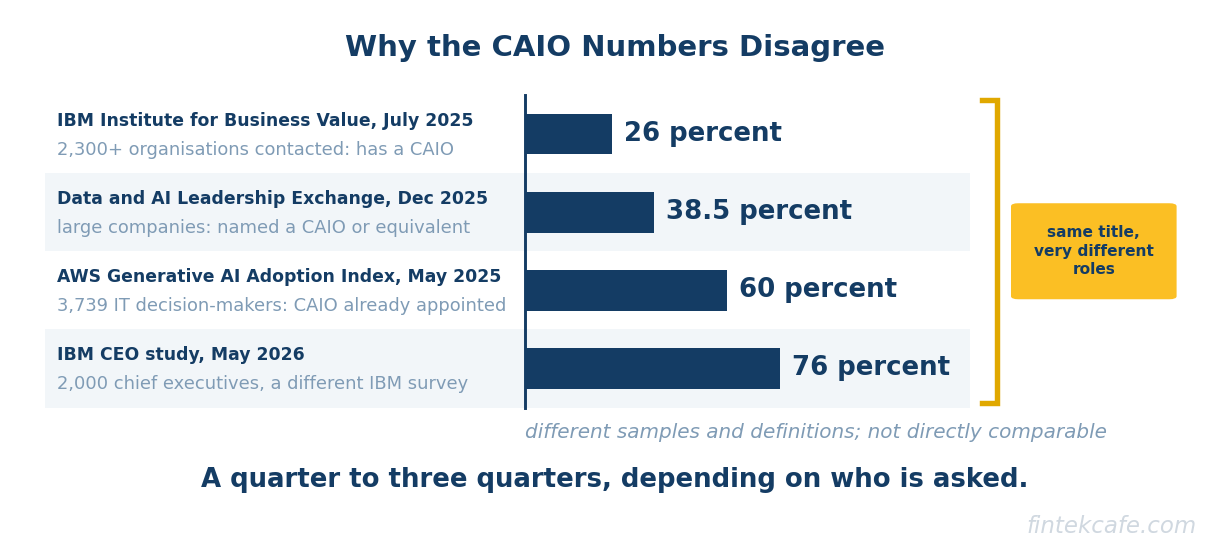
The surveys agree that the title is spreading fast. They disagree, wildly, on how far.
- IBM's Institute for Business Value reported in July 2025, in a study run with Dubai Future Foundation and Oxford Economics, that only 26 percent of the more than 2,300 organisations it contacted had a chief AI officer, up from 11 percent in 2023. IBM's CEO study in May 2026, a different survey of 2,000 chief executives, put the figure at 76 percent. The two samples are not directly comparable, but the direction is unmistakable.
- The AWS Generative AI Adoption Index (May 2025), a survey of 3,739 IT decision-makers in nine countries, found 60 percent of organisations had already appointed a CAIO and another 26 percent planned to in 2026.
- The Data and AI Leadership Exchange, Randy Bean's annual benchmark of large companies, reported in December 2025 that 38.5 percent had named a chief AI officer or equivalent, up from 33.1 percent a year earlier.
- Foundry's State of the CIO 2026 study found AI steering committees were led by the CIO or IT in 38 percent of organisations and by a chief AI officer or equivalent in 26 percent.
A spread from roughly a quarter to three quarters is not a measurement error. It reflects what the title means. In one company, "chief AI officer" is an executive reporting to the chief executive with a budget. In another, it is an extra hat on the CIO. In a third, it is the head of a data science team renamed for the moment. IBM's 2025 study found 57 percent of CAIOs report directly to the chief executive or the board and 61 percent control the AI budget, which means a large minority do neither. The Data and AI Leadership Exchange found the role reporting into technology at 33.9 percent of firms, into the chief data officer at 30.4 percent and into the business at 26.8 percent.
Public appointments show the same variety across industries. Eli Lilly named Thomas Fuchs its first chief AI officer in October 2024. Target announced its first, Chandhu Nair, in August 2026. GE HealthCare's first CAIO left in July 2026, and his successor reports to the chief technology officer, according to MedTech Dive. At consulting firm Resources Connection, the CAIO hired in March 2026 was named interim chief financial officer six months later, according to the company's September 2026 SEC filing. Lloyds Banking Group put its senior AI leader, a Group Director of AI and Advanced Analytics, under its chief data and analytics officer instead of creating a CAIO title.
Even the US federal government, which mandates the role, treats the title as optional. OMB Memorandum M-25-21 (April 3, 2025), which replaced the Biden-era M-24-10, requires every agency to retain or designate a chief AI officer within 60 days. It also says agency heads may designate an existing official, such as the CIO, chief data officer or CTO, provided that person has significant AI expertise. The federal rule requires the function and leaves the title to the agency. That is the right instinct, and most companies should copy it.
This is a Premium Article
Sign up for a Premium membership to read this article and get full access to strategic intelligence on technology and business.
Already a member? Sign in
Related Articles
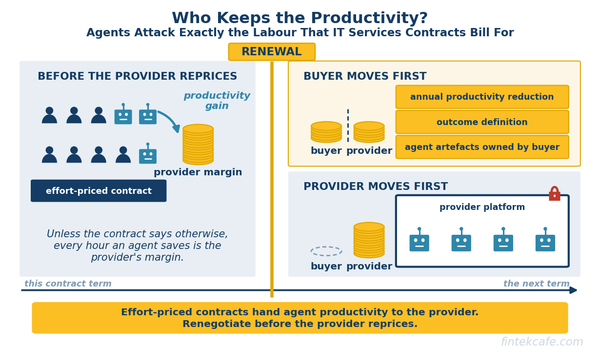
Agents Are Coming for the IT Services Contract, and Buyers Should Renegotiate First
Agents attack the labour IT services and BPO contracts bill for. Why buyers hold the leverage at renewal, and the terms to demand before providers reprice.
AI Sales Agents and AI SDRs: What They Actually Deliver, and Where They Damage the Pipeline
Do AI SDRs work? What AI sales agents deliver, where they burn domains and brand, the compliance rules, and when to assist, automate or replace by motion.
How to Test an AI Agent Before It Touches Production
Agent evals must score a sequence of actions, not one answer. The five test layers, pass^k reliability, graders and release gates by action risk.